Master the 4-5-4 Calendar — Industry-Standard Retail Fiscal System
Understand how the 4-5-4 retail calendar works and why thousands of retailers depend on it. Learn fiscal period planning, inventory management strategies, and use our free calculator to convert dates instantly. Complete guide for retail professionals.
What Is the 4-5-4 Retail Calendar and How Does It Work?
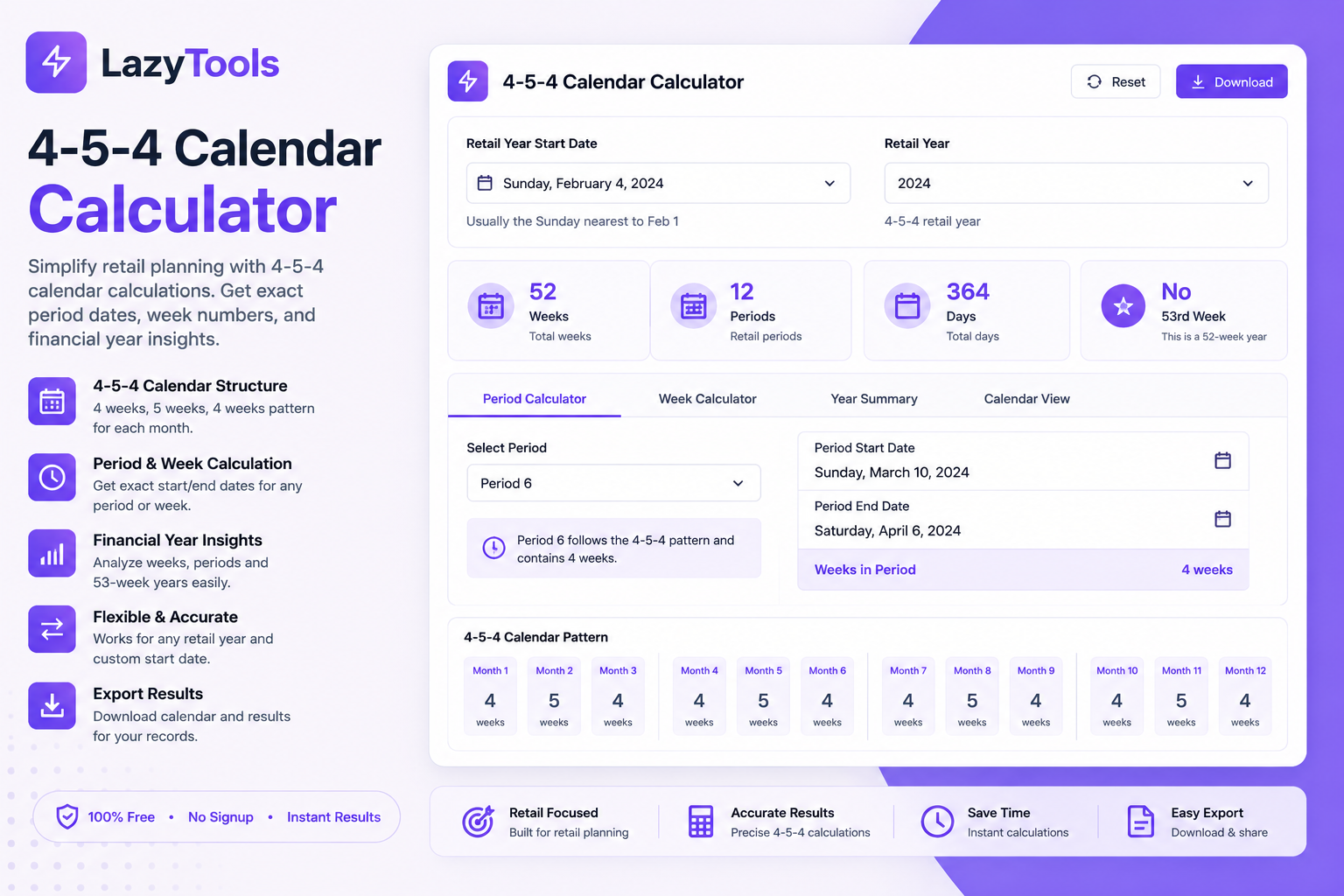
The 4-5-4 calendar is the standardized fiscal year system used by virtually every major American retailer. Furthermore, it divides the 52-week fiscal year into exactly 13 four-week to five-week periods, organized into 4 quarters. Specifically, each quarter contains the same pattern: a 4-week period, followed by a 5-week period, followed by another 4-week period.
Unlike the traditional calendar year with irregular month lengths (28 to 31 days), the 4-5-4 system creates consistency. Notably, this uniformity enables retailers to compare sales period-to-period and year-to-year with accuracy. Therefore, financial analysts, inventory managers, and retail executives depend on this framework for planning and forecasting. In fact, this standardization is one of the most important developments in modern retail management.
🔄 The Mathematical Logic Behind the System
A standard calendar year contains approximately 52.14 weeks (365 days ÷ 7 days per week). The 4-5-4-4-5-4-4-5-4-4-5-4 pattern totals exactly 52 weeks, accounting for that fractional extra day through the longer five-week periods. Additionally, this elegant design eliminates the complexities of comparing different month-lengths across financial reports.
Importantly, most retailers begin their fiscal year in early February. Consequently, the fiscal year (FY2026) runs from February 2025 through January 2026. This timing strategically places the critical holiday shopping season (Thanksgiving through New Year's) in Period 11, which is always a 5-week period when retailers can capture maximum sales. As a result, revenue maximization becomes more achievable with this framework.
📊 Who Uses the 4-5-4 Calendar?
The 4-5-4 calendar is the industry standard for American retail. Importantly, this includes major retailers such as Walmart, Target, Best Buy, Gap Inc., Macy's, Kohl's, and virtually all publicly traded retail companies. Moreover, many mid-size and independent retailers have adopted the system to align with industry practices and investor expectations.
Additionally, the system is also used by international retailers operating in the United States. Furthermore, any retailer that reports quarterly earnings or manages inventory nationally depends on this standardized framework for consistency and comparability. Consequently, understanding the 4-5-4 calendar is essential for anyone in retail management, finance, or planning roles.
Historical Evolution: Why Retailers Needed a Better Calendar System
Before the widespread adoption of the 4-5-4 calendar, retail financial reporting was chaotic. In fact, different retailers used different fiscal calendars, making meaningful comparison nearly impossible. Furthermore, a company's "Q2" might have contained different actual weeks than another company's "Q2", creating apples-to-oranges comparisons that distorted analysis.
During the 1990s and early 2000s, as retail grew more sophisticated and investor demands for transparency increased, the major retailers independently recognized this problem. Specifically, Walmart, operating with its laser focus on efficiency, pioneered the consistent 4-5-4 structure. Subsequently, other major retailers observed Walmart's competitive advantage in financial planning and inventory management, and they adopted similar systems.
By the mid-2000s, the 4-5-4 calendar had become the de facto industry standard. Moreover, financial analysts and investors began expecting all major retailers to report using this same framework. Consequently, any retailer seeking investment or credibility in the market adopted the 4-5-4 system to align with industry expectations. Today, this standardization is taken for granted, yet it represents a crucial evolution in retail management.
How to Use Our 4-5-4 Calendar Calculator for Your Business
Our free calculator makes implementing the 4-5-4 calendar simple and straightforward. First, select your fiscal year. Then, the tool displays all 13 periods with exact start and end dates. Additionally, you can enter any calendar date to instantly determine which fiscal period it belongs to. Finally, you can export results for planning purposes.
💼 Real Applications for Different Roles
For inventory managers, the calculator helps determine which periods require higher stock levels. Additionally, for financial analysts, it aligns forecasts with historical period-level data. Moreover, for marketing teams, it schedules promotions to align with peak shopping periods. Furthermore, for HR professionals, it enables workforce planning calibrated to seasonal demand spikes. Consequently, different departments find unique value in this standardized framework.
🎯 Ready to Plan Your Fiscal Year?
Convert dates, analyze periods, plan inventory. Completely free, no signup required.
Key Features That Make This System Essential for Retail
Understanding why retailers universally adopt the 4-5-4 calendar requires examining its specific advantages. Specifically, these benefits drive business outcomes across multiple functions:
Complete 4-5-4 Calendar Period Structure Reference
Below is the standard 4-5-4 calendar breakdown showing all 13 periods with typical timing and key retail events. Furthermore, this table demonstrates why each period requires different strategic approaches:
| Period | Quarter | Weeks | Season | Key Events |
|---|---|---|---|---|
| 1 | Q1 | 4 | Winter/Spring | New Year, Clearance Sales |
| 2 | Q1 | 5 | Spring | Valentine's Day, Easter Start |
| 3 | Q1 | 4 | Spring | Easter, Spring Break |
| 4 | Q2 | 4 | Spring/Summer | Mother's Day, Graduation |
| 5 | Q2 | 5 | Summer | Father's Day, Summer Sales |
| 6 | Q2 | 4 | Summer | Independence Day |
| 7 | Q3 | 4 | Summer/Fall | Back-to-School Start |
| 8 | Q3 | 5 | Fall | Labor Day, Back-to-School Peak |
| 9 | Q3 | 4 | Fall | Halloween, Fall Merchandise |
| 10 | Q4 | 4 | Fall/Holiday | Halloween Sales, Pre-Holiday |
| 11 | Q4 | 5 | Holiday | Black Friday, Christmas, New Year |
| 12 | Q4 | 4 | Winter | Post-Holiday, Clearance |
| 13 | Adj | 1 | Fiscal Year-End | Year-End Adjustments |
Pro Insight: Period 11 is critically important for retail profitability. Notably, it typically represents 20-30% of annual revenue for most retailers, making accurate forecasting and inventory planning essential. Additionally, this single period determines many retailers' annual performance.
What Retail Professionals Actually Search For: Common Questions Answered
Based on common retail industry searches, here are the questions people ask most frequently about the 4-5-4 calendar. Moreover, these questions reveal the practical challenges retailers face:
❓ "When does Period 11 start and end?"
Period 11 is the critical holiday period that typically runs from late November through early January. Specifically, it includes Thanksgiving, Black Friday, Cyber Monday, Christmas, and New Year's shopping. Notably, this single period generates approximately 25-30% of annual revenue for most retailers. Therefore, accurate forecasting and inventory planning for Period 11 directly impacts annual profitability. Additionally, staffing for this period requires months of advance planning and preparation.
❓ "How do I convert a calendar date to fiscal period?"
Use our calculator to instantly convert any calendar date to its fiscal period. Alternatively, retailers often maintain internal calendars or use ERP systems that contain these conversions. Importantly, having this conversion readily available is essential for daily operational decisions like inventory receiving, merchandise placement, and sales analysis. Furthermore, this conversion capability streamlines communication across departments and reduces errors in period identification.
❓ "Why is the 5-week period important?"
The five-week periods (Periods 2, 5, 8, and 11) capture major retail events and extended shopping seasons. Furthermore, each serves a strategic purpose: Period 2 covers Valentine's Day and Easter, Period 5 covers Father's Day and summer sales, Period 8 covers back-to-school momentum, and Period 11 covers the entire holiday season. Therefore, these longer periods ensure accurate financial and inventory analysis for these critical sales periods. Notably, the 5-week structure provides an extra week to capture the full customer journey for major shopping events.
❓ "Which retailers use 4-5-4 calendars?"
Nearly all major American retailers use the 4-5-4 calendar. Specifically, this includes Walmart, Target, Best Buy, Gap Inc., Macy's, Kohl's, J.C. Penney, Dick's Sporting Goods, and most other publicly traded retail companies. Additionally, many international retailers operating in the United States have adopted this system to align with industry standards and investor expectations. Consequently, understanding the 4-5-4 system is essential for anyone working in American retail.
❓ "How does 4-5-4 calendar affect inventory management?"
The 4-5-4 calendar enables precise inventory planning by providing consistent historical data. Notably, retailers use past Period 11 sales data to forecast current-year Period 11 needs. Furthermore, they can adjust for trends while maintaining methodological consistency. Consequently, this reduces both excess inventory (which must be marked down) and stock-outs (which lose sales). Additionally, the system enables predictive modeling and forecasting with greater accuracy than month-based planning.
How AI and Machine Learning Transform 4-5-4 Calendar Planning
Modern retail is increasingly incorporating artificial intelligence into 4-5-4 calendar-based planning. Furthermore, AI is dramatically improving accuracy and efficiency across multiple retail functions. Notably, these technologies represent the future of retail analytics and strategic planning.
📊 AI-Powered Demand Forecasting
Traditionally, retailers used historical period-level data to forecast demand. Today, machine learning algorithms analyze vastly more data points simultaneously. Specifically, AI considers not just historical sales but also weather patterns, economic indicators, social media trends, and competitor activity—all aligned to the 4-5-4 calendar.
The advantage is remarkable. Rather than using a simple "Period 11 was X amount last year, so we'll forecast 1.05X this year," AI models can account for external variables that influence sales. For instance, if weather forecasts predict an unusually warm November, AI adjusts Period 11 winter apparel forecasts downward while increasing summer carry-over merchandise. Consequently, inventory accuracy improves significantly. Furthermore, this intelligence enables retailers to reduce markdowns by 5-10% or more.
🏭 Automated Inventory Optimization
AI algorithms now automatically determine optimal inventory levels for each SKU (product) by period. Moreover, these systems continuously learn from actual sales outcomes. Specifically, if a forecast was too high, the system adjusts future forecasts for that item. Additionally, AI considers factors like shelf space, carrying costs, markdown risk, and sales velocity—all within the framework of the 4-5-4 calendar periods.
The result is a dramatic reduction in both excess inventory and stock-outs. Furthermore, some retailers report 5-10% improvements in inventory efficiency through AI-driven period-level planning. Consequently, these improvements translate directly to bottom-line profitability and improved cash flow.
💼 Dynamic Staffing Models
AI is revolutionizing workforce planning by predicting labor needs with precision. Rather than simply assigning more staff to Period 11, AI considers factors like local market conditions, store format, product mix, and historical labor productivity. Consequently, retailers can optimize staffing to precisely match customer traffic and transaction complexity. Additionally, some systems use predictive analytics to identify which shifts and which store locations will experience peak traffic, enabling real-time staffing adjustments throughout each period. Therefore, labor costs are minimized while customer service improves.
Helpful Resources and Industry References
To deepen your understanding of the 4-5-4 calendar and retail fiscal planning, explore these authoritative sources. Furthermore, these resources provide industry benchmarks and best practices:
📊 Retail Industry Standards
- National Retail Federation (NRF) — Industry association providing retail best practices and standards
- US Census Bureau Retail Trade — Government retail data and analysis
- Investopedia — Financial education on retail operations
🏢 Major Retailer Investor Relations
- Walmart Investor Relations — Quarterly earnings reports using 4-5-4 calendar
- Target Investor Relations — Period-based financial reporting
- Best Buy Investor Relations — Electronics retail fiscal reporting
💼 Planning and Analytics Tools
- Shopify Analytics — E-commerce analytics with period reporting
- Tableau — Data visualization for period-level analysis
- Microsoft Power BI — Business intelligence for retail planning