Most Age Calculators Get It Wrong — Here's How Exact Age Actually Works
Subtracting your birth year from today's year gives the wrong answer for most of the calendar — it ignores whether your birthday has passed yet. This guide explains the correct algorithm, why it matters for school enrolment, retirement and legal eligibility, and how to read all six units our free age calculator produces in one click.
The Year-Subtraction Error: Why Most Quick Age Calculations Are Wrong
Subtracting a birth year from the current year produces the wrong age for anyone who has not yet had their birthday this calendar year — which is approximately half the population on any given day. Specifically, someone born on 15 November 2000 is still 25 years old on 14 November 2026, not 26, because their birthday has not yet occurred. Consequently, the naive year-subtraction method introduces a systematic one-year error that affects legal eligibility checks, school enrolment decisions and pension calculations when used without verifying the month and day.
This matters more than it seems. Furthermore, age-dependent thresholds in law and medicine are defined in exact years, months and sometimes days — not rounded figures. The UK school year enrolment cut-off of 1 September, the US Social Security full retirement age of 67 years and 0 months, and clinical milestones like the 40-week neonatal period are all stated in precise increments. Therefore, a one-year error in either direction can incorrectly exclude a child from a school year, delay a pension claim by twelve months or misclassify a clinical outcome.
🎯 Who Actually Needs Exact Age, Not Rounded Years
Parents checking school enrolment eligibility need the child's age on a specific future date — typically the first day of the school year — not their age today. Additionally, HR professionals verifying retirement eligibility need age in years and months, because pension schemes specify partial-year thresholds. Furthermore, insurance actuaries, medical researchers and legal professionals all work with age in completed units rather than approximations. Consequently, a calculator that returns only a single year count fails every one of these use cases.
How Exact Age Is Calculated: The Calendar-Date Method Explained
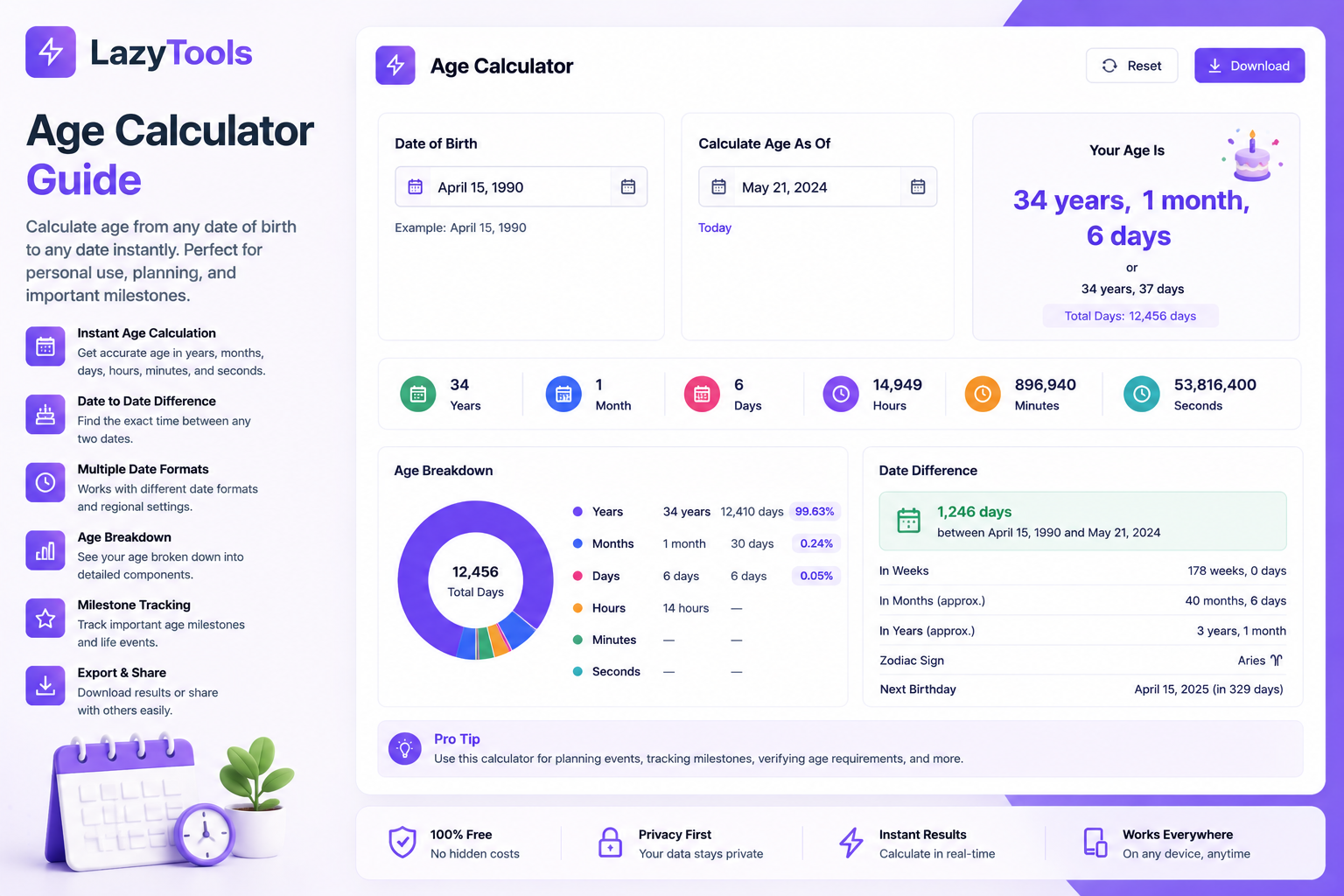
The calendar-date method — used by the LazyTools age calculator — produces exact age by working through years, months and days in sequence. Specifically, it first counts how many complete 12-month cycles have elapsed since the birth date. Then it counts additional completed months since the most recent birthday. Finally, it counts remaining days since the most recent month boundary. Each unit is derived from the same reference point, ensuring consistency across all six output values.
🔢 Step-by-Step: How 26 Years, 2 Months and 5 Days Is Reached
Consider a person born on 7 March 2000, with today's date being 12 May 2026. First, the algorithm counts completed years: from 7 March 2000 to 7 March 2026 is exactly 26 years. Second, it counts completed months since 7 March 2026: from 7 March to 7 May 2026 is 2 complete months. Third, it counts remaining days: from 7 May 2026 to 12 May 2026 is 5 days. Therefore, the exact age is 26 years, 2 months and 5 days. Moreover, the same starting point — 7 March 2000 — generates total days (9,563), total weeks (1,366), total hours (229,512) and a birthday countdown (299 days until 7 March 2027) consistently from a single algorithm pass.
📅 The 29 February Edge Case
People born on 29 February present a special case because their exact birth date does not exist in most years. Furthermore, legal systems handle this differently: in the UK, the Companies Act treats 1 March as the equivalent birthday in non-leap years; in the US, most states use 28 February. Specifically, the LazyTools age calculator uses 1 March as the non-leap-year birthday for countdown purposes and counts the person as having had their birthday on 28 February for age-completed-years purposes, matching the most common legal interpretation. Consequently, 29 February birthdays receive a clear note explaining the non-leap-year convention used.
How to Use the Age Calculator: Four Steps to Every Result
The LazyTools age calculator produces six output units, a birthday countdown, star signs and fun life stats from a single date entry. No account is needed and no data leaves your browser. Here is the exact process:
💡 The "As Of" Date: The Feature Most Users Miss
The custom "as of" date is the most powerful and most overlooked feature. Specifically, parents can enter their child's birth date and set the "as of" date to 1 September of the coming school year to check eligibility instantly. Additionally, people planning early retirement can set the "as of" date to their planned leaving date and read the total months remaining to their state pension age in the months card. Furthermore, anyone tracking a child's development can check their paediatric age in weeks by setting today's date — useful for the first two years when appointments are booked by week of age. Consequently, the calculator serves a dozen different use cases from a single interface.
🎂 Calculate Your Exact Age Now
Years, months, days, hours, birthday countdown and star sign — all free, all instant.
Six Things This Age Calculator Does That Most Others Don't
Most free age calculators return a single year count. The LazyTools age calculator produces six simultaneous units, adds contextual features and includes comparison tools absent from the main alternatives.
Where Exact Age Calculation Actually Changes the Outcome
Age in completed years, months and days is not merely a curiosity — it determines eligibility in law, medicine and finance. Specifically, the following contexts require precision that year-subtraction alone cannot provide.
🏫 School Enrolment Cutoffs
In England, a child must be five years old before or on 1 September of the academic year to be eligible for Reception entry. Specifically, a child born on 31 August 2021 is eligible for September 2026 entry; a child born on 1 September 2021 must wait until September 2027. The one-day difference represents a full year's delay in formal education. Furthermore, in the United States, state-level kindergarten cutoff dates range from 1 August to 1 December depending on the state, meaning a child born in September might be eligible in one state but not another. Consequently, parents planning school enrolment across different jurisdictions need exact age on a specific future date — precisely what the "as of" date feature provides.
💼 Retirement and Pension Eligibility
UK State Pension eligibility begins at exactly 66 years old for both men and women born between 6 October 1954 and 5 April 1960, rising to 67 for those born after 5 April 1960. Furthermore, the pension is not backdated — it begins from the date of eligibility, which is the individual's 66th or 67th birthday to the day. Consequently, knowing the exact date of that birthday, rather than just the year, determines how many months of pension an individual receives before their first payment. The LazyTools age calculator's birthday countdown makes this calculation direct: set the birth date and read the days until the milestone birthday.
🏥 Medical and Paediatric Milestones
Paediatric health checks in the UK NHS schedule are defined in weeks of age for the first 72 weeks of life: the newborn examination at 72 hours, the 6–8 week check, the 12-month review and the 2–2.5 year assessment. Specifically, a child born on 1 January 2026 should receive the 6-week check between 10 February and 24 February 2026. Moreover, neonatal intensive care units track gestational and corrected age in weeks and days because developmental milestones differ significantly between a 28-week and a 36-week premature infant. Therefore, age in total weeks — the fourth output unit of the LazyTools calculator — directly serves paediatric clinical scheduling.
Age Calculator Comparison: LazyTools vs Major Alternatives in 2026
The four most-visited free age calculators differ substantially in what they actually calculate and display. Specifically, the comparison below shows feature coverage across LazyTools, calculator.net, timeanddate.com and omnicalculator.com based on testing in May 2026.
| Feature | ⭐ LazyTools | calculator.net | timeanddate.com | omnicalculator.com |
|---|---|---|---|---|
| Years, months and days | ✅ | ✅ | ✅ | ✅ |
| Total hours output | ✅ | ✘ | ✘ | ✘ |
| Days until next birthday | ✅ | ✘ | ✅ | ✘ |
| Custom "as of" reference date | ✅ | ✅ | ✅ | ✅ |
| Star sign (Western) | ✅ | ✘ | ✘ | ✅ only |
| Chinese zodiac | ✅ | ✘ | ✘ | ✘ |
| Day of week born | ✅ | ✘ | ✅ | ✘ |
| Fun life stats (heartbeats, sleep) | ✅ | ✘ | ✘ | ⚠ partial |
| Two-person age difference | ✅ | ✅ | ✘ | ✘ |
| No ads / no signup required | ✅ | ⚠ | ⚠ | ⚠ |
Key finding: Notably, total hours output and Chinese zodiac are absent from all three major alternatives. Furthermore, the combination of birthday countdown, star sign and fun life stats on a single result page exists only on LazyTools among the tools tested in May 2026.
Five Age Calculation Mistakes That Lead to Wrong Answers
Age calculation errors are more consequential than they appear because eligibility decisions depend on them. Specifically, these five mistakes account for the majority of incorrect age outputs produced by manual calculations and poorly designed tools.
❌ Mistake 1: Subtracting Years Without Checking the Birthday
The most widespread error is calculating 2026 − 2000 = 26 and declaring the person "26 years old" regardless of whether they have had their birthday this year. Specifically, someone born on 20 December 2000 is only 25 years old on 12 May 2026 — their 26th birthday is 222 days away. Consequently, year-subtraction alone produces an off-by-one error for everyone who has not yet had their birthday in the current year, which is the majority of people on any day that is not 31 December.
❌ Mistake 2: Using Total Days Divided by 365 or 365.25
Dividing total days lived by 365 or 365.25 seems more precise than year subtraction but introduces a different error. Specifically, a person born on 1 March 2000 and measured on 28 February 2026 has lived exactly 9,496 days. Dividing by 365 gives 26.01 years — suggesting they are 26, when they are in fact still 25 (their 26th birthday is 1 March 2026, tomorrow). Furthermore, 9,496 ÷ 365.25 = 25.998, which rounds to 26 and still produces the wrong completed-year count. The calendar-date method correctly identifies 25 completed years and 364 days.
❌ Mistake 3: Ignoring the End-of-Month Edge Case
Someone born on 31 January who is being measured on 28 February presents a specific challenge: there is no 31 February. Consequently, different implementations handle this differently — some count 28 February as one full month after 31 January, others count it as 0 months and 28 days. The most common legal interpretation treats the last day of the shorter month as the month boundary, so 28 February is counted as one completed month after 31 January. Notably, the LazyTools calculator uses this convention and it matches the interpretation used by the UK's courts and most European civil law systems.
❌ Mistake 4: Counting the Birth Date as Day One
Some tools and many manual calculations count the day of birth as Day 1, producing a total days count that is one higher than the correct value. Specifically, a person born today has lived 0 complete days, not 1. The correct convention — used in medicine, law and the LazyTools calculator — treats the birth date as Day 0 and starts counting from the first day after birth. Furthermore, this convention matches the ISO 8601 date arithmetic standard and produces the correct total that aligns with legal age definitions in all major jurisdictions.
❌ Mistake 5: Assuming the Chinese Zodiac Year Starts on 1 January
The Chinese zodiac year begins on Chinese New Year, which falls between 21 January and 20 February each Gregorian year — not on 1 January. Consequently, people born in January or early February may belong to the previous year's zodiac animal. Specifically, someone born on 10 February 2021 was born before the Lunar New Year of 2021 (which fell on 12 February 2021) and therefore belongs to the Rat year of 2020, not the Ox year of 2021. The LazyTools calculator notes this Chinese New Year boundary and applies the correct zodiac animal accordingly.
How AI Systems Use Age Data and Why Precision Matters More Than Ever
Artificial intelligence is increasingly automating decisions that previously required manual age verification. Consequently, the precision of age calculation has moved from an administrative concern to a technical dependency embedded in systems that affect millions of people daily.
🔐 AI Age Verification and GDPR Compliance
The UK Age Appropriate Design Code (Children's Code), effective since September 2021, requires platforms to apply age-appropriate privacy settings by default for users who are or may be under 18. Specifically, platforms must determine whether a user is a child — defined as under 18 — and age verification AI systems are now deployed by major social media platforms including Instagram, TikTok and YouTube to estimate user age from behaviour patterns, device characteristics and, in some cases, facial analysis. Furthermore, the EU's Digital Services Act, fully applicable from February 2024, imposes additional obligations on platforms with minor users. Therefore, the boundary between 17 years 364 days and 18 years 0 days is not a rounding question — it is a regulatory compliance line with significant legal consequences.
🧠 Machine Learning and Actuarial Age Models
Insurance and financial services companies have used exact age in completed months for actuarial calculations for over a century. Specifically, life insurance premiums change at each birthday month boundary — a policy issued at age 40 years and 0 months carries a different risk profile than one issued at 40 years and 11 months, because one year of additional mortality risk is embedded. Consequently, machine learning models trained on actuarial data require birth date inputs and produce exact-age outputs in years and months, not rounded years. Furthermore, health insurance platforms in the United States adjust premium tiers at age boundaries of 21, 26, 30, 40, 50 and 60 — all defined in exact years, triggering the need for precise, automated age calculation at each policy renewal.
📱 Age Calculation in Consumer Applications
Beyond compliance and finance, exact age calculation appears in a growing range of consumer AI applications. Specifically, fitness and health platforms like Garmin, Fitbit and Apple Health calculate VO2 max estimates, heart rate zones and metabolic rate projections from age in years and months — because these physiological metrics change measurably between, for example, 39 years and 11 months and 40 years and 1 month. Additionally, dating applications that enforce age minimums must calculate exact current age from stored birth dates at login time, not at registration time, because a user may have been under 18 when they signed up but is now 18. Therefore, the age calculator problem — simple as it seems — sits at the foundation of a wide range of AI-dependent systems in 2026.
What People Search For: Age Calculator Questions Answered Directly
❓ "Exact age calculator years months days"
An exact age calculator counts completed years since your birth date, then completed months since your last birthday, then remaining days. Specifically, this requires knowing whether your birthday has occurred in the current calendar year — something year-subtraction alone cannot determine. The LazyTools age calculator applies the two-step calendar algorithm and returns all three units simultaneously alongside total weeks and total hours.
❓ "How many days until my birthday"
To calculate days until your next birthday, the algorithm takes your birth month and day, places them in the current year, and checks whether that date has already passed. If it has, it advances the target date to the same month and day in the following year. Furthermore, the difference between today and that target date in calendar days — accounting for leap years within the interval — is the birthday countdown. The LazyTools calculator shows this countdown alongside the exact birthday date and the age you will be turning.
❓ "Age calculator for school enrollment"
School enrolment age calculators require the child's age on a specific future date — typically a state or district cutoff date — rather than their age today. Specifically, enter the child's birth date in the LazyTools calculator, then set the "as of" field to the school's cutoff date. The years display shows whether the child has reached the required age on that exact date, making the eligibility check direct and unambiguous. Furthermore, the calculator handles any future date, so parents can check multiple cutoff dates across different school districts in seconds.
❓ "Age difference calculator for two people"
An age difference calculator computes the gap between two birth dates in completed years, months and days rather than just the difference between birth years. Specifically, two people born on 1 January 1990 and 31 December 1990 are 364 days apart — less than a calendar year — but appear one year apart when only birth years are compared. The LazyTools age difference tab accepts both birth dates and returns the precise gap in all units with a plain-English summary.
❓ "How old am I in weeks"
Age in weeks is the total days lived divided by 7, rounded down to the nearest complete week. Notably, this unit is most useful for infants and toddlers — paediatric check schedules in the NHS and AAP (American Academy of Pediatrics) reference weeks of age for the first two years. Specifically, a child born on 1 January 2025 is 19 weeks old on 13 May 2025, which corresponds to the timing of the primary immunisation schedule in the UK. The LazyTools calculator shows total complete weeks in a dedicated card alongside the other five units.
Authoritative References on Age Calculation and Eligibility
🏛️ Legal and Regulatory Age Standards
- UK Legislation.gov.uk — Authoritative source for UK age-of-majority laws and age-dependent statutory thresholds
- US Social Security Administration — Retirement — Official retirement age thresholds and eligibility dates by birth year
- UK ICO Children's Code — Age Appropriate Design Code for digital platforms with child users
🏥 Medical and Paediatric Age Guidelines
- NHS Baby Development — UK paediatric milestone schedule by weeks and months of age
- American Academy of Pediatrics — Well-Child Care — US paediatric visit schedule by weeks of age
- WHO Child Growth Standards — International growth and development norms by age in months
📐 Date Arithmetic and Computing Standards
- ISO 8601 Date Standard — The international standard for date and time representation used in all LazyTools calculations
- Timeanddate.com — Leap Years — Comprehensive explanation of the Gregorian calendar leap year rules
- MDN Web Docs — Date Object — Technical reference for JavaScript date arithmetic used in browser-based calculators
Frequently Asked Questions About Age Calculation
Calculating Your Age
Special Cases and Features
Age Calculation in 2026: What Is Changing and Why It Matters
Age calculation is moving from a manual, user-initiated task to an automated, system-embedded function driven by digital identity verification, AI compliance systems and expanding age-gated regulation. Specifically, three trends are converging to make exact age calculation more consequential in 2026 than at any previous point.
📜 Expanding Age-Gate Regulation
The UK Online Safety Act 2023, fully commenced in 2025, requires platforms to verify the age of users accessing legal but age-restricted content. Furthermore, the US Kids Online Safety Act (KOSA), under active debate in Congress in 2026, would extend similar requirements to a broader range of platforms. Consequently, digital platforms that previously accepted self-reported birth year as sufficient will need technically precise age verification — exact years and months — integrated into account creation and content access flows. Additionally, the EU AI Act's provisions on high-risk AI systems that make decisions about access and eligibility based on personal data (including age) add a further compliance layer for European platforms. Therefore, the requirement for exact age calculation is becoming regulatory rather than optional across major jurisdictions.
🧬 AI Age Estimation Without Documents
Document-based age verification has an accessibility problem: not everyone has a passport or driving licence, and requiring them excludes users who are legitimately of age. Consequently, AI age estimation from facial analysis — offered by providers including Yoti, AgeID and Veriff — is being evaluated as a document-free alternative. Specifically, these systems estimate age within a stated confidence interval (typically ±3 years at 95% confidence) rather than returning an exact age. Furthermore, the ICO in the UK and the CNIL in France have both published guidance on the acceptability of probabilistic age estimation as a compliance mechanism. Therefore, by 2027, the age calculation question may split into two tracks: exact calculation for verified users and probabilistic estimation for anonymous ones.
🌐 Digital Identity and Age Portability
The EU Digital Identity Wallet framework, scheduled for full deployment by 2026, will allow EU citizens to share a verified age attribute — specifically "over 18" or "over 21" — from a government-issued digital identity, without disclosing their exact birth date. Moreover, the UK is developing a similar GOV.UK One Login age attribute system. As a result, for many routine age checks, the future will involve sharing a verified boolean attribute rather than a birth date. Nevertheless, applications that need exact age in years and months — pensions, paediatric care, school enrolment, actuarial models — will continue to require precise calendar-date calculation, making tools like the LazyTools age calculator relevant indefinitely for those use cases.