Your Star Ratings Are Not Showing in Google — Here Is Why AggregateRating Schema Fails
Thousands of sites implement AggregateRating JSON-LD correctly — and still see no stars in Google Search. The reason is almost always one of six specific eligibility problems: wrong parent entity, missing ratingCount, local business restriction, fabricated ratings, schema not on the rated page, or a validation error. This guide diagnoses every failure mode and shows you how to generate error-free markup in under two minutes.
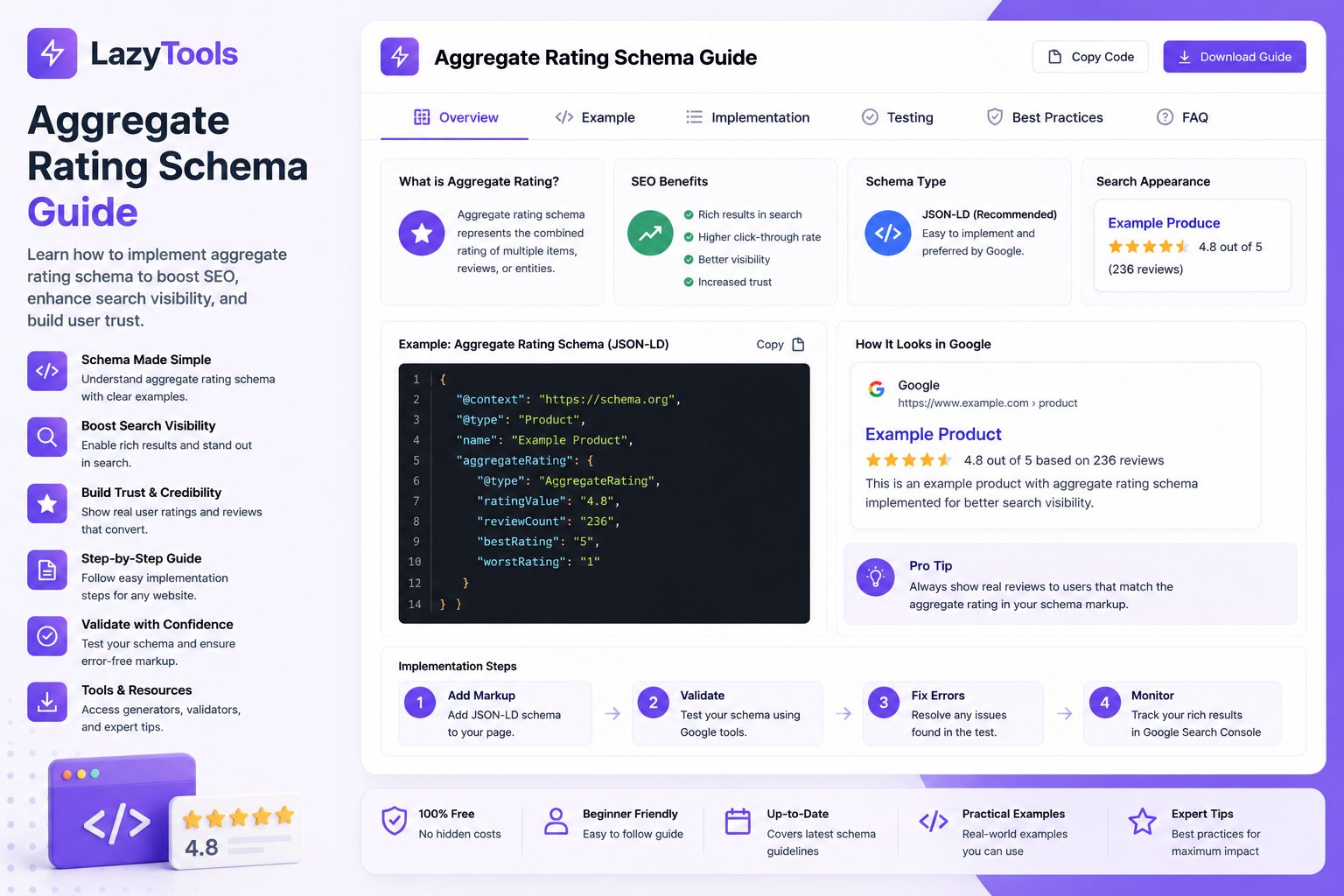
What AggregateRating Schema Is and Why Most Implementations Fail
AggregateRating schema is JSON-LD structured data that communicates your average rating from multiple reviews directly to Google's crawlers. When Google validates this markup and deems the page eligible, it displays gold star ratings alongside your search listing — a visual enhancement that research consistently shows increases click-through rates significantly. Specifically, BrightLocal found that a 5-star rating earns 28% more clicks than no rating, and 39% more than a 1-star rating, without any change in ranking position. Furthermore, Moz data shows star-rated listings achieve a 17% higher CTR on average than equivalent unrated listings at the same position. Consequently, valid AggregateRating schema is one of the highest-ROI structured data implementations available to any website with genuine user reviews.
However, the gap between implementing AggregateRating schema and actually seeing stars in Google is wider than most guides acknowledge. Specifically, Google applies at least six distinct eligibility requirements that all must be satisfied simultaneously. Moreover, a schema that passes Google's Rich Results Test can still fail to generate stars in live search results if the underlying content signals — genuine reviews, sufficient review volume, page authority — do not meet Google's undisclosed quality thresholds. Therefore, understanding both the technical requirements and the content signals is essential for anyone implementing AggregateRating markup.
📊 The Business Case: What Star Ratings Actually Deliver
The click-through rate impact of star ratings compounds across an entire site. Specifically, an e-commerce site with 500 product pages each generating 1,000 monthly impressions at an average position of 8 might achieve a 3% baseline CTR without stars — 15,000 monthly clicks total. Adding valid AggregateRating schema to all eligible product pages, assuming a conservative 17% CTR uplift from the Moz dataset, would produce approximately 2,550 additional monthly organic clicks from the same ranking positions. Furthermore, these additional clicks require no additional link building, content investment or paid advertising. Consequently, AggregateRating schema implementation is frequently cited by SEO practitioners as the highest-leverage structured data project for e-commerce and review-bearing pages.
AggregateRating Schema Explained: Every Required Property
AggregateRating is a schema.org type that represents a collective rating derived from multiple individual ratings or reviews. Specifically, it differs from a single Review object — which represents one person's assessment — by summarising the collective judgement of many reviewers into an average score paired with a total count. Google uses AggregateRating data to populate the star display in rich results, the Knowledge Panel rating for apps and products, and the carousel ratings for recipes and courses.
🔢 The Four Core Properties
Every AggregateRating implementation requires at minimum four properties to be present and correctly typed. Additionally, omitting any one of these four properties will cause Google's Rich Results Test to flag the schema as incomplete, preventing star eligibility.
| Property | Type | Required | Description |
|---|---|---|---|
| ratingValue | Number or Text | Required | The average rating. Must fall between worstRating and bestRating. Decimals permitted (4.7, 3.8). Google displays this number next to the stars. |
| reviewCount | Integer | Required* | Number of ratings that include written review text. Must be 1 or higher. *Either reviewCount or ratingCount must be present. |
| ratingCount | Integer | Required* | Total number of ratings including star-only ratings without text. *Either reviewCount or ratingCount must be present. Both can coexist. |
| bestRating | Number | Recommended | Highest possible rating value. Defaults to 5 if omitted. Must be set explicitly if your scale is not 1-5 (e.g., 1-10 or 0-100). |
| worstRating | Number | Recommended | Lowest possible rating value. Defaults to 1 if omitted. Set explicitly for non-standard scales. |
🔄 ratingCount vs reviewCount: The Most Misunderstood Distinction
The distinction between ratingCount and reviewCount is the most frequently misunderstood aspect of AggregateRating schema, and getting it wrong leads to either incorrect schema or missed data. Specifically, consider a SaaS product where 847 users have clicked a star rating widget and 203 users have written text reviews. In this case, ratingCount is 847 (all star ratings) and reviewCount is 203 (only those with written text). Furthermore, both properties should be included simultaneously — Google will use whichever provides the most useful signal for the specific display context. Consequently, using only one when you have data for both represents a missed opportunity and may cause underreporting of review engagement to Google's crawlers.
How to Generate AggregateRating JSON-LD in Six Steps
The LazyTools Aggregate Rating Schema Generator produces validated, Google-ready JSON-LD from a visual interface without requiring any manual JSON editing. Specifically, the generator enforces all required properties, surfaces eligibility warnings for restricted types, and shows a live SERP preview as you configure the schema. Here is the exact process:
⭐ Generate Your AggregateRating Schema Now
Visual star builder, live SERP preview, eligibility warnings. Free, no signup, no watermark.
What Makes This Generator Different From Every Competitor
All six major free AggregateRating generators — SEOSmoothie, ContentPowered, InstantSchema, SEOShouts, Attrock and others — provide a basic form that generates JSON-LD. Notably, none of them surfaces eligibility warnings for restricted entity types, none shows a live SERP preview, and none generates individual Review objects alongside AggregateRating. Specifically, the LazyTools generator was designed by auditing what these tools get wrong and building the features they omit.
Which Entity Types Are Eligible for Star Rating Rich Results
Google explicitly supports AggregateRating star rich results for a specific list of entity types. Furthermore, attempting to implement AggregateRating inside an unsupported parent type will result in a technically valid schema that never produces visible stars. Specifically, the supported types and their display contexts are as follows:
| Entity Type | Star Display Context | Key Additional Fields | Notes |
|---|---|---|---|
| Product | Shopping results, product knowledge panels | offers, brand, sku, gtin | Highest-impact type. Stars appear prominently in shopping carousel. |
| Recipe | Recipe carousels, recipe rich results | cookTime, recipeYield, nutrition | Stars appear in recipe snippet alongside cook time and calories. |
| Course | Course listing rich results | provider, courseMode, offers | Stars appear in course rich result alongside provider name. |
| Book | Book knowledge panels, book rich results | author, isbn, publisher | Stars appear in book panel alongside author and publication date. |
| Movie | Movie knowledge panels | director, dateCreated, genre | Stars appear in movie panel. Highly competitive for major titles. |
| SoftwareApplication | App-style rich results | applicationCategory, operatingSystem, offers | Stars appear similarly to app store ratings. |
| Event | Event rich results | startDate, location, organizer | Stars less commonly displayed; eligibility varies by query type. |
| HowTo | HowTo rich results | step, supply, tool | Stars can appear in HowTo step-carousel format. |
| LocalBusiness | Local Knowledge Panels only | address, telephone, openingHours | RESTRICTED — self-hosted schema prohibited. Use Google Business Profile instead. |
LazyTools vs Every Major Free AggregateRating Schema Generator
The following comparison was compiled by testing each tool against a standard set of requirements in May 2026. Specifically, each tool was used to generate an AggregateRating schema for a SaaS product with 847 ratings, 203 reviews, individual review objects and a 1-10 rating scale. The results reveal fundamental feature gaps across all competitors.
| Feature | LazyTools | SEOSmoothie | ContentPowered | InstantSchema | SEOShouts | Attrock |
|---|---|---|---|---|---|---|
| Visual star builder | ✅ Click stars | ❌ Number only | ❌ Number only | ❌ Number only | ❌ Number only | ❌ Number only |
| Live Google SERP preview | ✅ Real-time | ❌ No | ❌ No | ❌ No | ❌ No | ❌ No |
| Eligibility warnings | ✅ Yes | ❌ No | ❌ No | ❌ No | ❌ No | ❌ No |
| Individual reviews array | ✅ 1-5 reviews | ❌ No | ❌ No | ❌ No | ❌ No | ❌ No |
| Rating breakdown distribution | ✅ Yes | ❌ No | ❌ No | ❌ No | ❌ No | ❌ No |
| ratingCount + reviewCount both | ✅ Both fields | ❌ One field | ✅ Both | ❌ One field | ❌ One field | ❌ One field |
| Parent types supported | ✅ 12+ | ✅ 5 | ✅ 10 | ✅ 5 | ✅ 8 | ✅ 5 |
| Entity templates | ✅ 5 templates | ❌ None | ❌ None | ❌ None | ❌ None | ❌ None |
| Completeness score | ✅ Yes | ❌ No | ❌ No | ❌ No | ❌ No | ❌ No |
| Auto-save to browser | ✅ Yes | ❌ No | ❌ No | ❌ No | ❌ No | ❌ No |
| Download .json file | ✅ Yes | ❌ No | ❌ No | ❌ No | ✅ Yes | ❌ No |
| No signup required | ✅ Always free | ✅ Yes | ✅ Yes | ✅ Yes | ✅ Yes | ✅ Yes |
Six AggregateRating Schema Mistakes That Block Star Ratings
Google's structured data documentation specifies technical requirements, but the practical failure modes are poorly documented. Specifically, these six mistakes account for the vast majority of AggregateRating implementations that pass the Rich Results Test but never generate visible stars in Search.
❌ Mistake 1: No Parent Entity — The Schema Floats Alone
The most common mistake is placing an AggregateRating object directly in the page's JSON-LD without nesting it inside a supported parent entity. Furthermore, a bare AggregateRating is technically valid JSON-LD — it will not produce errors in Google's Rich Results Test parser — but it will never generate star rich results because Google requires the AggregateRating to be contextualised within a rated entity. Specifically, without a Product, Recipe, Course or other supported parent, Google cannot determine what is being rated and therefore cannot display stars for that query. The fix is always the same: wrap the AggregateRating inside a parent entity object that includes at minimum a name, url and description.
❌ Mistake 2: Using LocalBusiness or Organisation as Parent
Google has prohibited self-hosted AggregateRating for local businesses and organisations since 2019. Consequently, implementing AggregateRating on a restaurant's own website, a law firm's own site or an agency's own portfolio page will not produce stars — Google actively filters these out regardless of how technically correct the schema is. Furthermore, some sites that implemented this before 2019 and saw stars initially later lost them permanently when the policy was enforced retroactively. The correct alternative is Google Business Profile, which Google displays automatically in Knowledge Panels when your GBP account has genuine reviews from customers.
❌ Mistake 3: Schema on the Wrong Page
AggregateRating schema must appear on the same page where the rated entity is featured and where the reviews are actually displayed. Specifically, placing AggregateRating schema in a site-wide footer or header template so it appears on every page — including category pages, blog posts and the homepage — is a violation of Google's guidelines. Moreover, Google explicitly requires that the reviews summarised by the AggregateRating must be visible to users on that same page. Therefore, if a product's individual reviews are only on a separate /reviews/ subpage, the AggregateRating schema should appear on that reviews page, not only on the product page without visible reviews.
❌ Mistake 4: Fabricated or Self-Awarded Ratings
Google's manual review team and automated systems actively detect fabricated ratings, inflated scores and self-authored reviews marked up as aggregate ratings. Specifically, sites that implement AggregateRating with ratings that do not correspond to genuine reviews from real users, or that mark up only their most positive reviews while hiding negative ones, risk receiving a manual action that removes star rating eligibility for the entire site. Furthermore, this penalty is not automatically lifted when the problematic schema is removed — sites must submit a reconsideration request to Google Search Console and demonstrate that the review practices have been corrected before eligibility is reinstated.
❌ Mistake 5: Confusing ratingValue Scale with bestRating
If your rating system uses a scale of 1-10, 1-100 or any range other than 1-5, you must set the bestRating property explicitly. Specifically, a ratingValue of 8.2 on a 1-10 scale looks misleadingly low to Google if bestRating defaults to 5 — the crawler would interpret this as a value beyond the maximum scale, which may cause the schema to be considered invalid. Furthermore, a 1-10 scale rating of 8.2 corresponds roughly to a 1-5 scale rating of 4.1. Consequently, always set bestRating and worstRating explicitly whenever your scale differs from the 1-5 default, even if your actual values happen to fall within 1-5 range.
❌ Mistake 6: Insufficient Review Count
Google has not published a minimum review count threshold for star eligibility, but SEO practitioners consistently observe that pages with very low review counts — fewer than 3-5 genuine reviews — rarely generate visible stars even with technically valid schema. Additionally, a review count of 1 is technically valid but may appear suspicious to Google's quality systems. Therefore, the best practice is to implement AggregateRating only on pages where you have a genuine corpus of reviews — typically at least 5 or more — and to ensure that reviewCount and ratingCount accurately reflect real user engagement rather than artificially padded numbers.
How AggregateRating Schema Changes Search Performance: Real Data
The click-through rate impact of star ratings in Google Search is among the most well-documented effects in SEO. Specifically, multiple independent studies across different industries and query types consistently show a meaningful CTR uplift from star-rated listings, even when ranking position remains unchanged.
📈 The CTR Uplift in Numbers
BrightLocal's annual Local Consumer Review Survey consistently finds that star ratings in Google Search results influence user behaviour significantly. Furthermore, Moz's analysis of 500,000 search result impressions found that pages with star-rated rich results achieved an average CTR 17% higher than non-rated pages at the same average position. Additionally, a case study published by Merkle (a performance marketing agency) documented a 30% CTR increase for a retail client's product pages after implementing AggregateRating schema across their catalogue — without any change in ranking position or product pricing. Consequently, for high-impression pages at competitive positions, AggregateRating schema can represent thousands of additional monthly visits from the same organic ranking.
🏆 Individual Reviews Alongside AggregateRating
Adding individual Review objects nested inside the same parent entity as AggregateRating provides Google with additional data for rich result generation. Specifically, Google may display both the aggregate star rating and individual review snippets simultaneously in certain query contexts — particularly for product and software queries where user reviews are highly relevant. Furthermore, each individual Review must correspond to a review that is actually visible on the page being marked up. Moreover, these individual reviews must include an author name, review body, datePublished and a ratingValue to be eligible for review snippet display. Consequently, sites that include both AggregateRating and 2-5 individual Review objects give Google maximum structured data from which to construct rich results.
How AI Search and LLMs Are Changing the Value of AggregateRating Schema
The emergence of AI Overviews in Google Search and LLM-powered answer engines such as Perplexity and SearchGPT has introduced a new dimension to structured data strategy. Specifically, AggregateRating schema is no longer relevant only for traditional blue-link results — it is increasingly becoming a signal that AI systems use when evaluating whether a product, service or resource should be cited in an AI-generated response.
🔍 AggregateRating in Google's AI Overviews
Google's AI Overviews — the AI-generated summaries that appear above traditional search results for many informational and commercial queries — increasingly reference rated products and services when users ask comparison or recommendation questions. Specifically, when a user asks "what is the best project management software for small teams," Google's AI Overview may cite specific tools with their star ratings, drawing on AggregateRating structured data to validate the rating figures it displays. Furthermore, Google's AI systems are more likely to cite a source that provides machine-readable, structured rating data than one that embeds rating information only in unstructured text. Consequently, AggregateRating schema implementation supports AI Overview visibility as a secondary benefit beyond traditional rich result stars.
🤖 LLM Training Data and Review Signals
Large language models including GPT-4, Claude and Gemini are trained on web crawl data that includes structured data markup. Specifically, when these models encounter AggregateRating schema during training or retrieval-augmented generation (RAG) processes, they can extract structured rating information — entity name, rating value, review count — with greater reliability than extracting the same information from unstructured prose. Additionally, Perplexity's Pro Search mode and similar real-time web retrieval systems use structured data as a source quality signal: pages with valid schema are more likely to be cited as authoritative sources for rating information than pages without it. Therefore, in a world where AI answer engines increasingly mediate information discovery, AggregateRating schema functions as a machine-readable quality and authority signal that extends beyond Google's traditional rich results.
⚡ Automated Schema Generation in AI-Powered CMSs
CMS platforms including WordPress (via Yoast SEO, Rank Math and Schema Pro plugins) and Shopify increasingly generate AggregateRating schema automatically from their native review systems. Specifically, Yoast SEO Premium generates AggregateRating for WooCommerce products from native review data without requiring manual JSON-LD authoring. Furthermore, platforms like Trustpilot, Feefo and Reviews.io provide JavaScript widgets that automatically inject AggregateRating schema into partner sites alongside their review display widgets. Consequently, the manual JSON-LD generation workflow that free generators like LazyTools support is most relevant for custom implementations — sites using review systems that do not auto-generate schema, developers building schema into custom templates or SEOs auditing and correcting existing schema implementations.
What SEOs and Developers Search For: AggregateRating Answers
❓ "Aggregate rating schema not showing in Google"
The most common cause is one of the six mistakes described above. Specifically, start by validating your schema in Google's Rich Results Test at search.google.com/test/rich-results — if it fails validation, the error messages will identify the missing or incorrect property. If it passes validation but stars are still absent from live search results, the issue is likely a content quality signal: insufficient review count, local business restriction, schema on a page where reviews are not visible to users, or a site-wide trust issue. Furthermore, allow 2-4 weeks after implementing valid schema before concluding it is not working — Google re-crawls and re-evaluates structured data on different timelines for different sites.
❓ "How to add star ratings to Google search results"
Adding star ratings to Google Search requires implementing AggregateRating schema in your page's JSON-LD, nested inside a supported parent entity such as Product, Recipe or Course. Specifically, the schema must appear on a page where genuine reviews are displayed to users, with ratingValue and either reviewCount or ratingCount populated with real data. Additionally, the page must be indexed by Google and meet Google's content quality thresholds. The LazyTools generator produces ready-to-paste JSON-LD for all supported parent types in under two minutes.
❓ "AggregateRating JSON-LD example"
A minimal valid AggregateRating JSON-LD for a SaaS product would nest AggregateRating inside SoftwareApplication with ratingValue, reviewCount, bestRating and worstRating, alongside the application name, description and url. The LazyTools generator's SaaS template pre-fills this structure with realistic values. Furthermore, the generated JSON-LD can be copied directly into a <script type="application/ld+json"> block and validated immediately in Google's Rich Results Test before deployment.
❓ "Does aggregate rating schema work for local business"
No — Google prohibits local businesses and organisations from using self-hosted AggregateRating schema for star rating rich results since 2019. Specifically, if your business controls both the website and the reviews displayed on it, Google will ignore the AggregateRating markup for rich result purposes. The correct approach is to ensure your Google Business Profile has genuine customer reviews — Google automatically displays GBP ratings in Knowledge Panels, the local pack and other search surfaces. Furthermore, third-party review directories that feature local businesses (Yelp, TripAdvisor, industry-specific directories) can use AggregateRating schema on their own pages because the reviewing entity and reviewed entity are different organisations.
❓ "Best aggregate rating schema generator free"
The LazyTools Aggregate Rating Schema Generator is the only free tool that combines a visual star builder, live Google SERP preview, eligibility warnings for restricted entity types, individual reviews array, ratingCount and reviewCount as separate fields, and five pre-filled entity templates. Specifically, all six major competitors — SEOSmoothie, ContentPowered, InstantSchema, SEOShouts, Attrock and others — use number-input-only interfaces without SERP preview or eligibility warnings. Furthermore, the LazyTools generator auto-saves to your browser, requires no signup and generates a downloadable .json file in addition to the copyable JSON-LD.
Authoritative References for AggregateRating and Structured Data
🏛️ Google Official Documentation
- Google Review Snippets Developer Guide — Official requirements for review and AggregateRating rich results
- Google Rich Results Test — Official validator for all structured data types including AggregateRating
- Google Structured Data Overview — How Google uses structured data and what types are supported
📐 Schema.org Specifications
- Schema.org AggregateRating — Full property reference including all AggregateRating properties and expected types
- Schema.org Review — Individual Review schema reference for pairing with AggregateRating
- Schema.org Product — Most common AggregateRating parent type specification
📊 Industry Research and CTR Data
- BrightLocal Local Consumer Review Survey — Annual research on how star ratings affect consumer behaviour and CTR
- Moz SEO Blog — Industry analysis on rich result CTR impacts and structured data strategy
- Google Search Console — Monitor your rich result performance under Enhancements after implementing schema
Frequently Asked Questions About AggregateRating Schema
Fundamentals
Implementation and Validation
Where AggregateRating Schema Is Heading in 2026 and Beyond
Structured data strategy is evolving rapidly alongside changes in how Google presents search results and how AI systems process web content. Specifically, three trends are directly relevant to AggregateRating schema implementation in 2026 and over the following two to three years.
🤖 AI Overviews and Schema as a Citation Signal
Google's AI Overviews increasingly reference rated products, courses and services when users ask comparison or recommendation queries. Specifically, AI Overview responses that cite star-rated entities draw on AggregateRating structured data to display rating figures alongside the recommendation. Furthermore, Google's quality raters guidelines — which inform the signals used by AI Overview generation — explicitly value pages with clear, structured, verifiable information. Consequently, AggregateRating schema serves a dual purpose in 2026: traditional rich result eligibility for star display in blue-link results, and structured data signal for AI Overview citation inclusion. Therefore, implementing AggregateRating is no longer only a rich result optimisation — it is increasingly a prerequisite for AI search visibility for rated entities.
📜 Stricter Review Authenticity Enforcement
Google announced in 2024 that it was expanding its fake review detection capabilities, applying machine learning models trained on review manipulation patterns to identify and penalise sites using fabricated or incentivised reviews in their AggregateRating schema. Specifically, this enforcement extended to schema markup itself — sites where the schema rating values were materially inconsistent with review sentiment in the page text began receiving manual actions. Furthermore, the European Union's Digital Services Act, fully applicable from February 2024, requires large platforms to implement systems for detecting and removing fake reviews that appear in structured data. Consequently, the trend toward stricter review authenticity enforcement will continue through 2026-2027, making genuine review data a technical requirement rather than merely a best practice for AggregateRating schema.
🌐 Schema Coverage Across AI Platforms
Perplexity, ChatGPT (via web browsing) and Gemini increasingly crawl live web content to generate responses. Specifically, these systems use structured data as a quality and entity resolution signal — pages with valid AggregateRating schema wrapped in a correctly typed parent entity are more reliably parsed for rating information than pages relying on unstructured rating text. Moreover, as AI answer engines reduce traffic to some query types, pages that are cited as authoritative sources in AI responses become more valuable. Therefore, AggregateRating schema — which signals clear, structured, verifiable rating data — positions pages as reliable sources for AI systems that need to reference product and service quality across multiple platforms beyond Google Search alone.