Your Gross Salary and Your Take-Home Pay Are Not the Same Number — Here Is the Difference
A UAE offer of AED 20,000 per month and a UK offer of GBP 4,200 per month look similar on paper — but the UAE offer is worth substantially more after tax, allowances and end-of-service gratuity. This calculator computes your true annual income from any pay period, adds allowances and bonuses, applies country-specific tax estimates for 6 countries, and calculates UAE gratuity entitlement under the 2022 Labour Law.
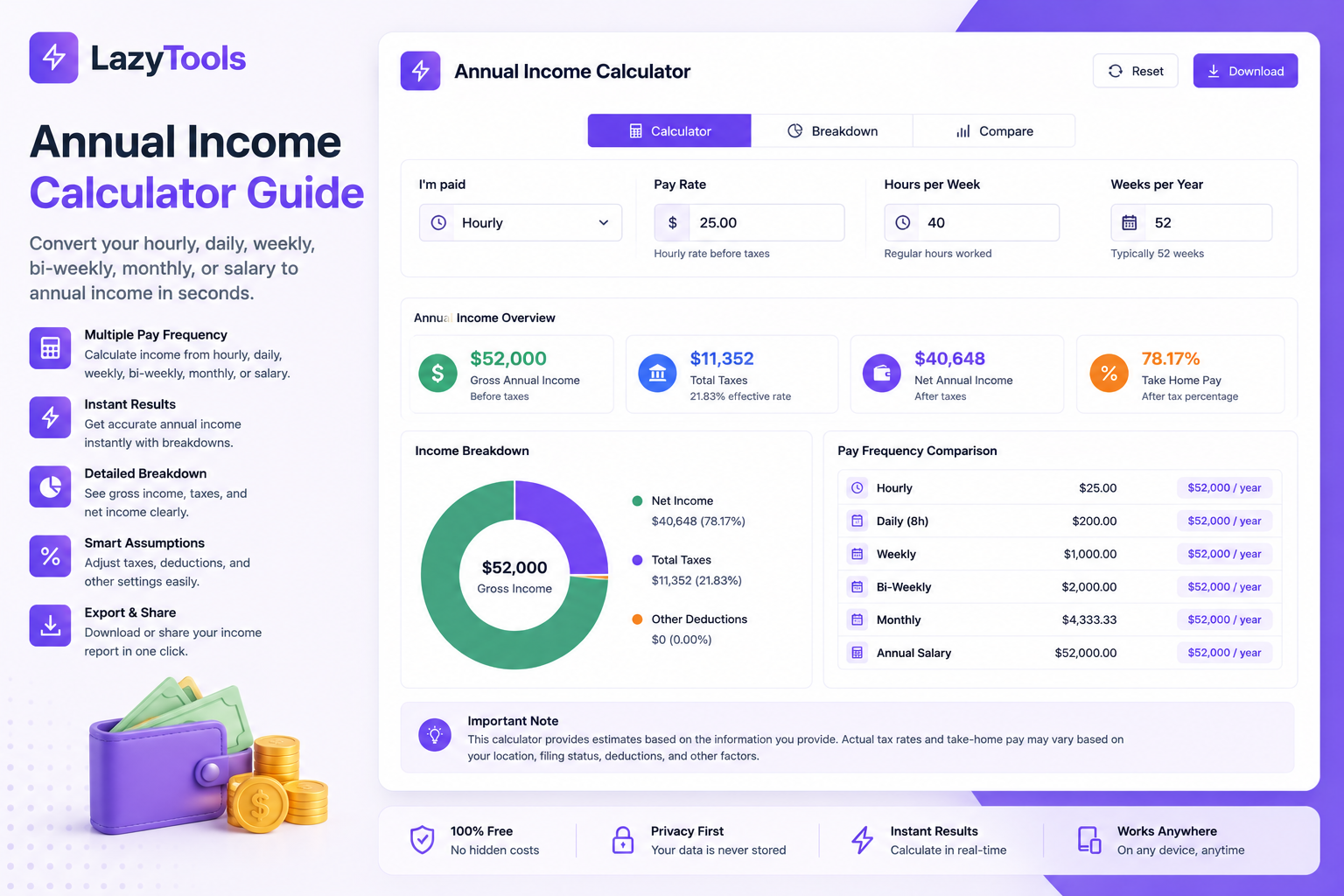
Why Your Quoted Salary Is Not Your Take-Home Pay — and How Far Apart They Can Be
Annual income has two fundamentally different meanings depending on who is using the term, and confusing them leads to systematic errors in budgeting, job comparisons and financial planning. Specifically, gross annual income is the total amount your employer pays you before any deductions — income tax, national insurance, social security, pension contributions or provident fund. Net annual income, also called take-home pay, is what you actually receive in your bank account after every statutory and voluntary deduction has been removed. Furthermore, the gap between gross and net is not a fixed percentage: it varies by country, income level, family circumstances and the specific components of your compensation package.
For middle earners, the gross-to-net gap is substantial. Specifically, a UK employee earning GBP 50,000 gross in 2024-25 takes home approximately GBP 37,500 net — a gap of GBP 12,500 or 25% of gross. A Canadian employee earning CAD 80,000 in Ontario takes home approximately CAD 59,000 — a gap of CAD 21,000 or 26% of gross. An Indian employee earning INR 12 lakh gross takes home approximately INR 9.5 lakh — a gap of INR 2.5 lakh or 21% of gross. Conversely, in the UAE, the gap is essentially zero because there is no personal income tax — AED 20,000 gross is AED 20,000 net, minus only any home-country tax obligations for expatriates. Therefore, understanding the gross-to-net gap for your specific country and income level is the foundation of every financial planning decision you will make.
💡 What Total Compensation Actually Includes
Base salary is only one component of total annual compensation. Specifically, a complete compensation package may include housing allowance, transport allowance, other allowances (food, phone, education, annual flight), annual performance bonus, 13th month bonus (mandatory in some countries, common in others), employer pension or superannuation contributions (11.5% in Australia), employer provident fund contributions (12% in India), end-of-service gratuity (UAE, Qatar, Saudi Arabia, Kuwait), medical insurance, life insurance and stock options or equity. Moreover, each of these components has different tax treatment in different countries — some are taxable as income, some are tax-exempt up to certain limits, and some (like Australian superannuation) are taxed at a lower rate. Consequently, comparing two job offers by base salary alone can dramatically misrepresent their relative value.
How Annual Income Is Defined and Calculated From Any Pay Period
Annual income is the total amount of money earned from employment in a 12-month period, expressed in gross (pre-tax) or net (post-tax) terms. Specifically, it is the standard reference point for tax calculations, loan applications, visa income requirements, financial planning and salary benchmarking — all of which use annual figures as their baseline, regardless of how frequently you are actually paid.
🔢 Converting Any Pay Period to Annual Income
The conversion formula depends on the pay period. Specifically, multiply your pay by the number of that period in a year: monthly pay times 12, weekly pay times 52, fortnightly pay times 26, and daily pay times the number of working days per year (typically 260 for a 5-day week, 52 weeks). For hourly workers, the formula is hourly rate times hours per week times working weeks per year. Furthermore, the number of working weeks per year matters — a worker who takes 4 weeks of annual leave and 2 weeks of public holidays effectively works 46 weeks per year, which should be used in the denominator when calculating hourly rates from a fixed annual salary.
| Pay Period | Multiplier for Annual | Example | Annual Result |
|---|---|---|---|
| Hourly | x hours/week x weeks/year | USD 25/hr, 40h/wk, 50wk | USD 50,000 |
| Daily | x working days/year | GBP 200/day, 260 days | GBP 52,000 |
| Weekly | x 52 | AUD 1,500/week | AUD 78,000 |
| Fortnightly | x 26 | CAD 3,200/fortnight | CAD 83,200 |
| Monthly | x 12 | INR 75,000/month | INR 9,00,000 |
| Monthly + 13th | x 13 | AED 15,000/month + 13th | AED 195,000 |
🏠 Gross Income vs Total Cost to Employer (CTC)
In India specifically, the term Cost to Company (CTC) is widely used in job offers and it frequently causes confusion. CTC includes all employer costs — basic salary, all allowances, employer EPF contribution, gratuity accrual, and sometimes non-cash benefits like medical insurance. Specifically, a CTC of INR 12 lakh does not mean you take home INR 1 lakh per month — after employer and employee EPF contributions, professional tax and income tax, the actual in-hand salary for a INR 12 lakh CTC is typically INR 80,000-85,000 per month, or INR 9.6-10.2 lakh annually. Furthermore, the difference between CTC and take-home is often 15-25% for mid-range Indian salaries. Therefore, always ask for the break-up of the CTC into components — basic, HRA, special allowance, EPF, LTA, etc. — rather than treating the total CTC as equivalent to gross salary.
How to Calculate Your Annual Income in Four Steps
The LazyTools annual income calculator handles the full complexity of a real compensation package — base salary in any pay period, multiple allowances, annual and 13th month bonuses, country-specific tax estimates and UAE gratuity — in a single calculation. Specifically, the tool supports all six pay period inputs and converts between them automatically, so you can always work in the number you know without manual arithmetic.
💰 Calculate Your True Annual Income Now
Allowances, bonuses, tax and gratuity — all free, all in one place, no signup.
What Makes This Calculator Different From Standard Salary Converters
Most online annual income calculators convert a single number from one time period to another — nothing more. Specifically, this calculator handles the full complexity of a real compensation package that most employees actually receive, across six different national tax systems.
Annual Income and Tax Overview by Country: What You Actually Keep
Income tax systems vary dramatically across countries. Specifically, the effective tax rate — the percentage of total income paid in tax — is far more relevant for financial planning than the headline marginal rate, because progressive tax systems apply higher rates only to income above each threshold, not to the entire income. Furthermore, statutory deductions like National Insurance (UK), Social Security (US), CPP and EI (Canada), EPF (India) and Medicare Levy (Australia) add materially to the effective total deduction rate beyond just income tax. Consequently, understanding the full deduction picture for your country is essential for realistic financial planning.
🇦🇪 UAE: Zero Income Tax + Gratuity
The UAE has no personal income tax. Employees keep 100% of their gross salary, subject only to any home-country tax obligations — some countries (notably the US) tax citizens on worldwide income regardless of where they live. Furthermore, UAE employment packages typically include significant non-basic-salary components: housing allowances of 25-30% of total package are standard, and transport allowances of AED 500-2,000 per month are common. Additionally, the UAE gratuity system provides a compulsory end-of-service benefit that accrues at 21 working days of basic salary per year for the first 5 years and 30 working days per year thereafter, capped at 2 years of total salary. Consequently, the total annual value of a UAE employment package is consistently higher than the basic salary figure suggests.
🇮🇳 India: New Tax Regime 2024-25
India's new tax regime (default from FY 2023-24) applies the following slabs to annual income: nil up to INR 3 lakh, 5% from INR 3-7 lakh, 10% from INR 7-10 lakh, 15% from INR 10-12 lakh, 20% from INR 12-15 lakh, and 30% above INR 15 lakh. A standard deduction of INR 75,000 reduces taxable income before these slabs are applied. Furthermore, the Section 87A rebate provides complete tax relief for incomes up to INR 7 lakh under the new regime, making it effectively tax-free for many salaried employees. Beyond income tax, employees contribute 12% of basic salary to the Employee Provident Fund (EPF), matched by the employer — this is a forced savings mechanism that appears as a deduction from in-hand pay but accumulates in the employee's EPF account. Consequently, the total deduction from CTC to in-hand salary for a INR 10 lakh CTC employee is typically 18-25%, comprising income tax, employee EPF and professional tax.
🇨🇦 Canada: Federal + Provincial Tax
Canada's income tax has two layers: federal tax and provincial/territorial tax. Federal brackets for 2024 are 15% on the first CAD 55,867, 20.5% up to CAD 111,733, 26% up to CAD 154,906, 29% up to CAD 220,000, and 33% above that. Every province adds its own rate — Ontario adds 5.05% on the first CAD 51,446, rising to 13.16% above CAD 220,000. Employees also contribute 5.95% to the Canada Pension Plan (CPP) up to the annual maximum of CAD 3,867.50, and 1.66% Employment Insurance (EI) up to CAD 1,409.51 annually. Consequently, for a Canadian earning CAD 80,000 in Ontario, the combined effective deduction rate is approximately 26-28%, leaving take-home pay of approximately CAD 58,000-59,000 per year.
🇬🇧 UK: PAYE and National Insurance
UK income tax for 2024-25 operates through the PAYE system with a personal allowance of GBP 12,570 — income below this threshold is tax-free. The basic rate of 20% applies between GBP 12,571 and GBP 50,270. The higher rate of 40% applies from GBP 50,271 to GBP 125,140. Above GBP 125,140, the personal allowance is withdrawn and the 45% additional rate applies. National Insurance (Class 1) adds 8% on earnings between GBP 12,570 and GBP 50,270, and 2% above that. Specifically, a basic-rate taxpayer earning GBP 35,000 pays approximately GBP 4,486 income tax and GBP 1,832 National Insurance — a combined effective rate of approximately 18% — and takes home approximately GBP 28,682 per year. Furthermore, the Scottish government applies different income tax rates (the starter rate of 19% and intermediate rate of 21%), so Scotland-based employees should use a Scotland-specific calculator for precise results.
🇺🇸 USA: Federal + State Tax
US federal income tax applies progressive brackets: 10% on income up to USD 11,600 (single), 12% up to USD 47,150, 22% up to USD 100,525, 24% up to USD 191,950, 32% up to USD 243,725, 35% up to USD 609,350, and 37% above that (2024 single filer brackets). FICA deductions add 6.2% for Social Security (up to the 2024 wage base of USD 168,600) and 1.45% Medicare (no cap). Furthermore, state income tax ranges from 0% in states like Texas, Florida, Washington and Nevada to 13.3% in California at the top bracket. Consequently, the effective total deduction rate for a USD 80,000 earner in California is approximately 28-32%, while the same earner in Texas faces approximately 19-22% (federal + FICA only). The LazyTools calculator applies an estimated effective federal and state rate based on the country selection.
🇦🇺 Australia: Super + Medicare Levy
Australia's income tax thresholds for 2024-25 are: tax-free up to AUD 18,200, 19% up to AUD 45,000, 32.5% up to AUD 135,000, 37% up to AUD 190,000, and 45% above that. The Medicare Levy adds 2% to the tax bill for most taxpayers. Furthermore, compulsory Superannuation is set at 11.5% of ordinary time earnings for 2024-25 — this is an employer contribution paid on top of (not deducted from) gross salary, accumulating in the employee's superannuation fund for retirement. Consequently, when comparing an Australian salary to a UK or Canadian salary, the super contribution should be counted as additional employer cost: an AUD 100,000 gross salary has an employer cost of approximately AUD 111,500 when superannuation is included. After income tax and Medicare Levy, an AUD 100,000 earner takes home approximately AUD 74,000 per year — an effective deduction rate of 26%.
LazyTools vs Other Annual Income Calculators: Feature Comparison
| Feature | LazyTools | Omni Calculator | Bayzat | Pearson |
|---|---|---|---|---|
| Any pay period input | ✅ 6 periods | Hourly only | Monthly only | Limited |
| Housing / transport allowances | ✅ Separate fields | ✘ | ✅ | ✘ |
| Annual bonus + 13th month | ✅ Both | ✘ | ✘ | ✘ |
| UAE gratuity calculator | ✅ Full formula | ✘ | Partial only | ✘ |
| Multi-country tax estimates | ✅ 6 countries | Custom rate only | UAE only | ✘ |
| India new tax regime 2024-25 | ✅ | ✘ | ✘ | ✘ |
| Full period breakdown output | ✅ All 4 periods | ✅ | Monthly only | Limited |
| Free, no login | ✅ Always | ✅ | Upsell platform | ✅ |
Five Annual Income Mistakes That Lead to Costly Financial Decisions
Misunderstanding annual income components — or comparing the wrong figures across countries — leads to poor salary negotiations, underestimated tax bills and financial shortfalls. Specifically, these five mistakes account for the majority of income-related financial errors made by professionals changing jobs or relocating.
❌ Mistake 1: Accepting a CTC Without Asking for the In-Hand Breakdown
In India, accepting a CTC offer without requesting a full component breakdown is extremely common and consistently leads to in-hand salary being lower than expected. Specifically, employer EPF contributions, gratuity accrual and sometimes even notice-period salary recovery are included in CTC totals by some employers. Furthermore, a CTC of INR 12 lakh with a high EPF base might yield only INR 78,000 in-hand per month, while a CTC of INR 12 lakh with a lower EPF base might yield INR 84,000. Consequently, always request the detailed salary structure — basic, HRA, special allowance, LTA, medical allowance, employer EPF, gratuity — before accepting an offer and use those figures to calculate your actual take-home.
❌ Mistake 2: Comparing UAE Gross to UK/US/Canada Gross Without Tax Adjustment
The most common cross-border salary comparison error is comparing gross figures across different tax environments as if they are equivalent. Specifically, AED 20,000 per month gross in Dubai is approximately GBP 4,211 per month gross in London at current exchange rates — but the London employee takes home only approximately GBP 3,175 after income tax and National Insurance, while the Dubai employee takes home AED 20,000 (the full gross amount). Therefore, the correct comparison is always net-to-net or gross-to-gross with explicit tax adjustment. Furthermore, cost-of-living differences must also be considered — accommodation costs in Dubai are high but transport and dining can be cheaper than London. Consequently, a true cross-border offer comparison requires computing net take-home in both locations, converting to a common currency, and adjusting for purchasing power parity.
❌ Mistake 3: Forgetting That Australian Superannuation Is On Top of Gross
Australian employees frequently undervalue their total compensation because superannuation is paid by the employer on top of gross salary and therefore does not appear in take-home pay calculations. Specifically, for an AUD 100,000 gross salary, the employer pays an additional AUD 11,500 in superannuation — bringing total employer cost to AUD 111,500. Furthermore, this superannuation accumulates in the employee's personal superannuation fund tax-advantageously and is available from age 60. Consequently, when comparing an Australian salary to a UK or Canadian offer, the full employer cost (including superannuation) should be the comparison point, not just the gross salary figure. An AUD 100,000 salary with 11.5% super is worth approximately AUD 111,500 in total employer contribution — equivalent to a UK employer paying GBP 23,450 in employer pension contributions on a GBP 52,700 salary.
❌ Mistake 4: Not Including UAE Allowances When Evaluating the Package
UAE employers frequently quote "basic salary" rather than "total package" in job advertisements and initial offers. Specifically, a quoted basic salary of AED 10,000 may come with housing allowance of AED 3,500 per month, transport allowance of AED 1,500 per month and an annual flight allowance of AED 5,000 — bringing total annual compensation to AED 185,000 versus the implied AED 120,000 from basic salary alone. Furthermore, UAE gratuity is calculated on basic salary only — not total package — so a higher basic proportion benefits the employee through larger gratuity entitlements. Consequently, always ask for the full package breakdown when evaluating UAE offers, and use the LazyTools calculator to compute total annual value including all allowances and gratuity accrual.
❌ Mistake 5: Using Gross Income for Loan Affordability Without Tax Adjustment
Mortgage lenders and financial advisors typically quote loan affordability ratios based on gross income — for example, "you can borrow up to 4.5 times your annual salary." However, mortgage repayments come from net (after-tax) income, not gross income. Specifically, a UK employee earning GBP 50,000 gross (GBP 37,500 net) who is told they can borrow 4.5 times salary has a maximum loan of GBP 225,000 — but their actual monthly take-home is GBP 3,125, and at 5% mortgage rates a GBP 225,000 25-year repayment mortgage costs approximately GBP 1,316 per month — 42% of take-home pay. Therefore, always calculate loan affordability from net monthly income and ensure the monthly repayment represents no more than 30-35% of take-home pay for a sustainable mortgage. The LazyTools calculator's net income output is the correct input for affordability calculations.
Cross-Border Offer Comparison: UAE vs UK vs India — A Worked Example
To demonstrate how dramatically different job offers can look when properly compared on a net, same-currency basis, consider a software engineer receiving three simultaneous offers in May 2026. Furthermore, this comparison illustrates exactly why gross salary alone is an insufficient basis for decision-making across borders.
| Component | UAE Offer | UK Offer | India Offer |
|---|---|---|---|
| Basic salary | AED 18,000/month | GBP 5,000/month | INR 1,40,000/month |
| Housing allowance | AED 4,000/month | — | INR 28,000/month (HRA) |
| Transport allowance | AED 1,500/month | — | INR 3,200/month |
| Gross annual income | AED 282,000 | GBP 60,000 | INR 20,54,400 (CTC) |
| Income tax + NI/EPF | 0% | ~GBP 16,500 (27.5%) | ~INR 2,50,000 (12.2%) |
| Net annual take-home | AED 282,000 | GBP 43,500 | INR 18,04,400 |
| Net in USD (approx.) | ~USD 76,800 | ~USD 55,500 | ~USD 21,700 |
| Gratuity / super accrual | AED 15,120/yr | Employer pension ~GBP 3,000 | INR 90,000/yr EPF |
| Total annual value (USD) | ~USD 80,900 | ~USD 59,300 | ~USD 22,800 |
How AI Is Transforming Salary Benchmarking and Annual Income Analysis
Artificial intelligence is fundamentally changing how individuals understand their market value and how organisations set compensation. Specifically, AI-powered salary tools are replacing static industry surveys with dynamic, personalised compensation benchmarks that update in near real time — and the implications extend from individual salary negotiations to national pay equity policy.
🔍 AI-Powered Salary Benchmarking
Traditional salary benchmarking relied on annual surveys conducted by firms like Mercer, Korn Ferry and Willis Towers Watson, which polled thousands of employers and published aggregated data with 6-12 month lags. Specifically, a candidate negotiating a salary in 2026 using a 2025 benchmarking survey was working with data that might not reflect recent market shifts caused by AI adoption, layoffs or remote work policy changes. Furthermore, these surveys typically provided broad ranges — "software engineers earn USD 80,000-120,000 in New York" — without accounting for years of experience, specific skills, company size, education or industry subsector. Consequently, AI-powered benchmarking tools including LinkedIn Salary, Glassdoor Pay, Levels.fyi and Ripplematch now provide real-time, multi-dimensional salary estimates by aggregating anonymised salary reports from millions of current and recent employees, normalised by job level, company, location, skills and tenure.
⚖️ Pay Equity Analysis and AI
Pay equity analysis — identifying and correcting gender, race or age-related pay gaps within organisations — has historically required expensive consulting engagements that analysed a company's entire payroll in a months-long process. Specifically, AI now enables continuous, automated pay equity monitoring: payroll systems can flag statistically significant pay gaps in real time, controlling for job level, performance rating, tenure and department. Furthermore, the EU Pay Transparency Directive, which requires employers with 250 or more employees to report pay gap data from 2027, is accelerating AI adoption in payroll analytics across European employers. Additionally, the UK's gender pay gap reporting requirement (mandatory since 2017 for employers with 250+ employees) has driven similar adoption of automated pay analytics tools. Consequently, the annual income data that tools like this calculator produce for individuals is increasingly being mirrored by AI-powered analytics systems at the organisational level, creating pressure for pay transparency and equity that is reshaping compensation policy across major employers globally.
📱 Personal Finance AI and Income Planning
AI-powered personal finance applications including YNAB, Monarch Money, Copilot and newer LLM-based tools are increasingly able to ingest gross salary data and produce personalised financial plans that account for country-specific tax treatment, pension contributions, insurance and cost-of-living patterns. Specifically, these tools use the same gross-to-net conversion logic as the LazyTools calculator but extend it into multi-year cashflow projections, retirement readiness scoring and investment allocation recommendations. Furthermore, LLMs integrated into financial planning tools can now answer natural-language questions like "If I receive a 10% pay rise, how much more will I actually take home after tax in the UK?" by performing the income tax marginal rate calculation automatically. Consequently, the boundary between salary calculators and comprehensive personal finance tools is dissolving — the annual income calculation is increasingly the first step in a continuous, AI-assisted financial planning workflow rather than an isolated one-time calculation.
Annual Income Questions Answered Directly
How do I calculate annual income from an hourly rate?
Multiply hourly rate by hours per week by working weeks per year. For a full-time worker doing 40 hours per week for 52 weeks: hourly rate x 2,080. The most common US approximation is to double the hourly rate and add three zeros — so USD 25/hour approximates USD 50,000 per year (assumes 2,000 working hours). For UK workers on 37.5 hours per week: hourly rate x 1,950 for a 52-week year. Furthermore, if you take unpaid leave or work fewer than 52 weeks, reduce the multiplier accordingly. The LazyTools calculator accepts hourly input directly alongside hours per week and working weeks per year for a precise result.
What is a good annual salary in the UAE?
AED 10,000-15,000 per month (AED 120,000-180,000 per year) covers a modest to comfortable lifestyle for a single expat in Dubai. AED 20,000-35,000 per month (AED 240,000-420,000 per year) is considered comfortable for a family. Senior management and professionals often earn AED 40,000-80,000+ per month. Since there is no income tax in the UAE, these figures represent actual take-home pay — making them directly comparable to post-tax salaries in other countries. Specifically, AED 20,000 per month take-home in Dubai is equivalent to approximately GBP 51,000 per year take-home in the UK, which corresponds to a gross UK salary of approximately GBP 69,000-70,000 — a mid-senior professional salary in London.
What annual income is tax-free in India under the new regime?
Under the new Indian tax regime for FY 2024-25, the effective zero-tax threshold is INR 7.75 lakh per year, after the INR 75,000 standard deduction and the Section 87A rebate of up to INR 25,000. For incomes up to INR 7.75 lakh, the total tax liability after deductions and the rebate is nil. For higher incomes, tax is computed progressively on the slabs above INR 3 lakh with no rebate. Consequently, the new regime is highly attractive for employees earning up to INR 7-8 lakh, and may also be preferable for higher earners who do not have large investment-linked deductions (which only benefit under the old regime).
How does the 13th month bonus work?
A 13th month bonus is an additional month's salary paid once per year, typically in November or December. It is a statutory requirement in several countries — mandatory in the Philippines under Presidential Decree 851 for all rank-and-file employees, and standard in Germany, Italy, Spain and much of Latin America under collective bargaining agreements. In the UAE and wider GCC region, it is an employer-specific benefit rather than a legal requirement. The LazyTools calculator adds a full month's gross salary when the 13th month toggle is enabled, increasing the annual gross figure by approximately 7.7% (1/13 of total annual). Furthermore, in some jurisdictions the 13th month is partially or fully tax-exempt — for example, in the Philippines the first PHP 90,000 is tax-free.
How do I compare salaries across Canada, UK and Australia?
The correct comparison method is to compute net take-home in each country, convert to a common currency at current exchange rates, and then adjust for purchasing power parity if comparing lifestyle rather than raw cash. Specifically: use the LazyTools calculator to compute net annual income in each country, use a reliable currency converter (the LazyTools currency converter supports live rates for all three) to convert CAD, GBP and AUD to a common base currency, and then optionally apply OECD purchasing power parity indices to compare actual purchasing power rather than nominal currency value. Furthermore, account for employer contributions not included in take-home pay — Australian superannuation (11.5% employer contribution) and employer pension auto-enrolment (at least 3% in the UK) should be counted as part of total compensation even though they do not appear in take-home pay.
Authoritative References on Tax Rates and Income Calculation
🏛️ Government Tax Authorities
- UK HMRC — Income Tax Rates and Bands — Official 2024-25 UK income tax rates, personal allowance and National Insurance thresholds
- US IRS — Tax Topics — Official US federal income tax brackets and FICA contribution rates
- CRA — Canadian Income Tax Rates — Federal and provincial income tax rates for individuals
🌏 Asia-Pacific and Middle East
- Income Tax India — Official Portal — New and old tax regime rates, Section 87A rebate, EPF and HRA rules for FY 2024-25
- ATO — Australian Tax Rates — Individual income tax rates, Medicare Levy and superannuation guarantee rates for 2024-25
- UAE Ministry of Human Resources (MOHRE) — UAE Labour Law 2022 text and gratuity calculation rules
📊 Salary and Benchmarking Data
- Glassdoor Salary Data — Anonymised salary reports by role, company and location for benchmarking
- LinkedIn Salary Insights — Real-time salary benchmarks by title, location and years of experience
- OECD Average Wages Data — Cross-country average annual wages adjusted for purchasing power parity
Frequently Asked Questions About Annual Income
Gross, Net and Tax
Pay Periods and Cross-Border Comparison
How Pay Transparency Laws and AI Are Reshaping Annual Income in 2026
Annual income — how it is defined, reported and compared — is undergoing its most significant transformation in decades, driven by pay transparency legislation, AI-powered compensation analytics and shifting workforce patterns. Specifically, three trends are reshaping compensation practices globally in 2026 and the years ahead.
📜 Global Pay Transparency Legislation
The EU Pay Transparency Directive, adopted in 2023, requires organisations with 250 or more employees to report their gender pay gap publicly from 2027 and to provide applicants with salary ranges before interviews from 2026. Furthermore, New York City, Colorado, Washington and California in the US now mandate salary range disclosure in job postings — laws that have already caused major employers to publish salary bands where they previously never did. Additionally, the UK government announced plans in 2025 to expand gender pay gap reporting obligations and pilot ethnicity pay gap reporting for large employers. Consequently, annual income is becoming a more transparent and more politically charged topic than at any point since the introduction of minimum wage legislation — and the tools needed to understand, calculate and compare income across countries are correspondingly more important.
🤖 AI Compensation Models and Real-Time Benchmarking
By 2026, AI-powered compensation tools have moved from experimental to mainstream in large-organisation HR. Specifically, Workday, SAP SuccessFactors, Beqom and Comp AI all offer real-time pay benchmarking that compares each employee's salary against external market data updated weekly or monthly, rather than relying on annual survey reports. Furthermore, generative AI integrated into these platforms can now produce natural-language explanations of pay decisions — "your salary is in the 58th percentile for your role, adjusted for your location and 4 years of experience" — and flag potential bias in proposed compensation changes. Consequently, employees negotiating salaries in 2026 are increasingly working against AI-generated pay ranges that their employers use internally, making individual salary calculators like this one essential tools for understanding where you stand in the market before entering any negotiation.
🌍 Remote Work and Cross-Border Income Complexity
The normalisation of remote work since 2020 has created a growing population of employees who live in one country, work for an employer based in another, and are paid in a third currency. Specifically, "digital nomad" visas introduced in 2022-2025 by countries including the UAE, Portugal, Spain, Indonesia and Thailand have formalised this arrangement — but the annual income and tax implications are complex. Furthermore, many countries now apply the "183-day rule" for tax residency, meaning a remote worker who spends more than 183 days in a given country may become liable for that country's income tax on their worldwide income, even if their employer is based elsewhere. Consequently, the cross-country income comparison that tools like this calculator facilitate will become increasingly relevant as more knowledge workers operate across multiple jurisdictions — and the complexity of computing true net annual income across those jurisdictions will continue to increase.