
explainer
Bra Size Conversion and Sister Sizes: US, UK and EU Explained
By Uttam Regmi · Published 2026-07-04 · Updated 2026-07-04 · 7 min read · Fact-checked, sources cited

A bra size is two separate measurements wearing one label: the band (ribcage) and the cup (the difference between bust and band). That’s why a US 34DD, an EU 75E and a FR 90E are the same bra, and why a 36D holds exactly the same cup volume. Convert any size, with sister sizes included, in the bra size converter, measurements never leave your browser.
How the two numbers work
The band number is the ribcage measurement, inches in the US/UK (30, 32, 34…), centimeters rounded to fives in the EU (65, 70, 75…). Because they measure the same thing in different units, bands convert exactly:
| US / UK | EU / DE | FR / ES | IT | AU |
|---|---|---|---|---|
| 30 | 65 | 80 | 1 | 8 |
| 32 | 70 | 85 | 2 | 10 |
| 34 | 75 | 90 | 3 | 12 |
| 36 | 80 | 95 | 4 | 14 |
| 38 | 85 | 100 | 5 | 16 |
| 40 | 90 | 105 | 6 | 18 |
The cup letter is relative: each letter step represents about one inch of difference between the bust and band measurements. A is ~1”, B ~2”, C ~3”, D ~4”. Crucially, a “C cup” on a 32 band is a physically smaller cup than a “C” on a 38 band, the letter only means something next to its band.
Where conversion goes wrong: the cup ladders fork
Up to D, everyone agrees. Beyond it, the systems diverge:
| Step | US | UK | EU |
|---|---|---|---|
| 4 | D | D | D |
| 5 | DD | DD | E |
| 6 | DDD | E | F |
| 7 | G | F | G |
| 8 | H | FF | H |
So “34E” means different bras in London and New York. The safe method, and what the converter does, is counting steps up the ladder, never matching letters.
📌 Citable fact Bra band sizes convert exactly between systems (US 34 = EU 75 = FR 90 = IT 3), but cup letters diverge above D: the sixth cup step is DDD in US sizing, E in UK sizing and F in EU sizing. Correct conversion counts cup steps rather than matching letters.
A conversion, worked end to end
Suppose you measure a 34-inch band and a 39-inch bust. The difference is 5 inches, which is the fifth cup step. Now convert each part on its own scale:
- Band: 34 inches → EU 75 → FR/ES 90 → IT 3 → AU 12.
- Cup: the fifth step is DD in the US ladder, DD in the UK ladder and E in the EU ladder.
Reassembled, one bra carries four labels: US 34DD, UK 34DD, EU 75E, FR 90E. The label looks wildly different in Paris and New York, yet the garment is identical. That is the whole trap, and the reason the safe move is always to convert band and cup separately, then read the letter off the destination ladder rather than copying it across.
For quick reference, here are five popular sizes carried through the main systems:
| US | UK | EU | FR | Bust − band |
|---|---|---|---|---|
| 32C | 32C | 70C | 85C | 3 in (~7.5 cm) |
| 34B | 34B | 75B | 90B | 2 in (~5 cm) |
| 34DD | 34DD | 75E | 90E | 5 in (~12.5 cm) |
| 36D | 36D | 80D | 95D | 4 in (~10 cm) |
| 38DDD | 38E | 85F | 100F | 6 in (~15 cm) |
Read each row left to right and notice the band digits and the cup letter move on separate tracks: the band scales by unit, the cup by ladder position.
Sister sizes: the fix for “almost fits”
Because cups are relative to bands, the same cup volume exists at several sizes. Move one band down and one letter up (or the reverse) and the volume stays constant:
32DDD ↔ 34DD ↔ 36D, same cups, different band lengths.
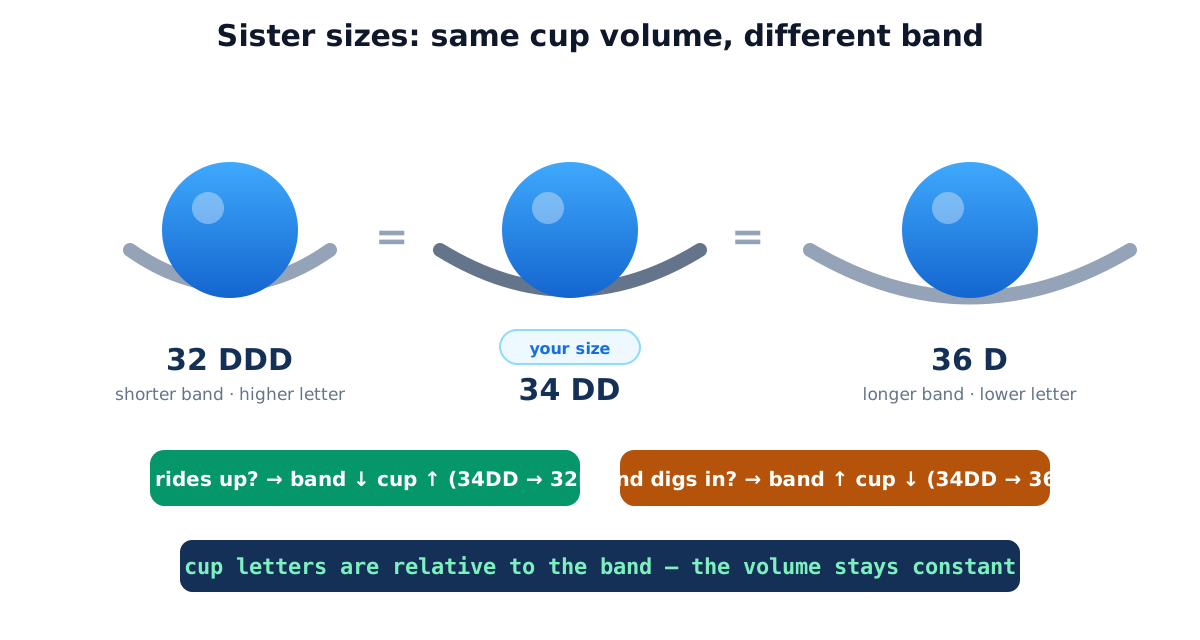
When to use which:
- Band rides up / feels loose, cup fine → sister size down: 36C → 34D
- Band digs in, cup fine → sister size up: 34D → 36C
- A favorite style out of stock in your size → its sister is often on the shelf
Fit heuristics worth knowing: the band should sit level and firm on the loosest hook (you tighten hooks as it stretches with age); roughly 80% of support comes from the band; straps digging in usually means the band is too loose, not the straps too short. Fitting surveys have long found a majority of people wearing a size off from their measurement, usually a too-large band with a too-small cup, which is exactly the case sister sizing untangles.
Measuring at home
- Band: tape snug and level directly under the bust; exhale first. Round to the nearest even number (US) or the nearest 5 cm (EU).
- Bust: around the fullest point, unpadded, tape parallel to the floor, arms relaxed.
- Cup: bust − band. Each ~1 inch / 2.5 cm is one cup step (1≈A, 2≈B, 3≈C, 4≈D, 5≈DD…).
- Enter the result in the converter for every system plus sister sizes.
Body measurements are personal data. This tool processes them entirely on your device, transmitting nothing.
Why the band matters more than the letter
It is tempting to treat the cup letter as the important half of the size, but fit is driven by the band. The band is the anchor that carries the weight; the cup only shapes what sits on top of it. A useful mental model is the “scoop test” after putting a bra on: lean forward, settle everything into the cups, then stand and check three things.
- Band level and firm. It should run parallel to the floor and stay put when you raise your arms. If it rides up your back, it is too loose, that is a band problem, not a strap problem.
- Cup fully filled, not spilling. Overflow at the top edge means one cup step up; wrinkling or empty fabric means one step down.
- Straps as helpers, not lifters. Straps that dig in are compensating for a band that is not doing its share. Loosen them and try a smaller, firmer band instead.
Because cup letters are relative, changing the band almost always changes the letter you need, which is exactly why sister sizing works. Move to a firmer band and the same body now needs a larger-looking cup letter, even though the physical cup volume has not changed at all.
Common conversion mistakes
- Matching cup letters across systems, a UK F ≠ US F; count ladder steps.
- Assuming AU sizes are inches, Australian band numbers are dress sizes (AU 12 ≈ US 34).
- Fixing loose bands with tighter straps, that’s a sister-size-down situation.
- Buying on the tightest hook, new bras should fit on the loosest, leaving room as the band ages.
- Ignoring style variation, like shoe lasts, cuts differ; the converted size is the start point, not a guarantee.
Quick summary
Bands convert exactly (US 34 = EU 75 = FR 90); cups convert by counting ladder steps, never matching letters, because the systems fork after D. If a bra almost fits, sister-size it: band down + cup up when the band rides up, the reverse when it digs in. The bra size converter does both, entirely in your browser.
Related: the ring and shoe size converters, and cm to inches for the raw measurement math.
Frequently asked questions
What is a US 34DD in EU and French sizing?
EU 75E and FR 90E. The band maps 34→75 (EU bands run in centimeters, steps of 5); the fifth cup step is DD in the US ladder and E in the EU ladder. FR/ES bands are always EU + 15.
What exactly is a sister size?
The same cup volume on a different band: go down one band and up one cup letter (34DD → 32DDD) or up one band and down one letter (34DD → 36D). It works because cup letters measure the bust-band difference, not an absolute volume.
How do I measure my bra size?
Band: snug tape directly under the bust, after exhaling. Bust: around the fullest point, tape level. Each inch (~2.5 cm) of bust-minus-band difference is one cup step: 1"≈A, 2"≈B, 3"≈C, 4"≈D, 5"≈DD.
Why do UK and US cups stop matching after D?
The ladders fork: US runs D, DD, DDD, G, H…; UK runs D, DD, E, F, FF, G…. A UK F is close to a US DDD/G. Convert by counting steps up the ladder, never by matching letters.
The cup fits but the band rides up, what size should I try?
Your sister size downward: one band smaller, one cup letter up (36C → 34D). A band that rides up in back isn't providing support; about 80% of support should come from the band, not the straps.
Is anything I enter here stored?
No. The converter runs entirely in your browser, body measurements are never transmitted, logged or stored anywhere.