
how-to
Celsius to Fahrenheit: Formula, Charts for Weather, Fever and Ovens
By Uttam Regmi · Published 2026-07-04 · Updated 2026-07-04 · 8 min read · Fact-checked, sources cited

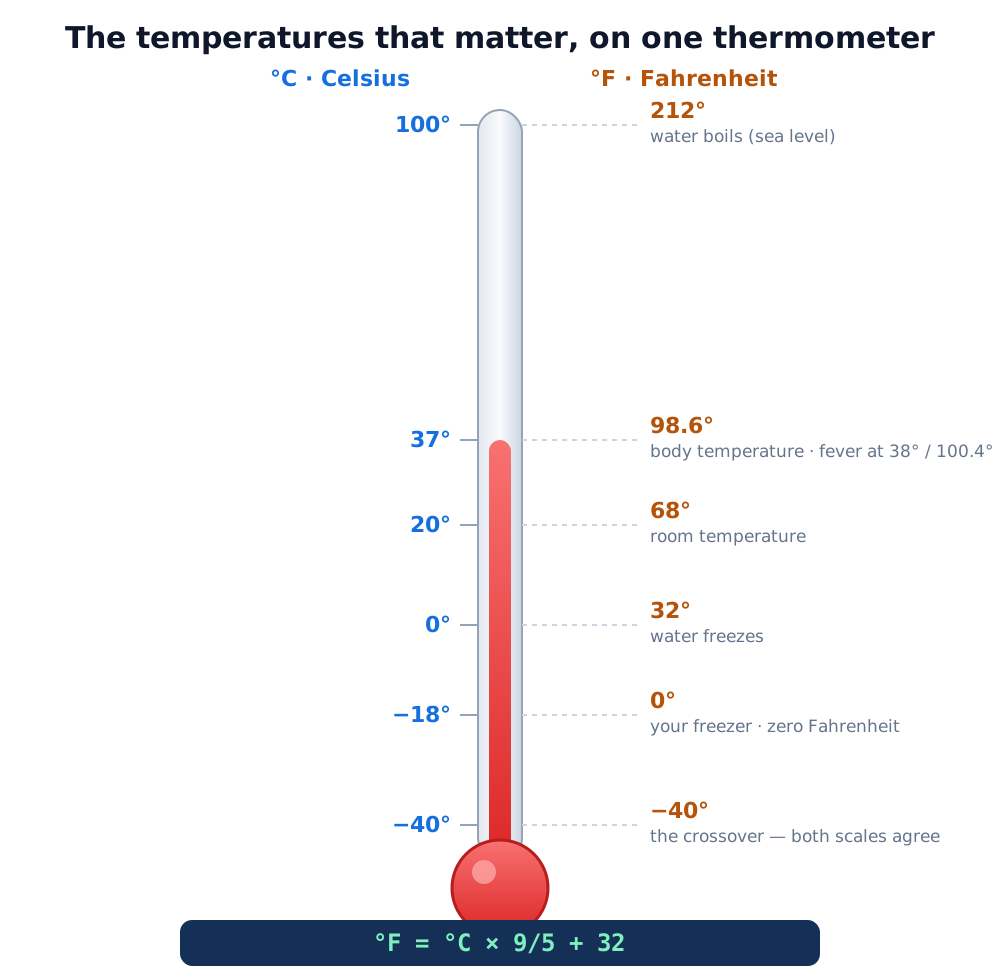
To convert Celsius to Fahrenheit, multiply by 9/5 (1.8) and add 32: °F = °C × 1.8 + 32. So 20 °C is 68 °F, body temperature of 37 °C is 98.6 °F, and water boils at 100 °C = 212 °F. For instant exact conversions with the working shown, use the Celsius to Fahrenheit converter. It runs entirely in your browser.
Why temperature needs a formula, not just a factor
Unlike weight or distance, the two temperature scales disagree about where zero is. Zero Celsius is water’s freezing point. Zero Fahrenheit is the coldest temperature Daniel Fahrenheit could reliably reproduce in 1724, an ice, water and ammonium-chloride brine mixture. Because the zeros don’t line up, converting takes two steps: scale the degree size (one Celsius degree spans exactly 1.8 Fahrenheit degrees) and shift by 32.
Worked examples, both directions:
- 25 °C → 25 × 1.8 = 45, + 32 = 77 °F
- 33 °C → 33 × 1.8 = 59.4, + 32 = 91.4 °F
- 77 °F → (77 − 32) × 5/9 = 25 °C, subtract 32 first
- 50 °F → (50 − 32) × 5/9 = 10 °C
The history: two scales, two centuries of coexistence
Daniel Gabriel Fahrenheit (1686-1736), inventor of the mercury thermometer, built his scale around three reproducible points: brine at 0°, water’s freezing point at 32°, and human body temperature at (originally) 96°. Recalibration after his death shifted body temperature to 98.6°.
Anders Celsius (1701-1744) proposed his hundred-step scale in 1742, upside down: 0° was boiling and 100° was freezing. Carl Linnaeus (of taxonomy fame) is generally credited with flipping it to the modern orientation in 1745. The scale was called centigrade until 1948, when the CGPM renamed it Celsius, partly honoring its author, partly avoiding a clash with the French angular unit “grade.”
The world then chose sides: as metrication swept the 20th century, virtually every country adopted Celsius. The US 1975 Metric Conversion Act made switching voluntary, and voluntary meant it never happened for weather. Today Fahrenheit remains the daily scale in the United States, the Bahamas, Belize, the Cayman Islands, Palau, Micronesia and (partially) Liberia.
📌 Citable fact One Celsius degree equals exactly 1.8 Fahrenheit degrees, and −40° is the unique temperature where both scales read the same number, provable by solving F = 1.8F + 32.
The anchor temperatures worth memorizing
| °C | °F | Meaning |
|---|---|---|
| −40 | −40 | the crossover, scales agree |
| −18 | 0 | your freezer (and zero Fahrenheit) |
| 0 | 32 | water freezes |
| 10 | 50 | cool day, light jacket |
| 20 | 68 | room temperature |
| 30 | 86 | hot day |
| 37 | 98.6 | body temperature (traditional average) |
| 100 | 212 | water boils at sea level |
| 180 | 356 | ”moderate oven”, metric recipes’ 350 °F |
Everything interpolates from these: 15 °C is “between light-jacket and room temp” (59 °F); 25 °C is “between room temp and hot” (77 °F).
The double-plus-30 mental trick (and exactly when it fails)
For weather-range temperatures:
- Double the Celsius: 16 → 32
- Add 30: 32 + 30 = 62 °F (exact: 60.8 °F)
The trick swaps ×1.8 for ×2 and +32 for +30, and the errors partially cancel, but only near the everyday range:
| Range | Trick error |
|---|---|
| 0-15 °C | ≤ 2 °F high |
| 15-25 °C | ≤ 1 °F either way |
| 25-35 °C | up to 3.5 °F high |
| 100 °C | 18 °F high |
| 200 °C (oven) | 38 °F high, do not use |
Reverse trick: subtract 30, then halve. 86 °F → 56 ÷ 2 = 28 °C (exact: 30 °C, the reverse version is rougher; for anything that matters, convert exactly).
Scenario: weather, travel and extremes
The packing heuristic in both scales: below 10 °C (50 °F) you want a real jacket; 10-20 °C (50-68 °F) is layers; 20-27 °C (68-80 °F) is shirt-sleeves; past 32 °C (90 °F) is genuinely hot; past 40 °C (104 °F) is heat-warning territory. Reference points travelers meet constantly: a European heatwave forecast of 35 °C means 95 °F; air-conditioning set to 24 °C is 75 °F; ski-resort −10 °C is 14 °F.
The record books, for scale:
| Record | °C | °F |
|---|---|---|
| Hottest air temperature (Death Valley, 1913) | 56.7 | 134.1 |
| Hottest in Europe (Sicily, 2021) | 48.8 | 119.8 |
| Coldest (Vostok Station, Antarctica, 1983) | −89.2 | −128.6 |
| Coldest inhabited place (Oymyakon, Russia) | −67.7 | −89.9 |
Climate reporting adds one more conversion worth knowing: the Paris Agreement’s 1.5 °C warming limit is a change of 2.7 °F, temperature differences convert with ×1.8 only, no +32 (offsets cancel when you subtract two temperatures).
Scenario: fever and body temperature
| °C | °F | Clinical meaning |
|---|---|---|
| 36.1-37.2 | 97.0-99.0 | normal range |
| 37.5-37.9 | 99.5-100.3 | low-grade elevation |
| 38.0 | 100.4 | fever threshold (CDC, fever definition, most hospitals) |
| 39.4 | 103.0 | high fever, seek advice |
| 40.0 | 104.0 | medical attention |
| 35.0 and below | 95.0 and below | hypothermia, emergency |
The famous 98.6 °F “normal” traces to Carl Wunderlich’s 1868 survey of 25,000 patients. A 2020 Stanford study published in eLife found the modern average is closer to 36.6 °C / 97.9 °F, humans have cooled slightly over 150 years (likely reduced chronic inflammation). Practical upshot: a reading below 98.6 isn’t “low”; the line that matters is 38.0 °C / 100.4 °F. Also note thermometer sites differ: ear and rectal read ~0.3-0.6 °C higher than oral; forehead strips read lower.
Scenario: ovens, baking and cooking temperatures
| °C | °F | Gas mark | Recipe language |
|---|---|---|---|
| 110 | 230 (→225) | ¼ | very slow / meringues |
| 140 | 284 (→275) | 1 | slow |
| 160 | 320 (→325) | 3 | low, rich fruit cakes |
| 180 | 356 (→350) | 4 | moderate, the default |
| 200 | 392 (→400) | 6 | hot, roasting |
| 220 | 428 (→425) | 7 | very hot, bread, pizza |
| 240 | 464 (→475) | 9 | maximum, pizza stones |
US dials move in 25 °F steps, hence the roundings; the 4-8 °F gap is smaller than most home ovens’ true calibration error, so follow the recipe’s rounded figure. Fan/convection ovens: reduce the stated temperature by ~20 °C (25 °F). Other kitchen anchors: water simmers ~85 °C (185 °F); sugar reaches “soft ball” at 113-116 °C (235-240 °F); deep-frying happens at 160-190 °C (320-375 °F); safe chicken internal temperature is 74 °C (165 °F).
💡 Tip Bookmark the converter with your value in the URL, lazytools.io/units/celsius-to-fahrenheit/?v=180 opens pre-filled at 180 °C, handy mid-recipe with flour on your hands.
Beyond Fahrenheit: Kelvin and Rankine
Science needs a scale starting at absolute zero, the complete absence of thermal energy at −273.15 °C / −459.67 °F:
- Kelvin (K): K = °C + 273.15. Same degree size as Celsius, no negative values, no degree symbol. Room temperature 25 °C = 298.15 K. The SI base unit, used across physics and chemistry.
- Rankine (°R): Fahrenheit’s absolute cousin (°R = °F + 459.67), surviving mainly in US aerospace and thermodynamics engineering.
Converters: Celsius to Kelvin · Kelvin to Fahrenheit · Fahrenheit to Kelvin
Common mistakes converting C to F
- Forgetting the +32. 20 °C × 1.8 = 36 is not the answer, the offset matters most at everyday temperatures.
- Using the weather trick on ovens, up to 40 °F off at baking temperatures (see the accuracy table above).
- Wrong order in reverse. °F → °C requires subtracting 32 first: (77 − 32) × 5/9 = 25 ✓, but 77 × 5/9 − 32 ≈ 10.8 ✗.
- Converting temperature differences with the full formula. A change of 5 °C is a change of 9 °F, multiply by 1.8 only; the +32 cancels between two readings.
- Trusting “normal is 98.6” too literally. Modern averages run lower; the clinical fever line is 100.4 °F / 38.0 °C.
Quick-reference chart: −40 °C to 250 °C
| °C | °F | °C | °F | |
|---|---|---|---|---|
| −40 | −40 | 37 | 98.6 | |
| −20 | −4 | 40 | 104 | |
| −10 | 14 | 50 | 122 | |
| 0 | 32 | 100 | 212 | |
| 5 | 41 | 150 | 302 | |
| 10 | 50 | 180 | 356 | |
| 15 | 59 | 200 | 392 | |
| 20 | 68 | 220 | 428 | |
| 25 | 77 | 230 | 446 | |
| 30 | 86 | 250 | 482 |
Quick summary
Multiply Celsius by 1.8 and add 32 to get Fahrenheit; subtract 32 first, then multiply by 5/9, to go back. Memorize the six anchors (0/32, 20/68, 37/98.6, 100/212, −18/0, −40/−40) and the double-plus-30 trick covers everyday weather, but never ovens or medicine, where the converter gives the exact figure.
All conversions use the exact defining formulas, verified against fixed reference points (0/32, 100/212, −40/−40) in our public test suite. Reverse tool: Fahrenheit to Celsius.
Frequently asked questions
What is the Celsius to Fahrenheit formula?
°F = (°C × 9/5) + 32. Multiply the Celsius temperature by 1.8, then add 32. Example: 25 °C × 1.8 = 45, + 32 = 77 °F.
What is 37 degrees Celsius in Fahrenheit?
37 °C is exactly 98.6 °F, the traditional average human body temperature. Modern studies put today's average closer to 36.6 °C (97.9 °F), so 98.6 shouldn't be treated as a strict personal baseline.
Is 38 degrees Celsius a fever?
Yes. 38 °C equals 100.4 °F, the standard medical threshold for fever used by the CDC and most hospitals. Between 37.5 and 38 °C is usually described as a low-grade elevation.
What is 180 C in Fahrenheit for baking?
180 °C is 356 °F. Recipes round it to 350 °F because oven dials use 25 °F steps, the 6 °F difference is smaller than a typical home oven's real-world accuracy.
Why do Celsius and Fahrenheit meet at -40 degrees?
Setting C = F in the conversion equation gives F = 1.8F + 32, which solves to F = −40. It's the only temperature where both scales show the same number.
Which countries still use Fahrenheit?
The United States plus a handful of associated territories and small nations: the Bahamas, Belize, the Cayman Islands, Palau, Micronesia and Liberia (partially). Every other country reports weather in Celsius.
Is centigrade the same as Celsius?
Yes. The scale was called centigrade ('hundred steps') from 1743 until 1948, when it was officially renamed Celsius after Anders Celsius, partly to avoid confusion with the French angle unit 'grade'.
What are the hottest and coldest temperatures ever recorded?
Hottest reliably recorded air temperature: 56.7 °C (134 °F) at Furnace Creek, Death Valley, on July 10, 1913. Coldest: −89.2 °C (−128.6 °F) at Vostok Station, Antarctica, on July 21, 1983.