Why F=ma Trips Up 60% of Physics Students — And How One Calculator Fixes It
F=ma is deceptively simple — yet unit confusion, sign errors, and multi-body problems trip up students and engineers alike. This guide explains exactly how force works, where people go wrong, and how our free calculator eliminates the arithmetic so you can focus on the physics.
What Is Force and Why Does It Matter in Physics?
Force is one of the most fundamental concepts in physics. Specifically, force is defined as any push or pull that causes an object to change its motion. Furthermore, understanding force is essential for engineering, physics education, and countless real-world applications. Notably, every interaction in the universe involves forces—from gravity pulling you toward Earth to friction slowing your car.
The mathematical relationship between force, mass, and acceleration is described by Newton's Second Law of Motion. Therefore, this single equation unlocks understanding of how the physical world works. Moreover, this principle forms the foundation of classical mechanics and is used daily in engineering, physics education, and scientific research. Consequently, mastering force calculations is essential for students and professionals alike.
⚙️ Understanding Newton's Second Law: F=ma
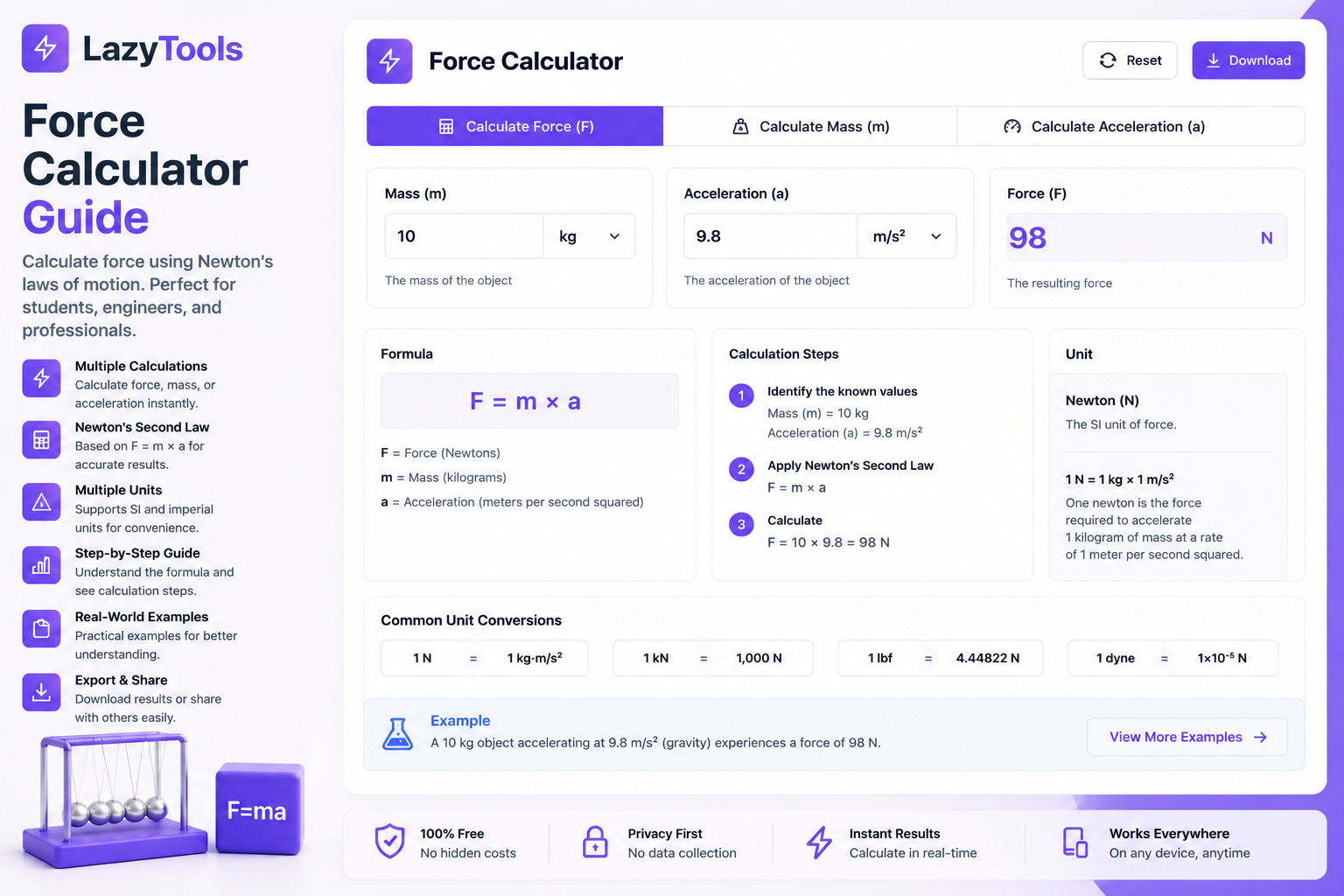
Newton's Second Law states that force equals mass multiplied by acceleration. Additionally, this relationship can be expressed mathematically as F = m × a, where F is force measured in Newtons (N), m is mass measured in kilograms (kg), and a is acceleration measured in meters per second squared (m/s²). Importantly, this elegant equation reveals fundamental truths about physics.
This equation reveals a profound truth: the more massive an object is, the more force is needed to accelerate it. Conversely, greater acceleration requires proportionally greater force. Therefore, if you double the mass or double the acceleration, you double the required force. Furthermore, this linear relationship enables precise calculations and predictions.
📏 Units and Measurements
Force is measured in Newtons (N), named after Sir Isaac Newton. Importantly, one Newton is defined as the force required to accelerate one kilogram of mass at one meter per second squared (1 N = 1 kg·m/s²). Additionally, other force units include pounds-force (lbf), where 1 lbf ≈ 4.45 N, and dyne, where 1 N = 100,000 dyne. Furthermore, understanding these conversions is essential for engineering applications.
Different fields use different units—aerospace engineers might use pounds-force, while physicists use Newtons. Consequently, knowing how to convert between units ensures accurate calculations. Moreover, this understanding is critical for engineers working on international projects or collaborating across disciplines. Therefore, unit conversion skills are a must for physics professionals.
The Evolution of Force: From Ancient Philosophy to Modern Physics
The concept of force has a rich history spanning thousands of years. In fact, ancient philosophers like Aristotle theorized about motion and force, though their understanding was largely incorrect. Subsequently, during the Renaissance, thinkers like Galileo began to challenge these ancient ideas through experimentation and observation. Importantly, this shift from theory to empirical evidence revolutionized scientific thinking.
The breakthrough came in 1687 when Sir Isaac Newton published his groundbreaking work "Philosophiæ Naturalis Principia Mathematica" (Mathematical Principles of Natural Philosophy), commonly known as the "Principia." Specifically, Newton formalized three laws of motion that revolutionized physics. Moreover, his Second Law of Motion (F=ma) became the cornerstone of classical mechanics. Furthermore, this single equation has remained relevant for over 330 years.
For over three centuries, Newton's laws governed physics education and engineering applications. Additionally, these laws remain the primary framework for most practical applications today. Notably, even in modern physics with quantum mechanics and relativity, Newton's laws apply accurately to everyday objects and macroscopic phenomena. Therefore, understanding Newtonian force calculations remains essential for students, engineers, and scientists. Consequently, Newton's legacy endures as one of humanity's greatest scientific achievements.
How to Use Our Force Calculator: Complete Step-by-Step Guide
Our free force calculator simplifies F=ma calculations into an intuitive three-step process. First, enter the mass of the object. Then, input the acceleration. Finally, the calculator instantly displays the resulting force. Additionally, it provides conversions to other force units.
💡 Practical Example
Consider a car weighing 1,500 kg accelerating at 5 m/s². Using F = m × a, the force is: F = 1,500 kg × 5 m/s² = 7,500 Newtons (or approximately 1,687 pounds-force). Therefore, the engine must produce this much force to achieve this acceleration. Importantly, using our calculator makes this instant and effortless. Furthermore, you can quickly experiment with different values to understand relationships.
⚡ Calculate Force Instantly
Physics calculations made simple. Completely free, no signup required.
Essential Force Calculator Features for Physics and Engineering
Force Conversions and Common Physics Constants Reference Table
| Unit | Abbreviation | To Newton (N) | Common Use |
|---|---|---|---|
| Newton | N | 1.0 | SI unit, physics |
| Pound-force | lbf | 4.448222 | Engineering, US |
| Kilogram-force | kgf | 9.80665 | Engineering, metric |
| Dyne | dyn | 0.00001 | CGS system |
| Ounce-force | ozf | 0.2780139 | Small forces |
| Poundal | pdl | 0.138255 | FPS system |
Common Physics Constants:
| Constant | Value | Description |
|---|---|---|
| Gravity (Earth) | 9.81 m/s² | Standard gravitational acceleration |
| Gravity (Moon) | 1.62 m/s² | Moon's surface gravity |
| Gravity (Mars) | 3.71 m/s² | Mars surface gravity |
| Speed of light | 299,792,458 m/s | Maximum speed in universe |
| Gravitational constant | 6.674×10⁻¹¹ N⋅m²/kg² | Universal gravity constant |
Real-World Force Applications in Engineering and Physics
🚗 Automotive Engineering
Vehicle engineers use force calculations to determine engine power requirements, braking distances, and acceleration performance. Specifically, calculating force from mass and acceleration helps design vehicles that meet performance specifications. Moreover, understanding force enables engineers to predict how vehicles behave on slopes, around curves, and during emergency maneuvers. Furthermore, this knowledge directly impacts vehicle safety and reliability.
🏗️ Structural Engineering
Bridge builders and building engineers calculate forces to ensure structures can support loads safely. Furthermore, they analyze forces from gravity, wind, earthquakes, and dynamic loads. Therefore, force calculations are fundamental to structural safety—incorrect calculations can result in catastrophic failures. Consequently, engineers must apply rigorous force analysis to every structural design.
🚀 Aerospace Engineering
Aircraft and spacecraft designers use force calculations extensively. Additionally, they calculate thrust requirements, aerodynamic forces, and g-forces experienced during maneuvers. Moreover, understanding force is essential for designing safe and efficient aircraft and space vehicles. Specifically, slight miscalculations in force analysis can compromise mission success or flight safety. Consequently, aerospace engineers employ sophisticated tools for precision force calculations.
⚡ Physics Education
Students worldwide learn Newton's laws and force calculations in physics classes. Furthermore, mastering force concepts builds understanding of mechanics that applies to countless career fields. Therefore, force calculations are a cornerstone of physics education globally. Importantly, understanding force fundamentals prepares students for advanced physics and engineering coursework. Consequently, force is one of the most important foundational concepts in science education.
🎾 Sports Physics
Sports scientists analyze forces in athletic movements—baseball pitches, golf swings, and basketball shots. Additionally, understanding force helps athletes improve performance and prevents injuries. Consequently, force analysis bridges physics and sports improvement. Specifically, professional athletes work with coaches and physicists to optimize force application. Moreover, force analysis provides measurable feedback for performance improvement.
How AI Enhances Physics Calculations and Problem-Solving
🧠 Intelligent Problem Interpretation
Modern AI systems can analyze physics problems written in natural language and automatically identify what calculation is needed. Specifically, if you describe a scenario, AI can determine whether you need to calculate force, mass, or acceleration. Furthermore, this makes physics tools accessible to students who aren't yet comfortable with formulas. Additionally, natural language interfaces reduce barriers to physics learning.
📊 Multi-Step Problem Solving
AI-powered physics tutors can solve complex, multi-step problems that require multiple force calculations. Additionally, they provide detailed explanations of each step, building conceptual understanding. Moreover, this is invaluable for students struggling to connect formulas to real-world scenarios. Specifically, step-by-step solutions show exactly how to approach problems. Consequently, students develop problem-solving skills alongside calculating techniques.
🔬 Real-World Scenario Modeling
Advanced AI systems can simulate complex force scenarios—vehicle crashes, structural loads, fluid dynamics. Furthermore, these simulations help engineers test designs virtually before building physical prototypes. Consequently, AI-powered simulation accelerates engineering development and reduces costs. Specifically, virtual testing identifies design flaws before expensive physical prototypes are built. Moreover, simulation allows exploration of scenarios too expensive or dangerous for physical testing.
📈 Predictive Analytics for Engineering
Machine learning models trained on historical engineering data can predict how structures will perform under specific forces. Additionally, these models identify patterns humans might miss. Therefore, AI enhances traditional force analysis with predictive capabilities. Specifically, ML models improve prediction accuracy beyond theoretical calculations. Importantly, combining physics theory with machine learning predictions creates superior design decisions.
🎓 Adaptive Learning Systems
AI tutoring systems adapt to student understanding, adjusting difficulty and approach based on performance. Furthermore, they provide personalized practice problems targeting specific weaknesses. Consequently, students master force concepts more effectively with AI support. Specifically, adaptive systems identify knowledge gaps and provide targeted remediation. Moreover, personalized learning increases student engagement and confidence.
Related Physics Concepts You Should Understand
⚖️ Newton's Three Laws of Motion
Newton's laws form the foundation of classical mechanics. Specifically: First Law states an object in motion stays in motion unless a force acts on it. Second Law (F=ma) relates force to acceleration. Third Law states for every action, there's an equal and opposite reaction. Therefore, understanding force requires understanding all three laws together. Furthermore, these three laws are interconnected and form a unified theory of motion.
⚙️ Work and Energy
Work is force applied over distance (W = F × d). Additionally, power is work divided by time. Furthermore, understanding the relationship between force, work, and energy is essential for engineering and physics. Therefore, force calculations often lead to work and energy calculations. Specifically, engineers use force analysis to determine work requirements for machines and devices. Consequently, force, work, and energy form an interconnected system of concepts.
🔄 Friction and Resistance
Friction is a force opposing motion between surfaces. Additionally, air resistance and water resistance are similar forces. Furthermore, these opposing forces must be considered when calculating net force. Therefore, realistic force calculations must account for friction and resistance. Specifically, ignoring friction leads to inaccurate predictions in real-world applications. Importantly, friction is the force that makes Newton's Second Law truly relevant to real objects.
📐 Momentum and Impulse
Momentum is mass times velocity (p = mv). Impulse is force times time (J = F × t). Furthermore, impulse changes momentum. Therefore, force, momentum, and impulse are interconnected concepts essential for collision analysis and impact calculations. Specifically, understanding these relationships is critical for vehicle safety design. Additionally, collision analysis demonstrates practical force applications. Consequently, these concepts bridge theoretical physics and real-world engineering.
Five Force Calculation Mistakes That Derail Physics Students
Understanding F=ma is straightforward in isolation — yet four out of five physics exam errors on force problems come from the same five recurring mistakes. Identifying them before they become habits saves significant revision time later.
❌ Mistake 1: Confusing Mass and Weight
Mass is the amount of matter in an object, measured in kilograms. Weight is the gravitational force acting on that mass, measured in Newtons. Specifically, a 70 kg person has a weight of 70 × 9.81 = 686.7 N on Earth — but the same person on the Moon weighs only 70 × 1.62 = 113.4 N, while their mass remains 70 kg throughout. Therefore, when an F=ma problem gives you "a 70 kg object," use 70 kg as mass — never convert it to Newtons as a first step.
❌ Mistake 2: Forgetting Net Force
Newton's Second Law applies to net force — the vector sum of all forces acting on an object. Consequently, if a 10 N force pushes right and a 4 N friction force pushes left, the net force is 6 N right, not 10 N. Furthermore, students working with inclined planes frequently forget to resolve gravity into parallel and perpendicular components before applying F=ma. Our calculator solves for single force values; always calculate net force first when multiple forces are present.
❌ Mistake 3: Using the Wrong Units
F=ma only produces Newtons when mass is in kilograms and acceleration is in metres per second squared. Mixing imperial and metric units — for example, pounds and metres per second squared — produces meaningless results. Specifically, 1 pound-force = 4.448 Newtons, and 1 kg = 2.205 pounds-mass. Moreover, our calculator handles unit conversion automatically, but understanding the underlying relationships prevents errors when working problems by hand.
❌ Mistake 4: Ignoring Direction (Sign Errors)
Force is a vector quantity — direction matters. A deceleration is a negative acceleration, and a force opposing motion is negative. Therefore, a car braking from 30 m/s to zero over 5 seconds has an acceleration of -6 m/s², and the braking force on a 1,200 kg car is F = 1,200 × (-6) = -7,200 N. The negative sign indicates the force opposes the direction of motion. Consequently, sign errors are the single most common cause of technically correct arithmetic producing a physically wrong answer.
❌ Mistake 5: Applying F=ma to Non-Inertial Frames Without Adjustment
Newton's Second Law applies to inertial reference frames — frames that are not themselves accelerating. When you are inside an accelerating lift, you are in a non-inertial frame. Specifically, a bathroom scale in an accelerating lift does not read your true weight; it reads your apparent weight, which includes the lift's acceleration. Advanced physics courses address this through pseudo-forces, but for most F=ma problems, the important rule is: define your reference frame as stationary and apply forces consistently from that frame.
What People Search For: Force and Physics Questions Answered
❓ "What is force in physics?"
Force is a push or pull that causes an object to change motion. Specifically, it's measured in Newtons and calculated using Newton's Second Law: F=ma. Furthermore, every physical interaction involves forces—gravity, friction, magnetic attraction, and tension are all forces acting on objects around us. Additionally, understanding force is essential for comprehending how the physical world works.
❓ "How do you calculate force?"
Force is calculated by multiplying mass by acceleration: F = m × a. Additionally, if you know force and mass, you can solve for acceleration. Similarly, if you know force and acceleration, you can solve for mass. Therefore, our calculator works for all three scenarios. Specifically, simply input any two variables and the calculator provides the third.
❓ "What is a Newton in physics?"
A Newton (N) is the SI unit of force. Specifically, one Newton is the force needed to accelerate one kilogram at one meter per second squared. Furthermore, about 4.45 Newtons equal one pound-force (lbf). Therefore, understanding Newtons is essential for working with force in science and engineering. Additionally, familiarity with Newtons makes physics problems easier to understand and solve.
❓ "What are examples of force in real life?"
Gravity pulling objects downward is a force. Car engines produce force to accelerate vehicles. Brakes apply force to decelerate. Magnetic attraction is force. Tension in ropes, cables, and chains is force. Wind exerting pressure is force. Furthermore, every motion you observe involves force. Specifically, force is everywhere in the physical world. Consequently, recognizing forces in daily life helps understand physics principles.
❓ "How does force relate to acceleration?"
Newton's Second Law directly relates force to acceleration: F=ma. Specifically, doubling force doubles acceleration if mass stays constant. Conversely, doubling mass halves acceleration if force stays constant. Therefore, force and acceleration are directly proportional when mass is fixed. Furthermore, this proportional relationship enables precise predictions and calculations. Importantly, this fundamental relationship appears throughout physics and engineering.
Authoritative Physics and Engineering Resources
📚 Educational Resources
- Khan Academy Physics — Free comprehensive physics courses covering Newton's laws
- HyperPhysics — Interactive physics tutorials and explanations
- PhET Simulations — Interactive physics simulations from University of Colorado
🔬 Scientific Organizations
- American Physical Society — Leading physics organization and research resource
- ASME (American Society of Mechanical Engineers) — Engineering standards and resources
- IEEE — Engineering and technology standards
💻 Calculation Tools
- Wolfram Alpha — Computational knowledge engine for physics calculations
- Desmos — Graphing and physics visualization tool
- GeoGebra — Interactive geometry and physics modeling