Master Morse Code — Convert Text in Real-Time
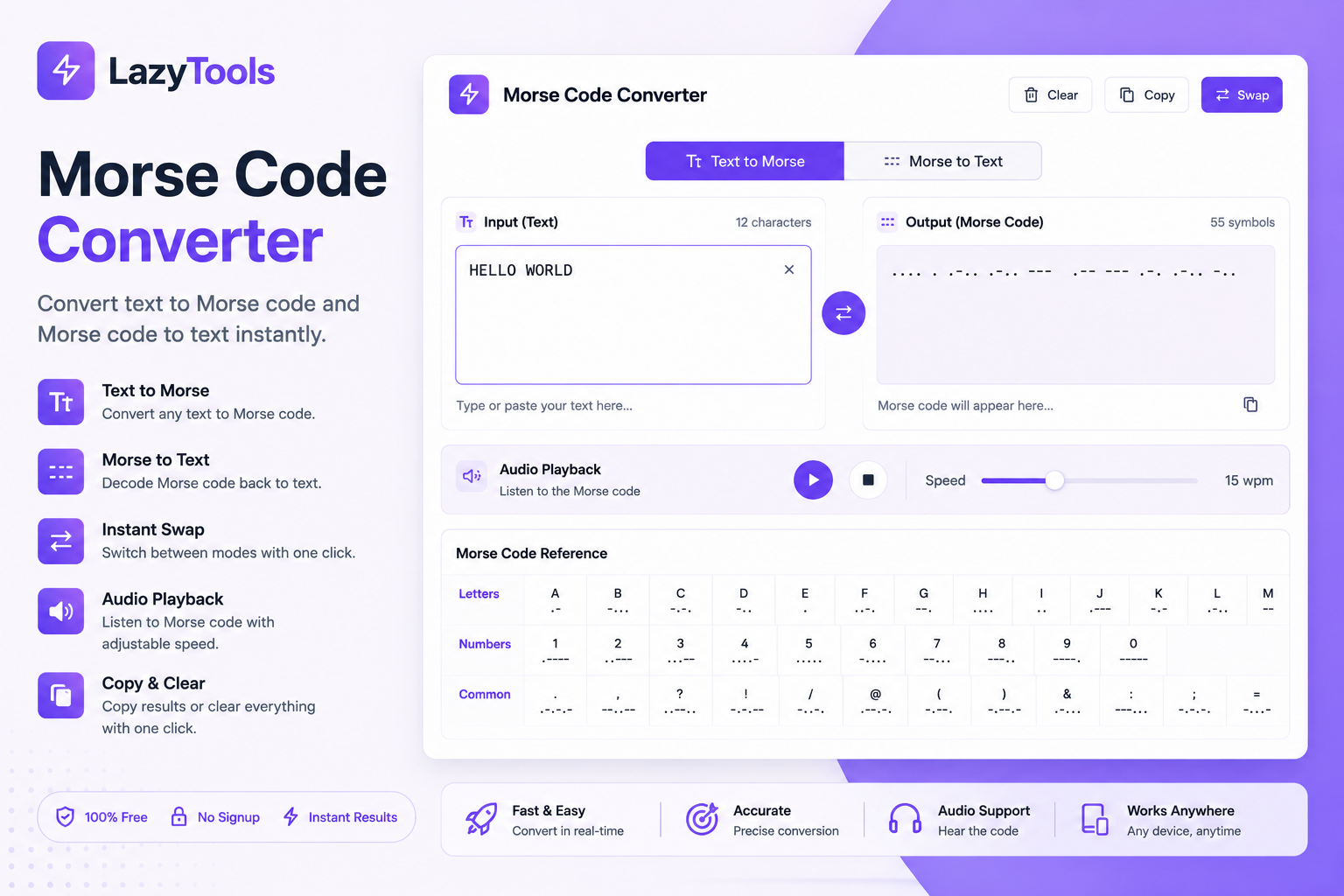
Undoubtedly, discover the fascinating world of morse code with our free, easy-to-use translator. Convert text to morse instantly, hear authentic audio, and master this timeless communication skill. Whether you're an amateur radio enthusiast, history buff, or simply curious, this guide is for you.
What Is Morse Code & Why Learn It?
🔤 The Basics: Dots, Dashes & Signals
Morse code is an ingenious system. In fact, it was created by Samuel Morse and Alfred Veil in the 1830s and converts text characters into sequences of short and long signals. These signals—called "dots" (or "dits") and "dashes" (or "dahs")—have fascinated operators for nearly two centuries. Moreover, what makes morse code truly remarkable is its simplicity: just two symbols encode all 26 letters, 10 numerals, and common punctuation marks.
The genius lies in flexibility. In particular, you can send a message via radio waves, flashing lights, tapping sounds, or even vibrations. This universality made morse code the communication backbone of our world during the telegraph era, maritime navigation, and military operations.
🎯 Why People Still Learn Morse Code Today
Interestingly, in our digital age, morse code might seem obsolete. However, thousands of enthusiasts worldwide prove otherwise. Amateur radio operators ("hams") still use it for competitions, emergency communication, and the pure joy of mastering a skill that transcends technology.
Beyond entertainment, educators value morse code for teaching binary thinking and communication fundamentals. Furthermore, during emergencies when modern infrastructure fails, morse code remains one of the most reliable communication methods available. Consequently, this ancient skill continues to hold practical value in our modern world.
How to Use Our Morse Code Converter
Getting started is incredibly simple. To begin, notably, there's no signup, no complex settings, just intuitive design. Here's your step-by-step guide to master the basics:
💡 Ready to Start Converting?
Stop reading and start using. Real-time translation, audio playback, completely free.
Key Features That Make This Tool Special
We've carefully designed this morse code converter with serious learners and enthusiasts in mind. In summary, here's what sets it apart from other options available:
Your Complete Learning Path
Mastering morse code is a journey divided into three distinct phases. Each phase builds progressively on the previous one to develop both speed and fluency:
🌱 Beginner Phase (Start Here): Foundation Building (Weeks 1-2)
To get started, focus on the most common letters: E (single dot), T (single dash), A (dot-dash), and I (two dots). These frequently-used characters account for 70% of English text. Therefore, mastering them first accelerates your progress dramatically.
After that, use our tool to repeatedly convert simple words while listening to the audio patterns. Moreover, consider learning the phonetic pronunciation: "E" is "dit," "T" is "dah," "A" is "dit-dah." This auditory association speeds recognition significantly.
📈 Intermediate Phase: Pattern Recognition (Weeks 3-6)
In the next stage, graduate to complete character sets: all letters and numbers. Clearly, at this stage, you'll start seeing patterns. For instance, notice how S (three dots) flows into H (four dots). Similarly, observe how numbers follow logical patterns (5 is five dots, 6 is four dots and a dash, etc.).
Importantly, practice at 5-10 Words Per Minute using the audio feature. Meanwhile, write down characters as you hear them to develop muscle memory. As a result, your recognition speed will improve dramatically during this phase.
🚀 Advanced Phase: Speed & Fluency (Weeks 7-12)
Ultimately, push toward 13-20 WPM. At this point, you stop thinking about individual dots and dashes and start recognizing entire character patterns instantly. As a result, this is where morse code becomes automatic and fun.
Furthermore, consider joining online ham radio communities or local radio clubs for practical experience. In addition to practice, community engagement provides motivation and real-world application opportunities. As a result, your skills will develop faster through peer interaction.
Quick Reference Guide
Below is a comprehensive quick reference table. Importantly, you can print this table or bookmark it for quick access while practicing:
| Letter | Morse | Letter | Morse | Letter | Morse |
|---|---|---|---|---|---|
| A | • – | J | • – – – | S | • • • |
| B | – • • • | K | – • – | T | – |
| C | – • – • | L | • – • • | U | • • – |
| D | – • • | M | – – | V | • • • – |
| E | • | N | – • | W | • – – |
| F | • • – • | O | – – – | X | – • • – |
| G | – – • | P | • – – • | Y | – • – – |
| H | • • • • | Q | – – • – | Z | – – • • |
Pro tip: Notably, numbers follow a pattern—five dots (5), four dots + dash (6), three dots + two dashes (7), etc. Learning this pattern saves tremendous memorization effort.
Morse Code in the Modern World
Despite rapid technological advances, morse code continues to serve important roles. As a matter of fact, it plays an important role in several critical areas. The following sections explore how this timeless technology remains relevant today:
📻 Amateur Radio & Emergency Communication & Ham Operators
Indeed, the ham radio community remains the largest keeper of morse code traditions. Thousands of licensed operators worldwide use morse code daily for pleasure, competition, and emergency communication.
Moreover, major contests like the ARRL contests attract hundreds of competitors transmitting at remarkable speeds. Importantly, during natural disasters when cell networks and internet fail, ham radio operators provide critical emergency communication—often using morse code for its reliability.
🚢 Maritime, Aviation & Safety & Aviation Safety
Significantly, modern ships and aircraft still maintain morse code capabilities as backup communication systems. The famous SOS distress signal (… — …) remains instantly recognized worldwide.
Importantly, international maritime law requires certain vessels to maintain morse code equipment for emergency situations. Consequently, this vital skill never becomes completely obsolete. Additionally, aviation authorities recognize morse code's value for critical communications.
🎖️ Military Applications
Essentially, military branches globally continue training personnel in morse code. Its reliability in low-bandwidth, harsh environments makes it invaluable for secure communications.
Furthermore, morse code requires less power than voice communication. Therefore, it's essential in field operations where resources are limited. In addition, military strategists value its encryption-resistant properties in tactical situations.
Helpful Resources & References
To deepen your morse code knowledge, we've compiled a list of authoritative resources and organizations. These links provide valuable information for learners and enthusiasts alike:
📡 Amateur Radio Organizations
Importantly, these organizations maintain the largest communities of morse code operators worldwide. They offer competitions, certifications, and learning materials:
- → ARRL (American Radio Relay League) - The largest amateur radio organization in the US, offering contests, exams, and educational resources.
- → IARU (International Amateur Radio Union) - International federation coordinating amateur radio activities globally.
- → RSGB (Radio Society of Great Britain) - UK's national amateur radio society with resources and licensing information.
🎓 Learning & Training Resources
Additionally, these platforms offer structured morse code training programs and interactive learning tools:
- → Learn CW Online (LCWO) - Free interactive platform for learning morse code with lessons and practice exercises.
- → Morse Code World - Comprehensive resource with training methods, history, and practice tools.
- → FCC Amateur Radio Information - Official US Federal Communications Commission resources for licensing and regulations.
📚 Historical & Reference Materials
Furthermore, explore the rich history and technical aspects of morse code through these academic and historical sources:
- → Wikipedia - Morse Code - Comprehensive overview of morse code history, variants, and applications.
- → Britannica - Morse Code Encyclopedia - Encyclopedia entry covering morse code development and significance.
- → Maritime Morse Code Archives - Historical information about morse code use in maritime communication.
🔊 Practice & Software Tools
Notably, these tools and applications help you practice morse code efficiently:
- → Just Learn Morse Code - Beginner-friendly web application with audio training and progress tracking.
- → ITU Morse Code Standard - Official International Telecommunication Union specification and recommendations.
- → Morse Code Rocks - Interactive web tool for learning and practicing morse code with gamification.
Disclaimer: These resources are provided for informational purposes. We recommend verifying current information directly with the official sources, as websites and regulations may change. Our tool is independent and not affiliated with these organizations.
Frequently Asked Questions
Learning & Getting Started
Technical & Usage Questions
Related Tools to Enhance Your Learning
To further your learning, explore these complementary LazyTools: