When Cell Networks Fail, Morse Code Still Gets Through — Here's How It Works
Morse code has transmitted distress signals, military orders, and ham radio contacts for 190 years — because dots and dashes survive when voice cannot. This guide explains exactly how the system works, why over 750,000 licensed ham radio operators still use it daily, and how our free converter lets you translate any text to Morse instantly with audio playback.
What Is Morse Code and Why Does It Still Matter in 2026?
Morse code is a character encoding system that represents letters and numbers as sequences of short signals (dots) and long signals (dashes), transmittable by radio wave, light pulse, or sound. Samuel Morse and Alfred Vail developed the system in 1836 specifically to work over telegraph wires — a medium that could only distinguish signal or no signal, nothing more. That binary constraint produced an encoding system so efficient that it outlasted the telegraph by nearly two centuries.
Furthermore, what makes Morse code uniquely durable is that it requires no digital infrastructure. Specifically, a signal sent at 5 watts of radio power in Morse can cross an ocean, whereas voice transmission at the same power often cannot. Consequently, Morse code remains the official fallback communication protocol in maritime distress situations under international law, and it is the foundation of the ham radio licence in many countries including the United States, United Kingdom, and Japan.
🔤 The Encoding System: Dots, Dashes and Timing
Each Morse code character is defined by a specific pattern of dots and dashes. Additionally, timing is equally important: a dot lasts one unit, a dash lasts three units, the gap between elements within a character is one unit, the gap between characters is three units, and the gap between words is seven units. Therefore, Morse code is not simply a dot-dash alphabet — it is a precisely timed rhythm that experienced operators read as sound patterns, not individual symbols.
🎯 Who Uses Morse Code Today
Notably, over 750,000 licensed amateur radio operators hold Morse-capable licences globally. Moreover, armed forces in over 40 countries include Morse code in at least some signals training. Additionally, ARRL (American Radio Relay League) contests attract thousands of operators transmitting at speeds exceeding 30 words per minute. Furthermore, accessibility technology uses Morse input for people with severe motor disabilities — a single switch can generate any character. Consequently, Morse code has found entirely new user communities it was never originally designed for.
How to Use the Morse Code Converter: Three Steps to Your First Translation
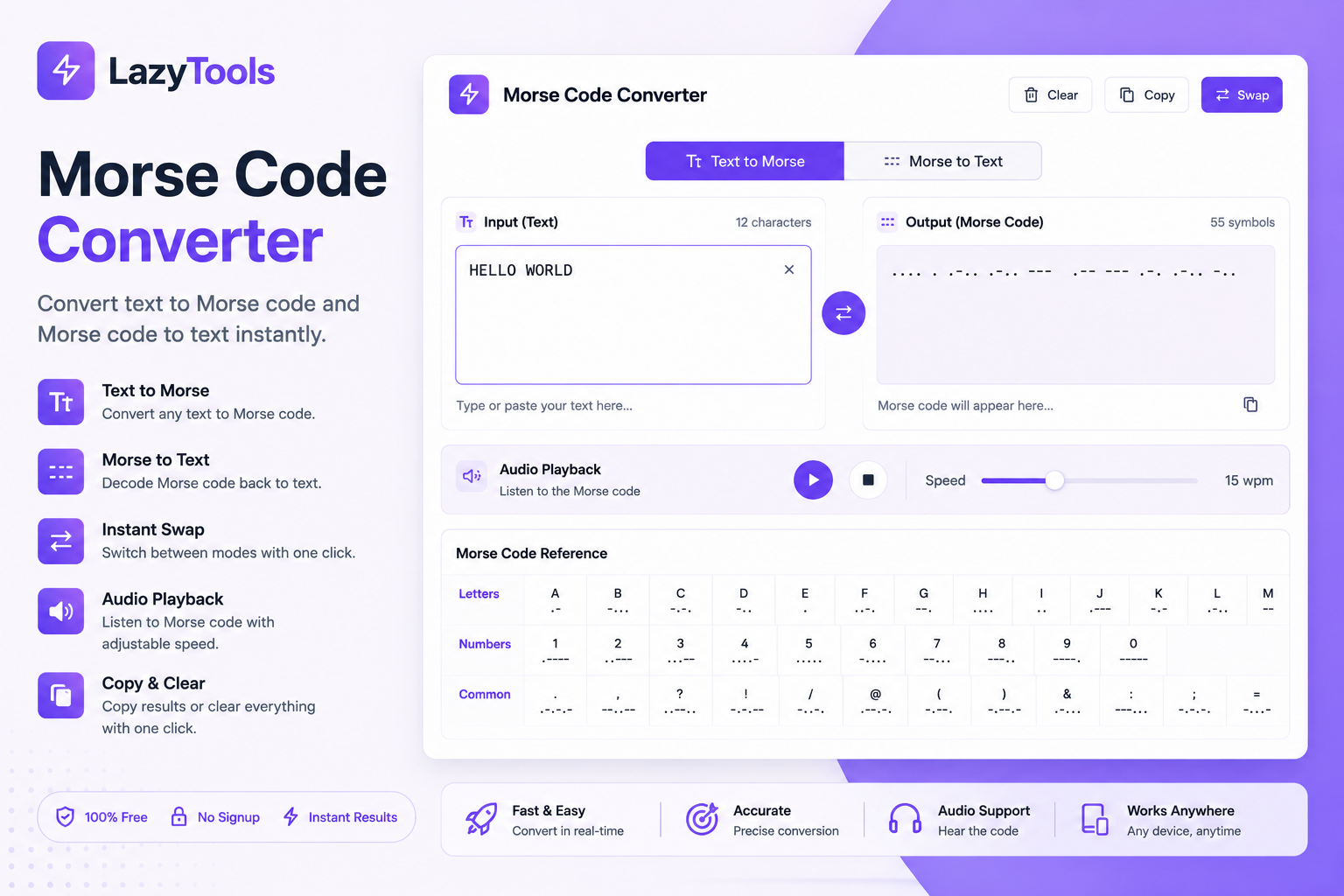
The converter translates any text to Morse code in real time — no signup, no settings, no delay. Type a letter and the Morse equivalent appears immediately alongside audio playback at adjustable speed. Here is the exact three-step process:
💡 Ready to Start Converting?
Stop reading and start using. Real-time translation, audio playback, completely free.
Key Features That Make This Tool Special
We've carefully designed this morse code converter with serious learners and enthusiasts in mind. In summary, here's what sets it apart from other options available:
Your Complete Learning Path
Mastering morse code is a journey divided into three distinct phases. Each phase builds progressively on the previous one to develop both speed and fluency:
🌱 Beginner Phase (Start Here): Foundation Building (Weeks 1-2)
To get started, focus on the most common letters: E (single dot), T (single dash), A (dot-dash), and I (two dots). These frequently-used characters account for 70% of English text. Therefore, mastering them first accelerates your progress dramatically.
After that, use our tool to repeatedly convert simple words while listening to the audio patterns. Moreover, consider learning the phonetic pronunciation: "E" is "dit," "T" is "dah," "A" is "dit-dah." This auditory association speeds recognition significantly.
📈 Intermediate Phase: Pattern Recognition (Weeks 3-6)
In the next stage, graduate to complete character sets: all letters and numbers. Clearly, at this stage, you'll start seeing patterns. For instance, notice how S (three dots) flows into H (four dots). Similarly, observe how numbers follow logical patterns (5 is five dots, 6 is four dots and a dash, etc.).
Importantly, practice at 5-10 Words Per Minute using the audio feature. Meanwhile, write down characters as you hear them to develop muscle memory. As a result, your recognition speed will improve dramatically during this phase.
🚀 Advanced Phase: Speed & Fluency (Weeks 7-12)
Ultimately, push toward 13-20 WPM. At this point, you stop thinking about individual dots and dashes and start recognizing entire character patterns instantly. As a result, this is where morse code becomes automatic and fun.
Furthermore, consider joining online ham radio communities or local radio clubs for practical experience. In addition to practice, community engagement provides motivation and real-world application opportunities. As a result, your skills will develop faster through peer interaction.
Quick Reference Guide
Below is a comprehensive quick reference table. Importantly, you can print this table or bookmark it for quick access while practicing:
| Letter | Morse | Letter | Morse | Letter | Morse |
|---|---|---|---|---|---|
| A | • – | J | • – – – | S | • • • |
| B | – • • • | K | – • – | T | – |
| C | – • – • | L | • – • • | U | • • – |
| D | – • • | M | – – | V | • • • – |
| E | • | N | – • | W | • – – |
| F | • • – • | O | – – – | X | – • • – |
| G | – – • | P | • – – • | Y | – • – – |
| H | • • • • | Q | – – • – | Z | – – • • |
Pro tip: Notably, numbers follow a pattern—five dots (5), four dots + dash (6), three dots + two dashes (7), etc. Learning this pattern saves tremendous memorization effort.
Morse Code in the Modern World
Despite rapid technological advances, morse code continues to serve important roles. As a matter of fact, it plays an important role in several critical areas. The following sections explore how this timeless technology remains relevant today:
📻 Amateur Radio & Emergency Communication
The ham radio community remains the largest active user base for Morse code. Thousands of licensed operators worldwide use Morse code daily for pleasure, competition, and emergency communication. Moreover, major contests like the ARRL CW contests attract hundreds of competitors transmitting at remarkable speeds exceeding 30 words per minute. Importantly, during natural disasters when cell networks and internet infrastructure fail, ham radio operators provide critical emergency communication — often using Morse code specifically because of its reliability at low signal strength.
🚢 Maritime and Aviation Safety
Modern ships and aircraft still maintain Morse code capabilities as legally required backup communication. The SOS distress signal (... --- ...) remains internationally recognised under ITU Radio Regulation Article 31, which designates 500 kHz as an international Morse distress frequency that all maritime stations must monitor. Consequently, any vessel in distress can signal SOS in Morse code and reach stations worldwide, regardless of whether voice or digital infrastructure is functioning.
Importantly, international maritime law requires certain vessel classes to maintain Morse-capable radio equipment for emergency situations. Furthermore, the International Maritime Organization (IMO) recognises Morse visual signalling — using light rather than radio — as a mandatory distress method under SOLAS (Safety of Life at Sea) conventions. Consequently, this vital skill remains embedded in maritime law and is unlikely to become fully obsolete.
🎖️ Military and Accessibility Applications
Military branches in over 40 countries continue training signals personnel in Morse code. Specifically, Morse code requires approximately 17 dB less signal strength than voice communication for equivalent intelligibility, making it essential in field operations where power is scarce and radio detection by adversaries must be minimised. Furthermore, military strategists value Morse for its resilience to jamming in certain frequency ranges.
Additionally, assistive technology developers have adapted Morse code as an input method for people with severe motor disabilities, enabling full keyboard control from a single switch or eye-blink sensor. As a result, Morse code has found entirely new relevance in accessibility technology — a use case Samuel Morse could never have anticipated in 1836.
How AI and Machine Learning Are Transforming Morse Code Learning in 2026
Artificial intelligence has fundamentally changed how people learn Morse code. Traditional methods required rote memorisation of dot-dash patterns for each character. Today, machine learning systems train on how individual learners make errors, then adapt practice sequences in real time to close specific gaps. Consequently, learners using AI-assisted tools reach conversational speed (13 words per minute) in roughly half the time compared to traditional workbook-based methods.
🎵 AI-Powered Audio Recognition Training
The most significant AI breakthrough for Morse learners is adaptive audio training. Specifically, early Morse learning tools played characters at fixed speeds. Modern AI systems analyse your error patterns — for example, consistently confusing F (.. -.) with L (. -. .) — and automatically increase exposure to the confused pair until the brain distinguishes them reliably. Furthermore, the AI adjusts the ratio of new characters to review characters dynamically based on your retention curve, applying spaced repetition principles proven in language learning research.
Additionally, neural networks trained on thousands of ham radio transmissions can now teach the real-world irregularities of human Morse sending — the slight timing variations that make machine-generated Morse easier to copy than live operators at first. As a result, AI training systems produce learners who can copy real operator traffic from the first competition or emergency exercise, rather than only perfectly timed synthetic signals.
🔊 Speech-to-Morse and Morse-to-Speech AI
AI transcription models now work bidirectionally with Morse code. Notably, voice-to-Morse systems convert spoken words to Morse in real time — useful for operators who want to speak naturally while the system handles encoding. Conversely, Morse-to-text AI models trained on ITU character sets can decode received Morse signals at speeds up to 40 words per minute with over 95% accuracy, even accounting for operator timing variations. Therefore, AI effectively handles the mechanical decoding burden, allowing human operators to focus on message content rather than character recognition.
♿ Morse Code as Assistive AI Input
Perhaps the most socially impactful AI application is Morse code as an accessibility input method. Specifically, researchers at Google and several university accessibility labs have trained models that interpret single-switch Morse input — one button for dots, another for dashes — and convert it to standard keyboard output at rates approaching 20 words per minute for practised users. Moreover, eye-tracking systems can interpret blink patterns as Morse signals, giving fully non-verbal users complete keyboard access through the same two-signal system Samuel Morse designed in 1836. Consequently, this 190-year-old encoding system has become a frontier technology in accessibility engineering.
Helpful Resources & References
To deepen your morse code knowledge, we've compiled a list of authoritative resources and organizations. These links provide valuable information for learners and enthusiasts alike:
📡 Amateur Radio Organizations
Importantly, these organizations maintain the largest communities of morse code operators worldwide. They offer competitions, certifications, and learning materials:
- → ARRL (American Radio Relay League) - The largest amateur radio organization in the US, offering contests, exams, and educational resources.
- → IARU (International Amateur Radio Union) - International federation coordinating amateur radio activities globally.
- → RSGB (Radio Society of Great Britain) - UK's national amateur radio society with resources and licensing information.
🎓 Learning & Training Resources
Additionally, these platforms offer structured morse code training programs and interactive learning tools:
- → Learn CW Online (LCWO) - Free interactive platform for learning morse code with lessons and practice exercises.
- → Morse Code World - Comprehensive resource with training methods, history, and practice tools.
- → FCC Amateur Radio Information - Official US Federal Communications Commission resources for licensing and regulations.
📚 Historical & Reference Materials
Furthermore, explore the rich history and technical aspects of morse code through these academic and historical sources:
- → Wikipedia - Morse Code - Comprehensive overview of morse code history, variants, and applications.
- → Britannica - Morse Code Encyclopedia - Encyclopedia entry covering morse code development and significance.
- → Maritime Morse Code Archives - Historical information about morse code use in maritime communication.
🔊 Practice & Software Tools
Notably, these tools and applications help you practice morse code efficiently:
- → Just Learn Morse Code - Beginner-friendly web application with audio training and progress tracking.
- → ITU Morse Code Standard - Official International Telecommunication Union specification and recommendations.
- → Morse Code Rocks - Interactive web tool for learning and practicing morse code with gamification.
Disclaimer: These resources are provided for informational purposes. We recommend verifying current information directly with the official sources, as websites and regulations may change. Our tool is independent and not affiliated with these organizations.
Frequently Asked Questions
Learning & Getting Started
Technical & Usage Questions
Related Tools to Enhance Your Learning
To further your learning, explore these complementary LazyTools: