
explainer
Women's Clothing Size Conversion: US, UK, EU, IT Charts, and Why Vanity Sizing Broke Them
By Uttam Regmi · Published 2026-07-05 · Updated 2026-08-23 · 5 min read · Fact-checked, sources cited
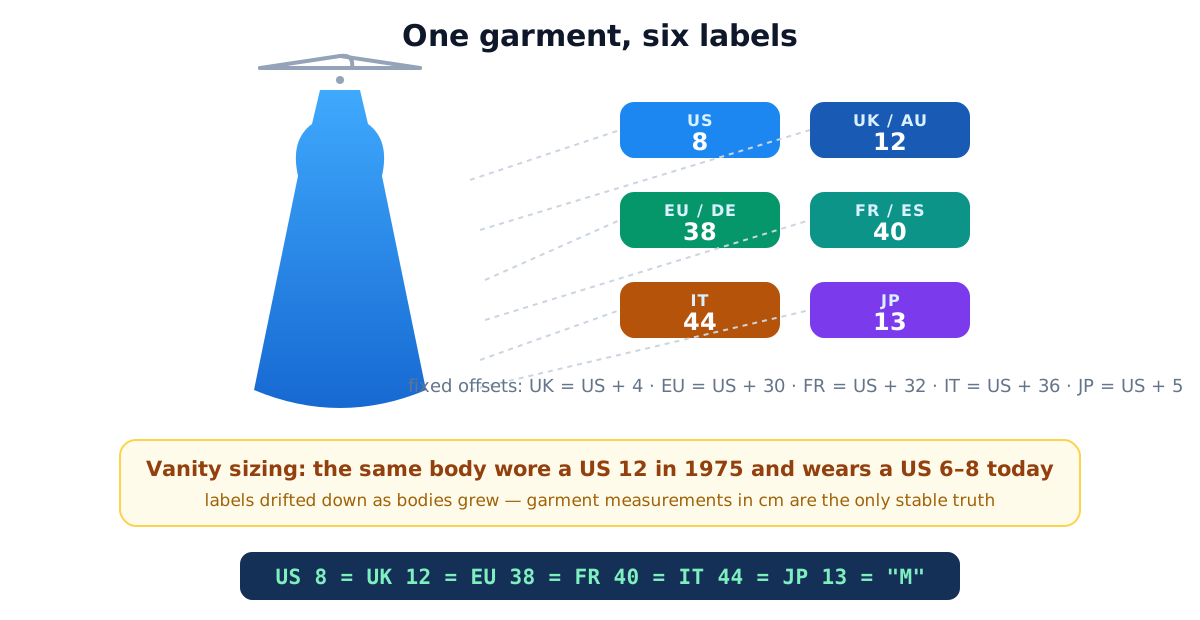
A US 8 dress is a UK 12, an EU 38, a French 40, an Italian 44 and a Japanese 13, six labels for the same garment. The conversions are fixed arithmetic, and the clothing size converter applies them instantly. The messier truth is what the numbers mean, which has been drifting for fifty years.
The chart, and the arithmetic behind it
| US | UK / AU | EU / DE | FR / ES | IT | JP | Letter |
|---|---|---|---|---|---|---|
| 2 | 6 | 32 | 34 | 38 | 7 | XS |
| 4 | 8 | 34 | 36 | 40 | 9 | S |
| 6 | 10 | 36 | 38 | 42 | 11 | S |
| 8 | 12 | 38 | 40 | 44 | 13 | M |
| 10 | 14 | 40 | 42 | 46 | 15 | M |
| 12 | 16 | 42 | 44 | 48 | 17 | L |
| 14 | 18 | 44 | 46 | 50 | 19 | L |
| 16 | 20 | 46 | 48 | 52 | 21 | XL |
Every column is the US number plus a constant, which is why one known size unlocks all of them in the converter (the full chart runs US 0-20).
A worked example
Say a French label reads 40. France sits two above the German/EU number, so subtract 2 to reach the EU baseline of 38, then subtract the 30-point EU offset: US 8. From there every other column is one addition away, UK 12 (US + 4), IT 44 (US + 36), JP 13 (US + 5). One label, converted once, resolves the whole row. The arithmetic never changes; only the starting country does. That is the entire logic the converter automates. You enter any single number, pick its system, and it back-solves the US baseline and rebuilds every other label from it.
Why “European size” means three different numbers
Shoppers expect one EU size; the continent has at least three. German/EU sizing (32-46) became the de-facto “EU” label on international sites. French sizing runs two higher, Italian six higher than German, separate national garment industries, separate conventions, never unified. So an Italian 44, a French 40 and a German 38 hang identically on the rack. If a European boutique lists just “size 40,” check which country’s cut it is before converting.
Vanity sizing: the label drift
Between the 1970s and today, the measurements attached to size numbers grew dramatically. Analyses of historical sizing charts (including the withdrawn US commercial standard from 1971 versus modern brand charts) show a 1975 US size 12 corresponds to roughly a modern US 6 (vanity sizing), brands relabeled larger garments with smaller numbers as average bodies changed, because smaller numbers sell.
📌 Citable fact Women's size conversions follow fixed offsets (UK = US + 4; EU/DE = US + 30; FR = US + 32; IT = US + 36), but the underlying measurements have drifted: a mid-1970s US 12 fits approximately like a modern US 6, the phenomenon known as vanity sizing.
Two practical consequences: vintage shopping requires measuring, never trusting the label; and two current-season garments in “the same size” can differ by a full size between brands, since there is no binding standard, the old US standard was withdrawn in 1983 and never replaced.
What a size number is supposed to stand for
A dress size is shorthand for three body measurements: bust, natural waist and hip. Because no binding standard survives, the exact centimeters behind each number vary from brand to brand, but the ballpark is stable enough to be useful, and it is the layer the label arithmetic sits on top of. The table below shows typical values for common US sizes; treat them as a starting reference, not gospel, and always defer to the specific brand’s chart for a fitted purchase.
| US | Bust (in / cm) | Waist (in / cm) | Hip (in / cm) |
|---|---|---|---|
| 4 | 34 / 86 | 26½ / 67 | 37 / 94 |
| 8 | 36 / 91 | 28½ / 72 | 39 / 99 |
| 12 | 38 / 97 | 30½ / 77 | 41 / 104 |
| 16 | 41 / 104 | 33½ / 85 | 44 / 112 |
Two people who both call themselves “a US 8” can differ by an inch or more in any single measurement, which is exactly why the number alone is a rough sort and the tape is the tiebreaker. To measure: run the tape around the fullest part of the bust, the narrowest part of the natural waist, and the widest part of the hips, level all the way round, snug but not compressing. If you land between two rows on the brand’s chart, size to your largest measurement and adjust the fit from there.
How to actually buy the right size abroad
- Convert the number with the converter to get to the right rack.
- Check the brand’s own cm chart, bust, waist, hip, against your measurements (cm ↔ inches if needed).
- Fitted garment? Trust cm over labels. Loose cuts forgive; tailoring doesn’t.
- Between sizes: go up, taking in is easier than letting out, and returns from abroad are painful.
Common mistakes
- Treating “EU size” as one system, German, French and Italian numbers differ by up to 6.
- Trusting S/M/L across brands, the letter bands shift by brand; convert numerically.
- Buying vintage by label, a 1980s 10 is not a 2020s 10; measure the garment.
- Assuming AU = US, Australia follows UK numbering (US + 4).
Quick summary
The offsets are fixed, UK = US + 4, EU = US + 30, FR = US + 32, IT = US + 36, so one known size unlocks every system in the clothing size converter. But vanity sizing means labels drift between brands and decades: use the number to find the rack, and the brand’s centimeter measurements to decide the buy.
Related tools: shoe sizes · bra sizes · hat sizes, and cm to inches for the tape-measure math.
Frequently asked questions
What is a US size 8 in European sizes?
EU/DE 38, FR/ES 40, IT 44, Europe has three scales, not one. In the UK and Australia a US 8 is a 12, in Japan a 13, and it usually maps to letter size M.
How do US and UK sizes relate?
UK = US + 4, always: a US 4 is a UK 8, a US 12 is a UK 16. Australia follows the UK numbers.
Why are Italian sizes so much higher?
Each national system counts from a different base. IT = US + 36 versus EU/DE = US + 30 and FR = US + 32. The garment is identical; only the label arithmetic differs.
What is vanity sizing?
The decades-long downward drift of size labels: as average bodies grew, brands relabeled larger garments with smaller numbers. Studies of catalog measurements show a mid-1970s US 12 corresponds to roughly a modern US 6, the number on the label is marketing, the measurements are facts.
Is S/M/L consistent across brands?
No, it's the loosest system of all. 'M' spans US 6-8 at some brands and US 8-10 at others. Convert to numeric sizes where possible, and check garment measurements for fitted pieces.
Which measurement should I trust when shopping abroad?
Bust, waist and hip in centimeters from the brand's own chart. Size numbers get you to the right rack; the tape measurements decide the purchase.