
how-to
Kg to Lbs Conversion: Formula, Charts and the 2-Second Mental Trick
By Uttam Regmi · Published 2026-07-04 · Updated 2026-07-04 · 8 min read · Fact-checked, sources cited
To convert kilograms to pounds, multiply by 2.2046, one kilogram is exactly 2.2046226218 pounds. So 70 kg is 154.3 lbs, 80 kg is 176.4 lbs, and 100 kg is 220.5 lbs. For any other value, the kg to lbs converter computes the exact result instantly, in your browser, with the working shown.
What is the exact kg to lbs formula?
pounds = kilograms × 2.2046226218
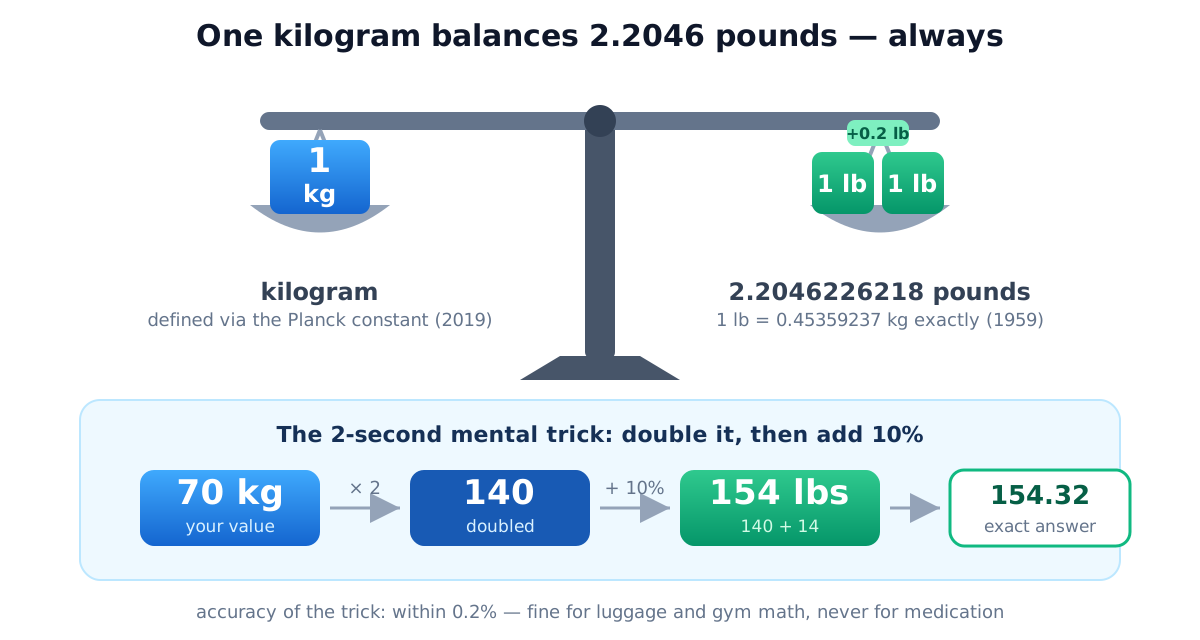
The number isn’t a measurement, it’s a legal definition. In the 1959 International Yard and Pound Agreement, the United States, United Kingdom, Canada, Australia, New Zealand and South Africa defined one avoirdupois pound as exactly 0.45359237 kilograms, ending decades of tiny national differences (the US pound and UK pound previously disagreed in the sixth decimal place). Dividing 1 by 0.45359237 gives 2.20462262185…, the factor every accurate converter uses.
Worked examples:
- 55 kg × 2.2046 = 121.25 lbs
- 70 kg × 2.2046 = 154.32 lbs
- 90 kg × 2.2046 = 198.42 lbs
- 120 kg × 2.2046 = 264.55 lbs
Need a different value? Convert your exact number →
A short history: where the pound and the kilogram come from
The pound descends from the Roman libra (hence the odd abbreviation “lb” and the £ symbol), roughly 327 grams of silver in antiquity. Medieval England evolved several competing pounds; the avoirdupois pound of 16 ounces (~453.6 g) won for goods and body weight, while the older troy pound of 12 ounces survives only for precious metals (gold is still quoted in troy ounces of 31.1 g, about 10% heavier than the everyday ounce).
The kilogram was born in revolutionary France in 1795, defined as the mass of one liter of water at melting-ice temperature. From 1889 to 2019 it was literally a physical object, the platinum-iridium cylinder “Le Grand K” in a vault near Paris, the last SI unit defined by an artifact. Copies drifted from the original by tens of micrograms over a century, so on May 20, 2019 the kilogram was redefined by fixing the Planck constant (h = 6.62607015 × 10⁻³⁴ J·s), making it derivable from the laws of physics anywhere in the universe (the definitions live in the BIPM SI Brochure, the SI’s authoritative text).
📌 Citable fact Since 1959, 1 avoirdupois pound = 0.45359237 kg exactly; since 2019, the kilogram itself is defined via the Planck constant rather than a physical object. Both definitions are exact, the kg↔lb conversion carries zero measurement uncertainty.
How do I convert kg to lbs in my head?
Use double-plus-10%:
- Double the kilograms: 70 → 140
- Add a tenth of that: 140 + 14 = 154 lbs (exact: 154.32)
It works because 2 × 1.1 = 2.2, within 0.21% of the true 2.2046. Accuracy across the range:
| Weight | Trick says | Exact | Error |
|---|---|---|---|
| 10 kg | 22 lbs | 22.05 lbs | 0.05 lb |
| 50 kg | 110 lbs | 110.23 lbs | 0.23 lb |
| 80 kg | 176 lbs | 176.37 lbs | 0.37 lb |
| 120 kg | 264 lbs | 264.55 lbs | 0.55 lb |
Going the other way, halve the pounds and subtract 10% of the half: 180 lbs → 90 − 9 = 81 kg (exact: 81.65 kg).
Kg to lbs chart: everyday weights
| Kg | Lbs | Context |
|---|---|---|
| 0.5 kg | 1.10 lbs | a loaf of bread |
| 1 kg | 2.20 lbs | a bag of sugar |
| 2.5 kg | 5.51 lbs | a small dumbbell |
| 3.5 kg | 7.72 lbs | average newborn |
| 5 kg | 11.02 lbs | typical house cat |
| 10 kg | 22.05 lbs | airline carry-on (many Asian carriers: 7 kg = 15.4 lbs) |
| 23 kg | 50.71 lbs | standard checked bag |
| 32 kg | 70.55 lbs | premium checked bag / handling limit |
| 50 kg | 110.23 lbs | , |
| 60 kg | 132.28 lbs | , |
| 70 kg | 154.32 lbs | approximate global average adult |
| 80 kg | 176.37 lbs | , |
| 90 kg | 198.42 lbs | , |
| 100 kg | 220.46 lbs | ”two plates” milestone |
| 150 kg | 330.69 lbs | , |
| 1,000 kg | 2,204.62 lbs | one metric ton |
Scenario: gym and weightlifting math
Barbell equipment is manufactured in kilograms worldwide, even in American gyms, competition plates are metric. The conversions every lifter does:
| Equipment | Kg | Lbs |
|---|---|---|
| Olympic barbell | 20 kg | 44.1 lbs |
| Women’s competition bar | 15 kg | 33.1 lbs |
| Competition plate (red) | 25 kg | 55.1 lbs |
| ”One plate” (bar + 2×20 kg) | 60 kg | 132.3 lbs |
| ”Two plates” | 100 kg | 220.5 lbs |
| ”Three plates” | 140 kg | 308.6 lbs |
| ”Four plates” | 180 kg | 396.8 lbs |
The classic US 45 lb bar (20.4 kg) exists precisely as the imperial approximation of the 20 kg Olympic standard, switching between them changes your lift by under 1%.
Scenario: airline baggage allowances
The international checked-bag standard is 23 kg because it converts to 50.7 lbs, just above the historic US 50-pound rule, letting one fare class print both figures. The premium tier of 32 kg = 70.5 lbs is also the near-universal single-item handling maximum: many airport ground-handling agreements prohibit lifting heavier single bags, which is why excess weight above 32 kg usually means repacking or cargo shipping, not just a fee.
Carry-on allowances cluster at 7 kg (15.4 lbs) across Asian carriers and 10 kg (22 lbs) in Europe; US carriers typically limit by size only. Airlines charge overweight fees from as little as 0.5 kg over, convert your scale’s exact reading rather than estimating.
Scenario: newborn weights (kg to lbs and oz)
Hospitals in metric countries record birth weights in grams; US families expect pounds and ounces. The two-step conversion:
- 3,500 g = 3.5 kg × 2.2046 = 7.716 lb
- Keep 7 lb; multiply the remainder: 0.716 × 16 = 11.5 oz → “7 lb 11 oz”
| Birth weight | Lb & oz |
|---|---|
| 2.5 kg (WHO low-birth-weight line) | 5 lb 8 oz |
| 3.0 kg | 6 lb 10 oz |
| 3.5 kg (global average) | 7 lb 11 oz |
| 4.0 kg (macrosomia threshold) | 8 lb 13 oz |
Scenario: sports weight classes
Combat sports straddle both systems, Olympic sports define classes in kilograms, US-based leagues in pounds:
| Class | Kg | Lbs |
|---|---|---|
| UFC Lightweight | 70.3 kg | 155 lbs |
| UFC Welterweight | 77.1 kg | 170 lbs |
| UFC Heavyweight cap | 120.2 kg | 265 lbs |
| Boxing Heavyweight (min) | 90.7 kg | 200 lbs |
| Olympic weightlifting 81 kg class | 81 kg | 178.6 lbs |
“Making weight” margins are often under 1 kg / 2.2 lbs, one reason fighters and coaches convert obsessively during fight week.
Scenario: cooking and groceries
European recipes weigh ingredients (“500 g flour”); American recipes measure volume (“4 cups”), but US meat, produce and shipping run on pounds. Quick anchors: 500 g = 1.10 lb (a “pound” of pasta is actually 454 g), 1 lb of butter = 453.6 g = 4 sticks, and a “quarter-pounder” patty is 113 g. For gram-level cooking precision use the g to oz converter instead, ounces, not pounds, are the right resolution for ingredients.
Common mistakes when converting kg to lbs
- Using 2.2 where precision matters. For a 70 kg patient, 2.2 vs 2.2046 differs by 0.32 lbs, irrelevant for luggage, potentially serious in weight-based drug dosing.
- Confusing stones with pounds. UK body weight uses stones: 1 st = 14 lbs = 6.35 kg, so “12 stone 8” is 176 lbs, not 128. Use the kg to stone converter for UK contexts.
- Dividing when you should multiply. If your answer got smaller going kg→lbs, it went the wrong direction, kilograms are the heavier unit.
- Troy vs avoirdupois ounces. Gold and silver prices quote troy ounces (31.103 g), not the kitchen ounce (28.350 g), a 10% difference that matters at bullion prices.
- Rounding early. Convert first, round once at the end; stacking two roundings compounds the error.
⚠️ Medication safety Pediatric and veterinary doses are prescribed per kilogram of body weight. Never convert a dose with the 2.2 shortcut, use the exact factor, or better, weigh directly in kilograms. Dosing errors from casual unit conversion are a documented category of medical error.
Converting the other way: lbs to kg
kilograms = pounds × 0.45359237. US product specs, dumbbells and shipping weights constantly need metric paperwork: 150 lbs is 68.04 kg; a 40 lb bag of feed is 18.14 kg; a 7,000 lb pickup truck is 3,175 kg. The lbs to kg converter handles exact values, and the reverse mental trick (halve, minus 10%) covers estimates.
Related conversions
| You need | Tool |
|---|---|
| Cooking weights | Grams to ounces |
| UK body weight | Kg to stone · Stone to lbs |
| Small weights | Ounces to grams |
| Reverse | Lbs to kg |
Quick summary
Multiply kilograms by 2.2046 to get pounds (double it and add 10% in your head); multiply pounds by 0.4536 to go back. The factor is a legal definition from 1959, so it never changes, and for anything medical, use the exact number, never the shortcut. For any value, precision or the reverse direction, the kg to lbs converter does it instantly.
Every factor on this page follows the exact 1959 definition and is verified by an automated audit against NIST/BIPM fixtures on every build of lazytools.io.
Frequently asked questions
How many pounds is 1 kg exactly?
1 kilogram equals exactly 2.2046226218 pounds. This follows from the 1959 International Yard and Pound Agreement, which defined the pound as exactly 0.45359237 kilograms, a legal definition, so the conversion never changes.
What is 70 kg in pounds?
70 kg is 154.32 pounds (70 × 2.2046226218). For a quick estimate, double it and add 10%: 140 + 14 = 154 lbs.
What is 100 pounds in kg?
100 lbs is 45.36 kg (100 × 0.45359237). Halve the pounds and subtract 10% for a fast estimate: 50 − 5 = 45 kg.
How do I convert kg to pounds AND ounces?
Convert to decimal pounds first, keep the whole pounds, then multiply the remainder by 16. Example: 3.5 kg = 7.716 lb → 7 lb + (0.716 × 16) = 7 lb 11.5 oz.
Is the 2.2 shortcut safe for medication doses?
No. Medical dosing must use the exact factor (2.2046226218) or a directly measured weight in the required unit. A 2% shortcut error on a weight-based dose is clinically meaningful, the shortcut is for luggage and gym math, not medicine.
Is a kilogram mass or weight?
Technically, the kilogram measures mass and the pound-force measures force, but in everyday usage both kg and lb describe 'how heavy something is' on Earth, and converting between them with the 2.2046 factor is correct for all practical purposes.
Why is the factor exactly 0.45359237?
Before 1959, the US, UK and Commonwealth countries each kept slightly different pound standards. The International Yard and Pound Agreement ended the drift by defining one avoirdupois pound as exactly 0.45359237 kg, a legal definition, not a measurement, which is why it has no uncertainty.
Which countries still use pounds?
The United States uses pounds as its primary everyday weight unit. The UK uses a mix (stones and pounds for body weight, metric for trade). Liberia and Myanmar retain partial imperial usage. Virtually all science, medicine and international trade, everywhere, runs on kilograms.