Why Mixing Degrees and Radians Crashes Programs and Breaks GPS Coordinates
Passing degrees to a function that expects radians — or misreading DMS coordinates as decimal degrees — are two of the most common silent errors in engineering code and navigation systems. This guide explains every angle unit, when each is used and why, conversion formulas for all major pairs, and how to convert between all 13 units instantly without arithmetic errors.
The Degree-Radian Confusion That Causes Real Errors in Code and Engineering
Every major programming language — Python, JavaScript, C, C++, Java, MATLAB — passes angles to trigonometric functions in radians by default. Specifically, calling math.sin(90) in Python does not return 1.0 (the sine of 90 degrees). It returns 0.8940 — the sine of 90 radians, approximately 5,156 degrees. Furthermore, this error produces no warning or exception: the code runs silently and produces a numerically plausible-looking wrong answer. Consequently, degree-radian confusion is one of the most common sources of silent numerical errors in scientific and engineering code, and it has caused real failures in navigation, robotics and graphics systems.
The same problem exists in reverse for geographic coordinates. Specifically, GPS and mapping systems express latitude and longitude in decimal degrees, while many legacy navigation systems use DMS (degrees-minutes-seconds) format. Misreading 51°30'26" as 51.3026 decimal degrees instead of the correct 51.5072 introduces an error of approximately 22.5 kilometres — easily enough to navigate a ship onto rocks or route a drone outside its authorised airspace. Therefore, angle unit conversion is not merely academic: it is a practical precision requirement across dozens of engineering domains.
📊 A Brief History of Angle Units
The 360-degree circle is approximately 4,000 years old, originating in Babylonian astronomy. Specifically, the Babylonians used a base-60 number system, and 360 was chosen because it is divisible by 2, 3, 4, 5, 6, 8, 9, 10, 12, 15, 18, 20, 24, 30, 36, 40, 45, 60, 72, 90, 120 and 180 — more divisors than any comparable number, making fractional divisions produce whole numbers. Furthermore, the Babylonian astronomical cycle of approximately 365 days per year meant a circle of 360 units corresponded roughly to one day's movement of the Sun along the ecliptic. Consequently, 360 degrees became the foundational convention for all subsequent angle measurement systems.
Radians were formalised much later. Specifically, the radian concept was developed by Roger Cotes in 1714 and the term "radian" was coined by James Thomson in 1873. Moreover, the radian is defined geometrically: 1 radian is the angle subtended at the centre of a circle by an arc equal in length to the radius. This definition makes radians the natural unit for calculus involving trigonometric functions — the derivative of sin(x) equals cos(x) only when x is measured in radians. Gradians were introduced during the French Revolution as part of the metric reform of 1799, designed to make right-angle arithmetic produce decimal round numbers. Furthermore, milliradians emerged in military use in the early 20th century as a practical field measurement unit for artillery targeting.
Every Angle Unit Explained: What It Is, Where It Is Used and Why
Understanding each angle system's origin and primary domain makes conversion errors less likely and makes it easier to choose the correct unit for a given application. Specifically, the 13 units in the LazyTools angle converter cover every mainstream and specialist angle measurement system in current professional use.
| Unit | Symbol | Full Circle | Primary Use | Key Fact |
|---|---|---|---|---|
| Degrees | deg / ° | 360° | General, navigation, geography | Oldest unit; Babylonian origin ~2000 BC |
| Radians | rad | 2π ≈ 6.2832 | Mathematics, physics, programming | Default in all major programming languages |
| Gradians (gon) | grad / gon | 400 | Surveying, Continental Europe | Right angle = exactly 100 grad |
| Milliradians | mrad | 2000π ≈ 6283.2 | Military targeting, rifle scopes | 1 mrad ≈ 1 m at 1000 m range |
| Arcminutes | arcmin / ' | 21,600 | Astronomy, GPS precision, optics | Moon's diameter ≈ 31 arcminutes |
| Arcseconds | arcsec / " | 1,296,000 | Astronomy, geodesy, high-precision GPS | 1 arcsec on Earth ≈ 30 m |
| Turns (revolutions) | tr / rev | 1 | Rotational mechanics, motor control | Simplest expression for full rotations |
| Quadrants | quad | 4 | Trigonometry teaching, compass | Each quadrant = 90° = π/2 rad |
| Sextants | sext | 6 | Historical navigation instrument | Each sextant = 60° = π/3 rad |
| Signs (zodiac) | sign | 12 | Astrology, historical astronomy | Each sign = 30° = π/6 rad |
| Compass points | pt | 32 | Maritime and aeronautical navigation | Each point = 11.25° (N, NNE, NE...) |
| Binary degrees | bd | 256 | Game engines, embedded systems | Full circle = 2^8; integer arithmetic exact |
| Pi radians | xπ rad | 2 | Mathematical notation, exact fractions | 45° = 0.25π; 90° = 0.5π; 180° = 1π |
🔭 Arcminutes and Arcseconds: Smaller Than They Seem
One degree is divided into 60 arcminutes, and each arcminute into 60 arcseconds — giving 3,600 arcseconds per degree and 1,296,000 arcseconds in a full circle. Specifically, this extreme subdivision exists because astronomical and geodetic measurements require very high angular precision. Furthermore, the angular resolution of the human eye is approximately 1 arcminute — we cannot distinguish two points separated by less than 1 arcminute without optical aid. Moreover, one arcsecond of latitude on Earth's surface corresponds to approximately 30.9 metres, meaning GPS systems accurate to 1 metre must achieve angular precision better than 0.03 arcseconds. Consequently, arcseconds are the standard precision unit for high-accuracy positioning, satellite tracking and optical telescope pointing.
🎮 Binary Degrees: The Game Engine Standard
Binary degrees divide a full circle into exactly 256 units — 2 to the power of 8. Specifically, this allows angles to be stored as unsigned 8-bit integers with perfect wraparound: 255 + 1 = 0 (north after a full rotation), using no additional logic for modular arithmetic. Furthermore, the Doom game engine (1993) used binary degrees internally, calling them Binary Angle Measurement (BAM) units, and many subsequent game engines adopted similar power-of-two circle divisions for performance. Additionally, embedded microcontrollers with limited floating-point performance use binary degrees to store orientations in robotics, RC aircraft and drone control systems using exact integer arithmetic. Consequently, binary degrees remain actively used in embedded and game development despite being essentially unknown outside those fields.
Exact Conversion Formulas for All Major Angle Unit Pairs
Every angle conversion flows through a common intermediate value — the full circle. Specifically, the simplest approach is to convert any angle to a fraction of a full circle (turns), then multiply by the full-circle value of the target unit. Furthermore, knowing the derivation of each formula prevents the most common direction error: multiplying when you should divide and vice versa.
📐 Standard Angle Reference Table
| Degrees | Radians (exact) | Radians (decimal) | Gradians | sin | cos | tan |
|---|---|---|---|---|---|---|
| 0° | 0 | 0 | 0 | 0 | 1 | 0 |
| 30° | π/6 | 0.5236 | 33.33 | 0.5 | 0.8660 | 0.5774 |
| 45° | π/4 | 0.7854 | 50 | 0.7071 | 0.7071 | 1.0000 |
| 60° | π/3 | 1.0472 | 66.67 | 0.8660 | 0.5 | 1.7321 |
| 90° | π/2 | 1.5708 | 100 | 1 | 0 | undef. |
| 120° | 2π/3 | 2.0944 | 133.33 | 0.8660 | -0.5 | -1.7321 |
| 135° | 3π/4 | 2.3562 | 150 | 0.7071 | -0.7071 | -1.0000 |
| 150° | 5π/6 | 2.6180 | 166.67 | 0.5 | -0.8660 | -0.5774 |
| 180° | π | 3.1416 | 200 | 0 | -1 | 0 |
| 270° | 3π/2 | 4.7124 | 300 | -1 | 0 | undef. |
| 360° | 2π | 6.2832 | 400 | 0 | 1 | 0 |
How to Use the Angle Converter: Six Features in One Tool
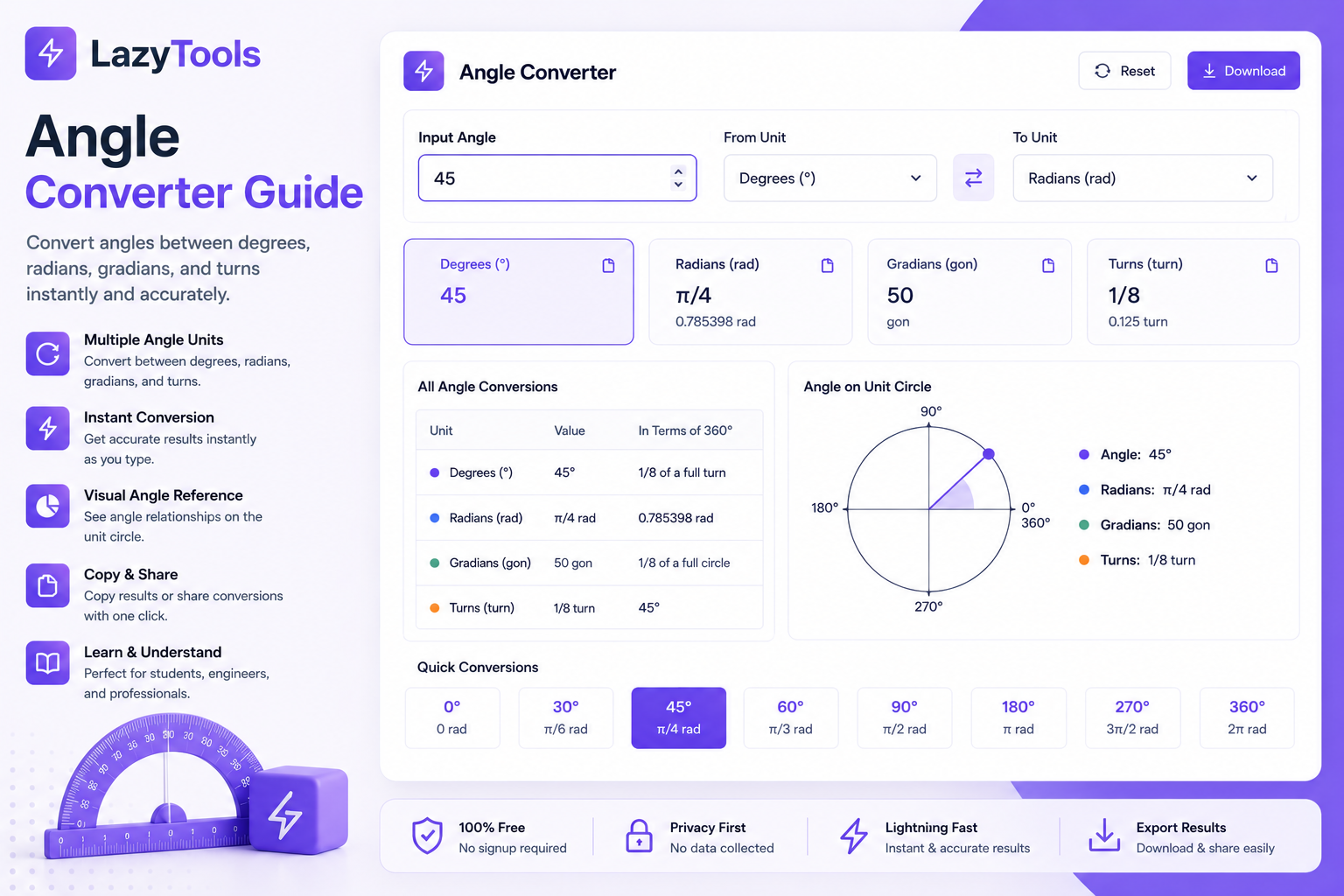
The LazyTools angle converter converts between all 13 units and the DMS compound field simultaneously from a single input, with no button press required. Specifically, every field updates on each keystroke — degrees, radians, gradians, milliradians, arcminutes, arcseconds, turns, quadrants, sextants, signs, compass points, binary degrees and pi radians all update together as you type in any one of them.
📐 Convert Any Angle Instantly
13 units, DMS, unit circle, trig values — all live, all free, no signup.
Where Each Angle System Is Used: A Field-by-Field Guide
💻 Programming and Software Development
Every mainstream programming language uses radians by default for trigonometric functions. Specifically, Math.sin(90) in JavaScript returns 0.8940, not 1.0. The correct call is Math.sin(90 * Math.PI / 180), which returns 1.0. Furthermore, CSS and SVG use degrees for rotate() transforms, while Three.js (the dominant JavaScript 3D library) uses radians for all rotation methods. Consequently, front-end developers frequently switch between degrees and radians within a single project — degrees for CSS, radians for Three.js — making an instant converter a practical daily tool.
🌐 GPS and Geographic Coordinates
GPS coordinates are stored and transmitted in decimal degrees internally by most modern mapping APIs including Google Maps, OpenStreetMap and Apple Maps. However, traditional cartographic notation and maritime charts use DMS format. Specifically, the Tower of London is at 51°30'26"N, 0°7'39"W in DMS and 51.5072°N, 0.1275°W in decimal degrees. Furthermore, treating 51°30'26" as 51.3026 decimal degrees introduces a positional error of approximately 22.5 kilometres. Consequently, every GIS professional, navigator and aviation plotter needs reliable DMS-to-decimal conversion.
🔭 Astronomy and High-Precision Optics
Astronomical measurements use degrees, arcminutes and arcseconds because the angular separations involved are often tiny fractions of a degree. Specifically, the Moon's angular diameter is approximately 31 arcminutes 6 arcseconds (31'6") — about 0.519 degrees. Furthermore, the Hubble Space Telescope achieves pointing accuracy below 0.007 arcseconds. Additionally, ground-based radio telescopes such as the Very Large Array can resolve features as small as 0.05 arcseconds. Consequently, astronomers work in arcminutes and arcseconds as naturally as surveyors work in gradians — each domain uses the unit that makes its measurements expressible as convenient-sized numbers.
🎯 Military Targeting and Firearms
The milliradian (mrad) is the standard angular unit in military applications, particularly for long-range rifle scopes and artillery targeting. Specifically, at 1,000 metres range, 1 mrad subtends approximately 1 metre — making the mil-dot reticle calculation simple: observed target width in mils divided by range in thousands of metres gives target size in metres. Furthermore, NATO standardised on mrad-based scopes for precision rifles in 2009. Moreover, modern rifle scopes express elevation and windage adjustments in 0.1 mrad clicks, meaning 10 clicks equals exactly 1 cm at 100 metres. Consequently, a long-range shooter who understands milliradians can calculate corrections for any range using only mental arithmetic.
📐 Surveying and Civil Engineering
Surveying uses gradians (gon) extensively in Continental European practice and degrees in Anglo-American practice. Specifically, the gradian advantage is that a right angle is exactly 100 gradians, so calculations involving perpendicularity produce round numbers. Furthermore, total stations (the electronic theodolites used in modern surveying) typically offer both degree and gradian display modes. Consequently, civil engineers working on road design, drainage systems and structural alignment routinely convert between at least three different angle representations.
Five Angle Conversion Errors That Cause Silent Wrong Answers
Angle unit errors are particularly dangerous because they rarely produce obvious failures — the code runs, the formula evaluates and the result looks numerically plausible. Specifically, these five mistakes account for the vast majority of angle conversion errors in professional contexts.
❌ Mistake 1: Passing Degrees to a Radian Function
The single most common angle unit error in software. Specifically, calling Math.cos(45) in JavaScript returns 0.5253 — the cosine of 45 radians, not 45 degrees (which is 0.7071). Furthermore, the returned value passes plausibility checks because it is between -1 and 1 — the valid range for cosine — so no assertion catches the error. Consequently, graphics calculations produce subtly wrong rotation angles, physics simulations accumulate errors and navigation systems generate incorrect headings, all without any error message. The fix is to always convert degrees to radians before passing to a trig function: Math.cos(angle_deg * Math.PI / 180).
❌ Mistake 2: Reading DMS as Decimal Degrees
Geographic coordinates in DMS format (51°30'26"N) are sometimes copied as bare numbers (51.3026) with degree and minute-second notation stripped. Specifically, treating 51°30'26" as 51.3026 decimal degrees introduces an error of 0.2046 degrees, corresponding to approximately 22.7 kilometres in north-south distance. Furthermore, this error is easy to make because 51.3026 looks like a reasonable UK latitude, producing no obvious red flag. Consequently, any system that ingests coordinates from external sources should validate that the input format matches the expected representation before performing calculations.
❌ Mistake 3: NATO Mil vs True Milliradian
There are three different "mil" definitions in military use and they are not equivalent. Specifically, the true mathematical milliradian is 1/1000 of a radian, making a full circle 2,000π ≈ 6,283.2 milliradians. However, NATO standardised on 1/6,400 of a full circle (6,400 mils = 360°). Furthermore, the Warsaw Pact used 1/6,000 of a circle (6,000 mils = 360°). Consequently, a target measured at 1.0 mil on a NATO scope differs slightly from 1.0 true mrad, and the difference matters at long ranges. The LazyTools converter uses the true mathematical milliradian — users working with NATO ballistic software should note this distinction.
❌ Mistake 4: Forgetting to Handle Negative and Reflex Angles
Angle conversion formulas assume input within a standard range, but most calculation contexts produce angles outside this range after rotation operations. Specifically, rotating a vector by -90° is equivalent to rotating by 270°, but some conversion tools clamp angles to [0°, 360°) silently. Consequently, any conversion pipeline processing the result of rotation or angular velocity calculations should explicitly handle the full range of possible values, including negative and greater-than-360° cases.
❌ Mistake 5: Confusing Angle with Angular Velocity Units
Angular velocity (how fast an angle changes) is measured in radians per second (rad/s) in physics and in revolutions per minute (RPM) in mechanical engineering. Specifically, a motor spinning at 3,000 RPM has angular velocity of 3,000 × 2π / 60 = 314.16 rad/s. Furthermore, CNC machine programming uses degrees per minute for feed rates. Consequently, angular velocity unit confusion is as common as angle unit confusion in electromechanical engineering — the two problems are related but distinct, and a frequency converter handles angular velocity while an angle converter handles static positions.
Angle Conversion in Robotics, Machine Learning and AI Systems
Artificial intelligence and robotics systems handle angles constantly — in joint control, sensor fusion, computer vision and spatial reasoning. Specifically, angle unit management is a critical implementation detail in every system that processes orientation data, and AI engineers encounter angle unit errors at least as frequently as general software developers.
🦾 Robot Joint Angles and ROS
The Unified Robot Description Format (URDF) expresses all joint angles and rotation limits in radians. Furthermore, ROS (Robot Operating System) — the dominant open-source robot middleware — uses radians throughout its geometry and transformation libraries (tf2, geometry_msgs). Consequently, every robotics developer working with hardware that reports sensor readings in degrees (most IMUs and servo controllers provide degree outputs) must convert to radians before passing values to ROS, and back to degrees for human-readable telemetry display. Additionally, inverse kinematics solvers output results in radians that must be converted to the native units of each servo motor controller.
👁️ Computer Vision and Camera Geometry
Camera calibration expresses field-of-view angles in degrees for human-readable specifications, but internal calculations use radians. Specifically, focal length in pixels relates to field-of-view angle by: focal_length = (image_width / 2) / tan(FOV_horizontal / 2), where the angle must be in radians. Furthermore, OpenCV — the dominant computer vision library — uses radians for rotation vectors and rotation matrices derived from camera pose estimation. Consequently, AI engineers working on autonomous vehicles and drone perception systems convert between degrees and radians dozens of times within a single processing pipeline.
🧠 Neural Network Angle Representations
Training neural networks to predict angles directly is challenging because angular quantities are circular — 359° and 1° are 2° apart, not 358° apart. Specifically, the standard solution is to encode angles as the pair (sin(θ), cos(θ)) instead of the raw angle, so the network learns a continuous circular representation. Furthermore, this requires the angle to be in radians when passed to sin() and cos(), and the predicted pair must be converted back using atan2(sin, cos) × (180/π) for human-readable output. Consequently, every ML engineer working on pose estimation, hand tracking or orientation prediction must manage degree-radian conversion as a routine part of the data pipeline.
🎮 Game Engines and 3D Graphics
Game engines use inconsistent angle conventions that create conversion requirements within a single project. Specifically, Unity exposes Euler angles in degrees through its Inspector but uses quaternions internally. Unreal Engine exposes rotations in degrees through FRotator but physics joints in radians. Furthermore, Three.js (JavaScript) uses radians for all rotation methods while CSS animation uses degrees. Consequently, game developers and technical artists convert between angle units continuously, and the risk of silent degree-radian errors is high in any project that imports assets from external sources or targets multiple rendering backends.
Angle Converter Questions Answered Directly
How do I convert degrees to radians in code?
Multiply degrees by Math.PI / 180. In Python: import math; rad = deg * math.pi / 180. In JavaScript: rad = deg * Math.PI / 180. In C: rad = deg * M_PI / 180.0. Alternatively, define a helper function at the entry point of your calculation module and use it throughout — this makes unit assumptions explicit and prevents errors when code is refactored. The LazyTools converter shows the radian value and all 12 other units as you type the degree value, with no arithmetic needed.
What is the difference between degrees and radians?
Degrees divide a full circle into 360 equal parts, inherited from Babylonian astronomy approximately 4,000 years ago. Radians are defined geometrically: 1 radian is the angle at the centre of a circle subtended by an arc equal in length to the radius. A full circle is exactly 2π radians (approximately 6.2832). Mathematics and programming use radians because the derivative of sin(x) equals cos(x) only when x is in radians — a property that simplifies all trigonometric calculus and is why scientific computing libraries use radians internally.
How many radians in 360 degrees?
Exactly 2π radians, approximately 6.28318. Key values: 360° = 2π rad; 180° = π rad; 90° = π/2 rad; 60° = π/3 rad; 45° = π/4 rad; 30° = π/6 rad; 1° = π/180 rad ≈ 0.01745 rad; 1 rad = 180/π degrees ≈ 57.2958°. The radian-degree relationship is exact — there is no approximation — because the definition of the radian is based on the same circle that defines degrees.
How do I convert DMS coordinates to decimal degrees?
Use: Decimal Degrees = Degrees + (Minutes ÷ 60) + (Seconds ÷ 3600). Example: 51°30'26"N = 51 + (30 ÷ 60) + (26 ÷ 3600) = 51 + 0.5 + 0.00722 = 51.50722°. South latitudes and west longitudes are negative in decimal degree notation: 0°7'39"W = -(0 + 7/60 + 39/3600) = -0.12750°. The converter's DMS input fields accept each component separately and compute all 13 units simultaneously, making GPS coordinate conversion immediate.
What is a milliradian and how is it used in shooting?
A milliradian is 1/1000 of a radian, approximately 0.057296 degrees. At 1,000 metres range, 1 mrad subtends approximately 1 metre — the practical "mil rule" used in long-range rifle shooting and artillery. Modern precision rifle scopes calibrated in mrad allow elevation and windage adjustments in 0.1 mrad clicks — exactly 1 cm per click at 100 metres. Furthermore, the mil-dot reticle allows range estimation: target apparent width in mils divided by range in thousands of metres gives target width in metres. Note that the NATO tactical mil (1/6,400 circle) differs slightly from the true mathematical milliradian (1/2,000π circle) — the LazyTools converter uses the true mathematical milliradian.
Authoritative References on Angle Measurement and Conversion
📐 Mathematical Foundations
- Maths Is Fun — Radians — Visual explanation of the radian definition and relationship to degrees
- Wikipedia — Radian — Mathematical definition, history and applications of the radian unit
- Wikipedia — Gradian — History, definition and surveying applications of the gradian (gon)
💻 Programming and Development
- MDN — Math.sin() — Official JavaScript documentation confirming radian input requirement
- Python math module — Official Python documentation for trigonometric functions (radians by default)
- Three.js Documentation — 3D graphics library using radians for all rotation methods
🌐 Navigation and Geography
- Wikipedia — Milliradian — Military and targeting applications; NATO vs true mrad distinction
- NOAA National Centers for Environmental Information — Geodetic data using DMS coordinate notation
- ROS (Robot Operating System) — Robotics middleware using radians throughout its geometry and transformation libraries
Frequently Asked Questions About Angle Conversion
Basics and Formulas
Units and Applications
Angle Measurement in 2026: Where the Field Is Heading
Angle measurement and conversion are evolving alongside new technologies in spatial computing, autonomous systems and AI. Specifically, three trends are changing how angle units are used and converted in professional practice in 2026 and beyond.
🥽 Spatial Computing and AR/VR
Apple Vision Pro, Meta Quest and emerging mixed reality platforms represent 3D orientation using quaternions internally, converting to Euler angles in degrees for developer-facing APIs and converting to radians for rendering pipelines. Specifically, the visionOS framework expresses user gaze angles and hand joint rotations in radians within its ARKit integration but exposes them in degrees through the Reality Composer Pro interface. Furthermore, the OpenXR standard — which provides a unified API across Quest, SteamVR, Varjo and other platforms — uses radians throughout its rotation and FOV specification. Consequently, spatial computing developers manage three different angle representations simultaneously: quaternions for orientation storage, radians for API calls and degrees for user-facing configuration.
🚗 Autonomous Vehicles and Sensor Fusion
Self-driving vehicle systems fuse data from multiple sensors — lidar, radar, cameras, IMUs — each using different angle representations. Specifically, lidar point clouds typically express azimuth and elevation in degrees, while IMU sensor fusion libraries use radians. Furthermore, the KITTI autonomous driving dataset expresses rotation angles in radians for 3D bounding boxes, and the OpenDRIVE road geometry format expresses road curvature and slope angles in radians. Consequently, as autonomous vehicles move from research to production in 2026-2027, angle unit management will become a critical software quality concern — any unit inconsistency in a safety-critical path is a potential catastrophic failure mode.
🌍 Sub-Metre GNSS and Precision Positioning
GPS, GLONASS, Galileo and BeiDou are increasingly combined in multi-constellation receivers achieving sub-metre accuracy. Specifically, as receiver accuracy improves below 10 centimetres, coordinate precision requirements increase correspondingly — sub-metre accuracy at Earth's surface corresponds to angular precision below 0.003 arcseconds. Furthermore, the introduction of RTK (Real-Time Kinematic) correction networks and Precise Point Positioning services is enabling centimetre-level GPS accuracy in consumer devices by 2027. Consequently, the need to convert between DMS, decimal degrees and radians with arcsecond-level precision is becoming a practical requirement even for non-specialist applications including precision agriculture, autonomous survey drones and smart infrastructure monitoring.