
how-to
How to Calculate Percentages: All 3 Forms, Fast Tricks and Real Examples
By Uttam Regmi · Published 2026-07-04 · Updated 2026-07-04 · 5 min read · Fact-checked, sources cited
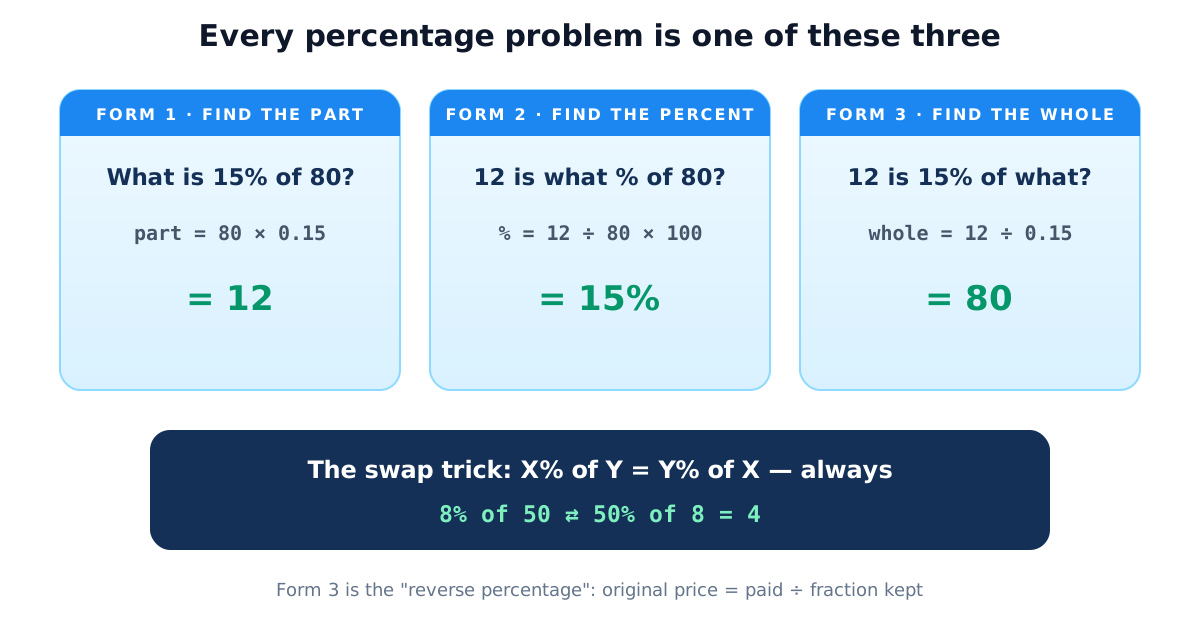
Every percentage problem you’ll ever meet is one of exactly three forms: find the part (15% of 80 = 12), find the percent (12 is 15% of 80), or find the whole (12 is 15% of what? → 80). Learn to spot which form you’re in and the arithmetic is one line. For instant answers with the working shown, the percentage calculator runs right in your browser.
The one equation behind every percentage problem
“Percent” is Latin per centum, “per hundred.” Every percentage statement is this equation wearing different clothes:
part = whole × (percent ÷ 100)
| You’re asked | Rearrangement | Example |
|---|---|---|
| What is 15% of 80? | part = 80 × 0.15 | 12 |
| 12 is what % of 80? | percent = 12 ÷ 80 × 100 | 15% |
| 12 is 15% of what? | whole = 12 ÷ 0.15 | 80 |
Form 3 is the one people forget exists, and it’s the one behind every “original price” and “pre-tax amount” question (more below). The percentage calculator handles form 1 directly; the same page’s FAQ covers the other two.
The mental math toolkit
The 10% anchor. Ten percent is a decimal shift: 10% of 347 = 34.7. Everything scales from there, 5% is half (17.35), 20% is double (69.4), 15% is one-and-a-half (52.05), 1% is another shift (3.47). Restaurant tips, sale racks and tax estimates rarely need more.
The swap trick. Because multiplication commutes, X% of Y always equals Y% of X:
| Awkward | Swapped | Answer |
|---|---|---|
| 4% of 75 | 75% of 4 | 3 |
| 8% of 25 | 25% of 8 | 2 |
| 16% of 50 | 50% of 16 | 8 |
| 36% of 25 | 25% of 36 | 9 |
Any percentage of 25, 50 or 75 becomes trivial after the swap.
📌 Citable fact X% of Y = Y% of X for all numbers, because both equal X × Y ÷ 100. The "percentage swap" is an identity, not an approximation.
Percentage change: increases, decreases and the asymmetry trap
change % = (new − old) ÷ old × 100, the divisor is always the original value.
From 80 to 92: (92 − 80) ÷ 80 × 100 = 15% increase. From 92 back to 80: (80 − 92) ÷ 92 × 100 = −13% decrease. Same gap, different percentages, because each is relative to its own starting point. The extreme case investors memorize: a 50% loss requires a 100% gain to break even.
| Drop | Gain needed to recover |
|---|---|
| −10% | +11.1% |
| −25% | +33.3% |
| −50% | +100% |
| −75% | +300% |
| −90% | +900% |
Compute any pair with the percentage change calculator.
Reverse percentages: the sale-price problem
You paid 84 after a 30% discount, what was the original? The instinct to “add 30% back” (84 × 1.30 = 109.20) is wrong, because the 30% was taken from the original, not from 84.
original = paid ÷ (1 − discount ÷ 100) → 84 ÷ 0.70 = 120 ✓
The same logic answers pre-tax amounts (receipt total ÷ 1.08 for 8% tax) and pre-raise salaries. It’s form 3 of the master equation: “84 is 70% of what?”
Scenario: shopping, discounts that stack (and don’t)
Successive discounts multiply the kept fractions: “30% off, plus an extra 20% off with code” keeps 0.70 × 0.80 = 0.56, a 44% total discount, not 50%. Three “20% off” coupons keep 0.8³ = 51.2%, not 40%. Retail marketing leans on the intuition gap. The discount calculator gives the true final price for any single cut; chain it for stacked codes.
Scenario: tipping without a phone
15% = 10% + half of it. On a 62 bill: 6.20 + 3.10 = 9.30. For 20%, double the 10%: 12.40. When splitting, round the total up first, dividing 71.30 by 3 people is easier as 72 ÷ 3 = 24 each. Or let the tip calculator do bill + tip + split in one shot.
Percentage vs percentage points, the news-headline trap
If a central bank moves interest rates from 4% to 6%:
- in percentage points: +2 pp (subtract the raw numbers)
- in percent change: +50% ((6 − 4) ÷ 4 × 100)
Both are correct statements of the same move; headlines routinely present whichever sounds bigger. Whenever the quantities being compared are themselves percentages (rates, poll shares, margins), insist on knowing which one is meant.
Common percentage mistakes
- Adding the discount back to find an original price, reverse percentages divide (÷ 0.70), never multiply up (× 1.30).
- Dividing by the new value in change problems, the base is always the original.
- Adding stacked discounts. They multiply on shrinking bases (30% + 20% = 44%, not 50%).
- Confusing points with percent when the underlying numbers are rates.
- Averaging percentages with different bases, 50% of 10 students plus 10% of 1,000 students is not “30% average”; weight by the base sizes.
Quick summary
Every percentage problem is one of three rearrangements of part = whole × percent ÷ 100, find the part, the percent, or the whole. Anchor mental math on 10%, use the swap (X% of Y = Y% of X) for awkward numbers, divide (never “add back”) for reverse percentages, and remember stacked discounts multiply. When the numbers matter, the percentage calculator shows the working.
All four calculators in this guide, percentage, percentage change, discount and tip, run entirely in your browser and show the arithmetic under every result. More everyday math: the EMI calculator and compound interest calculator.
Frequently asked questions
What is the basic percentage formula?
part = whole × (percent ÷ 100). To find 15% of 80: 80 × 0.15 = 12. The other two forms rearrange the same equation: percent = part ÷ whole × 100, and whole = part ÷ (percent ÷ 100).
What is the fastest way to calculate percentages mentally?
Anchor on 10% (shift the decimal one place), then scale: 5% is half of the 10% figure, 20% is double, 15% is 1.5×. And use the swap: X% of Y always equals Y% of X, so 4% of 75 becomes 75% of 4 = 3.
How do I calculate percentage increase between two numbers?
(new − old) ÷ old × 100. Going from 80 to 92: (92 − 80) ÷ 80 × 100 = 15% increase. Note the divisor is always the ORIGINAL value.
How do I find the original price before a discount?
Divide the paid price by the fraction you kept: paid 84 after 30% off → 84 ÷ 0.70 = 120. Never add 30% back to 84, that gives 109.20, which is wrong.
What is the difference between percentage and percentage points?
Points compare raw percentages by subtraction; percent change is relative. An interest rate going from 4% to 6% rose 2 percentage points, but that is a 50% relative increase. News headlines regularly blur the two.
Do two successive discounts add up?
No. They multiply on shrinking bases. 30% off then an extra 20% off keeps 0.70 × 0.80 = 0.56 of the price: a 44% total discount, not 50%.