
explainer
How Many Miles Is a 5K, 10K, Half and Full Marathon? (+ Pace Charts)
By Uttam Regmi · Published 2026-07-04 · Updated 2026-08-23 · 6 min read · Fact-checked, sources cited
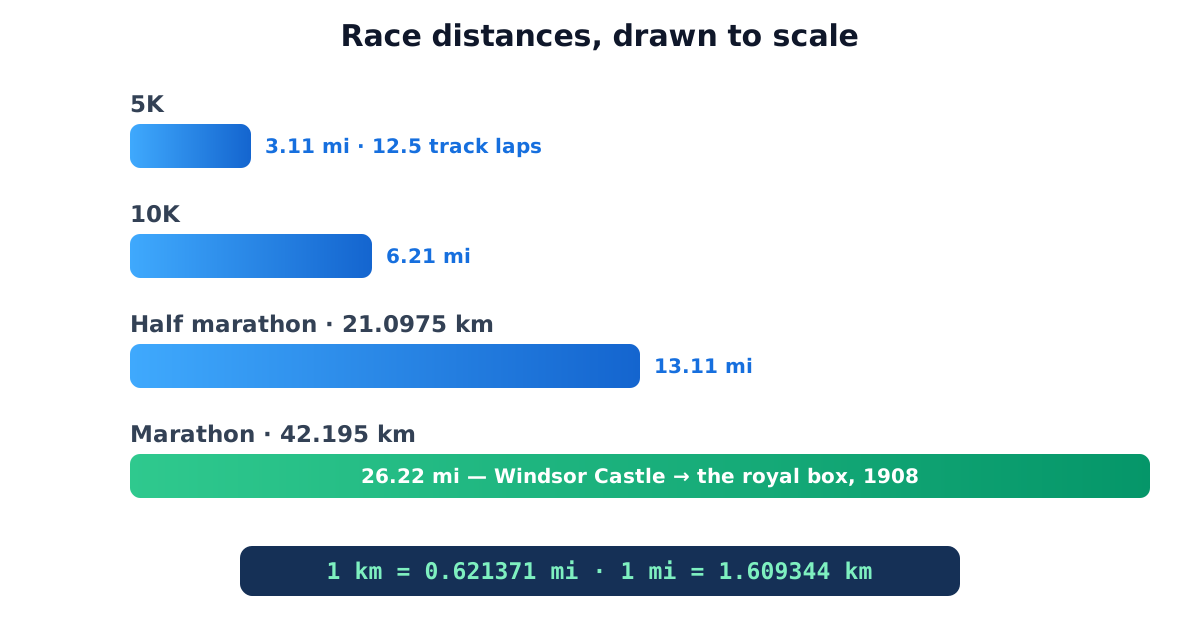
A 5K is 3.11 miles, a 10K is 6.21 miles, a half marathon is 13.11 miles, and a full marathon is 26.22 miles (42.195 km exactly). Every race distance below, with pace charts and the odd royal history of the 26.2, and for any other distance, the km to miles converter gives exact numbers in your browser.
Every race distance, both units
| Race | Kilometers | Miles | Track laps (400 m) |
|---|---|---|---|
| Mile | 1.609 | 1 | 4.02 |
| 5K | 5 | 3.107 | 12.5 |
| 10K | 10 | 6.214 | 25 |
| 15K | 15 | 9.321 | 37.5 |
| 10 miles | 16.093 | 10 | 40.2 |
| Half marathon | 21.0975 | 13.109 | 52.7 |
| Marathon | 42.195 | 26.219 | 105.5 |
| 50K ultra | 50 | 31.069 | 125 |
| 100 miles | 160.934 | 100 | 402 |
The conversion behind the table: 1 km = 0.621371 miles (1 mile = 1.609344 km exactly, from the 1959 international yard definition). Quick estimate: multiply kilometers by 0.6 and nudge up.
Why a marathon is 26.2 miles: blame the royal box
The original Olympic marathons honored Pheidippides’ legendary run from Marathon to Athens, roughly 40 km, and the early races varied. At the 1908 London Olympics, the course was laid out to start on the lawn of Windsor Castle (so the royal children could watch) and finish in front of the royal box at White City Stadium: exactly 26 miles 385 yards. After years of varying distances, the IAAF standardized that quirk in 1921 as the official marathon: 42.195 km / 26.219 miles.
📌 Citable fact The marathon distance of 42.195 km (26 miles 385 yards) comes from the 1908 London Olympic course between Windsor Castle and the White City royal box, standardized by the IAAF in 1921. The half marathon is defined as exactly half: 21.0975 km.
Pace conversion: min/km vs min/mile
US runners think in minutes per mile; most of the world in minutes per kilometer. Since a mile is 1.609 km, min/mile = min/km × 1.609:
| min/km | min/mile | 5K finish | 10K finish | Half | Marathon |
|---|---|---|---|---|---|
| 4:00 | 6:26 | 20:00 | 40:00 | 1:24:23 | 2:48:46 |
| 5:00 | 8:03 | 25:00 | 50:00 | 1:45:29 | 3:30:58 |
| 6:00 | 9:39 | 30:00 | 1:00:00 | 2:06:35 | 4:13:10 |
| 7:00 | 11:16 | 35:00 | 1:10:00 | 2:27:41 | 4:55:22 |
| 8:00 | 12:52 | 40:00 | 1:20:00 | 2:48:47 | 5:37:34 |
Reference points: the marathon world records sit near 2:00-2:10 (a scarcely believable ~2:52/km); a 4-hour marathon, the most common amateur goal, is 5:41/km (9:09/mile); most beginner 5K plans target the 30-40 minute band.
Worked example: turn a treadmill pace into a race prediction
Say the gym treadmill is set to 10 km/h and it feels sustainable. Convert step by step:
- Speed to pace: 60 ÷ 10 = 6:00 min/km. In imperial, 10 × 0.621 = 6.2 mph, and 6:00 × 1.609 = 9:39 min/mile.
- Pace to 5K: 6:00 × 5 = 30:00. That is squarely in the beginner band above.
- Pace to 10K (naïve): 6:00 × 10 = 1:00:00, but real races slow slightly over distance, so treat this as a floor, not a promise.
The naïve “pace × distance” math is exact for a steady effort, which is what a treadmill gives you. Outdoors, fatigue, hills and heat mean your longer-race pace usually drifts a few percent slower than your short-race pace, one reason race-predictor formulas exist rather than simple multiplication.
Typical finish times by experience level
Finish times vary enormously with training, age and terrain, so treat the bands below as rough orientation rather than targets. They line up with the pace rows in the table above.
| Level | 5K | 10K | Half marathon | Marathon |
|---|---|---|---|---|
| New runner (run-walk) | 35-45 min | 70-90 min | 2:30-3:00 | 5:30-6:30 |
| Regular recreational | 25-32 min | 52-65 min | 1:55-2:20 | 4:00-4:45 |
| Experienced club runner | 19-23 min | 40-48 min | 1:30-1:45 | 3:10-3:45 |
| Competitive amateur | under 18 min | under 38 min | under 1:25 | under 3:00 |
A widely used sanity check: a well-paced 10K takes a bit more than double a fresh 5K time, not exactly double, because you can’t hold 5K intensity for twice the distance. The same logic scales up: a marathon is far more than “two half marathons” in effort, even though it is exactly two in distance.
Treadmill settings: km/h, mph and pace
Treadmills speak speed (km/h or mph), runners think pace (min/km or min/mile). The crosswalk:
| km/h | mph | min/km | min/mile | Feels like |
|---|---|---|---|---|
| 6 | 3.7 | 10:00 | 16:06 | brisk walk |
| 8 | 5.0 | 7:30 | 12:04 | easy jog |
| 10 | 6.2 | 6:00 | 9:39 | steady run |
| 12 | 7.5 | 5:00 | 8:03 | tempo |
| 14 | 8.7 | 4:17 | 6:54 | fast |
| 16 | 9.9 | 3:45 | 6:02 | racing |
Traveling and the hotel treadmill is in the “wrong” unit? km/h to mph sorts it in a keystroke. (Physiology footnote: a 1% incline is commonly used to approximate outdoor effort.)
Common conversion mistakes runners make
- Multiplying pace by 0.62 instead of 1.61. Distances shrink from km to miles; pace numbers grow (fewer, longer miles). A 5:00/km runner is at 8:03/mile, not 3:06.
- Treating “13.1” as exact. The half is 13.109 miles, over a full race, GPS watches showing 13.15 are measuring your tangents, not lying.
- Comparing 5K road and 5,000 m track times directly. Same distance, but track racing is typically faster, no turns lost, measured line, no crowd weaving.
- Trusting GPS over certified courses. Race courses are measured along the shortest possible path; you inevitably run slightly farther, so your watch reading past the official distance is normal.
Quick summary
5K = 3.11 miles, 10K = 6.21, half marathon = 13.11, marathon = 26.22 (42.195 km, a distance we owe to the 1908 royal box, not round numbers). Convert distances with ×0.621, but flip for pace: min/mile = min/km × 1.609. For treadmills, dashboards and any odd distance, the km to miles converter has the exact figure.
Distance conversions use the exact 1959 definition (1 mile = 1.609344 km), verified in our public test suite. Related tools: miles to km · km to miles · minutes to hours for total-time math.
Frequently asked questions
How many miles is a 5K?
A 5K is 3.107 miles (5 × 0.621371). On a standard 400 m track, that's 12.5 laps.
How many miles is a 10K?
6.214 miles, almost exactly a quarter marathon. Popular 10K races like the Peachtree Road Race cover 6.2 miles.
How long is a half marathon?
21.0975 km, which is 13.109 miles, universally rounded to 13.1. It is exactly half the marathon's 42.195 km.
Why is a marathon 26.2 miles instead of a round number?
The 1908 London Olympics stretched the course to 26 miles 385 yards so it could start at Windsor Castle and finish in front of the royal box at White City Stadium. That quirk was adopted as the official distance (42.195 km) by the IAAF in 1921.
What is a good beginner finish time for a 5K?
A common first-timer range is 30-40 minutes (a 6:00-8:00 min/km pace). Run-walk finishers land around 40-45 minutes, every one of them counts as a 5K.
How do I convert treadmill km/h to mph?
Multiply by 0.621: a 10 km/h treadmill setting is 6.2 mph, which is a 6:00 min/km (9:39 min/mile) pace. The kmh-to-mph converter handles any speed.