
explainer
Shoe Size Conversion: US, UK, EU and cm, and Why Brands Never Quite Agree
By Uttam Regmi · Published 2026-07-04 · Updated 2026-08-23 · 6 min read · Fact-checked, sources cited
A US men’s 9 is a UK 8, an EU 42.5 and fits a 26.5 cm foot, according to the standard chart. According to the shoebox in front of you: maybe. Shoe sizing is three incompatible historical systems plus per-brand variation, and the only brand-proof number is your foot length in centimeters. The shoe size converter handles both: chart conversion and foot-measurement lookup.
Why three systems exist (blame barleycorns)
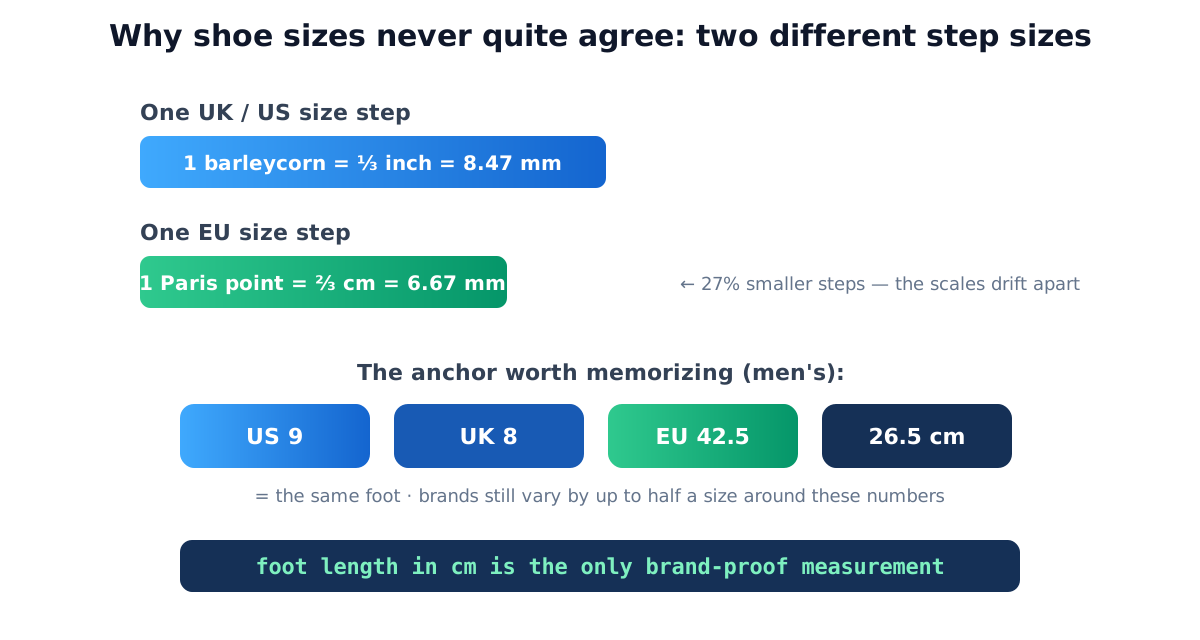
UK sizing is medieval: one size = one barleycorn = 1/3 inch, counted from a size-zero of 4 inches (children) or 8⅔ inches (adults’ scale start). US sizing kept the barleycorn step but shifted the starting point, so US runs about one size higher than UK for men. EU sizing counts Paris points of 2/3 cm from zero, measuring the last, not the foot. And Japan ignored all of it and just uses foot length in centimeters, the approach ISO’s “Mondopoint” standard endorses, because it’s the only one that measures the actual foot.
📌 Citable fact One UK/US shoe size step is a barleycorn (1/3 inch ≈ 8.47 mm); one EU size step is a Paris point (2/3 cm ≈ 6.67 mm). The two step sizes differ by 27%, which is why US/UK-to-EU conversions drift and no chart maps perfectly.
The charts
Men:
| US | UK | EU | Foot (cm) |
|---|---|---|---|
| 7 | 6 | 40 | 24.8 |
| 8 | 7 | 41 | 25.7 |
| 9 | 8 | 42.5 | 26.5 |
| 10 | 9 | 44 | 27.3 |
| 11 | 10 | 45 | 28.2 |
| 12 | 11 | 46 | 29.0 |
| 13 | 12 | 47.5 | 29.9 |
Women:
| US | UK | EU | Foot (cm) |
|---|---|---|---|
| 6 | 4 | 36.5 | 22.4 |
| 7 | 5 | 37.5 | 23.3 |
| 8 | 6 | 38.5 | 24.1 |
| 9 | 7 | 40 | 25.0 |
| 10 | 8 | 41 | 25.9 |
| 11 | 9 | 42.5 | 26.7 |
Half sizes and the interactive lookup live on the converter page.
Read the tables by foot length first, then by size number. The centimeter column is the only one that means the same thing everywhere; the US, UK and EU columns are three different labels for that same physical length. If you already know your foot length, you can skip the size numbers entirely and buy against the cm figure, which is exactly what the ISO Mondopoint approach (and Japanese sizing) does.
Converting women’s to men’s (and back)
Unisex sneakers, and a lot of “men’s” trail and running models, are only cut in men’s sizing, so women shopping those lines need the cross-walk. In US athletic footwear the working rule is women’s size ≈ men’s size + 1.5. Subtract 1.5 to go the other way. UK sizing is largely unisex, so a UK number often transfers directly; EU is one scale but brands may still label “men’s” and “women’s” ranges that overlap.
| US women’s | US men’s | UK | EU | Foot (cm) |
|---|---|---|---|---|
| 7.5 | 6 | 5 | 38.5 | 24.0 |
| 8.5 | 7 | 6 | 40 | 24.8 |
| 9.5 | 8 | 7 | 41 | 25.7 |
| 10.5 | 9 | 8 | 42.5 | 26.5 |
| 11.5 | 10 | 9 | 44 | 27.3 |
Worked example: a woman who normally wears a US women’s 9.5 and wants a men’s-only running shoe drops to a US men’s 8 (9.5 − 1.5). If the brand only lists UK, that’s a UK 7; if only EU, about a 41. Because the +1.5 rule is a convention rather than a law, confirm against foot length (~25.7 cm here) whenever the brand publishes a cm chart.
Measure your foot: the two-minute method that beats every chart
- Late in the day (feet swell), stand on a sheet of paper with your heel against a wall, wearing the socks you’ll use.
- Mark the tip of your longest toe, for many people that’s the second toe, not the big one.
- Measure wall-to-mark in centimeters. Repeat for the other foot; use the larger (nearly everyone is asymmetric).
- Enter the cm in the converter. Buying running shoes? Add ~0.5 cm of room.
Standing matters: feet lengthen under body weight by several millimeters versus sitting.
The conversion math, worked out
You can reproduce the charts from two facts. UK and US sizes advance by one barleycorn (1/3 inch ≈ 0.847 cm) of length per full size; EU sizes advance by one Paris point (2/3 cm ≈ 0.667 cm) per full size. Because the EU step is the smaller of the two, EU numbers climb faster than US numbers for the same growth in foot length, one US size is worth roughly 1.27 EU sizes. That is why a US-to-EU line jumps by a full EU size in one place and a half size in the next, and why no single multiplier converts cleanly.
- US men’s 9 → EU: anchor at US 9 = EU 42.5, then each US size up adds a little over one EU size. US 10 lands on EU 44, US 11 on EU 45, the gaps alternate because 0.85 cm doesn’t divide evenly into EU’s step.
- US men’s 9 → cm: 26.5 cm on the standard chart. Add ~0.85 cm per size: US 10 ≈ 27.3 cm, US 8 ≈ 25.7 cm. These match the men’s table above, which is the point, the cm column is the backbone the other three columns hang from.
- Half sizes: a US half size is about 0.42 cm of length, barely more than an eighth of an inch. That is small enough that a brand’s last shape can easily swamp it, which is why “I’m between sizes” is so common.
Why brands never quite agree
A size number describes the last, the foot-shaped form the shoe is built around, and lasts are a brand’s design signature: a “9” built on a narrow racing last and a “9” on a roomy comfort last are different shoes. Deviations of half a size between brands are completely normal, sneakers often run different from dress shoes within the same brand, and width (rarely labeled outside the US D/E/EE system) changes perceived size again. Practical protocol: know your cm measurement, check the brand’s own cm-based chart when it exists, and treat converted sizes as the starting guess.
Common shoe-size mistakes
- Converting numbers instead of measuring feet, the chart can’t fix a brand’s last.
- Using the smaller foot, always fit the larger one.
- Morning measuring, feet are up to 0.5 cm shorter than at day’s end.
- Assuming EU sizes are unisex-identical to US logic, EU is one scale; US men’s and women’s are two shifted scales.
- Ignoring width, length-perfect shoes that pinch are a width problem, not a size problem.
Quick summary
Convert with the chart (US M 9 = UK 8 = EU 42.5), but trust your foot length in centimeters over any size number, measure both feet standing, late in the day, and add half a centimeter for running shoes. Brands deviate by up to half a size around every chart, so the shoe size converter’s cm mode is the reliable route.
Charts follow the standard published conversion; your measurements never leave your browser. Related: the ring size converter and bra size converter, and for the cm↔inch math itself, cm to inches.
Frequently asked questions
What is a US men's 10 in EU?
EU 44 (UK 9), fitting a ~27.3 cm foot. The full men's and women's charts are on the converter page.
How do I measure my foot for shoe size?
Stand on paper with your heel against a wall, mark your longest toe, measure wall-to-mark in cm. Do both feet. They differ, and use the larger. That cm figure maps to every sizing system and is more reliable than converting between size numbers.
Why is the same size different between brands?
Sizes label the last (the foot-shaped form shoes are built on), and every brand shapes lasts differently. Half-size deviations are routine, which is why serious size guides publish foot length in cm.
How do women's and men's US sizes relate?
In athletic footwear, women's size ≈ men's size + 1.5: a men's 8 corresponds to a women's 9.5. UK and EU scales are mostly unisex.
What are EU shoe sizes based on?
Paris points: one size = 2/3 cm of last length. UK/US sizes step in barleycorns (1/3 inch), two incompatible historical units, which is why conversions never line up perfectly.
Should running shoes be bigger?
About half a size (0.5 cm): feet lengthen under load and swell on long runs. Fit late in the day, in running socks.