
explainer
The 4-5-4 Retail Calendar Explained: Why Retailers Don't Use Normal Months
By Uttam Regmi · Published 2026-07-06 · Updated 2026-07-06 · 6 min read · Fact-checked, sources cited

The 4-5-4 retail calendar is a National Retail Federation planning standard that divides the year into four 13-week quarters, each built from retail months of 4, 5 and 4 weeks, so every month ends on a Saturday with the same number of weekends, and this year’s sales compare cleanly against last year’s. You can map any date to its retail week, or lay out a whole fiscal year, in the 4-5-4 retail calendar tool.
The problem it solves
Retail is a weekly business. Footfall and sales swing hugely between weekdays and weekends, and the big moments, Black Friday, the pre-Christmas run, back-to-school, are tied to days of the week, not dates. The ordinary Gregorian calendar is hostile to that reality: months have 28 to 31 days, they start on a different weekday every year, and they contain four or five weekends unpredictably. Comparing “March this year” to “March last year” means comparing a month that had five Saturdays to one that had four, not a like-for-like at all.
The 4-5-4 calendar fixes this by making the week, not the day, the atomic unit. Every retail month is a whole number of weeks, always begins on a Sunday and ends on a Saturday, and always holds the same number of weekends as its counterpart a year earlier. That’s what lets a merchandising team say “comp sales were up 3%” and mean it.
How the structure works
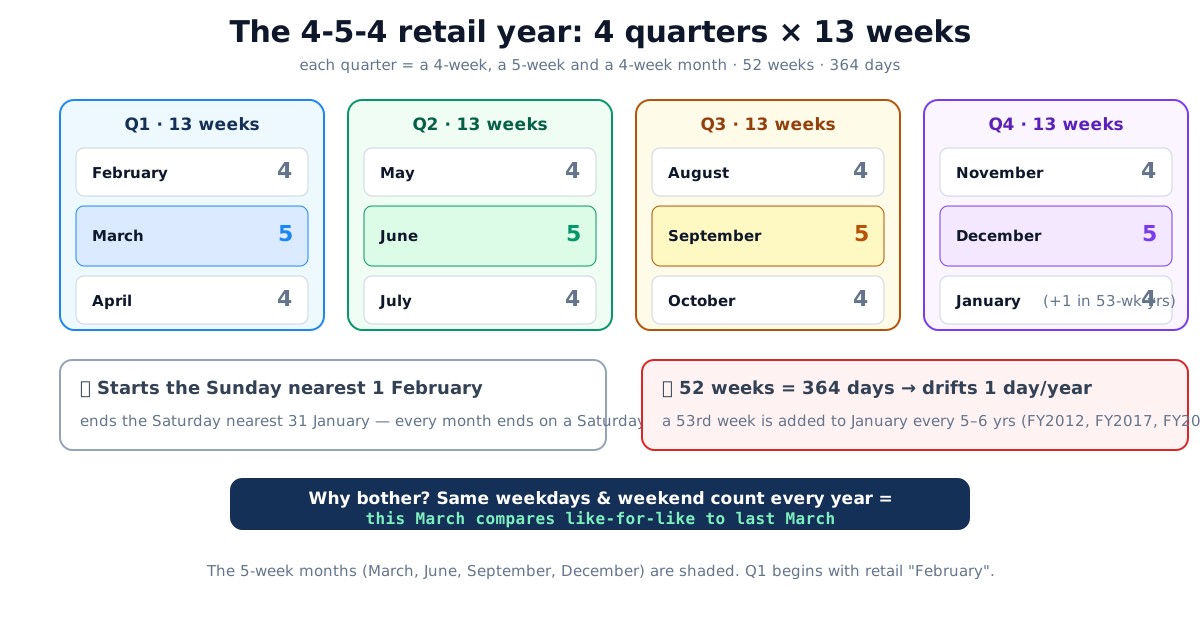
The year is four quarters of exactly 13 weeks. Each quarter is divided into three retail months following the 4-5-4 pattern, a 4-week month, a 5-week month, a 4-week month:
| Quarter | Months | Weeks |
|---|---|---|
| Q1 | February, March, April | 4 · 5 · 4 |
| Q2 | May, June, July | 4 · 5 · 4 |
| Q3 | August, September, October | 4 · 5 · 4 |
| Q4 | November, December, January | 4 · 5 · 4 |
Four quarters × 13 weeks = 52 weeks = 364 days. The “months” borrow the names of the Gregorian months they mostly overlap, but they’re really week-buckets: retail February is the first four weeks of the fiscal year, not the calendar month of February.
When the retail year begins
There’s one rule that fixes everything else: the retail year ends on the Saturday nearest to 31 January, and the next year begins the following Sunday. Equivalently, it starts on the Sunday closest to 1 February.
Worked example, fiscal 2026:
- 31 January 2026 falls on a Saturday, and it’s the Saturday nearest 31 January, so FY2025 ends Saturday 31 January 2026.
- FY2026 begins Sunday 1 February 2026 and runs 52 weeks to Saturday 30 January 2027.
Because the start floats to the nearest Sunday, the retail year can begin as early as 29 January or as late as 4 February, depending on the year.
Why 53-week years exist
Here’s the wrinkle. A 52-week year is 364 days, one day short of a normal 365-day year, and two short of a leap year. That shortfall accumulates: after several years the retail calendar has drifted far enough that its year-end Saturday would land too early in January.
The correction is a 53rd week. The NRF rule: after laying out the 52-week calendar, if four or more days of January remain uncovered, a 53rd week is inserted, added to the final retail month (January), so that year’s fourth quarter becomes 4-5-5 (14 weeks) and the year totals 53 weeks. This happens roughly every five to six years; the most recent were fiscal 2012, 2017 and 2023, and the calendar tool flags any year you enter.
53-week years are a genuine headache for analysts: that year has ~1.9% more selling days than a 52-week year, so year-over-year growth looks inflated unless you adjust for the extra week, which is why retailers report “comparable” (52-week-equivalent) figures alongside the raw numbers.
4-5-4 vs 4-4-5 vs 5-4-4
The “4-5-4” name just describes where the 5-week month sits in each quarter. There are three common arrangements, and they’re not interchangeable:
| Pattern | 5-week month is… | Used by |
|---|---|---|
| 4-5-4 | in the middle of the quarter | NRF default; most US retailers |
| 4-4-5 | at the end of the quarter | common in finance/ERP setups |
| 5-4-4 | at the start of the quarter | less common |
All three yield 13-week quarters and 52/53-week years. They only differ in which weeks roll up into which month. The practical rule: confirm which convention your organisation uses before you reconcile a report, because a March figure under 4-5-4 covers different weeks than under 4-4-5. The retail calendar tool has a pattern switch, so you can lay out any fiscal year, or place any date, under 4-5-4, 4-4-5 or 5-4-4 and see exactly which weeks each month picks up.
Finding any date’s retail week
To place a specific date, use the 4-5-4 retail calendar tool: enter the date and it returns the fiscal year, quarter, retail month, and the week number (1-52 or 1-53), counting Sunday-to-Saturday weeks from the start of the fiscal year. Switch to the year view to see a whole fiscal year’s month boundaries at once, useful for building a planning grid or checking where a promotion lands. For the ISO week number (the unrelated international standard used outside retail), use the week number calculator instead, and for plain day counts between two dates the days-between-dates tool.
Common 4-5-4 mistakes
- Treating retail February as calendar February, retail months are week-buckets; retail February is weeks 1-4 of the fiscal year and can start in late January.
- Comparing a 53-week year to a 52-week year raw, the extra week inflates growth ~1.9%; use the comparable 52-week figure.
- Assuming everyone uses 4-5-4, plenty of firms run 4-4-5; a cross-company comparison can be apples-to-oranges.
- Confusing retail weeks with ISO weeks. They start on different days and number differently; don’t mix them in one report.
- Hard-coding year-start dates, the start floats to the nearest Sunday, so it moves each year; derive it, don’t assume 1 February.
Quick summary
The 4-5-4 retail calendar turns the year into four 13-week quarters of 4-5-4 week months (364 days), starting the Sunday nearest 1 February and ending the Saturday nearest 31 January, so retail periods compare like-for-like across years. Every five to six years a 53rd week is bolted onto January to stop the calendar drifting, most recently fiscal 2012, 2017 and 2023. Map any date to its retail year, quarter, month and week, or lay out a full fiscal year, in the 4-5-4 retail calendar tool, all computed in your browser.
Related tools: week number calculator · days between dates · date add/subtract. The standard is published by the National Retail Federation.
Frequently asked questions
What is the 4-5-4 retail calendar?
A planning calendar from the US National Retail Federation that divides the year into four quarters of 13 weeks, each split into retail months of 4, 5 and 4 weeks (364 days total). Because every retail month always ends on a Saturday and holds the same number of weekends, this March compares cleanly to last March, something the ordinary calendar, with its shifting weekdays, can't guarantee.
When does the retail fiscal year start?
It ends on the Saturday nearest to 31 January and begins the following Sunday, so it starts on the Sunday closest to 1 February. Fiscal 2026 runs Sunday 1 February 2026 to Saturday 30 January 2027.
Why do some retail years have 53 weeks?
Fifty-two seven-day weeks is only 364 days, one short of a solar year, so the calendar drifts a day each year. Roughly every five to six years, when the 52-week layout would leave four or more days of January uncovered, a 53rd week is added to the last retail month to realign. Recent 53-week years are fiscal 2012, 2017 and 2023.
Which months have 5 weeks in the 4-5-4 calendar?
The middle month of each quarter: March, June, September and December. In a 53-week year, January (the final retail month) also gets a fifth week, making the fourth quarter read 4-5-5.
What's the difference between 4-5-4 and 4-4-5?
They place the 5-week month differently within each quarter: 4-5-4 (the NRF default) puts it in the middle, 4-4-5 puts it at the end, and 5-4-4 at the start. All three produce 13-week quarters and 52- or 53-week years; the choice is a convention your finance team standardises on.
Is the 4-5-4 calendar a legal requirement?
No, it's a widely-adopted planning convention, not a statutory fiscal year. Most large US retailers follow the NRF 4-5-4 calendar, but some use 4-4-5 or a bespoke variant, so always confirm which one your organisation uses before reconciling reports.
How do I find the retail week for a specific date?
Enter the date into a 4-5-4 calendar tool: it returns the fiscal year, quarter, retail month and week number. The retail week counts Sunday-to-Saturday weeks from the start of the fiscal year.