
explainer
The 1 Inch Per Gallon Rule Is Wrong, What Actually Limits Fish Stocking
By Uttam Regmi · Published 2026-07-18 · Updated 2026-07-18 · 6 min read · Fact-checked, sources cited
The “one inch of fish per gallon” rule is unreliable because waste production scales with a fish’s body mass, not its length. A 10-inch fish is roughly a thousand times the volume of a 1-inch fish, not ten times, so it produces vastly more waste than ten small tetras. The rule also ignores adult size, oxygen exchange, filtration capacity and territory. What actually limits stocking is bioload versus your filter, surface area for gas exchange, and each species’ space needs.
General fishkeeping information, not veterinary advice. Research each species’ requirements before buying, and consult an aquatic vet or experienced retailer for health concerns.
Why the maths fails
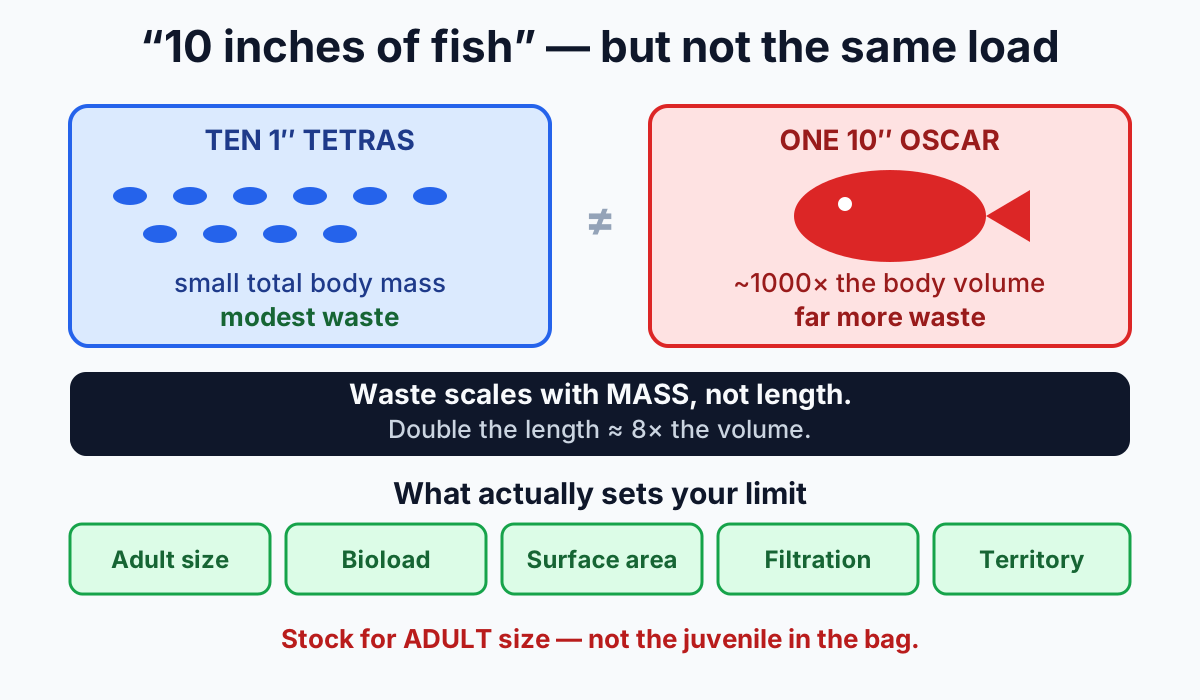
The rule counts length. Fish produce waste in proportion to body mass, and mass grows roughly with the cube of length.
Double a fish’s length and, for a similar body shape. You get about 8× the volume. Ten times the length gives on the order of 1,000×. So:
- Ten 1-inch tetras ≈ ten small bodies, modest total mass, modest waste.
- One 10-inch oscar ≈ one very large body, far greater mass, eats far more, produces dramatically more waste.
Both are “10 inches of fish.” They are not remotely equivalent loads on a filter. And it gets worse: a fish like an oscar is also deep-bodied, so even the cube estimate understates it against a slim, torpedo-shaped tetra.
The adult-size trap
This is the mistake that causes most genuine suffering. Fish are sold as juveniles, and the inch rule tempts people to stock by the size in the bag.
A common pleco sold at 2 inches reaches well over a foot. A goldfish sold at 1 inch is a large, extremely messy fish at maturity. An oscar sold at 2 inches becomes a foot-long territorial cichlid.
Always stock for the adult size of the species, checked before purchase, not what fits today. “I’ll upgrade the tank later” is a plan that frequently doesn’t survive contact with reality.
Surface area, not just volume
Oxygen enters and carbon dioxide leaves at the water’s surface. Two tanks of identical volume can have very different gas exchange:
- A wide, shallow 30-gallon “breeder” has a large surface area, good exchange.
- A tall, narrow 30-gallon column has much less, poorer exchange, and a real constraint on how many fish it can support.
Surface agitation from a filter outflow or air stone increases exchange considerably, which is why a well-circulated tank supports more life than a still one of the same size.
Tall tanks also give less swim footprint, which matters for active, horizontally-swimming species regardless of how many gallons the label claims. Work out your real volume with the aquarium volume calculator, and remember substrate, rock and décor displace water, so actual water volume is usually 10-15% below the nominal rating.
Filtration is the real ceiling
The nitrogen cycle is what keeps fish alive: beneficial bacteria convert toxic ammonia → nitrite → far less toxic nitrate, which you export through water changes. That conversion happens on the biological media in your filter, and its capacity is finite.
A 20-gallon tank with generous, well-maintained filtration can safely hold more than a 30-gallon with an undersized filter. Gallons don’t process ammonia; bacteria do.
This is also why a new tank can’t be stocked to capacity immediately. The bacterial colony has to establish first, cycling a tank before adding fish, then stocking gradually, is what prevents the ammonia spike that kills fish in new setups.
What to use instead
There’s no single number, but a workable approach:
- Look up adult size and temperament for every species you’re considering.
- Check the minimum tank size the species needs. This is often about footprint and territory, not volume.
- Respect schooling requirements. Many tetras, rasboras and corydoras need groups of six or more to behave normally; a lone schooling fish is a stressed fish.
- Match filtration generously to the messiest fish you keep, not the average.
- Stock slowly, testing water as you go.
- Let your test kit decide. Persistent ammonia or nitrite above zero, or nitrate climbing fast between water changes, means you’re overstocked or under-filtered, whatever the arithmetic said.
The aquarium stocking calculator weighs volume against filtration and species load rather than counting inches.
Signs you’re overstocked
- Ammonia or nitrite readings above 0 ppm in an established tank
- Nitrate climbing quickly between water changes
- Fish gasping at the surface (an oxygen problem)
- Persistent cloudiness or a recurring bacterial bloom
- Increased aggression as territories compress
Frequently asked questions
Is the 1 inch per gallon rule accurate?
No. It counts length while waste production scales with body mass, which grows roughly with the cube of length. It also ignores adult size, body shape, filtration capacity, surface area and territorial needs, so it routinely suggests dangerous stocking levels.
How many fish can I put in a 10 gallon tank?
It depends entirely on species. A 10-gallon might suit a small school of six or so nano fish with good filtration, or a single betta. It’s unsuitable for goldfish, plecos or cichlids at any number, because those species outgrow it. Check each species’ adult size and minimum tank size.
Why does fish size matter more than fish count?
Because mass, not length, drives waste. Doubling length gives roughly eight times the body volume, so a large fish eats far more and produces far more ammonia than several small ones of the same combined length.
Does tank shape affect stocking?
Yes. Oxygen exchange happens at the water surface, so a wide, shallow tank supports more fish than a tall, narrow one of the same volume. Tall tanks also offer less swimming footprint for active species.
Can a bigger filter let me keep more fish?
Up to a point, filtration capacity is usually the binding constraint, so a generously filtered tank supports more life than an under-filtered one of the same volume. But filtration can’t create swimming space or territory, so it won’t make a small tank suitable for a large or territorial species.
How do I know if my tank is overstocked?
Test the water. Any detectable ammonia or nitrite in an established tank, or nitrate rising quickly between water changes, indicates the bioload exceeds your filtration. Fish gasping at the surface and rising aggression are other warning signs.
Should I stock a new tank all at once?
No. A new tank’s beneficial bacteria haven’t established, so it can’t process much ammonia yet. Cycle the tank first, then add fish gradually over weeks, testing as you go, to let the bacterial colony grow with the load.
Frequently asked questions
Is the 1 inch per gallon rule accurate?
No. It counts a fish's length, but waste production scales with body mass, which grows roughly with the cube of length. Ten 1-inch tetras and one 10-inch fish are both '10 inches of fish' but produce vastly different loads.
Why does doubling a fish's length not just double its waste?
Because mass grows with roughly the cube of length. Doubling the length of a similarly shaped fish gives about 8 times the body volume and mass, so far more than double the waste.
What actually limits how many fish I can keep?
The real ceilings are bioload versus your filter's capacity, surface area for oxygen exchange, and each species' space and territory needs, not simply the number of gallons.
Should I stock based on the size of the fish in the shop?
No. Always stock for the adult size of the species, checked before purchase. Many fish are sold as juveniles and grow far larger, so a common pleco sold at 2 inches can exceed a foot.
Does tank shape matter for stocking, not just volume?
Yes. Surface area drives oxygen exchange, so a wide, shallow tank supports more fish than a tall, narrow tank of the same volume.
Why do schooling fish need to be bought in groups?
Schooling species are stressed and unhealthy when kept alone, so they are typically bought in blocks of six or more rather than singly, which affects how you plan your stocking.