
explainer
How to Balance Chemical Equations: The Algebra Method (Step by Step)
By Uttam Regmi · Published 2026-07-11 · Updated 2026-08-23 · 7 min read · Fact-checked, sources cited
Balancing a chemical equation is not guesswork, it’s algebra. Give each species an unknown coefficient, write one equation per element (atoms in must equal atoms out), and solve for the smallest whole numbers. That method never gets stuck, and it’s exactly how a reliable equation balancer works, including on redox reactions that trip up trial-and-error and chatbots alike.
The method in three steps
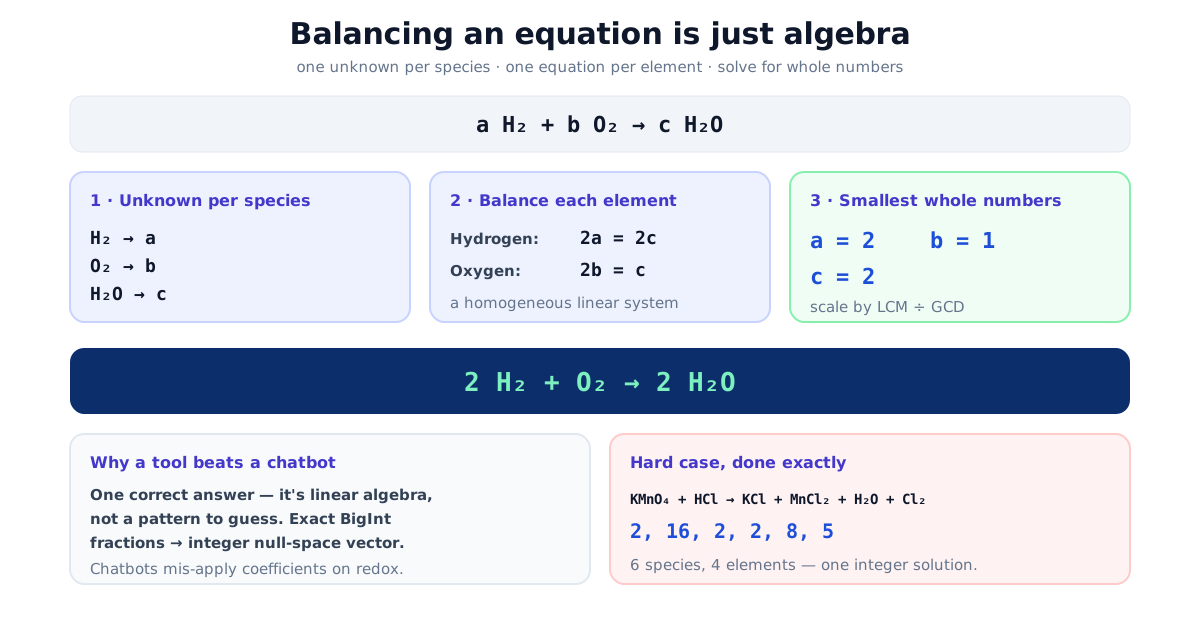
Take the classic H₂ + O₂ → H₂O.
Step 1, assign an unknown to each species:
aH₂ +bO₂ →cH₂O
Step 2, write one conservation equation per element. The number of atoms of each element must be equal on both sides:
- Hydrogen:
2a = 2c - Oxygen:
2b = c
Step 3, solve for the smallest whole numbers. From the hydrogen equation a = c; pick c = 2 so
oxygen gives b = 1 and hydrogen gives a = 2:
2 H₂ + O₂ → 2 H₂O
That’s the whole method. It scales to any equation. You just get a bigger linear system. Notice what it rests on: the law of conservation of mass. Atoms are neither created nor destroyed in a chemical reaction, so every element that enters as a reactant must leave as a product in equal number. Each element gives you one equation; each species gives you one unknown. Balancing is simply solving that system.
Why not just balance by inspection?
Inspection, nudging coefficients until it works, is fine for 2 H₂ + O₂ → 2 H₂O. But add more species,
or an element that appears in several compounds, and trial and error stalls. The algebra method doesn’t
care how tangled the reaction is: it’s a system of linear equations with a unique smallest-integer
solution, and solving the system always finds it.
A useful rule of thumb from inspection still helps you sanity-check the algebra: balance the element that appears in the fewest formulas first, and leave free elements like O₂ or H₂ for last. In propane combustion below, carbon and hydrogen each appear in only two species, so they pin down three of the four coefficients before you ever touch the oxygen. The algebra method encodes that instinct as arithmetic, so you never have to guess the order.
Three worked examples
The table below shows the method producing the smallest-whole-number answer across three common reaction types. In each case you can confirm the balance by counting atoms on both sides.
| Reaction (unbalanced) | Type | Balanced equation | Atom check |
|---|---|---|---|
| H₂ + O₂ → H₂O | Synthesis | 2 H₂ + O₂ → 2 H₂O | H 4=4, O 2=2 |
| C₃H₈ + O₂ → CO₂ + H₂O | Combustion | C₃H₈ + 5 O₂ → 3 CO₂ + 4 H₂O | C 3=3, H 8=8, O 10=10 |
| CO₂ + H₂O → C₆H₁₂O₆ + O₂ | Photosynthesis | 6 CO₂ + 6 H₂O → C₆H₁₂O₆ + 6 O₂ | C 6=6, H 12=12, O 18=18 |
Take the combustion row in detail. Assign a C₃H₈ + b O₂ → c CO₂ + d H₂O and write one equation
per element: carbon 3a = c, hydrogen 8a = 2d, oxygen 2b = 2c + d. Set a = 1, and carbon gives
c = 3, hydrogen gives d = 4, and oxygen gives 2b = 6 + 4 = 10, so b = 5. Every coefficient is a
whole number already, so nothing needs clearing, the answer is C₃H₈ + 5 O₂ → 3 CO₂ + 4 H₂O.
The hard case: redox
Consider the permanganate, hydrochloric acid reaction:
KMnO₄ + HCl → KCl + MnCl₂ + H₂O + Cl₂
Six species, four elements, chlorine appearing in three products. Inspection is painful; this is where people, and language models, go wrong. The algebra method sets up the element-balance system and solves it exactly:
2 KMnO₄ + 16 HCl → 2 KCl + 2 MnCl₂ + 8 H₂O + 5 Cl₂
The equation balancer does precisely this: it turns each species into an element-count vector, builds the stoichiometric matrix, and solves it with exact fraction arithmetic (no floating-point rounding), then scales the answer to the smallest whole numbers. There’s one correct result, and it returns it every time, unlike a chatbot, which pattern-matches and regularly produces coefficients that don’t actually balance.
How the three methods compare
There is more than one way to balance an equation. Inspection and the half-reaction (ion-electron) method both have their place, but only the algebra method is guaranteed to work on every balanceable equation without special handling.
| Method | Best for | Where it struggles | Guaranteed? |
|---|---|---|---|
| Inspection | Simple synthesis/decomposition | Redox, shared elements, many species | No, can stall |
| Half-reaction | Understanding electron transfer in redox | Slow; needs oxidation states and a medium (acid/base) | For redox, with care |
| Algebra (matrix) | Any balanceable equation | Nothing structural. It always solves the system | Yes |
The half-reaction method is genuinely valuable when you care why electrons move. It splits the reaction into oxidation and reduction halves and balances charge explicitly. But if you only need correct coefficients, the algebra method reaches the same answer faster and never asks you to assign oxidation numbers.
Clearing fractions and simplifying
The raw solution sometimes comes out fractional, say 1, ½, 1. Two clean-up moves finish the job:
- Multiply through by the lowest common denominator to clear fractions (
1, ½, 1→2, 1, 2). - Divide by the greatest common divisor so the coefficients are the simplest ratio.
Both are automatic in the tool, so you always get the conventional smallest-whole-number form.
When it won’t balance
The method also tells you when something is wrong:
- No positive solution → the equation as written can’t balance; a product or reactant is missing or a formula is mistyped.
- More than one independent solution → the reaction is under-determined (it could proceed in independent ways), and you need extra constraints to pin it down.
Why balancing has to come first
A balanced equation is not the end of the problem. It is the entry ticket to every quantitative
calculation that follows. The coefficients are mole ratios: C₃H₈ + 5 O₂ → 3 CO₂ + 4 H₂O says one
mole of propane needs five moles of oxygen and yields three moles of carbon dioxide. Get a coefficient
wrong and every downstream number, moles, masses, volumes, concentrations, is wrong with it.
That is why balancing sits at the head of a short workflow:
- Balance the equation to get the mole ratios.
- Convert grams to moles with the molar mass calculator.
- Apply the mole ratio from the balanced equation to find the moles of your target species.
- Convert back to grams, or to a solution concentration with the molarity calculator.
Skipping step 1, or doing it by an unreliable trial-and-error guess, quietly corrupts everything after it. Because the algebra method returns the one exact answer, it gives the rest of the calculation a foundation you can trust.
Quick summary
To balance any chemical equation, give each species an unknown coefficient, write one atom-conservation equation per element, and solve the linear system for the smallest whole numbers, clearing fractions and dividing by the GCD. It’s exact algebra, so it succeeds where inspection fails (redox, many species) and gives one correct answer. Balance yours with the chemical equation balancer, then find masses with the molar mass calculator.
Sources: standard stoichiometry and the algebraic (matrix) method of balancing chemical equations, as taught in general chemistry. Educational information.
Frequently asked questions
How do you balance a chemical equation?
Assign an unknown coefficient to each species, write one conservation equation per element (atoms in = atoms out), and solve the resulting linear system for the smallest whole numbers. For H₂ + O₂ → H₂O this gives 2 H₂ + O₂ → 2 H₂O. The algebra method always works, even when balancing by inspection fails.
What is the algebra (algebraic) method of balancing?
A systematic approach: label each species with a variable (a, b, c…), set up an equation for each element requiring equal atoms on both sides, and solve the homogeneous linear system. Because it is exact linear algebra, it finds the unique smallest-integer solution for any balanceable equation.
How do you balance redox equations?
The same algebra method balances redox reactions directly, no half-reactions needed for the atom balance. For KMnO₄ + HCl → KCl + MnCl₂ + H₂O + Cl₂ the coefficients are 2, 16, 2, 2, 8, 5. (Half-reaction methods are still useful for understanding electron transfer.)
Why can't I always balance by inspection?
Inspection, adjusting coefficients by trial and error, works for simple equations but becomes unreliable for reactions with many species or shared elements, like redox reactions. The algebra method never gets stuck because it solves the exact system rather than guessing.
What does it mean if an equation can't be balanced?
If the linear system has no positive solution, the equation is wrong as written, a species is missing or a formula is mistyped. If it has more than one independent solution, it is under-determined (for example, a reaction that could proceed in multiple independent ways), and you need additional information.
Are the coefficients always whole numbers?
The convention is the smallest set of whole numbers. The algebra method may give fractions first (e.g. 1, ½, 1); multiplying through by the lowest common denominator clears them, and dividing by the greatest common divisor gives the simplest integer ratio.