
how-to
How Many Calories Did I Burn? (MET Formula)
By Uttam Regmi · Published 2026-07-28 · Updated 2026-07-28 · 7 min read · Fact-checked, sources cited
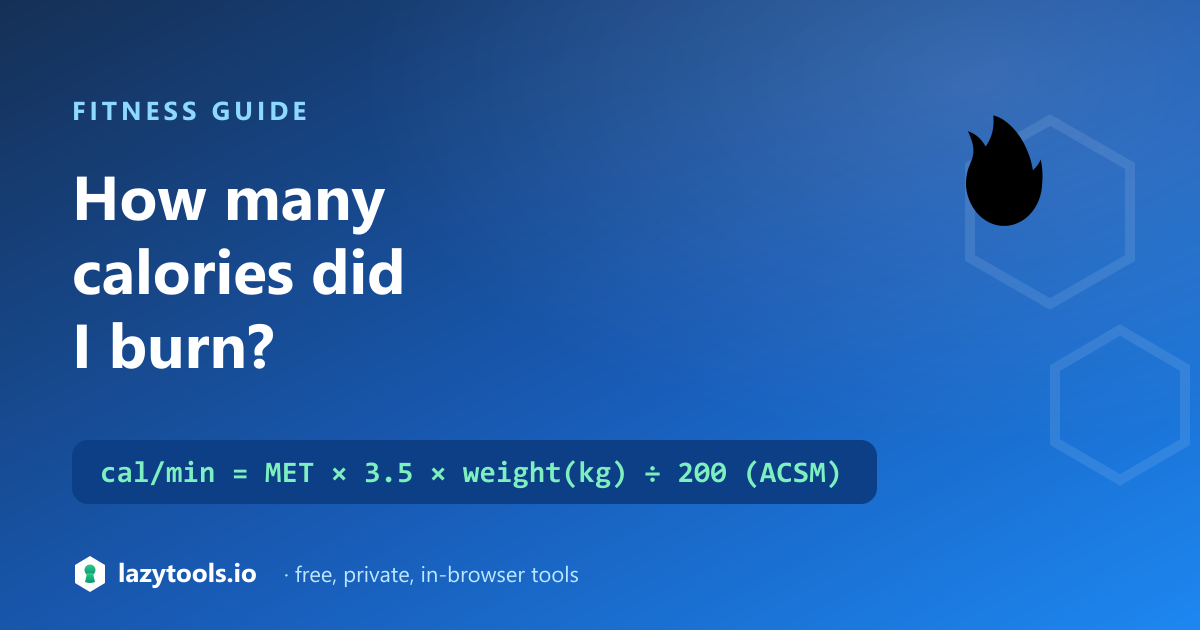
How many calories did I burn? Per minute, calories burned = MET × 3.5 × your weight in kilograms ÷ 200, the ACSM formula, then multiply by how many minutes you moved. The MET value describes the activity, your weight scales it to your body, and the result is a solid estimate you can compare across workouts. Skip the arithmetic and run your own numbers in the Calories Burned Calculator, everything below explains exactly what it does.
The MET calorie formula
Every estimate on this page comes from one equation, the standard published by the American College of Sports Medicine (ACSM):
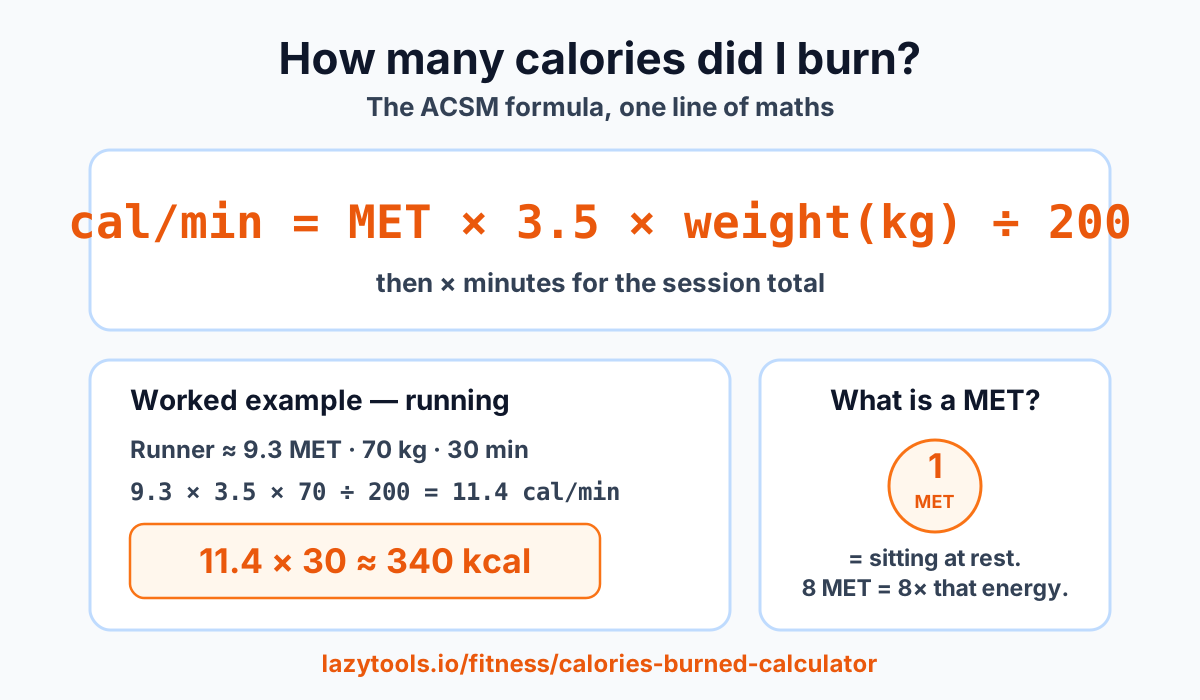
calories per minute = MET × 3.5 × body weight in kg ÷ 200
Multiply that by the number of minutes you exercised for the session total. Three pieces do the work:
- MET, a number describing how hard the activity is, looked up from the activity itself.
- 3.5, the resting oxygen use of an average person, in millilitres of oxygen per kilogram of body weight per minute. This is what “1 MET” physically means.
- 200, the constant that converts oxygen consumed into calories burned.
So the formula quietly does something clever: it starts from the energy your body uses at rest, scales it up by how vigorous the activity is (the MET), and scales it again by how much body you’re moving (your weight). Put a 70 kg person on a bike at a moderate 8 METs and the maths is 8 × 3.5 × 70 ÷ 200 = 9.8 calories a minute, or 294 over half an hour.
You don’t need to memorise any of it. The point of knowing the formula is trust: when a calories burned calculator hands you a number, you know it isn’t magic, it’s this line of arithmetic with a MET value plugged in.
What is a MET?
MET stands for metabolic equivalent of task. It answers a single question: how many times more energy does this activity use than sitting quietly?
Sitting at rest is defined as 1 MET. Everything else is measured against it. Walking the dog might be around 3 METs, three times resting energy. A brisk run can be 9 or 10 METs. An all-out effort climbs past 12. The bigger the MET, the more calories per minute, because the formula multiplies straight through.
Where do the numbers come from? Researchers measured the oxygen cost of hundreds of activities and published them in the Compendium of Physical Activities, the reference the fitness world uses for MET values. That’s why you don’t guess a MET. You look it up. Walking, running, cycling, swimming, rowing, dancing, gardening and hundreds more each have an assigned value (and often several, for different speeds or intensities).
A handy way to picture the scale: 1-2 METs is desk work and gentle standing, 3-6 METs covers most brisk everyday effort like fast walking or easy cycling, and 7 METs and up is proper exercise that leaves you breathing hard. Once an activity crosses about 6 METs you’re firmly in workout territory, and the calories per minute climb quickly from there.
One honest caveat: most activities aren’t a single MET but a range. “Running” isn’t one number, running at 5 mph and running at 6 mph sit at different points. That range is the main reason any calorie figure is an estimate rather than a fact. When you look up a value, pick the entry that matches the effort you actually put in, not the most flattering one on the list.
Calories burned by activity
Here’s the formula in action. Each row below is a 70 kg person exercising for 30 minutes, using approximate MET values from the Compendium, remember every figure is an estimate, and your own pace could land higher or lower.
| Activity | Approx. MET | Calories in 30 min (70 kg) |
|---|---|---|
| Walking, 3.5 mph | 4.3 | ≈ 158 kcal |
| Swimming, moderate | 5.8 | ≈ 213 kcal |
| Cycling, moderate | 8.0 | ≈ 294 kcal |
| Running, 6 mph | 9.3 | ≈ 342 kcal |
Take the running row as the worked example: 9.3 × 3.5 × 70 ÷ 200 = 11.39 calories per minute, and 11.39 × 30 ≈ 342 kcal (round to about 340). Every other row is the same formula with a different MET.
Two things jump out. First, higher-MET activities burn more per minute, running tops the list. Second, the gaps aren’t huge over a fixed time: the moderate cyclist isn’t far behind the runner, and could pull ahead over a longer ride. Which brings up the classic question.
Running vs cycling: per minute, vigorous running (roughly 11-12+ METs at faster paces) generally burns more than moderate cycling (around 8 METs). But it genuinely depends on intensity and duration, a hard cycling interval can out-burn an easy jog. Compare the actual paces rather than assuming one activity always wins.
Why body weight changes the number
Notice the formula multiplies by your weight in kilograms. That isn’t a quirk, it’s physics. Moving your body through space costs energy, and moving more mass costs more energy. A heavier person walking the same mile at the same speed burns more calories than a lighter person, because they’re transporting more of themselves.
Run the running example again at 90 kg instead of 70: 9.3 × 3.5 × 90 ÷ 200 = 14.65 calories a minute, about 440 kcal in 30 minutes versus 342. Same activity, same duration, different body, and roughly a 29% jump, exactly matching the jump in weight (90 ÷ 70). Because weight sits as a simple multiplier, scaling it scales the whole result proportionally.
This is also why generic “running burns 300 calories” claims are shaky. Without a weight attached, a calorie figure is only true for one particular body. That’s what your Calories Burned Calculator fixes. It asks for your weight so the number is yours, not an average stranger’s.
Common mistakes
A few traps turn a useful estimate into a misleading one:
- Trusting the number as exact. It’s an estimate built on a MET range. Real expenditure shifts with intensity, fitness, technique and body composition. Use it to compare activities and watch trends over weeks, don’t plan your day around a single calorie count.
- Ignoring intensity within an activity. “Cycling” spans a lazy cruise and a lung-busting climb. If you pick a MET that doesn’t match how hard you actually worked, the estimate drifts. Match the intensity, not just the label.
- Double-counting resting calories. The MET formula already scales from resting energy. If you then add a workout’s calories on top of a fitness tracker or app that’s already counting your all-day movement, you count the same minutes twice.
- Comparing to a device without knowing its method. Your watch and this formula may disagree because they measure differently, heart-rate models, accelerometers and MET tables all make different assumptions. A gap doesn’t mean one is “wrong”; it means they’re two estimates. Pick one method and track it consistently.
Estimate your own burn
Now you know the whole picture: a MET describes the activity, your weight scales it to your body, and MET × 3.5 × weight(kg) ÷ 200 turns both into calories per minute. It’s an estimate, an honest, useful one, best used to compare workouts and follow your trend rather than to chase an exact figure.
Plug in your activity, weight and time in the Calories Burned Calculator and get your number in the browser, nothing uploaded. To see how a workout fits your whole day, pair it with the TDEE calculator for your daily calorie needs, or browse the rest of the Fitness tools.
Frequently asked questions
How are calories burned calculated?
With the ACSM formula: calories per minute = MET × 3.5 × body weight in kg ÷ 200, then multiplied by the number of minutes. The MET value comes from the activity you did (from the Compendium of Physical Activities), 3.5 is the resting oxygen use per kilogram per minute, and 200 converts oxygen into calories. So a 70 kg person doing an 8-MET activity burns 8 × 3.5 × 70 ÷ 200 = 9.8 calories a minute.
What is a MET?
A MET (metabolic equivalent of task) is how many times more energy an activity uses than sitting quietly. Sitting at rest is 1 MET. An activity rated at 8 METs burns eight times the energy per minute that resting does. MET values are published in the Compendium of Physical Activities, a research reference that assigns a number to hundreds of activities, from sleeping to sprinting.
Does body weight affect calories burned?
Yes, weight is built into the formula. Moving more mass costs more energy, so a heavier person burns more doing the exact same activity for the same time. That is why a calories-burned estimate always asks for your weight: swap 70 kg for 90 kg in the formula and every result rises by the same proportion.
How accurate is a calories-burned estimate?
Treat it as a good estimate, not an exact count. Real expenditure varies with intensity, fitness, technique and body composition, and each activity spans a MET range, running at 5 mph and 6 mph carry different MET values. Use the number to compare activities and track trends over weeks, not to balance your intake to the calorie.
Which burns more, running or cycling?
Per minute, vigorous running (about 11-12+ METs) generally burns more than moderate cycling (about 8 METs). But it depends on intensity and duration: an easy jog and a hard cycling sprint can swap places. Compare the actual MET values for the pace you rode or ran rather than assuming one activity always wins.
Should I subtract my resting calories from the total?
For most everyday tracking, no, the MET formula already scales from resting energy, and the difference is small for a 30-60 minute session. Just avoid the opposite mistake of adding a workout's calories on top of a device or app that already counts all-day movement, which double-counts the same minutes.