
explainer
Character Limits Cheat Sheet: X/Twitter, SMS, Google, Instagram and More
By Uttam Regmi · Published 2026-07-05 · Updated 2026-08-23 · 6 min read · Fact-checked, sources cited
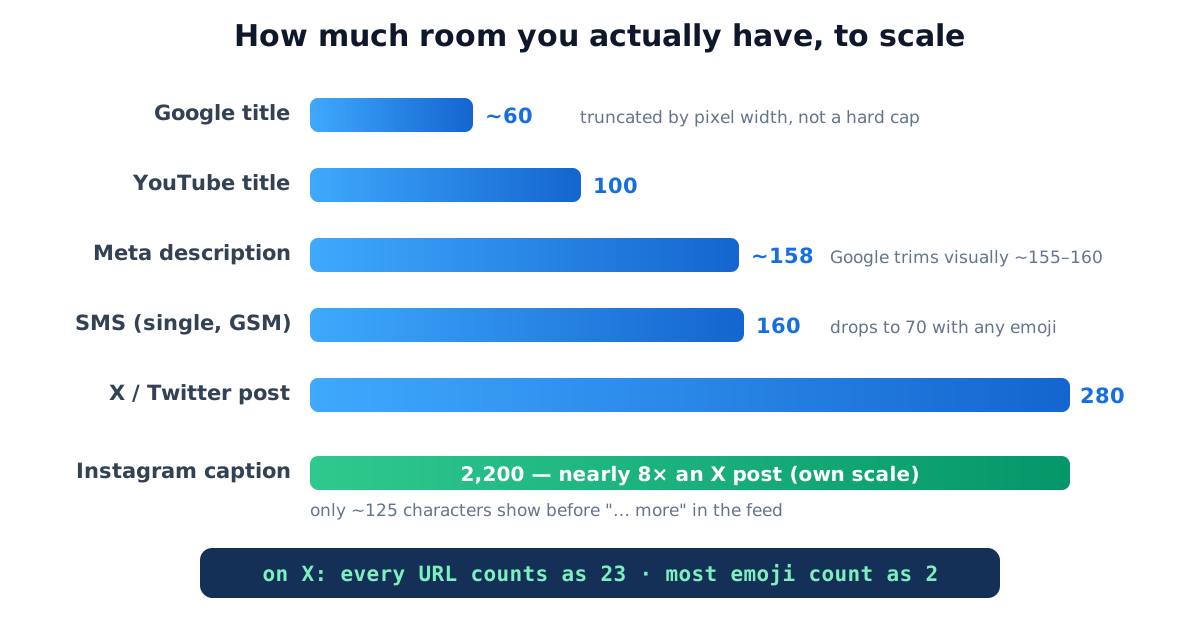
The numbers to remember: an X post is 280 characters, one SMS is 160, Google shows about 60 characters of a title and 155-160 of a meta description, and Instagram captions run to 2,200, of which only ~125 show before ”… more”. Draft against any of them live with the character counter, which tracks these limits as you type.
The cheat sheet
| Platform / field | Limit | The catch |
|---|---|---|
| X / Twitter post | 280 | URLs = 23 flat; emoji = 2; Premium longer but folds at ~280 |
| SMS (single) | 160 | any emoji → 70; multipart segments carry 153 (or 67) |
| Google title | ~60 shown | pixel-based truncation (~600 px), not a hard cap |
| Meta description | ~155-160 shown | pixel-based; mobile shows less |
| Instagram caption | 2,200 | feed folds at ~125; 30-hashtag cap |
| YouTube title | 100 | ~70 visible in most listings |
| YouTube description | 5,000 | first ~157 show in search |
| LinkedIn post | 3,000 | folds after ~210 in the feed |
| Facebook post | 63,206 | folds after ~250; famously precise cap |
| Pinterest description | 500 | ~50-60 visible in grid |
Two patterns run through the table: hard caps (SMS, X) where the platform refuses more, and visibility folds (Google, Instagram, LinkedIn) where you can write more but nobody sees it. The second kind rewards front-loading far more than trimming.
The two traps that surprise everyone
The emoji/SMS trap. Standard SMS uses GSM-7 encoding: 160 characters per message. The moment your text includes a character outside that set, an emoji, curly quotes, many accented letters, the entire message re-encodes as UCS-2 and the limit drops to 70. Long messages then split into segments of 153 (GSM) or 67 (UCS-2) characters, and bulk-SMS services bill per segment: one 🎉 in a marketing blast can double the invoice.
The X link trap. On X, every URL is counted as exactly 23 characters via the t.co wrapper, whether the link is 15 characters or 200. Budget 280 − 23 = 257 for your words per link, and remember most emoji cost 2.
Why a “character” isn’t one thing
The word character hides three different units, and platforms disagree on which one they count. That disagreement is the single biggest reason your own tally and the platform’s tally drift apart.
| Unit | What it counts | Where it shows up |
|---|---|---|
| Byte | Raw storage (1 byte in GSM-7, up to 4 in UTF-8) | SMS segments, some database fields |
| Code point | One Unicode value | Most “character count” APIs, older counters |
| Grapheme cluster | One visible symbol a reader perceives | X, modern JavaScript counters, human intuition |
A single emoji makes the gap obvious. Take the family emoji 👨👩👧👦: a reader sees one symbol (one grapheme cluster), but it is built from four people joined by invisible zero-width joiners, seven code points, and 25 bytes in UTF-8. Paste it into a naive counter and you might see 7 or 11; X shows it as a small handful; your reader sees one. Skin-tone modifiers and flag emoji behave the same way. This is why the character counter counts by grapheme cluster, the unit that matches what people actually read on screen, while still surfacing the raw code-point number for fields that police it.
Accented letters carry a subtler version of the same trap. The letter “é” can be a single pre-composed code point (U+00E9) or an “e” followed by a separate combining accent (two code points that render as one glyph). Text copied from a word processor often uses the two-code-point form, so a name like “José” that looks like four letters can register as five. Normalizing the text collapses that difference; a good counter does it for you.
How to draft against a limit (the workflow)
- Write freely first, editing down beats padding out.
- Paste into the character counter, the limits panel shows characters left (or over) for each platform live.
- For X: subtract 23 per link from what the counter shows; for SMS: strip emoji or accept 70s.
- For Google fields: put the message in the first 50 characters, survival under pixel truncation is about order, not just length.
- Final check in the platform’s own composer. It enforces its own arithmetic.
For word-based limits (essays, abstracts, ad copy word caps), the word counter tracks words, sentences and reading time the same way.
Two worked examples
Budgeting an X post with a link and an emoji. Say you want to post: a headline, a link to your article, and a 🎉 to close. X gives you 280. The link, however long the real URL is, is billed at a flat 23 through the t.co wrapper. The 🎉 costs 2. That leaves 280 − 23 − 2 = 255 characters for your words plus spacing around them. Write to 255, not 280, and the composer will never bounce you.
Costing an SMS campaign. You draft a 158-character promo, comfortably “one SMS.” Then you add a single 🎉 for warmth. That one emoji forces the whole message from GSM-7 into UCS-2, where a single segment holds only 70 characters. Your 159-character message now spans three UCS-2 segments (67 characters each after headers), so a bulk-SMS provider bills it as three messages instead of one, a 3× cost jump from one emoji. Swapping the emoji for the word “Thanks!” keeps it in GSM-7 and on a single segment.
| Draft | Encoding | Segments | Billed as |
|---|---|---|---|
| 158 plain characters | GSM-7 | 1 (up to 160) | 1 message |
| 158 characters + 1 emoji | UCS-2 | 3 (67 each) | 3 messages |
The lesson in both cases is the same: the visible length is not the billed or enforced length. Count against the platform’s real arithmetic, not the character tally your eye gives you.
Writing short: what actually helps
Cutting characters without losing meaning is a skill with three reliable moves: delete throat-clearing openers (“We are pleased to announce that” → nothing), prefer strong verbs over noun phrases (“made a decision” → “decided”), and replace conjunctions with punctuation (“and additionally” → ”—”). A 320 character draft usually contains a 260-character message.
Common mistakes
- Counting words when the limit is characters (or vice versa), SEO titles are characters/pixels, essay limits are words.
- Forgetting spaces count, “characters with spaces” is the number platforms enforce.
- Trusting the emoji to cost 1, it’s 2 on X and it nukes SMS encoding entirely.
- Treating Google’s ~60/~158 as hard caps, they’re visibility folds; write for the fold, don’t fear it.
- Padding to reach a limit, limits are ceilings, not targets; shorter almost always reads better.
Quick summary
Memorize four numbers, 280 (X), 160 (SMS), ~60 (Google title), ~158 (meta description), and the two traps: links cost 23 on X, and one emoji turns an SMS into a 70-character message. Draft with the character counter’s live limit tracking, front-load anything Google will truncate, and let the platform composer make the final call.
Related tools: word counter · case converter · find & replace. Platform figures are the documented values as of mid-2026, platforms occasionally change them.
Frequently asked questions
What is the character limit on X (Twitter)?
280 characters for standard accounts. Every URL counts as 23 characters regardless of length, and most emoji count as 2. Premium subscribers can write much longer posts, but only ~280 characters show before the 'Show more' fold.
Why is one SMS 160 characters?
The GSM standard packs 160 seven-bit characters into one 140-byte message. Include any character outside the GSM set, most emoji, many accented letters, and the whole message switches to 70-character UCS-2 encoding.
How long should a meta description be?
Google truncates by pixel width, not a character count, roughly 155-160 characters usually fits on desktop, less on mobile. Front-load the key message; longer text isn't penalized, just cut visually.
How long can an Instagram caption be?
2,200 characters (and up to 30 hashtags), but the feed collapses everything after roughly 125 characters behind '… more', so the opening line does all the work.
Do spaces and punctuation count as characters?
Yes, on effectively every platform, a character is a character, spaces included. Some style guides also quote 'characters without spaces'; the character counter shows both.
Why does my count differ from the platform's count?
Platforms count some things specially: X's fixed 23 for links, emoji counting as 2, invisible formatting characters in pasted text. Use a counter for drafting, and treat the platform's own composer as the final referee.
Do these limits change?
Occasionally, X famously doubled from 140 to 280 in 2017. The figures here are the widely documented values as of mid-2026; the platform's help pages are the canonical source.