
explainer
Colligative Properties: Why Salt Melts Ice and Antifreeze Works
By Uttam Regmi · Published 2026-07-11 · Updated 2026-08-23 · 6 min read · Fact-checked, sources cited
Colligative properties are the ones that only care how many particles you dissolve, not what they
are. Dissolve anything in water and you lower its freezing point (ΔTf = i·Kf·m) and raise its boiling
point (ΔTb = i·Kb·m). That single idea explains salted roads, antifreeze, and why pasta water with salt
boils a hair hotter.
The two equations
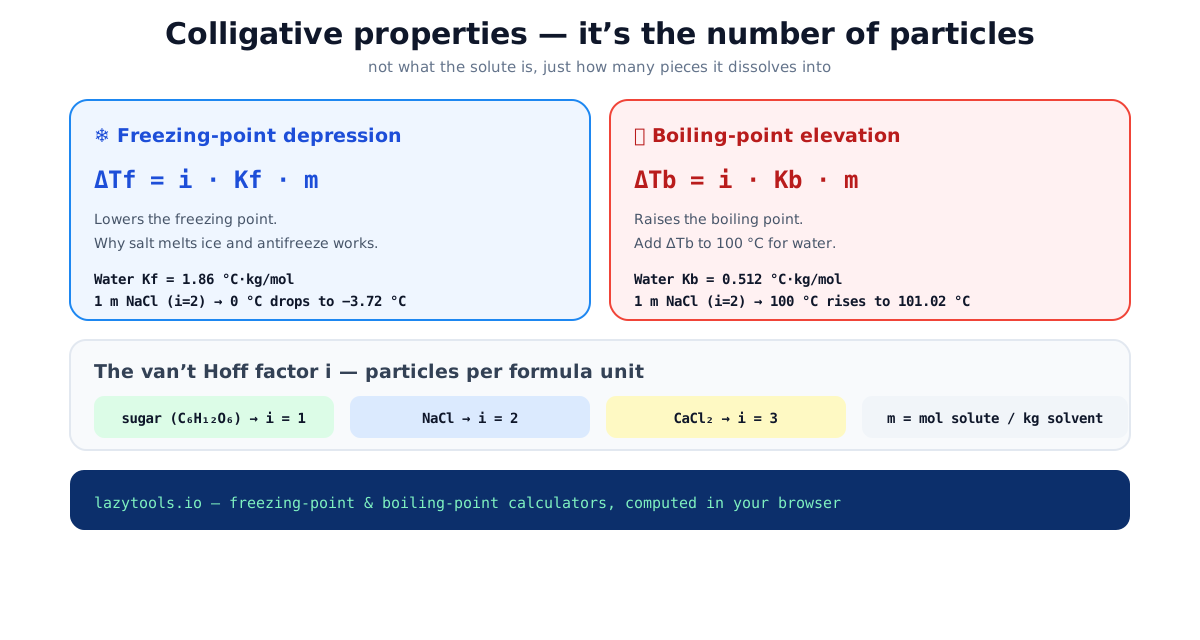
Both effects have the identical shape:
- Freezing-point depression:
ΔTf = i · Kf · m, subtract ΔTf from the pure freezing point. - Boiling-point elevation:
ΔTb = i · Kb · m, add ΔTb to the pure boiling point.
Three quantities feed both, computed by the freezing-point and boiling-point calculators.
The van’t Hoff factor (i)
This is the piece students most often forget. i is the number of particles a solute breaks into. A colligative property counts particles, so an ionic compound that splits into ions has a bigger effect than its formula-unit count suggests:
- Sugar (glucose), stays as one molecule → i = 1
- NaCl → Na⁺ + Cl⁻ → i = 2
- CaCl₂ → Ca²⁺ + 2 Cl⁻ → i = 3
So 1 molal CaCl₂ depresses freezing about three times as much as 1 molal sugar, even though it’s “one solute.” (Real ionic solutions fall a little short of the ideal i because of ion pairing, but the whole number is the working value.)
Kf and Kb are solvent constants
Kf (cryoscopic) and Kb (ebullioscopic) depend only on the solvent. For water:
| Constant | Value | Direction |
|---|---|---|
| Kf | 1.86 °C·kg/mol | freezing point down |
| Kb | 0.512 °C·kg/mol | boiling point up |
Because Kf is ~3.6× larger than Kb, dissolving something drops the freezing point far more than it raises the boiling point, which is why de-icing is dramatic but “salt makes water boil hotter” is a barely measurable ~1 °C at kitchen concentrations. Every solvent has its own pair of constants: benzene, for example, has a much larger Kf (about 5.1 °C·kg/mol), which is why chemists historically used freezing-point depression in benzene to measure the molar mass of unknown compounds.
Molality, not molarity
Colligative equations use molality (m = moles of solute per kilogram of solvent), not molarity (per litre of solution). Molality is used because it doesn’t change with temperature, and these calculations span from freezing to boiling. Convert to molality first (the molarity calculator helps with the mole count).
Worked example: salted water
1 mole of NaCl in 1 kg of water, how much does the freezing point drop?
ΔTf = i · Kf · m = 2 × 1.86 × 1 = 3.72 °C
So the water now freezes at −3.72 °C instead of 0 °C. The same solution boils at 100 + (2 × 0.512 × 1) = 101.02 °C. That asymmetry, a big freezing drop, a small boiling rise, is colligative behaviour in one sentence.
A second example: CaCl₂ vs sugar
Say you dissolve 0.5 mol of calcium chloride in 1 kg of water. CaCl₂ splits into three ions (i = 3), so:
ΔTf = 3 × 1.86 × 0.5 = 2.79 °C
Now compare 0.5 mol of table sugar (sucrose, i = 1) in the same kilogram of water:
ΔTf = 1 × 1.86 × 0.5 = 0.93 °C
Identical mole count, identical solvent, but the ionic solute depresses the freezing point three times as much because it releases three times as many particles. This is the whole reason road crews reach for calcium chloride when it gets truly cold: at the same weight it puts far more particles into the melt-water.
The other two colligative properties
Freezing-point depression and boiling-point elevation get the headlines, but the family has four members, all driven by the same particle-counting logic.
- Vapour-pressure lowering. Adding a non-volatile solute lowers the solvent’s vapour pressure. Raoult’s law describes the ideal case: the solution’s vapour pressure equals the solvent’s mole fraction times the pure solvent’s vapour pressure. This lowering is actually the root cause of both boiling-point elevation and freezing-point depression.
- Osmotic pressure. The pressure needed to stop solvent flowing across a semipermeable membrane into a
solution:
π = i · M · R · T, with M the molarity, R = 0.08206 L·atm/(mol·K), and T in kelvin. Osmotic pressure is enormous even for dilute solutions, which is why it governs biology, cell turgor, IV-fluid tonicity, and how a salted slug loses water.
| Property | Formula | Direction |
|---|---|---|
| Freezing-point depression | ΔTf = i·Kf·m | freezing point falls |
| Boiling-point elevation | ΔTb = i·Kb·m | boiling point rises |
| Vapour-pressure lowering | ΔP = X_solute·P° (ideal) | vapour pressure falls |
| Osmotic pressure | π = i·M·R·T | pressure builds across a membrane |
Real solutions fall short of the ideal i
The whole-number van’t Hoff factor is the ideal value, assuming every ion floats free. In real solutions, especially concentrated ones, oppositely charged ions briefly pair up, so they behave as slightly fewer than the ideal count. Measured freezing-point data for dilute NaCl, for instance, gives an effective i a little below 2 rather than exactly 2. For most back-of-the-envelope work the integer is fine, and calculators use it by default, just know that the real depression is usually a touch smaller than the ideal formula predicts, and the gap grows as concentration rises.
Choosing a de-icer
De-icers are ranked by how cold they stay effective, which comes straight from i and how soluble they are. A rough field guide:
| De-icer | Ideal i | Notes |
|---|---|---|
| Sodium chloride (NaCl) | 2 | Cheapest; loses bite below roughly −7 to −9 °C in practice |
| Magnesium chloride (MgCl₂) | 3 | Works colder than NaCl; attracts moisture |
| Calcium chloride (CaCl₂) | 3 | Effective to much lower temperatures; releases heat as it dissolves |
| Potassium chloride (KCl) | 2 | Gentler on plants; weaker than NaCl per unit mass |
| Urea (CO(NH₂)₂) | 1 | Non-ionic, non-corrosive, but a weak de-icer for its weight |
The pattern is exactly what the equations predict: more particles per formula unit (higher i) plus high solubility means a lower usable temperature. Calcium chloride wins on cold performance partly because it dissolves exothermically, warming the ice it lands on and jump-starting the melt.
Quick summary
Colligative properties depend on the number of dissolved particles. Freezing point falls by
ΔTf = i·Kf·m and boiling point rises by ΔTb = i·Kb·m, where i (the van’t Hoff factor) counts particles
per formula unit and Kf/Kb are solvent constants (1.86 and 0.512 for water). This is why salt melts ice
and antifreeze protects an engine at both ends. Work it out with the
freezing-point depression and
boiling-point elevation calculators.
Sources: standard general-chemistry treatment of colligative properties; cryoscopic and ebullioscopic constants for water. Educational information.
Frequently asked questions
What are colligative properties?
Properties of a solution that depend only on the number of dissolved solute particles, not on what the solute is. The main ones are freezing-point depression, boiling-point elevation, vapour-pressure lowering and osmotic pressure. Two solutions with the same particle concentration show the same effect.
How do you calculate freezing point depression?
ΔTf = i·Kf·m, where i is the van't Hoff factor (particles per formula unit), Kf the cryoscopic constant (1.86 °C·kg/mol for water) and m the molality. For 1 molal NaCl (i ≈ 2), ΔTf = 2 × 1.86 × 1 = 3.72 °C, so water freezes at −3.72 °C.
What is the van't Hoff factor?
The number of particles a solute produces per formula unit when it dissolves. NaCl gives i ≈ 2 (Na⁺ + Cl⁻), CaCl₂ ≈ 3, and molecular solutes like sugar give i = 1. A larger i means a bigger colligative effect.
Why does salt melt ice?
Dissolved salt lowers water's freezing point below the surrounding temperature (freezing-point depression), so the ice melts. The more particles dissolved (higher i·m), the larger the depression, which is why salt and calcium chloride are used to de-ice roads.
How does antifreeze work?
Ethylene glycol dissolved in an engine's water lowers the freezing point (so the coolant doesn't freeze and crack the block) and raises the boiling point (so it doesn't boil over), both colligative effects from the same equations.
Why is boiling-point elevation smaller than freezing-point depression?
Because for water the ebullioscopic constant Kb (0.512) is much smaller than the cryoscopic constant Kf (1.86). The same molality raises the boiling point about 3.6× less than it lowers the freezing point.