
explainer
Crop Factor Explained: Your 50mm Doesn't Become a 75mm (and f/1.8 Is Still f/1.8)
By Uttam Regmi · Published 2026-07-18 · Updated 2026-07-18 · 4 min read · Fact-checked, sources cited
Crop factor is the ratio between your sensor’s diagonal and that of 35mm film (36 × 24 mm). A smaller sensor sees a smaller portion of the image the lens projects, so the picture is cropped, the lens itself is unchanged. A 50 mm on APS-C still has a 50 mm focal length; it simply frames like a 75 mm would on full frame. And the aperture number does not change for exposure: f/1.8 is f/1.8 on any sensor. There’s one place aperture multiplication is real, and it’s depth of field, not brightness.
Where the number comes from
35 mm film measures 36 × 24 mm, a diagonal of about 43.3 mm. Crop factor is that diagonal divided by your sensor’s:
| Format | Approx. size | Crop factor | 50 mm frames like |
|---|---|---|---|
| Full frame | 36 × 24 mm | 1.0× | 50 mm |
| APS-C (Nikon, Sony, Fuji, Pentax) | ~23.5 × 15.6 mm | 1.5× | 75 mm |
| APS-C (Canon) | ~22.3 × 14.9 mm | 1.6× | 80 mm |
| Micro Four Thirds | 17.3 × 13 mm | 2.0× | 100 mm |
| 1-inch type | 13.2 × 8.8 mm | 2.7× | 135 mm |
Full frame is the reference only for historical reasons, it’s what 35 mm film was, so generations of photographers learned what “50 mm” looks like on it. There’s nothing physically special about the size. Run any sensor through the crop factor calculator.
What’s actually happening
A lens projects a circular image. Its focal length is a fixed physical property, determined by the glass, not by what’s behind it.
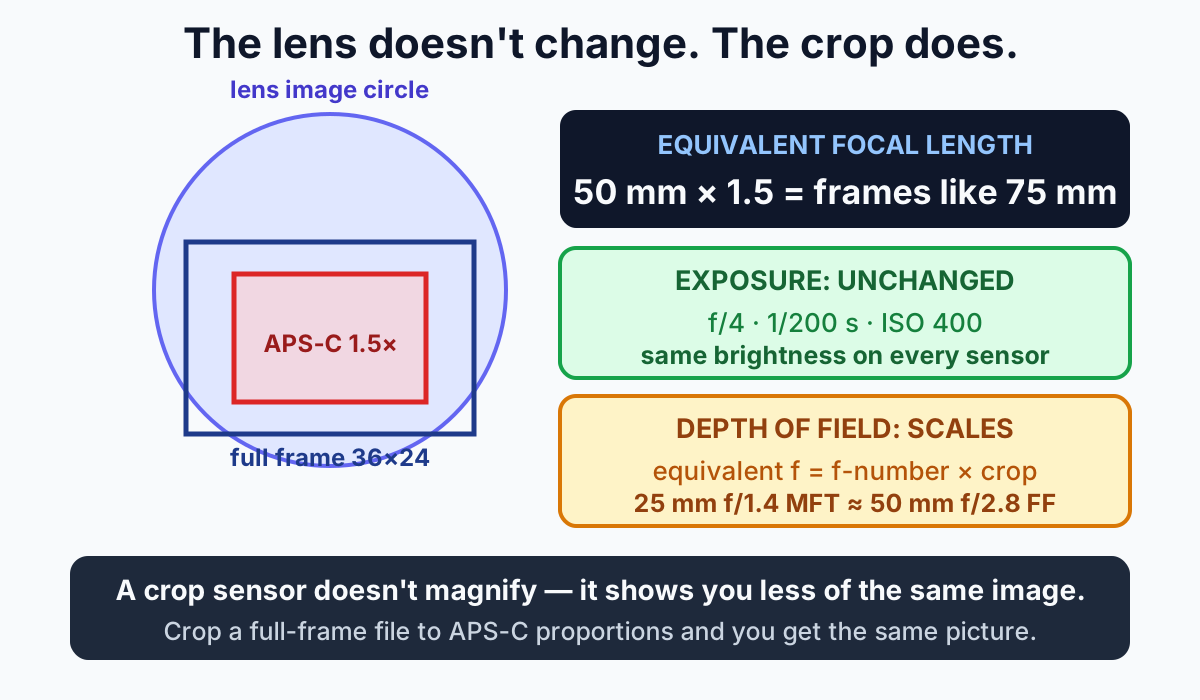
Put a smaller sensor behind that lens and it simply records a smaller rectangle from the middle of that circle. The result looks like a photo taken with a longer lens because the field of view is narrower, but only because you cropped, not because anything magnified.
The proof: shoot the same scene from the same spot on full frame and APS-C with the same 50 mm lens, then crop the full-frame file to the APS-C proportions. The images match. Cropping in software gives you exactly what the smaller sensor gave you, minus the resolution the smaller sensor kept.
That’s why “equivalent focal length” is shorthand for framing, not a change in the lens. Perspective, the relationship between near and far objects, is set by where you stand, not by focal length or sensor, so a crop sensor doesn’t produce telephoto compression either.
The aperture question, answered properly
This is where most explanations go wrong, because the honest answer is “it depends what you’re asking.”
For exposure: nothing changes. An f-number is focal length ÷ entrance pupil diameter, a measure of light per unit area. f/4 at 1/200 s and ISO 400 produces the same image brightness on full frame, APS-C and Micro Four Thirds. Crop factor does not multiply your f-number and does not multiply ISO. Your light meter doesn’t care what sensor you have.
For depth of field: it does scale. If you compare shots with the same framing (which means either moving, or using an equivalently shorter lens on the smaller sensor), the smaller format gives more depth of field at the same f-number. To find the full-frame look-alike:
equivalent aperture = f-number × crop factor
So 25 mm f/1.4 on Micro Four Thirds frames like, and has roughly the depth of field of, 50 mm f/2.8 on full frame. But it still exposes like f/1.4.
Both statements are true at once, and conflating them is the source of endless argument. Compare depth of field across formats with the depth of field calculator.
Practical consequences
Wide angle is harder on a crop sensor. To get a full-frame 24 mm view on APS-C you need about a 16 mm lens. This is why crop-sensor systems sell ultra-wide zooms that sound absurdly short.
Telephoto reach is cheaper. A 300 mm on a 1.6× body frames like 480 mm. You haven’t gained magnification, you’ve cropped, but if you were going to crop anyway, the smaller sensor spends all its pixels on the part you wanted. For distant wildlife and sport, that’s a genuine practical advantage.
Lenses are smaller and lighter. Covering a smaller image circle takes less glass, which is much of the appeal of Micro Four Thirds.
Deep depth of field can be a feature. Landscape, macro and video work often want more in focus, the same property that frustrates portrait shooters chasing background blur.
Frequently asked questions
What is crop factor?
Crop factor is the ratio between the diagonal of 35mm film (36 x 24 mm, about 43.3 mm) and the diagonal of your camera's sensor. A smaller sensor captures a smaller portion of the image the lens projects, so the picture is cropped.
Does a 50mm lens become a 75mm on APS-C?
No. The lens's actual focal length never changes; a 50mm stays 50mm. On a 1.5x APS-C sensor it simply frames like a 75mm would on full frame, because the smaller sensor sees a narrower field of view.
Does crop factor change the aperture or exposure?
No. For exposure, f/1.8 is f/1.8 on any sensor. Settings like f/4, 1/200 s, ISO 400 give the same brightness on every format. The lens gathers light the same way regardless of the sensor behind it.
What are the common crop factors?
Full frame is 1.0x, APS-C is about 1.5x (Nikon, Sony, Fuji, Pentax) or 1.6x (Canon), Micro Four Thirds is 2.0x, and 1-inch type is about 2.7x.
Where is aperture multiplication by crop factor actually real?
Only for depth of field, not brightness. The equivalent aperture for depth-of-field comparison equals the f-number times the crop factor, so f/2.8 on a 1.5x sensor gives depth of field like f/4.2 on full frame.