
explainer
Debt Snowball vs Avalanche: Which Pays Off Debt Faster?
By Uttam Regmi · Published 2026-07-11 · Updated 2026-07-11 · 7 min read · Fact-checked, sources cited
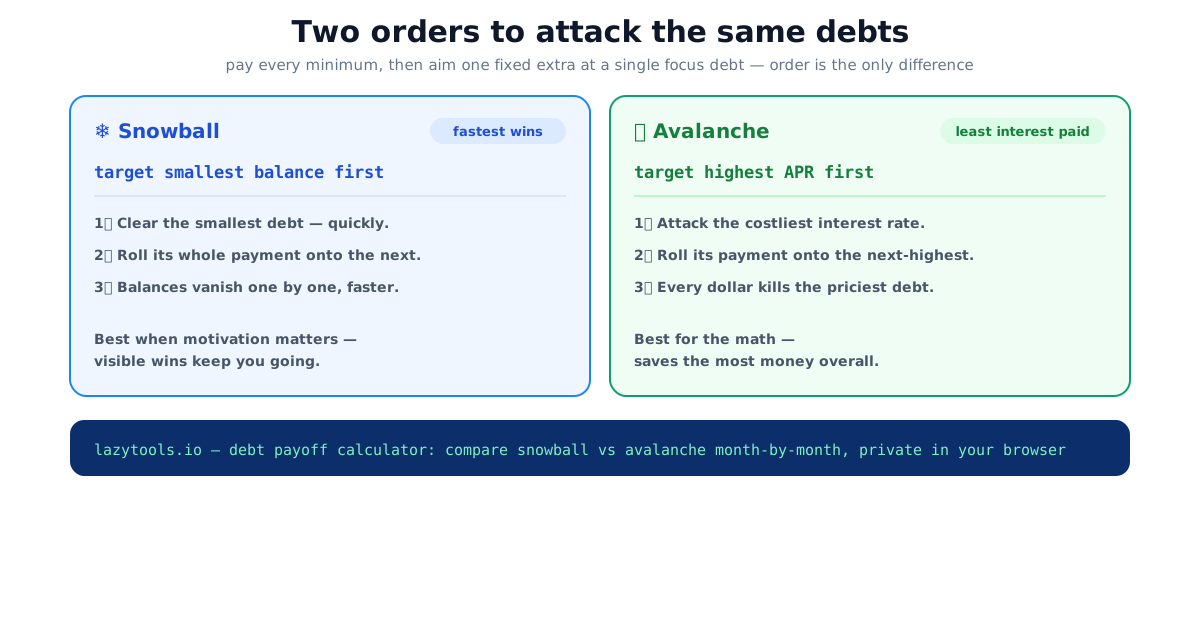
Both methods use the exact same monthly budget, the only thing that changes is which debt you attack first. The avalanche targets the highest interest rate and always pays the least total interest. The snowball targets the smallest balance and clears individual debts sooner, which keeps a lot of people motivated. Neither is “wrong”; they optimise for different things.
The one idea both methods share
Whatever order you choose, the mechanics are identical:
- Pay every minimum on every debt, every month.
- Take a fixed extra amount you can afford and throw it at one focus debt.
- When that debt clears, its whole payment rolls onto the next focus debt.
That rolling-over is the “snowball” effect (it applies to both methods): the amount you attack with grows every time a debt disappears, because freed-up minimums join your extra payment. The methods differ on one decision only, which debt is the focus.
Snowball: smallest balance first
Order your debts by balance, smallest to largest, and ignore the interest rates. Attack the smallest until it’s gone, then roll onto the next.
The appeal is psychological: a small debt can vanish in a month or two, and that early win is a powerful motivator. Behavioural research on goal-setting and debt paydown has repeatedly found that people who see a debt account fully closed are more likely to stay engaged and keep going, the momentum of visible progress, not the maths, is the selling point. The cost is that you may leave a high-interest debt sitting there accruing while you clear a cheaper small one.
Snowball tends to suit you if you have several small balances (a store card, a medical bill, a small personal loan) that can each be cleared quickly, or if you’ve abandoned a payoff plan before and need the encouragement of watching accounts disappear one by one.
Avalanche: highest interest rate first
Order your debts by APR, highest to lowest, and ignore the balances. Every spare dollar goes to the most expensive interest until that debt clears, then rolls onto the next-highest rate.
Because interest is what makes debt grow, killing the highest rate first means the least money is lost to interest overall, for a fixed monthly budget, this ordering minimises total interest. The trade-off: if your highest-rate debt also has a big balance, it can take a while before you see your first debt disappear, which some people find discouraging.
Avalanche tends to suit you if you’re comfortable being guided by the numbers, or if one debt, usually a credit card at 20%+ APR, sits far above everything else. In that case the interest saving isn’t marginal, and there’s little behavioural downside to postponing a “win” you’d only get a month or two sooner anyway.
Side by side
| Snowball | Avalanche | |
|---|---|---|
| Sort debts by | Balance, smallest first | Interest rate (APR), highest first |
| Optimises for | Motivation and momentum | Lowest total interest |
| First win arrives | Usually fast (small balance) | Can be slow (if top-rate debt is large) |
| Total interest paid | Slightly higher | Lowest possible for your budget |
| Best when | You’ve struggled to stick with a plan | One debt has a much higher rate |
| Risk | Leaves costly interest running longer | Early progress feels slow, easier to quit |
Both columns assume the same non-negotiable: every minimum paid, every month, with one fixed extra aimed at the focus debt.
A worked example
Say you owe four debts and can put $250/month extra toward them on top of the minimums (total minimums here are $345, so the budget is $595/month either way):
| Debt | Balance | APR | Minimum |
|---|---|---|---|
| Medical bill | $500 | 0% | $25 |
| Store card | $2,000 | 24.5% | $50 |
| Credit card | $4,000 | 19% | $90 |
| Car loan | $8,000 | 6% | $180 |
Running both methods month-by-month:
| Snowball (smallest first) | Avalanche (highest APR first) | |
|---|---|---|
| First debt cleared | Medical bill, month 2 | Store card, month 8 |
| Payoff order | Medical → Store → Credit → Car | Store → Credit → Medical → Car |
| Total interest | $1,834 | $1,729 |
| Months to debt-free | 28 | 28 |
Here avalanche saves about $105 in interest, real money, but not life-changing, because the rates aren’t wildly far apart. Meanwhile the snowball wipes out a whole debt in month 2 (the interest-free medical bill), giving you an early, motivating win. Both finish in 28 months because the $8,000 car loan is the last debt paid either way, so it sets the finish line.
The lesson: the bigger the gap between your highest and lowest rate, the more avalanche saves. If that store card were 29.9% and your other debts were 5%, avalanche would pull far ahead. When rates are close, pick whichever keeps you paying.
Why the payment “snowballs” either way
The name confuses people, so it’s worth being precise: the snowball effect, your attack payment growing as debts clear, happens under both methods. It’s just the label “snowball method” that refers specifically to the smallest-balance ordering.
Trace the extra payment through the worked example above under the snowball ordering:
| Stage | What you’re paying the focus debt |
|---|---|
| Start | $25 minimum (medical) + $250 extra = $275 |
| Medical cleared | $50 (store min) + $25 (freed) + $250 = $325 |
| Store cleared | $90 (credit min) + $75 (freed) + $250 = $415 |
| Credit cleared | $180 (car min) + $165 (freed) + $250 = $595 |
By the final stretch your entire $595 budget is landing on one debt, even though your out-of-pocket cost never changed. That compounding of freed-up minimums is what makes a fixed budget so much more powerful than paying minimums alone, where the same $8,000 car loan at 6% would take far longer and cost far more.
Common mistakes that undo the plan
- Skipping a minimum to overpay the focus debt. A single missed minimum can trigger a late fee and, on credit cards, a penalty APR, wiping out weeks of progress. Minimums first, always; the extra is what’s left.
- Not freezing new borrowing. Paying down a card and then charging it back up leaves you running in place. The math only works if the balances actually fall.
- Restarting the order after every statement. Pick your ordering once and stick to it until a debt clears. Reshuffling monthly loses the momentum both methods depend on.
- Ignoring a promotional 0% period ending. If a balance-transfer or store-card 0% offer expires soon, its “real” rate may be far higher than the sticker 0%, worth targeting before the deferred interest kicks in, whichever method you’re following.
So which should you choose?
- Choose avalanche if you’re motivated by the numbers, or if one debt has a much higher rate than the rest (most credit cards vs. a car loan or student loan). It saves the most.
- Choose snowball if you’ve struggled to stick with a plan before, or your smallest debts can be cleared in a month or two. The visible progress is worth more than a small interest saving.
- Either beats no plan. The single biggest factor is how much extra you can pay, even a modest, consistent extra payment cuts months off the finish line and hundreds off the interest.
The debt payoff calculator runs both methods on your actual debts side by side and shows the interest each costs and the order each clears them in, so you can see the trade-off for your numbers, not a textbook example. It’s a private, browser-only calculator: your balances and rates never leave your device.
Educational calculators, not financial advice. LazyTools does arithmetic on the figures you enter and cannot account for your full circumstances. For guidance on your own debts, consider a qualified, non-profit credit counsellor.
Sources: for the underlying mechanics and the behavioural evidence on debt paydown, see the Consumer Financial Protection Bureau, “How to reduce your debt” and research summarised by the Harvard Business Review, “Research: The Power of Small Wins in Debt Repayment”. Interest and payoff figures above are computed by LazyTools’ own month-by-month amortization for the example shown.
Frequently asked questions
Is the snowball or avalanche method better?
The avalanche method (paying the highest interest rate first) always costs you the least total interest, it's the mathematically optimal choice. The snowball method (paying the smallest balance first) clears individual debts sooner, which many people find more motivating. If the interest difference is small, the snowball's momentum can be worth more than the few dollars saved; if you have one debt at a much higher rate, avalanche is clearly better.
How does the debt snowball method work?
List your debts from smallest balance to largest, regardless of interest rate. Pay the minimum on all of them, then throw every spare dollar at the smallest. When it's gone, roll its whole payment onto the next-smallest, the amount you attack with 'snowballs' as each debt clears. The quick early wins are the whole point.
How does the debt avalanche method work?
List your debts from highest interest rate (APR) to lowest. Pay the minimum on all of them, then put every spare dollar toward the highest-rate debt. When it clears, roll its payment onto the next-highest rate. Because you always kill the most expensive interest first, you pay the least interest overall and usually finish a little sooner.
Does the avalanche method always save money?
Yes, for the same monthly budget, targeting the highest interest rate first mathematically minimises the total interest you pay. The savings can be small (a few dollars) when your rates are similar, or large (hundreds or thousands) when one debt has a much higher APR than the rest.
Why do both methods take a similar number of months sometimes?
The total time is driven mostly by your total balance and your monthly budget, not the order. When your largest debt is also the last one paid under both methods, both finish in the same month, the difference shows up as interest paid and how soon the earlier debts disappear, not the finish line.
Should I stop paying minimums on other debts?
No. Both methods rely on paying every minimum every month, missing one triggers late fees, penalty rates and credit-score damage. You only send your extra payment to the one focus debt; everything else keeps getting its minimum until its turn comes.
Is this calculator financial advice?
No. LazyTools' debt payoff calculator is an educational tool that does arithmetic on the numbers you enter. It runs entirely in your browser and nothing is uploaded. It doesn't know your full situation and can't recommend a plan. For decisions about your own debts, consider a qualified, non-profit credit counsellor.