
explainer
Dew Point vs Relative Humidity: Why 100% Humidity Can Feel Fine and 50% Can Feel Awful
By Uttam Regmi · Published 2026-07-18 · Updated 2026-07-18 · 4 min read · Fact-checked, sources cited
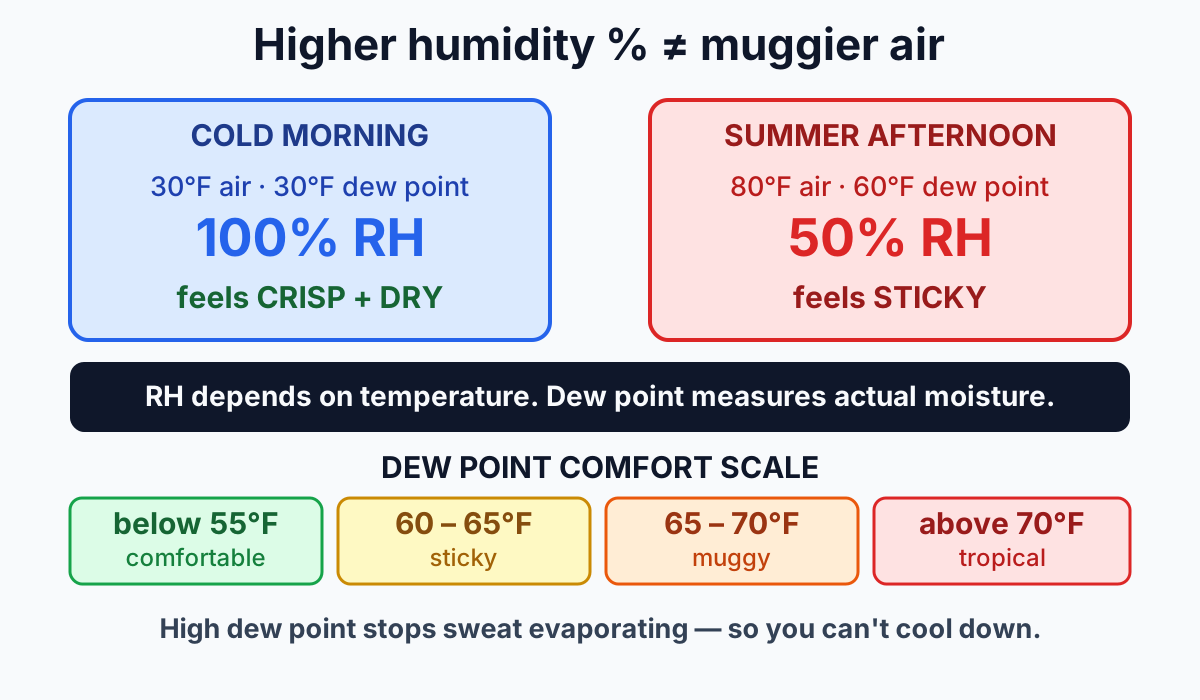
Relative humidity is a percentage of what the air could hold at that temperature, so it moves when the temperature moves, even if the moisture doesn’t. Dew point measures the actual amount of water vapour in the air, and it doesn’t care what the thermometer says. That’s why a 30°F morning at 100% relative humidity feels crisp and dry, while an 80°F afternoon at just 50% feels sticky and oppressive. Meteorologists quote dew point for comfort because it’s the number that actually tracks how the air feels.
What each number actually means
Dew point is the temperature to which air must be cooled for it to become saturated and start condensing water. It’s a direct readout of how much water vapour is present. Higher dew point = more moisture in the air, full stop.
Relative humidity is the ratio of the moisture present to the maximum the air could hold at its current temperature, expressed as a percentage. The catch is in that last clause: warm air can hold dramatically more water vapour than cold air, so the denominator changes constantly.
This means RH can swing wildly through a single day while the actual moisture never changes. A typical summer day starts at dawn with high RH (cool air, small capacity), and by mid-afternoon the same air reads much lower RH simply because it warmed up. Nothing was added or removed.
The example that settles it
| Cold morning | Summer afternoon | |
|---|---|---|
| Air temperature | 30°F (−1°C) | 80°F (27°C) |
| Dew point | 30°F | 60°F |
| Relative humidity | 100% | 50% |
| How it feels | Crisp, dry | Sticky, humid |
The 100% reading is the comfortable one. At 30°F the air is saturated, but saturated cold air contains very little actual water. At 80°F with a 60°F dew point, the air is only half “full”, yet it holds far more moisture in absolute terms.
Ask “how much water is in the air?” and RH can’t answer without also knowing the temperature. Dew point answers directly. Convert between them with the dew point calculator.
The dew point comfort scale
| Dew point | Feels like |
|---|---|
| Below 50°F (10°C) | Dry, pleasant |
| 50-55°F (10-13°C) | Comfortable |
| 55-60°F (13-16°C) | Getting noticeable |
| 60-65°F (16-18°C) | Sticky, humid |
| 65-70°F (18-21°C) | Muggy, uncomfortable |
| Above 70°F (21°C) | Oppressive, tropical |
Most people find the transition point sits right around 60°F. Below it, summer air feels manageable; above it, the same temperature starts to feel like work.
Why it’s about sweat, not water
Your body cools itself mainly by evaporating sweat, the phase change carries heat away from your skin. Evaporation depends on the difference between the moisture on your skin and the moisture already in the air.
When the dew point is high, the air is already carrying a lot of vapour, so sweat evaporates slowly or barely at all. It sits on your skin, you stay hot, and you feel sticky. Nothing is cooling you.
This is also why high dew points are genuinely dangerous, not just unpleasant: they disable the body’s main cooling mechanism. That’s the physiology behind heat index, which combines temperature and humidity into an apparent temperature, see the heat index calculator, and behind wet-bulb temperature, the measure used to identify conditions where sweating can no longer keep a person cool at all.
Two things dew point tells you for free
1. It can never exceed the air temperature. If they’re equal, the air is saturated (100% RH), which is what produces fog, dew on grass, and condensation on a cold drink. The gap between temperature and dew point is a quick read on how close the air is to saturation.
2. It predicts the overnight low. Air generally can’t cool much below its dew point, because condensation releases heat as it happens. So on a calm, clear night, tonight’s dew point is a decent first guess at tomorrow morning’s minimum temperature.
When relative humidity is the right number
RH isn’t useless, it’s just the wrong tool for outdoor comfort. It’s the correct metric when the temperature is controlled and what you care about is saturation relative to that temperature:
- Indoor comfort and health, roughly 30-50% RH is the usual target range
- Mould and condensation risk, mould growth tracks surface RH
- Musical instruments, wood, paper and artwork, all respond to RH
- Greenhouses and growing, though growers increasingly use VPD (vapour pressure deficit), which combines temperature and humidity into how hard plants must work to transpire
Frequently asked questions
What is the difference between dew point and relative humidity?
Dew point is the temperature at which air becomes saturated, an absolute measure of moisture content. Relative humidity is the percentage of moisture relative to what the air could hold at its current temperature, so it changes as temperature changes even when the moisture does not.
Why does 100% humidity sometimes feel dry?
Because relative humidity is relative to temperature. At 30 degrees Fahrenheit, saturated air at 100% RH contains very little actual water vapour, so it feels crisp. Warm air at 50% RH can hold far more water in absolute terms and feels much muggier.
What dew point is uncomfortable?
Above about 60 degrees Fahrenheit (16 degrees Celsius) starts to feel sticky, 65 degrees is clearly muggy, and above 70 degrees (21 degrees Celsius) is oppressive. Dew points of 55 degrees and below are generally comfortable.
Why does high humidity make heat dangerous?
Your body cools by evaporating sweat. When the air already holds a lot of moisture, sweat evaporates poorly, so that cooling mechanism fails. This is why heat index and wet-bulb temperature, which account for humidity, describe heat risk far better than air temperature alone.
Can dew point be higher than the temperature?
No. Dew point can equal the air temperature (saturation, 100% relative humidity) but not exceed it. When air cools to its dew point you get condensation such as fog, dew, or clouds.
Should I use relative humidity indoors?
Yes. Indoors the temperature is controlled and RH is the useful measure. Around 30 to 50% is a common target for comfort, and RH is what governs mould risk and the wellbeing of wood, paper, and instruments.