
explainer
C1V1 = C2V2: How to Calculate Any Dilution (with Serial Dilutions)
By Uttam Regmi · Published 2026-07-10 · Updated 2026-08-23 · 7 min read · Fact-checked, sources cited
The dilution equation C₁V₁ = C₂V₂ says the amount of solute stays the same when you dilute, so to
find how much stock you need, rearrange to V₁ = C₂V₂ / C₁. To make 100 mL of a 1× solution from a
10× stock, that’s (1 × 100) / 10 = 10 mL of stock plus 90 mL of diluent. Solve for any unknown, or
plan a full serial dilution, with the dilution calculator; here’s how
it works.
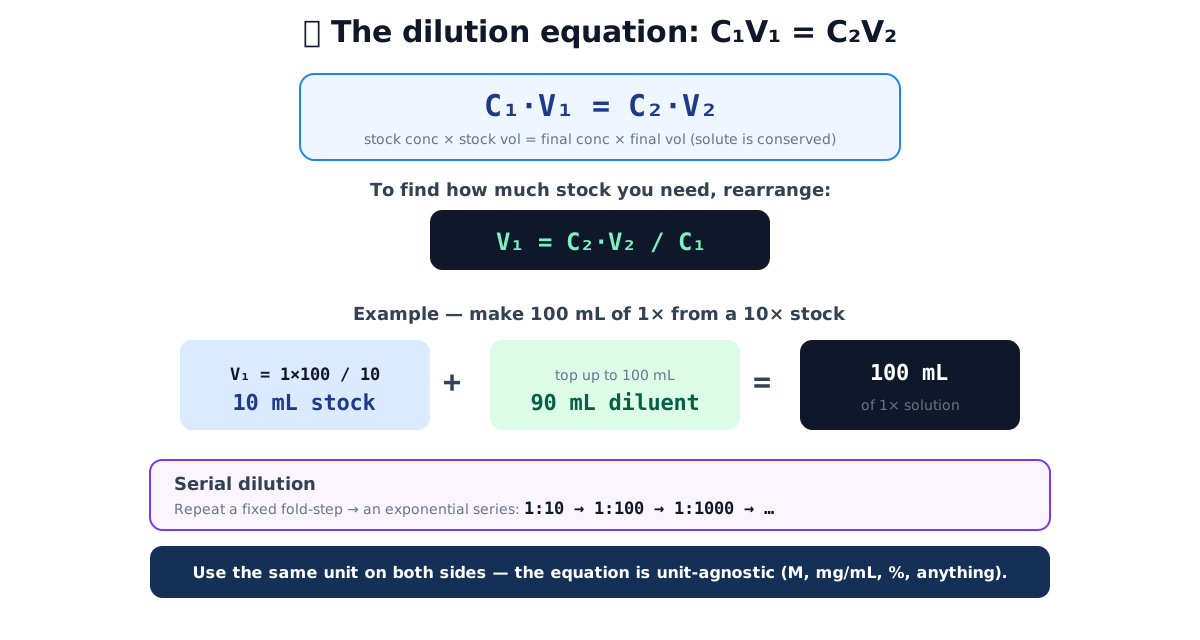
The equation in one picture
Why it works: solute is conserved
When you dilute a solution, you add solvent but not more solute, so the amount of solute (grams, moles, whatever) is the same before and after. Amount = concentration × volume, so:
C₁ × V₁ = C₂ × V₂
where 1 is the concentrated stock and 2 is the diluted final solution. That’s the whole idea, and it follows directly from conservation of mass: dilution rearranges the same solute into a larger volume, so concentration falls in exact proportion to how much you spread it out. Nothing is created or destroyed, so the two products must be equal.
To find any one value, rearrange for it. Most often you know the stock concentration (C₁), the concentration you want (C₂) and the final volume (V₂), and you’re solving for how much stock to use:
V₁ = C₂ × V₂ / C₁
But the equation solves for whichever variable you’re missing. The table below shows the four rearrangements, pick the row for the value you don’t know.
| Unknown | You know | Rearranged formula | In words |
|---|---|---|---|
| V₁ (stock volume) | C₁, C₂, V₂ | V₁ = C₂V₂ / C₁ | How much stock to measure |
| C₂ (final conc.) | C₁, V₁, V₂ | C₂ = C₁V₁ / V₂ | How dilute you’ll end up |
| V₂ (final volume) | C₁, V₁, C₂ | V₂ = C₁V₁ / C₂ | How far to top up |
| C₁ (stock conc.) | C₂, V₂, V₁ | C₁ = C₂V₂ / V₁ | How strong the stock must be |
A worked example
Make 100 mL of 1× working solution from a 10× stock:
- C₁ = 10×, C₂ = 1×, V₂ = 100 mL
- V₁ = (1 × 100) / 10 = 10 mL of stock
- Diluent = 100 − 10 = 90 mL
So: measure 10 mL of the 10× stock, add 90 mL of diluent, and you have 100 mL of 1×. The dilution calculator solves for whichever value you leave blank, so you never have to rearrange by hand.
Note the order of operations that matters at the bench: add the stock to a partially filled container, then bring the total up to the final volume, do not add the full diluent volume and then the stock. V₂ is the final total volume, not the volume of diluent added. The diluent you add is V₂ − V₁, which here happens to be 90 mL only because volumes are additive for dilute aqueous solutions; for concentrated stocks or non-ideal mixtures, measuring to the final mark is the reliable approach.
Three quick examples in real units
The same three-step method, plug in, rearrange, subtract for diluent, works regardless of the concentration unit:
- Molarity. You have a 1 M NaCl stock and need 50 mL of 0.15 M saline. V₁ = (0.15 × 50) / 1 = 7.5 mL of stock, topped up to 50 mL with water.
- Mass concentration. From a 10 mg/mL antibiotic stock you want 20 mL at 50 µg/mL. Convert to shared units first, 50 µg/mL = 0.05 mg/mL, then V₁ = (0.05 × 20) / 10 = 0.1 mL (100 µL).
- Percent solution. To make 500 mL of 0.5% agarose from a 2% stock: V₁ = (0.5 × 500) / 2 = 125 mL of stock plus 375 mL of buffer.
The middle example shows the one place errors creep in: mismatched units. Convert before you divide, not after.
Why the units don’t matter (as long as they’re consistent)
Because concentration appears on both sides, the units cancel. Use molarity, mg/mL, µg/mL or %, the
equation doesn’t care, provided both concentrations share a unit and both volumes share a unit. That’s
also why this is M₁V₁ = M₂V₂ when the concentration happens to be molarity: same equation, one
specific unit. And it’s why the tool needs no compound database and never goes stale, the maths is
exact for whatever units you use.
One caution: C₁V₁ = C₂V₂ assumes the concentration unit is linear in the amount of solute, which is true for molarity, mass/volume and % w/v. It is not designed for pH or other logarithmic scales, and % w/w (by mass) mixes cleanly only when you also account for density, for routine lab work with w/v and molar stocks you rarely hit those edges.
Serial dilutions and the dilution factor
Sometimes one dilution can’t reach the concentration you need accurately (pipetting 1 µL of stock into 10 L isn’t practical). A serial dilution solves this by repeating a smaller, fixed fold-dilution step by step:
- 1:10, then 1:10 again → 1:100, then again → 1:1000, and so on.
Each step’s dilution factor is final volume ÷ sample volume, and the cumulative factor is the product of the steps. A worked 10-fold series makes this concrete: transfer 100 µL from each tube into 900 µL of diluent, mix, then repeat.
| Tube | Transfer in | Diluent | Step factor | Cumulative factor | Concentration (from 1 M) |
|---|---|---|---|---|---|
| A | 100 µL stock | 900 µL | 10× | 10× | 0.1 M |
| B | 100 µL of A | 900 µL | 10× | 100× | 0.01 M |
| C | 100 µL of B | 900 µL | 10× | 1000× | 0.001 M |
| D | 100 µL of C | 900 µL | 10× | 10 000× | 0.0001 M |
The cumulative factor multiplies (10 × 10 × 10 …), which is why four easy 10× steps reach a 10 000-fold dilution that would be impractical to pipette in one shot. The dilution calculator’s serial-dilution planner lays out the transfer volume, diluent volume and cumulative fold-dilution for every tube, the recipe you actually pipette. Once you have a target concentration, the molarity calculator tells you how much to weigh out for the stock in the first place.
Common mistakes to avoid
- Treating V₂ as the diluent volume. V₂ is the final total volume. The diluent you add is V₂ − V₁, so measure up to the mark rather than adding V₂ of solvent to the stock.
- Mixing units across a side. Both concentrations must share a unit and both volumes must share a unit. Convert µg/mL to mg/mL, or mL to L, before you calculate.
- Skipping the mix step in a serial dilution. Each tube must be thoroughly mixed before you draw the next transfer, or the cumulative factor drifts and later tubes read high.
- Carrying pipetting error down the chain. In a serial dilution every step compounds, so a small volume error in an early tube is amplified in the most dilute tubes, use the largest practical transfer volume and a calibrated pipette for the first steps.
Quick summary
C₁V₁ = C₂V₂ conserves solute, so V₁ = C₂V₂/C₁ tells you how much stock to use, 10 mL stock + 90 mL diluent gives 100 mL of 1× from a 10× stock. Units cancel, so it works for any consistent concentration unit (that’s the same equation as M₁V₁ = M₂V₂). For very dilute targets, a serial dilution repeats a fold-step for an exponential series. Solve any dilution, or plan a serial one tube-by-tube, with the dilution calculator.
Sources: conservation of mass (amount of solute = concentration × volume), standard analytical chemistry; general laboratory dilution practice. Educational information.
Frequently asked questions
What is the C1V1 = C2V2 formula?
It is the dilution equation. The amount of solute doesn't change when you dilute, so the concentration times volume of the stock equals the concentration times volume of the final solution: C₁V₁ = C₂V₂. It is the same as M₁V₁ = M₂V₂ when the concentration is molarity.
How do I calculate how much stock solution to use?
Rearrange to V₁ = C₂V₂ / C₁. For example, to make 100 mL of a 1× solution from a 10× stock: V₁ = (1 × 100) / 10 = 10 mL of stock, then top up with 90 mL of diluent to reach 100 mL.
Do the units matter in C1V1 = C2V2?
Only that they are consistent. Use the same unit for both concentrations (M, mg/mL, %, whatever) and the same unit for both volumes. The units cancel, so the equation works for any concentration unit, that's why it needs no lookup tables and never goes out of date.
What is a serial dilution?
A stepwise dilution where each tube is diluted by the same factor from the previous one, producing an exponential concentration series such as 1:10, 1:100, 1:1000. It's used to reach very low concentrations accurately and to make standard curves. A serial-dilution planner gives the transfer and diluent volume for each tube.
What is a dilution factor?
The ratio of final volume to sample volume, how many times more dilute the result is. A dilution factor of 10 (a 1:10 dilution) means the sample ends up 10× less concentrated. Multiply the concentrations of each step to get the cumulative dilution factor of a serial dilution.
Is C1V1 = C2V2 the same as M1V1 = M2V2?
Yes, M₁V₁ = M₂V₂ is the same equation with molarity as the concentration. C₁V₁ = C₂V₂ is the general form for any concentration unit (molarity, mg/mL, % w/v, and so on).