
explainer
How Old Is My Dog in Human Years? The 7-Year Myth, Debunked
By Uttam Regmi · Published 2026-07-12 · Updated 2026-08-23 · 6 min read · Fact-checked, sources cited

“Multiply by 7” is the most famous pet-math rule, and it’s wrong. Dogs don’t age at a steady seven human years per calendar year. They grow up fast, a one-year-old dog is closer to a 15-year-old human than a 7-year-old, and then age more slowly. So the real curve bends, while the ×7 rule draws a straight line that’s off at both ends.
Why the ×7 rule fails
The maths of “multiply by 7” assumes a dog ages the same amount every year of its life. But development is front-loaded: a dog reaches near-adult size and sexual maturity within its first year, something that takes a human around 15 years. Then ageing slows down. Plotting the two side by side makes the mismatch obvious:
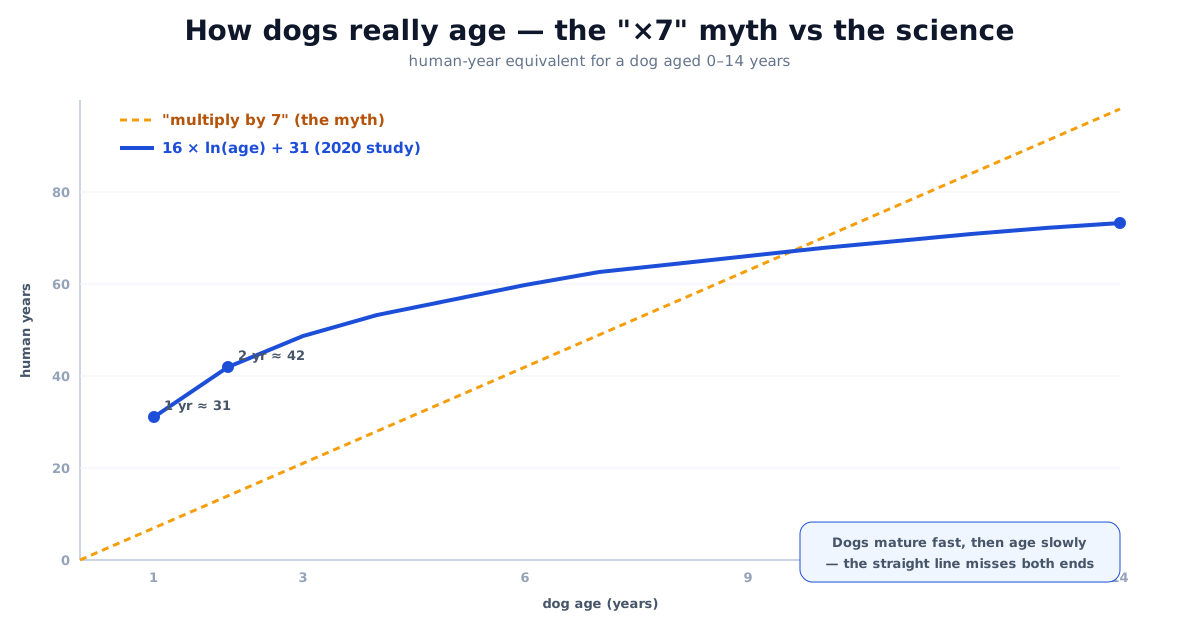
The straight orange line under-counts a young dog’s age (it calls a 1-year-old “7”) and over-counts an old one. The blue curve, the science, does the opposite of a straight line: steep early, gentle later.
Where does “7” even come from? The most common story is that it was a rough marketing rule from decades ago, loosely reasoned as “humans live to about 70, dogs to about 10, so one dog year is seven human years.” It was never based on biology. The problem is that ageing isn’t a fixed exchange rate, the ratio changes dramatically across a dog’s life, so any single multiplier is wrong somewhere.
The modern method: the epigenetic formula
In 2020, researchers (Wang et al.) compared DNA methylation, chemical marks that accumulate on DNA as both dogs and humans age, and derived a translation:
human age = 16 × ln(dog age) + 31
where ln is the natural logarithm. Run a few numbers and the fast-then-slow shape appears:
| Dog age | Human years (epigenetic) |
|---|---|
| 1 | ~31 |
| 2 | ~42 |
| 4 | ~53 |
| 8 | ~64 |
| 10 | ~68 |
| 14 | ~73 |
The first year is a huge leap; each later year adds less. (The formula is meant for dogs past puppyhood, and was based on Labrador Retrievers, so treat it as a population guide rather than a per-dog verdict.)
A worked example
Suppose you have a 4-year-old dog and want the epigenetic estimate by hand. Take the natural log of 4, which is about 1.386. Multiply by 16 to get ≈ 22.2, then add 31: the result is ≈ 53 human years. Do the same for a 1-year-old and the log term vanishes (ln 1 = 0), leaving exactly 31, which is why the formula treats even a young adult dog as firmly middle-aged in human terms. The lesson: most of a dog’s “human age” is banked early, and the curve barely moves in the senior years.
The traditional method: size matters
The other common approach is the size-based chart used by many vets (and published by groups like the American Veterinary Medical Association): about 15 human years for the first year, +9 for the second (so ~24 at age two), then a yearly amount that depends on the dog’s size. Larger breeds have shorter lifespans and age faster, so a giant breed gains more human-equivalent years per calendar year than a toy breed. That’s why a 10-year-old Great Dane is “older” than a 10-year-old Chihuahua.
Here is how the same calendar age lands very differently by size under the traditional convention:
| Dog age | Small (<10 kg) | Medium (10-25 kg) | Large (25-45 kg) | Giant (>45 kg) |
|---|---|---|---|---|
| 2 | ~24 | ~24 | ~24 | ~24 |
| 5 | ~36 | ~37 | ~40 | ~45 |
| 8 | ~48 | ~51 | ~55 | ~64 |
| 10 | ~56 | ~60 | ~66 | ~79 |
| 13 | ~68 | ~74 | ~82 | ~101 |
The first two years are roughly the same for every dog; the size gap opens up later, which is why a giant breed can be “over 100” while a small dog of the same age is still in its late sixties. These per-size increments are a widely-used convention rather than an official standard, so read them as ballpark figures.
Life stages: a quicker mental model
If exact numbers matter less to you than knowing what your dog needs, life stage is often more useful than a single human-age figure. Ageing is fastest in the first two years, then settles into a slower cruise before the senior slowdown, and larger dogs reach each stage sooner.
| Life stage | Small/medium dog | Large/giant dog |
|---|---|---|
| Puppy | birth, ~1 year | birth, ~1.5 years |
| Young adult | ~1-3 years | ~1.5-3 years |
| Mature adult | ~3-7 years | ~3-5 years |
| Senior | ~7+ years | ~5-6+ years |
Life stage is what drives the practical decisions, diet, exercise load, and how often a check-up is worth booking, more than the exact human-year number.
So how old is your dog?
Both methods beat the ×7 myth, and they roughly agree in the middle years even though they part ways at the extremes. The honest answer is that any translation is a population estimate: breed, weight, and individual health all shift the real picture, and two dogs of the same calendar age can be in visibly different shape.
The dog age calculator shows both approaches at once, the epigenetic estimate and the size-based one, so you can see your dog’s age in human years without pretending there’s a single exact number. Got a cat too? The cat age calculator uses the standard feline chart (15, then 24, then +4 a year). And once you know your pet’s life stage, the dog food calculator helps you match the portion to that stage. All of it runs in your browser, nothing about your pet is uploaded anywhere.
If you don’t know your dog’s age at all, say you adopted an adult, a vet can estimate it from teeth wear, coat, eyes, muscle tone, and joints, and you can feed that estimate into the calculator. Just remember you’re translating one estimate into another: useful for context and care decisions, not a birth certificate.
The epigenetic formula is from Wang et al., “Quantitative Translation of Dog-to-Human Aging by Conserved Remodeling of the DNA Methylome” (Cell Systems, 2020); the size-based figures follow the AVMA/AKC guideline (15 the first year, +9 the second), with the per-size increments a widely-used convention rather than an official standard. All are population-level estimates, your vet can best assess your individual dog.
Frequently asked questions
How old is my dog in human years?
Not simply its age times 7. A better estimate is the 2020 epigenetic formula: human age = 16 × ln(dog age in years) + 31. So a 4-year-old dog is about 16 × ln(4) + 31 ≈ 53 human years. A 1-year-old is roughly 31, and a 10-year-old about 68.
Is the 'multiply by 7' rule for dogs true?
No, it's a myth. Dogs mature far faster than humans in their first two years (a 1-year-old dog is more like a 15-year-old human than a 7-year-old), then age more slowly. The straight 7× line misjudges both the young and old ends badly.
What is the epigenetic dog age formula?
From a 2020 study (Wang et al.), human age = 16 × ln(dog age) + 31. It came from comparing DNA methylation, chemical 'age marks' on DNA, in dogs and humans, and it captures the fast-then-slow ageing curve much better than a fixed multiplier.
Do big dogs and small dogs age at the same rate?
No. Larger breeds have shorter lifespans and reach old age sooner, so each year counts for more human-equivalent years. The traditional size-based chart adds more per year for large and giant breeds than for small ones.
How old is a 1-year-old dog in human years?
Roughly 15 human years by the traditional chart, or about 31 by the epigenetic formula, both far more than the 7 the old rule suggests. Dogs are near physical maturity by their first birthday.
Where did the 'multiply by 7' idea come from?
It's thought to have started decades ago as a rough marketing rule, loosely based on humans living to about 70 and dogs to about 10. It was never scientific, and it fails because ageing isn't a constant ratio.
How can I tell my dog's real age if I don't know it?
A vet can estimate age from teeth, coat, eyes, muscle tone and joints. Once you have an approximate dog age, use the calculator to translate it, but remember all these are estimates, not exact figures.