
explainer
Received an Invoice as an XML File? XRechnung and ZUGFeRD Explained
By Uttam Regmi · Published 2026-07-06 · Updated 2026-07-06 · 5 min read · Fact-checked, sources cited
If a supplier sent you an invoice as an .xml file or a PDF that your accounting software treats
differently than a normal one, you’ve met Germany’s e-invoicing mandate: since January 2025 every
B2B business must be able to receive structured e-invoices, and formats like XRechnung and ZUGFeRD
are how they arrive. The e-invoice viewer turns that XML into a
readable summary, on your device, because an invoice is confidential commercial data.
Why invoices suddenly look different
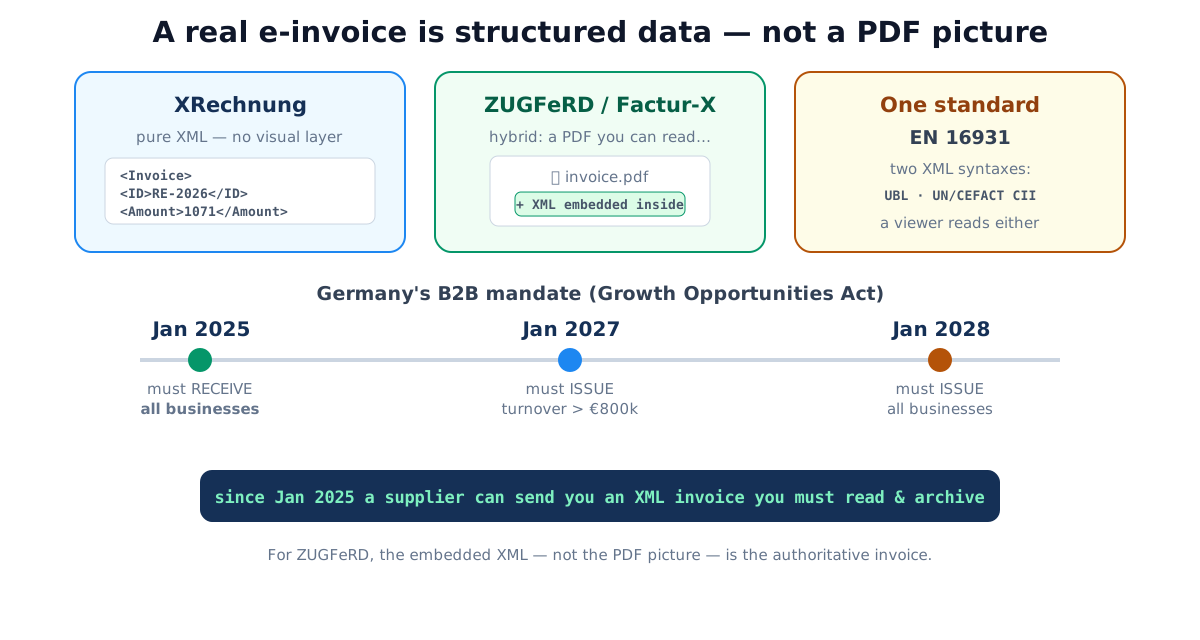
For decades a “digital invoice” meant a PDF, essentially a picture of a paper invoice. A human reads it easily; software has to guess where the numbers are. The European Union decided that isn’t good enough for automated processing, and defined EN 16931, a standard for invoices as structured data: every field, seller, VAT ID, each line item, the tax breakdown, the amount due, tagged in machine-readable XML.
Germany implemented this through the Growth Opportunities Act (Wachstumschancengesetz), and the timeline is why you’re encountering it now:
| Date | Obligation | Who |
|---|---|---|
| 1 Jan 2025 | Must be able to receive EN 16931 e-invoices | All domestic B2B businesses, including freelancers |
| 1 Jan 2027 | Must issue e-invoices | Businesses with prior-year turnover over €800,000 |
| 1 Jan 2028 | Must issue e-invoices | All remaining domestic B2B businesses |
The receiving obligation is the one that catches people: since the start of 2025, a supplier can send you a structured e-invoice and you’re expected to accept and archive it, even if you’re a one-person business that has never issued one. Similar mandates are rolling out across other EU countries, so this isn’t only a German concern.
XRechnung vs ZUGFeRD vs Factur-X
All three implement the same EN 16931 standard; they differ in packaging:
- XRechnung, Germany’s pure-XML profile. There’s no picture, just the structured file. It’s the required format for invoicing German public authorities, and common in B2B too. Opening it in a text editor shows a wall of XML tags.
- ZUGFeRD, a hybrid: an ordinary-looking PDF you can open and read like any invoice, with the EN 16931 XML embedded inside the PDF file. Humans read the PDF layer; software reads the embedded XML. Best of both.
- Factur-X, the French name for the same hybrid format; ZUGFeRD 2.x and Factur-X are technically aligned, so a tool that reads one reads the other.
Under the hood, EN 16931 allows two XML syntaxes, UBL (Universal Business Language) and UN/CEFACT CII (Cross Industry Invoice). They encode the same information with different tag names. XRechnung permits both; ZUGFeRD uses CII. You generally don’t need to care which you have, a viewer that handles both just shows you the invoice.
The trap: a PDF is no longer “an invoice”
The conceptual shift that trips people up: a plain PDF is not a compliant e-invoice, no matter how professional it looks. Under EN 16931 an e-invoice must carry structured, machine-readable data. A PDF image of an invoice has none, which is exactly why ZUGFeRD embeds XML inside the PDF, and why XRechnung dispenses with the visual layer altogether.
For a ZUGFeRD file this has a practical consequence: the pretty PDF page and the embedded XML are supposed to match, but the XML is the authoritative version. If a supplier’s system rendered the PDF from stale data, or the two diverge for any reason, your accounting software processes the XML, so it’s worth actually seeing what the XML says, not just trusting the picture.
Reading one without uploading it
An invoice is about as sensitive as routine business documents get: it names your clients or suppliers, lists itemized prices (your margins), and often includes VAT identification and bank account (IBAN) details. Many “free XRechnung viewer” sites are lead-generation for ERP and accounting suites, and they want you to upload the file.
The e-invoice viewer reads it in your browser instead:
- Choose the file, XRechnung
.xml, or a ZUGFeRD/Factur-X.pdf(the embedded XML is extracted automatically). - It parses the structure, UBL or CII, with your browser’s own XML engine.
- You get a clean summary: invoice number, parties, dates, line items, VAT breakdown, totals and payment details.
Nothing is transmitted; it works offline. For the raw structure, the XML to JSON converter and JSON formatter, also local, let you inspect the underlying data directly.
One boundary worth stating: a viewer displays the invoice faithfully but doesn’t run formal EN 16931 / XRechnung validation (the compliance rules an authority checks before accepting a submission). For “what does this invoice say,” use the viewer; for “is this invoice formally compliant before I submit it,” use an official validator.
Common e-invoice mistakes
- Treating a received XML as junk, it’s the legally authoritative invoice; you’re obliged to accept and archive it.
- Assuming a nice PDF is a compliant e-invoice, without embedded structured data it isn’t, under EN 16931.
- Trusting the ZUGFeRD PDF layer over its XML, in a conflict, the embedded XML governs.
- Uploading invoices to read them, client names, prices and IBANs are exactly what to keep off unknown servers.
- Confusing viewing with validating, a viewer shows content; formal compliance needs an official validator.
Quick summary
Germany’s mandate makes structured e-invoices the B2B norm, receive since January 2025, issue from 2027-2028, so invoices now arrive as XRechnung (pure XML) or ZUGFeRD/Factur-X (PDF with XML embedded), both implementing EN 16931 in UBL or CII syntax. A compliant e-invoice is structured data, not a PDF picture, and for ZUGFeRD the embedded XML is authoritative. Read either in the e-invoice viewer, locally, because an invoice’s clients, prices and bank details shouldn’t be uploaded to a stranger.
Related tools: XML to JSON · JSON formatter · CSV to JSON. Germany’s rules are documented by the European Commission’s eInvoicing pages.
Frequently asked questions
Why did I receive an invoice as an XML file?
Germany's Growth Opportunities Act makes structured e-invoices the B2B norm. Since 1 January 2025 every domestic business must be able to receive them, and issuing becomes mandatory in phases (2027 for larger firms, 2028 for all). The XML is the legally authoritative invoice, a viewer makes it human-readable.
What's the difference between XRechnung and ZUGFeRD?
Both implement the European standard EN 16931. XRechnung is Germany's pure-XML profile, a structured file with no visual layer, required for invoicing public authorities. ZUGFeRD (called Factur-X in France) is a hybrid: a normal-looking PDF with the same structured XML embedded inside, so humans and software both read it.
My ZUGFeRD PDF opens normally, why would I need a viewer?
The PDF page is a human-friendly rendering, but the embedded XML is the authoritative data your accounting software processes. If the two ever disagree, the XML governs, so it's worth seeing exactly what the XML says, which the visual PDF doesn't show you directly.
Is it safe to open an e-invoice in an online viewer?
Only a client-side one. An invoice names your clients or suppliers, itemized prices, VAT IDs and bank details, sensitive commercial data. Many online viewers are lead-generation for accounting software and upload your file. A browser-based viewer parses it on your device with nothing transmitted.
What are UBL and CII?
The two XML syntaxes EN 16931 allows. UBL (Universal Business Language) and UN/CEFACT CII (Cross Industry Invoice) express the same invoice data with different tag structures. XRechnung supports both; ZUGFeRD uses CII. A good viewer reads either without you needing to know which you have.
Does the mandate apply to small businesses and freelancers?
The receiving obligation (since January 2025) applies to all domestic B2B businesses regardless of size, including freelancers and small firms. The issuing obligation phases in later, but you may already receive e-invoices you need to read and archive today.
Is a PDF invoice the same as an e-invoice now?
No, and this is the key change. A plain PDF (even a nicely formatted one) is just an image of an invoice; it isn't a structured e-invoice under EN 16931. A compliant e-invoice must carry machine-readable structured data, which is why XRechnung XML and ZUGFeRD's embedded XML exist.