
explainer
Elastic vs Inelastic Collisions: What's Conserved (and Why)
By Uttam Regmi · Published 2026-07-12 · Updated 2026-08-23 · 7 min read · Fact-checked, sources cited

Every collision conserves momentum. Only some conserve kinetic energy. That one distinction, which quantity survives, is the whole story of elastic versus inelastic collisions, and it’s what lets you predict what happens when two things hit.
The one law that always holds: momentum
In any collision with no outside forces, the total momentum before equals the total after:
m₁u₁ + m₂u₂ = m₁v₁ + m₂v₂This is true whether the objects bounce, stick, shatter or explode. It’s the anchor for every collision problem. But it’s a single equation with two unknowns (v₁ and v₂), so momentum alone can’t finish the job. You need a second condition. That condition is what separates elastic from inelastic.
Momentum is a vector, so in one dimension you must respect signs: pick a positive direction and treat anything moving the other way as negative. A 2 kg cart at +3 m/s and a 1 kg cart at −1 m/s have a total momentum of 2×3 + 1×(−1) = 5 kg·m/s, not 7. Getting the signs right is where most collision mistakes actually happen.
Elastic: kinetic energy survives too
In a perfectly elastic collision, kinetic energy is also conserved:
½m₁u₁² + ½m₂u₂² = ½m₁v₁² + ½m₂v₂²Solving the two conservation laws together gives the final velocities:
v₁ = ((m₁ − m₂)u₁ + 2m₂u₂) / (m₁ + m₂)
v₂ = ((m₂ − m₁)u₂ + 2m₁u₁) / (m₁ + m₂)
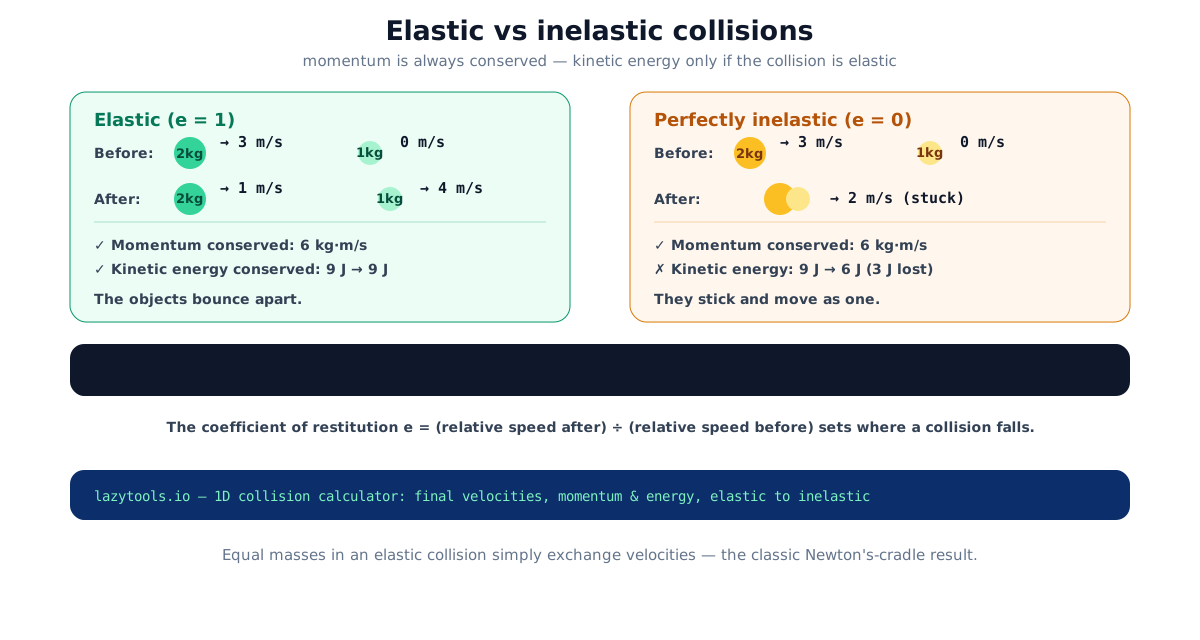
Take a 2 kg ball at 3 m/s hitting a stationary 1 kg ball: v₁ = 1 m/s, v₂ = 4 m/s. Check it, momentum is 6 before (2×3) and 6 after (2×1 + 1×4), and kinetic energy is 9 J before and 9 J after. Both conserved; the balls bounce apart. Truly elastic collisions are an idealisation (billiard balls and atoms come close).
A neat special case: equal masses swap velocities. That’s why a Newton’s cradle passes the motion straight through. Two more limits are worth memorising, because they explain everyday physics:
- A light object hitting a much heavier stationary one (m₁ ≪ m₂) bounces almost straight back with nearly its original speed, like a ball off a wall. The wall barely moves.
- A heavy object hitting a much lighter stationary one (m₁ ≫ m₂) ploughs on almost undisturbed while the light object shoots off at close to twice the heavy object’s speed. That factor of two is why a golf club (heavy) sends a ball (light) away faster than the clubhead itself was travelling.
Inelastic: energy leaks away
In an inelastic collision, kinetic energy is not conserved, some is converted to heat, sound and deformation as the objects crumple. Momentum still holds (those processes exert no net external force), but the objects come apart slower, or don’t come apart at all.
The extreme is a perfectly inelastic collision, where the objects stick together and move as one. Their common velocity is just the total momentum divided by the total mass:
v = (m₁u₁ + m₂u₂) / (m₁ + m₂)For the same 2 kg + 1 kg example: v = 6 ÷ 3 = 2 m/s. Now the kinetic energy drops from 9 J to ½(3)(2²) = 6 J, 3 J vanished into heat and sound. This is the most kinetic energy any collision of those two objects can lose while still conserving momentum.
Why can’t all the kinetic energy disappear? Because the combined object still has to carry the original 6 kg·m/s of momentum, and a moving mass necessarily has kinetic energy. Momentum conservation sets a hard floor on how much energy a collision can shed. The leftover, unavoidable energy is the kinetic energy of the centre of mass; only the motion relative to the centre of mass is available to be lost.
Why momentum survives but kinetic energy doesn’t
It feels strange that one conserved quantity can vanish while another is untouchable. The reason is the difference between the two quantities. Momentum change requires a net external force over time (an impulse). During a collision the forces the two objects exert on each other are equal and opposite (Newton’s third law), so they cancel in the total, internal forces can never change the system’s momentum. Kinetic energy has no such protection: internal forces do negative work as the objects deform, and that ordered energy of motion is converted into the disordered energy of jiggling molecules (heat), pressure waves (sound), and permanent bending. Energy overall is still conserved. It just leaves the “kinetic” column.
The dial between them: coefficient of restitution
Real collisions live between the two extremes, and the coefficient of restitution e measures where:
e = (relative speed after) / (relative speed before)e = 1 is perfectly elastic, e = 0 is perfectly inelastic, and most real objects sit in between, which is exactly why a dropped ball bounces back to less than its drop height. For a ball dropped onto a rigid floor, e is easy to measure: it equals √(bounce height ÷ drop height). A properly inflated basketball is quite bouncy, with e roughly around 0.8, while a regulation tennis ball rebounds a little less, the ITF drop test (about 254 cm onto concrete, rebounding roughly 135-147 cm) corresponds to e ≈ 0.73-0.76. Give the collision calculator an e and it solves that in-between case directly.
A quick reference table
| Collision type | e | Momentum conserved? | Kinetic energy conserved? | Objects afterward |
|---|---|---|---|---|
| Perfectly elastic | 1 | Yes | Yes (none lost) | Bounce apart |
| Real / partially inelastic | 0 < e < 1 | Yes | No (some lost) | Bounce apart, slower |
| Perfectly inelastic | 0 | Yes | No (maximum lost) | Stick together |
| Explosion / recoil | > 0 | Yes | Increases | Fly apart |
The last row is the mirror image of a perfectly inelastic collision: a spring, an explosive, or a gun adds kinetic energy from stored chemical or elastic energy, yet momentum is still conserved. Start a rifle and bullet at rest (total momentum zero) and the forward momentum of the bullet must be balanced by the backward momentum of the recoiling rifle, that’s the same law running in reverse.
Worked example: a real crash
Momentum conservation is exactly how crash investigators reconstruct accidents. Suppose a 1,500 kg car travelling at 20 m/s rear-ends a stationary 1,000 kg car and the two lock bumpers and slide together. Their common speed is v = (1,500 × 20) ÷ (1,500 + 1,000) = 30,000 ÷ 2,500 = 12 m/s.
Now count the energy. Before: ½ × 1,500 × 20² = 300,000 J. After: ½ × 2,500 × 12² = 180,000 J. So 120,000 J, 40% of the kinetic energy, was absorbed by crumpling metal, heat and sound in a fraction of a second. That is not a flaw; it is the point of a crumple zone. A more elastic collision would conserve that energy by throwing the occupants back the way they came, which is far more dangerous. Designing cars to be more inelastic is a deliberate safety choice.
Solve any collision
The collision calculator takes the two masses and initial velocities and returns the final velocities for an elastic, perfectly inelastic, or custom-e collision, along with the momentum (to see it’s conserved) and the kinetic energy before, after and lost. Pair it with the momentum and kinetic energy calculators to check each piece. Like every LazyTools tool, it runs entirely in your browser.
These are the standard results for one-dimensional two-body collisions: momentum conserved always, kinetic energy conserved only when e = 1, with the coefficient of restitution interpolating between. Velocities are signed (negative = opposite direction). Source: standard introductory-mechanics treatment of collisions (e.g. Halliday/Resnick, Serway).
Frequently asked questions
Is momentum conserved in an inelastic collision?
Yes. Momentum is conserved in every collision with no external forces, elastic or inelastic. What differs is kinetic energy: it's only conserved in an elastic collision. In an inelastic one, some kinetic energy becomes heat, sound and deformation.
What is the difference between elastic and inelastic collisions?
In an elastic collision both momentum and kinetic energy are conserved and the objects bounce apart. In an inelastic collision only momentum is conserved; a perfectly inelastic collision is the extreme where the objects stick together and the most kinetic energy is lost.
How do I find the final velocities in an elastic collision?
v₁ = ((m₁−m₂)u₁ + 2m₂u₂)/(m₁+m₂) and v₂ = ((m₂−m₁)u₂ + 2m₁u₁)/(m₁+m₂). These come from solving conservation of momentum and kinetic energy together.
What is the coefficient of restitution?
A number e from 0 to 1 for how bouncy a collision is: the relative speed after divided by the relative speed before. e = 1 is perfectly elastic, e = 0 is perfectly inelastic (objects stick), and real collisions fall in between.
Where does the kinetic energy go in an inelastic collision?
Into heat, sound, and permanent deformation of the objects. Momentum is still conserved because those processes don't exert a net external force, but the ordered kinetic energy is converted into disordered forms.
What happens when two equal masses collide elastically?
They exchange velocities. A moving ball striking an identical stationary one stops dead while the other moves off at the original speed, the classic Newton's-cradle behaviour.