
explainer
France's 2026 E-Invoicing Mandate: How to Open a Factur-X Invoice Without Accounting Software
By Uttam Regmi · Published 2026-07-07 · Updated 2026-07-07 · 8 min read · Fact-checked, sources cited
From 1 September 2026, every company in France, down to the smallest auto-entrepreneur, must be able to receive electronic invoices, and most will arrive as Factur-X: a PDF that looks ordinary but carries the real, legally authoritative invoice as XML embedded inside. You don’t need an ERP to read one: the Factur-X viewer extracts and displays that XML, profile, parties, VAT breakdown, line items, IBAN, entirely in your browser.
What the reform actually requires, and when
France’s e-invoicing reform (facturation électronique) covers domestic B2B transactions between VAT-registered French businesses. The official timeline has two dates that matter:
| Date | Who | Obligation |
|---|---|---|
| 1 September 2026 | All companies, every size | Must be able to receive e-invoices |
| 1 September 2026 | Large companies & ETI (mid-size) | Must issue e-invoices |
| 1 September 2027 | SMEs & micro-enterprises | Must issue e-invoices |
The receive obligation is the one that catches people: it applies to everyone on day one. Invoices flow through certified platforms (plateformes agréées, the operators previously described as PDP), not by email attachment, and the accepted structured formats are the EN 16931 trio: Factur-X, UBL and CII, per the EU Commission’s country profile. Factur-X, the format designed in France, is the one most small businesses will actually see.
Alongside the invoice flow, the reform introduces e-reporting: businesses transmit certain transaction and payment data (for B2C sales and cross-border B2B, which fall outside the domestic e-invoicing circuit) to the tax administration. E-invoicing and e-reporting are two halves of the same anti-fraud programme, the underlying goal is to give the Direction générale des Finances publiques a structured, near-real-time view of VAT. That is why the structured data, not the printed page, is what the whole system is built on.
The three accepted syntaxes
All three permitted formats express the same EN 16931 semantic model; they differ only in how the data is serialised and packaged. Understanding which is which helps when a supplier sends something that does not look like the Factur-X PDF you expected:
| Format | Underlying syntax | Human-readable layer? | Where you’ll meet it |
|---|---|---|---|
| Factur-X | UN/CEFACT CII (XML) | Yes, embedded in a PDF/A-3 | Default for French SMEs; identical to German ZUGFeRD 2.x |
| UBL | OASIS UBL 2.1 (XML) | No, pure XML | Common via Peppol and in public-sector Chorus Pro flows |
| CII | UN/CEFACT CII (XML) | No, pure XML | The same syntax as Factur-X, but without the PDF wrapper |
Factur-X is the only one of the three that carries its own human-readable rendering, which is exactly why it dominates among smaller firms: you can forward it, print it, or archive it like an ordinary PDF, and the machine-readable invoice rides along inside.
Anatomy of a Factur-X file: one PDF, two invoices
Factur-X was developed jointly by France’s FNFE-MPE and Germany’s
FeRD (where the identical standard is named ZUGFeRD 2.x). The trick: a PDF/A-3 document, readable by any PDF viewer, archivable for the legal retention period, with the full invoice
embedded inside as a structured XML attachment (typically named factur-x.xml) in UN/CEFACT
Cross-Industry Invoice syntax.
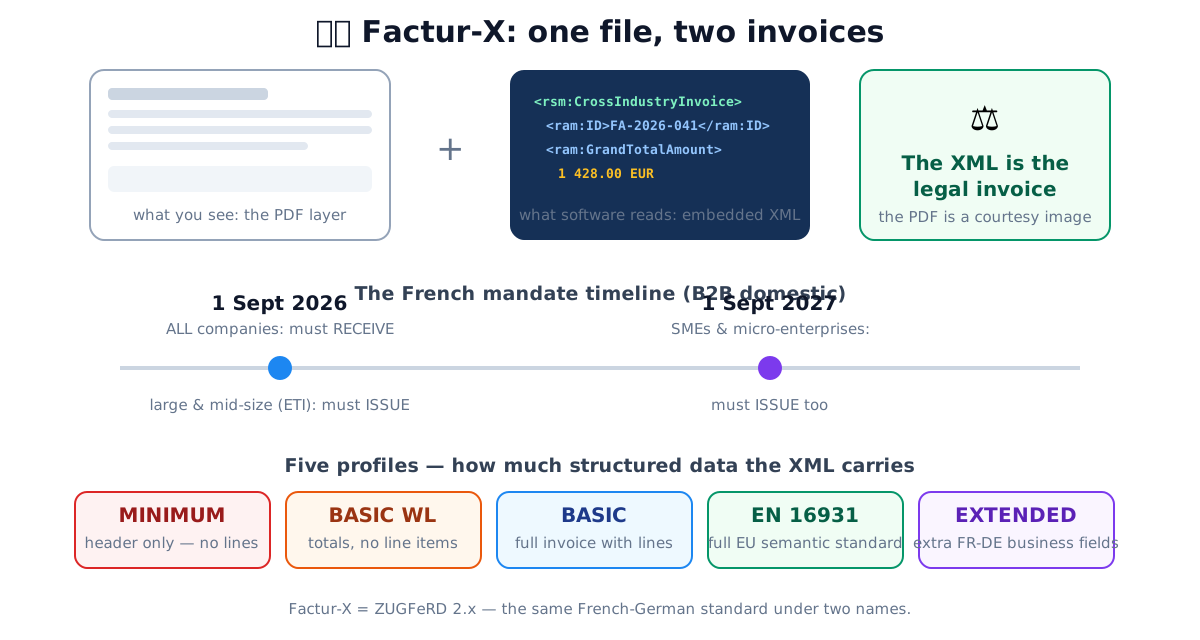
The legal hierarchy is the part worth internalizing: the structured XML is the authoritative invoice. If the PDF image says one amount and the XML another, the XML governs, your accounting software processes it, the tax administration’s e-reporting is built on it, and disputes resolve against it. Checking what the XML actually says, rather than trusting the picture, is precisely what a viewer is for.
The five profiles, and the trap in the small ones
Every Factur-X XML declares a profile in its guideline URN, fixing how much structured data it carries:
| Profile | Line items? | What it’s for |
|---|---|---|
| MINIMUM | ✗ | Header data only, parties, totals, VAT. Not a complete EN 16931 invoice |
| BASIC WL | ✗ | Header + totals “without lines” |
| BASIC | ✓ | Complete invoice with line items |
| EN 16931 (Comfort) | ✓ | The full European semantic standard |
| EXTENDED | ✓ | EN 16931 plus additional Franco-German business fields |
The trap: a MINIMUM-profile invoice looks complete on paper, the PDF layer shows every line, but its machine-readable half contains only headline figures. If your workflow (or your accountant’s) consumes the XML, the line detail simply isn’t there. The Factur-X viewer reads the guideline URN, names the profile, and flags MINIMUM/BASIC WL files explicitly, so you know what you actually received.
The profile isn’t a label you have to trust blindly. It is written into the XML as a guideline
identifier (the GuidelineSpecifiedDocumentContextParameter element in CII). Each profile has its
own distinctive URN, so a viewer can read it directly rather than inferring the profile from the
data present:
| Profile | Guideline URN (identifier) fragment |
|---|---|
| MINIMUM | …factur-x.eu:1p0:minimum |
| BASIC WL | …factur-x.eu:1p0:basicwl |
| BASIC | …en16931:2017#compliant#…factur-x.eu:1p0:basic |
| EN 16931 (Comfort) | urn:cen.eu:en16931:2017 |
| EXTENDED | …en16931:2017#conformant#…factur-x.eu:1p0:extended |
Notice that only BASIC and above reference en16931:2017, MINIMUM and BASIC WL sit below the
European norm and are, strictly, not complete EN 16931 invoices. That is the single most useful
thing a viewer tells you at a glance.
A worked example
Say a supplier sends you a PDF that renders as a normal invoice for €1,200 plus €240 VAT. Opened in a viewer, its embedded XML might begin like this (abridged CII):
<rsm:ExchangedDocumentContext>
  <ram:GuidelineSpecifiedDocumentContextParameter>
    <ram:ID>urn:factur-x.eu:1p0:minimum</ram:ID>
  </ram:GuidelineSpecifiedDocumentContextParameter>
</rsm:ExchangedDocumentContext>
The minimum URN is the tell: this file carries the seller, buyer, invoice number, date, the VAT
total and the grand total, but no IncludedSupplyChainTradeLineItem elements at all. The four
line items you can see printed on the PDF exist only as pixels. If your bookkeeping imports the XML,
you would need to key those lines in by hand, or ask the supplier to re-issue at BASIC or above. A
viewer that names the profile up front turns that from a nasty month-end surprise into a two-second
check on receipt.
Reading one without accounting software
The receive obligation doesn’t come with a software obligation. To read a Factur-X invoice you need exactly one capability: extracting the XML attachment from the PDF and rendering it legibly. That runs fine in a browser:
- Open the Factur-X viewer (works offline once loaded).
- Drop in the PDF, or a bare XML if that’s what you received.
- Read the result: profile, seller and buyer with VAT identifiers, dates, line items, VAT breakdown by rate, totals, IBAN and payment reference.
One deliberate design point: the invoice never leaves your machine. The parsing happens in your browser’s own XML engine. That matters because an invoice is a bundle of confidential data, who your suppliers are, what you pay them, your bank coordinates, and most “free online invoice viewers” are lead-generation funnels for ERP suites that log every upload. Local parsing makes the privacy question moot. (The same viewer reads German XRechnung and ZUGFeRD files, and Peppol BIS invoices, the general e-invoice viewer is the same engine with a Germany-focused guide.)
The same file works across the border
Because Factur-X and Germany’s ZUGFeRD 2.x are the identical technical standard under two names, a Factur-X invoice is already a valid German e-invoice and vice versa, a genuine convenience for firms trading between the two countries. Germany’s own B2B mandate is phasing in on a parallel track: since 1 January 2025 every German business has had to be able to receive structured e-invoices, with issuing obligations following in stages through 2027-2028. The formats overlap almost completely:
| File type | Country of origin | Structure | Read by the same viewer? |
|---|---|---|---|
| Factur-X | France | PDF/A-3 + CII XML | Yes |
| ZUGFeRD 2.x | Germany | PDF/A-3 + CII XML (same spec) | Yes |
| XRechnung | Germany (public sector) | Pure CII or UBL XML | Yes |
| Peppol BIS Billing 3.0 | EU (Peppol network) | UBL XML | Yes |
The practical upshot: one local viewer that understands the shared EN 16931 model handles almost everything you are likely to receive, whichever side of the Rhine it came from. The general e-invoice viewer is the same parsing engine as the Factur-X tool, with a Germany-oriented guide for XRechnung and ZUGFeRD files.
What to do before September
- Every business: make sure you’re connected to a certified platform for receiving, many offer free receive-only tiers. Check that whoever does your bookkeeping can consume structured invoices, not just PDFs.
- Large & mid-size companies: your issuing obligation lands the same day; that’s an ERP/billing project with lead time, not a September task.
- Everyone who receives a “weird PDF” from a supplier already: it’s probably Factur-X ahead of schedule. Load it in the viewer and see what the XML says. You may find your suppliers switched months before the deadline.
Quick summary
France’s mandate makes e-invoice reception universal on 1 September 2026, with issuing phased through 2027, and Factur-X, a PDF with the legal invoice embedded as XML, is the format built for the transition. The XML outranks the PDF image, the profile determines how much data it carries (beware MINIMUM), and reading one requires no accounting software: the Factur-X viewer extracts, identifies and displays everything locally, so your suppliers’ names, amounts and IBANs stay on your machine.
Sources: service-public.gouv.fr, generalization of e-invoicing · EU Commission, eInvoicing in France · FNFE-MPE, Factur-X standard
Frequently asked questions
What exactly becomes mandatory in France on 1 September 2026?
Two things: every French company, regardless of size, must be able to receive electronic invoices for domestic B2B transactions; and large plus mid-size companies (grandes entreprises and ETI) must issue them. Small and micro-enterprises get one more year, their issuing obligation starts 1 September 2027.
What is a Factur-X invoice?
A hybrid e-invoice: a normal-looking PDF (technically PDF/A-3) with the structured invoice data embedded inside as an XML attachment in UN/CEFACT CII syntax. It was developed jointly by France's FNFE-MPE and Germany's FeRD, in Germany the identical standard is called ZUGFeRD. Legally, the XML is the invoice; the PDF is a human-readable courtesy.
Do I need to buy accounting software to comply with the receive obligation?
You need to be connected to a certified platform (plateforme agréée) to receive invoices through the official circuit, many offer free or low-cost receive-only tiers. Reading an invoice you've received requires no special software at all: a browser-based viewer can extract and display the embedded XML.
What are the Factur-X profiles and why do they matter?
Five levels of structured detail: MINIMUM and BASIC WL carry only header data (no line items, not complete EN 16931 invoices), BASIC carries a full invoice with lines, EN 16931 covers the complete European semantic standard, and EXTENDED adds Franco-German business fields. The profile is declared in the XML's guideline URN; a viewer that shows it tells you instantly how much of the invoice is actually machine-readable.
I received a PDF invoice, how do I know if it's Factur-X?
You can't tell by looking; the PDF layer is deliberately ordinary. Load it into a viewer that checks for embedded files: if there's an XML attachment (typically factur-x.xml), it's a hybrid invoice and the viewer will show the structured data. If there's no attachment, it's just a regular PDF.
Is it safe to upload invoices to online viewers?
An invoice names your suppliers and clients, amounts, VAT numbers and bank details (IBAN), data worth protecting. Prefer a viewer that parses the file locally in your browser rather than uploading it to a server; the LazyTools viewer works that way and runs offline.