
explainer
Grams to Cups: Why a Cup of Flour Isn't a Cup of Sugar
By Uttam Regmi · Published 2026-07-11 · Updated 2026-08-23 · 6 min read · Fact-checked, sources cited

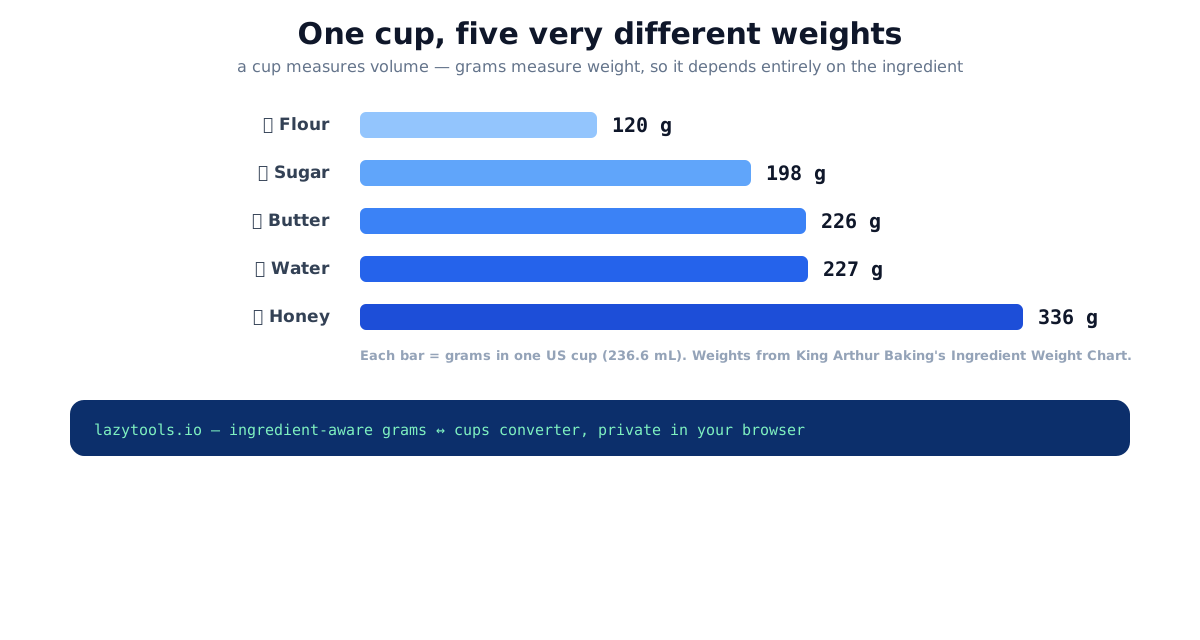
“How many grams in a cup?” has no single answer, and that’s the whole point. A cup measures volume (how much space something fills), but grams measure weight. How much a cup weighs depends entirely on the ingredient’s density: one US cup holds about 120 g of flour, 198 g of sugar, 226 g of butter, and 336 g of honey. Any converter that gives you one fixed “grams per cup” number is wrong for almost everything.
Volume vs weight, the core of it
When a recipe says “1 cup of flour,” it’s telling you to fill a cup-shaped container. But flour is light and full of air, while sugar is dense and packs tightly, and honey is a heavy liquid. Fill the same cup with each and you get very different weights. That’s why there’s no universal conversion, the number of grams in a cup is a property of the ingredient, not of the cup.
The weights that matter most
Using King Arthur Baking’s Ingredient Weight Chart (the US baking standard), per US cup (236.6 mL):
| Ingredient | Grams per cup |
|---|---|
| All-purpose / bread / cake flour | 120 g |
| Whole wheat flour | 113 g |
| Granulated (white) sugar | 198 g |
| Brown sugar (packed) | 213 g |
| Confectioners’ (powdered) sugar | 113 g |
| Butter | 226 g |
| Water / milk | 227 g |
| Honey | 336 g |
| Cocoa powder | 84 g |
Notice how flour and powdered sugar land near 113-120 g (light, airy), while granulated sugar, butter and water cluster around 200-227 g, and honey, a dense liquid, tops 330 g. Same cup, wildly different weights.
Worked examples: converting a real recipe
The rule is simple: grams = cups × (grams per cup for that ingredient). The catch is that you have to use the right per-cup weight for each line. Take a basic cookie recipe calling for 2 cups flour, 1 cup granulated sugar, ½ cup packed brown sugar and 1 cup butter:
- 2 cups flour → 2 × 120 = 240 g
- 1 cup granulated sugar → 1 × 198 = 198 g
- ½ cup packed brown sugar → 0.5 × 213 = 107 g (round to 106-107 g)
- 1 cup butter → 1 × 226 = 226 g (two US sticks)
Going the other way is just as easy, divide grams by the per-cup weight. If a European recipe lists 250 g of flour, that’s 250 ÷ 120 ≈ 2.08 cups, or about 2 cups plus 1 tablespoon. This is exactly the kind of arithmetic the grams to cups converter handles instantly, ingredient by ingredient, so you never apply flour’s number to sugar by mistake.
A quick cups-to-grams reference
For the ingredients bakers reach for most, here are common recipe amounts already worked out (US cup, King Arthur weights, rounded to the nearest gram):
| Ingredient | ¼ cup | ⅓ cup | ½ cup | 1 cup |
|---|---|---|---|---|
| All-purpose flour | 30 g | 40 g | 60 g | 120 g |
| Granulated sugar | 50 g | 66 g | 99 g | 198 g |
| Brown sugar (packed) | 53 g | 71 g | 107 g | 213 g |
| Butter | 57 g | 75 g | 113 g | 226 g |
| Water / milk | 57 g | 76 g | 113 g | 227 g |
| Honey | 84 g | 112 g | 168 g | 336 g |
These are linear, so scaling is trivial: 1½ cups of flour is simply 120 + 60 = 180 g. Fractional cups of butter are especially handy because US butter is sold in sticks, and one stick is ½ cup, so ½ cup butter = 113 g = one stick, and 1 cup = 226 g = two sticks.
Why liquids trip people up
There’s a second confusion hiding in the word “cup.” Water is the one ingredient whose volume and weight nearly coincide: 236.6 mL of water weighs about 237 g at room temperature. Baking charts, including King Arthur’s, often list a cup of water or milk as 227 g instead, because they equate one cup with 8 ounces by weight (8 × 28.35 g ≈ 227 g), a rounding convention rather than a true volume-to-weight match. Either way, that near-equivalence only holds for water. Milk is slightly denser; cooking oil is less dense (roughly 0.92 g/mL), so a cup of oil weighs less than a cup of water; and honey, a concentrated sugar syrup, is close to 1.4 times as dense as water, which is why it tops the chart at 336 g. Fluid ounces measure volume, not weight, so never assume a fluid-ounce figure equals the same number of grams.
Why weighing beats scooping
Flour is the troublemaker. Scoop it straight from the bag and you compress it; a “cup” measured that way can weigh 140 g or more instead of 120 g, over 15% extra, enough to make a cake dry or a cookie tough. Spoon it into the cup and level it and you get closer to 120 g, but it’s still inconsistent from person to person.
A kitchen scale removes all of that: 120 g of flour is 120 g every time, regardless of how packed it is. It’s faster, more accurate, and means one fewer measuring cup to wash. This is why nearly every professional recipe, and a growing number of home baking books, lists ingredients by weight.
The cup that isn’t a cup
One more trap: not all cups are equal. The US customary cup is 236.6 mL, but the metric cup used in Australia, New Zealand and much of Europe is 250 mL, about 6% larger. There’s even a separate US “legal” cup of 240 mL used on nutrition labels. Here’s how the common standards compare:
| Cup standard | Volume | Vs US customary |
|---|---|---|
| US customary | 236.6 mL | , |
| US legal (labeling) | 240 mL | +1.4% |
| Metric (AU/NZ/EU) | 250 mL | +5.7% |
Gram-per-cup charts (including the one above) almost always mean the US customary cup, so if you’re measuring with a 250 mL metric cup, you’ll scoop nearly 6% more of everything. For the amounts in baking, that gap can be the difference between success and a flop, another reason to switch to grams, which mean the same thing in every country.
The grams to cups converter is ingredient-aware: pick flour, sugar, honey or any of two dozen common ingredients and it converts using the correct weight for that item, in either direction, right in your browser, nothing uploaded.
Sources: ingredient weights are from King Arthur Baking’s Ingredient Weight Chart; cup volume definitions follow NIST. Weights are per US customary cup and are typical values, actual weights vary a little with humidity, brand and how the ingredient is packed.
Frequently asked questions
How many grams are in one cup?
It depends entirely on the ingredient, because a cup measures volume while grams measure weight. One US cup is about 120 g of all-purpose flour, 198 g of granulated sugar, 226 g of butter, 227 g of water or milk, and 336 g of honey. There is no single grams-per-cup number.
How many grams of flour are in a cup?
About 120 g of all-purpose, bread or cake flour per US cup (whole wheat is about 113 g), using King Arthur Baking's standard. Because flour compresses, scooping straight from the bag can pack in 20% or more than 120 g, which is exactly why weighing is more reliable.
Why does a cup of sugar weigh more than a cup of flour?
Density. Sugar granules are heavier and pack together more tightly than the light, air-filled particles of flour. So the same volume, one cup, holds 198 g of sugar but only 120 g of flour.
Is a US cup the same as a metric cup?
No. A US customary cup is 236.6 mL; the metric cup used in Australia, New Zealand and much of Europe is 250 mL, about 6% larger. Gram weights per cup are usually quoted for the US cup, so a metric-cup measure holds slightly more.
Should I bake by weight or by cups?
By weight, whenever you can. A digital scale removes the biggest source of error in baking, how tightly you pack a cup, and it's faster and means fewer dishes. Most professional recipes and serious baking books give weights for this reason.
How do I convert a recipe from cups to grams?
Multiply the number of cups by the ingredient's grams-per-cup weight: 2 cups of flour × 120 g = 240 g. Because that weight differs for every ingredient, use an ingredient-aware converter rather than one fixed number.
Where do these gram weights come from?
The weights used here are from King Arthur Baking's Ingredient Weight Chart, the widely-cited US baking reference, measured with their standard 'fluff, sprinkle, level' method for dry ingredients.