
explainer
How Long Does Jet Lag Last? Why Flying East Is Worse, and How to Cut Recovery in Half
By Uttam Regmi · Published 2026-07-18 · Updated 2026-07-18 · 6 min read · Fact-checked, sources cited

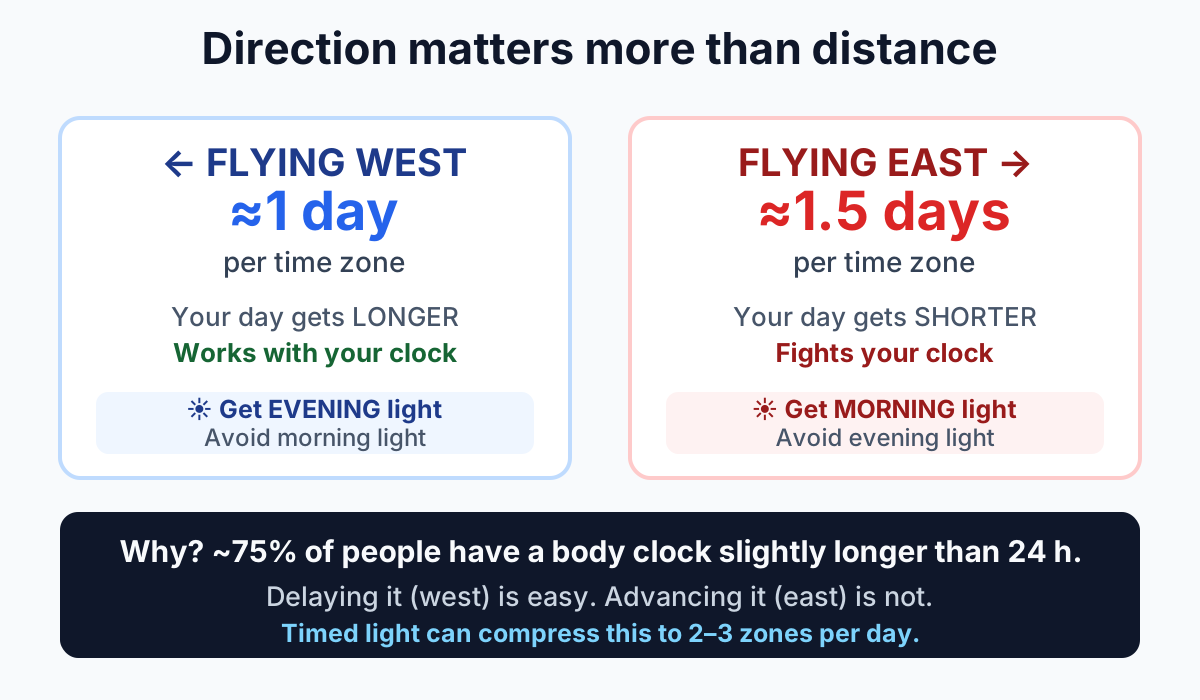
Left alone, jet lag takes about one day per time zone crossed flying west, and roughly 1.5 days per time zone flying east. A six-zone westward trip resolves in about six days; the same six zones eastward can take eight to ten. The direction matters more than the distance, and correctly timed light exposure is the one intervention that reliably compresses it, to roughly two to three time zones of adjustment per day.
Why east is harder than west
Your circadian clock isn’t exactly 24 hours. For roughly three quarters of people it runs slightly longer than 24 hours, which the daily cycle of light resets each morning.
That small detail explains the whole east, west asymmetry:
- Flying west lengthens your day. You stay up later and sleep later, a phase delay. Your clock already drifts that direction, so you’re working with your biology.
- Flying east shortens your day. You must fall asleep and wake earlier, a phase advance. That’s the direction your clock resists.
Research on the brain’s master clock (the suprachiasmatic nucleus) finds it responds more sluggishly to eastward shifts, needing meaningfully more recovery time. The effect is strong enough that a shorter eastward trip can take longer to recover from than a longer westward one, five zones east can outlast seven zones west.
The baseline: how many days
Without any deliberate intervention, plan for:
| Zones crossed | Westward (≈1 day/zone) | Eastward (≈1.5 days/zone) |
|---|---|---|
| 3 | ~3 days | ~4-5 days |
| 5 | ~5 days | ~7-8 days |
| 6 | ~6 days | ~8-10 days |
| 8 | ~8 days | ~11-12 days |
These are rough averages, age, sleep quality before departure, and individual chronotype all shift them. The jet lag calculator works out your zone count and an adjustment schedule for a specific route.
Light: the one intervention that reliably works
Light is the dominant signal that sets your circadian clock, which makes timed light exposure, and just as importantly, timed light avoidance, the most powerful tool available. Used correctly it can compress adaptation to roughly two to three time zones per day, and combined with melatonin the clock can shift on the order of 3-4 hours daily.
The direction of travel flips the strategy completely:
| Direction | Seek light | Avoid light |
|---|---|---|
| Eastward (advance the clock) | Morning at destination | Evening |
| Westward (delay the clock) | Evening at destination | Morning |
Get this backwards and you actively push your clock the wrong way, which is why “just get sunlight” is incomplete advice. Flying east and sitting outside all evening will delay the clock you’re trying to advance.
Practical version: flying east, seek bright morning light on arrival and wear sunglasses / stay dim in the late evening. Flying west, keep mornings dim and get outside in the late afternoon and evening.
Shifting before you fly
You don’t have to start on arrival. Shifting your sleep schedule by an hour a day in the days before departure, earlier for eastward trips, later for westward, means you land already partly adapted. Studies of pre-flight advancing (moving sleep earlier, paired with morning bright light) show the clock can be meaningfully shifted before an eastward flight, reducing the deficit on arrival.
Even two or three days of an hour’s shift removes two or three days from the far end. Combine it with the time zone converter so you’re planning against destination time from the start.
When not to adapt
For a trip of about three days or less, adapting is often the wrong goal. You’d shift your clock one way, then have to shift it back, two rounds of jet lag for a short stay.
For short trips, consider staying close to home time: schedule important meetings during hours that overlap your home-time daytime, keep your usual sleep window if the local schedule allows, and treat it like a night shift rather than a relocation.
What actually helps (and what doesn’t much)
Helps:
- Timed light exposure and avoidance, the strongest lever by far
- Shifting your schedule 1 hour/day before departure
- Switching your watch, phone and meal times to destination time on boarding
- Sleeping on the plane only if it’s night at your destination
Overrated:
- “Beat jet lag” diets, evidence is thin compared with light timing
- Alcohol as a sleep aid. It fragments sleep and worsens next-day fatigue
- Forcing daytime naps longer than ~20-30 minutes, which erodes the night’s sleep pressure you need
Hydration is worth doing for cabin-air comfort, but dehydration and jet lag are separate problems, drinking water doesn’t move your circadian clock.
Frequently asked questions
How long does jet lag last?
Roughly one day per time zone crossed when flying west, and about 1.5 days per zone flying east. Six zones west is about six days; six zones east can be eight to ten. Timed light exposure can cut this to two or three zones of adjustment per day.
Is jet lag worse going east or west?
East, for most people. About three quarters of us have a circadian clock that naturally runs slightly longer than 24 hours, so flying west (a later day, a phase delay) works with that drift, while flying east (an earlier day, a phase advance) fights it.
How do I get over jet lag faster?
Time your light exposure to the direction you flew: after an eastward flight seek morning light and avoid evening light; after a westward flight avoid morning light and seek evening light. Shift your sleep an hour a day before departure, and switch to destination time as soon as you board.
Does jet lag get worse with age?
Many people find recovery slower with age, as circadian rhythms tend to become less flexible and sleep more fragmented. The direction rule still holds, eastward remains the harder adjustment.
Should I nap when I arrive?
Short naps of about 20-30 minutes can take the edge off without eating into your night sleep. Long afternoon naps reduce the sleep pressure you need to fall asleep at local bedtime, which prolongs the adjustment.
Does melatonin help with jet lag?
Timed melatonin is commonly used alongside light to shift the clock, and combined they can move it several hours a day. Timing and dose matter and they vary by direction of travel, so it’s worth discussing with a clinician or pharmacist rather than guessing. This article is general information, not medical advice.
Is jet lag the same as travel fatigue?
No. Travel fatigue is the tiredness from the journey itself, dry cabin air, cramped seating, disrupted routine, and it resolves after a good night’s sleep. Jet lag is a misalignment between your body clock and local time, and it persists for days until the clock resets. A north, south flight can cause travel fatigue with no jet lag at all.
Frequently asked questions
How long does jet lag last on average?
Left alone, it takes roughly one day per time zone crossed when flying west, and about 1.5 days per time zone when flying east. A six-zone westward trip resolves in about six days; the same six zones eastward can take eight to ten.
Why is jet lag worse flying east than west?
For most people the body clock naturally runs slightly longer than 24 hours, so flying west (a phase delay, staying up later) works with your biology, while flying east (a phase advance, sleeping earlier) fights it. The brain's master clock also adjusts more sluggishly to eastward shifts.
Can a shorter eastward trip take longer to recover from than a longer westward one?
Yes. Because direction matters more than distance, a smaller eastward shift can outlast a larger westward one, for example, five zones east can take longer to recover from than seven zones west.
What is the fastest way to get over jet lag?
Correctly timed light exposure is the strongest lever and can shift your clock roughly two to three time zones per day. Flying east, get morning light and avoid evening light; flying west, avoid morning light and get evening light.
Should I bother adjusting for a short trip?
For trips under about three days, many people are better off staying on home time rather than adapting to the destination and then having to readjust when they return.
Is jet lag advice a substitute for medical guidance?
No. This is general information, not medical advice. Talk to a clinician before using sleep medication or melatonin, or if jet lag seriously disrupts your health.