
explainer
How Many Solar Panels Do I Need? A Simple Way to Size a System
By Uttam Regmi · Published 2026-07-12 · Updated 2026-08-23 · 6 min read · Fact-checked, sources cited
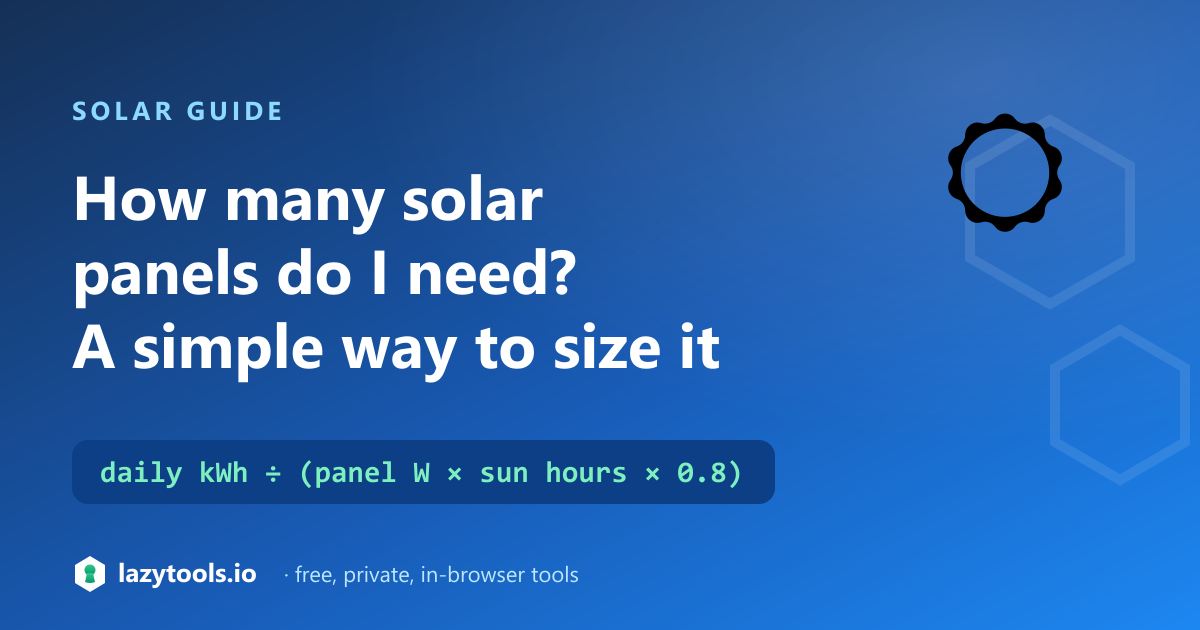
“How many solar panels do I need?” has no single answer, but it has a simple formula. It comes down to two things about you: how much electricity you use, and how much sun your location gets. Get those two numbers and the panel count falls straight out.
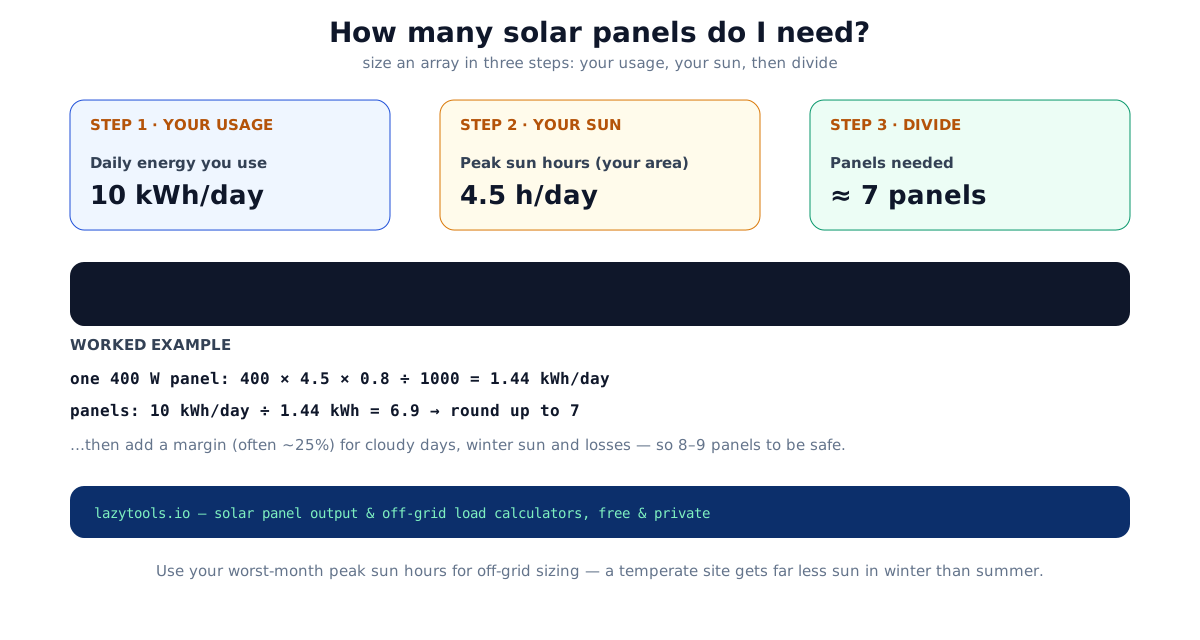
Step 1: How much energy do you use?
Everything starts with your daily energy use in kilowatt-hours (kWh). For a grid-tied home, read it off your electricity bill. It usually shows your monthly kWh; divide by 30 for a daily figure. A typical home uses somewhere around 10-30 kWh a day.
For an off-grid setup (a cabin, van or tiny home) you build it up appliance by appliance: each device’s watts × the hours it runs per day, added together. That’s exactly what an off-grid load calculator is for, and the honest part is run-time: a fridge rated 150 W only runs its compressor part of the time, so use its average daily hours, not 24.
Step 2: How much sun do you get?
The second number is peak sun hours, and it’s not the same as daylight hours. One peak sun hour is an hour of sunshine at 1,000 W/m², the full “test” intensity. Your location’s peak sun hours bundle a whole day’s sunlight into an equivalent number of those full-strength hours: maybe 3-4 in a cloudy northern climate, 5-6 or more in a sunny one.
Two things matter here. First, look up your figure (a solar-irradiance map like NREL’s, or a peak-sun-hours tool). Second, for anything off-grid, use your worst month, a temperate site can get three to four times less sun in December than June, and a system sized for summer will fall short in winter.
Step 3: Divide
Now the arithmetic. One panel produces, per day:
panel watts × peak sun hours × system efficiency ÷ 1000 = kWh per dayThe system efficiency (~0.8) accounts for the energy lost to the inverter, wiring, heat, dust and mismatch, real panels deliver less than their lab rating. So a 400 W panel at 4.5 peak sun hours:
400 × 4.5 × 0.8 ÷ 1000 = 1.44 kWh per panel per day
Then divide your usage by that:
10 kWh/day ÷ 1.44 kWh = 6.9 → round up to 7 panels
How the answer shifts with sun and panel size
The two levers that move the count most are your peak sun hours and the wattage of the panel you choose. The table below runs the same 10 kWh/day home through a range of both, using the 0.8 efficiency factor and rounding up to whole panels. Notice how a sunny site can need roughly half the panels of a cloudy one for the identical load.
| Peak sun hours | 350 W panels | 400 W panels | 450 W panels |
|---|---|---|---|
| 3.0 (cloudy climate) | 12 | 11 | 10 |
| 4.5 (temperate) | 8 | 7 | 7 |
| 5.5 (sunny) | 7 | 6 | 6 |
| 6.5 (desert) | 6 | 5 | 5 |
A few things fall out of this. Higher-wattage panels cut the count but rarely change your roof area much, because a 450 W panel is physically larger than a 350 W one. You are mostly trading panel count for panel size, not saving space. And the swing from 3.0 to 6.5 sun hours more than halves the array, which is why plugging in your location matters far more than any rule of thumb.
Turning panels into system size (kW)
Installers and permits usually talk in kilowatts (kW) of nameplate capacity, not panel count. Converting is easy: multiply the number of panels by their wattage, then divide by 1,000.
7 panels × 400 W = 2,800 W = 2.8 kW
That is the DC nameplate, the lab rating before real-world losses. So a modest all-electric home wanting to offset most of its 10 kWh/day might land near a 3 kW array, while a larger household at 30 kWh/day in the same climate scales to roughly 9-10 kW. This is also the number that drives cost, since residential solar is commonly priced per watt or per kW installed.
Don’t forget the margin
That 7 is the bare minimum for average conditions. Real life has cloudy weeks, low winter sun, hot panels (which are less efficient) and gradual ageing (~0.5% a year). Adding roughly 25%, so 8 or 9 panels here, keeps the lights on when conditions are poor. Off-grid systems also need a battery bank sized to carry you through the sunless hours and cloudy days; that’s a separate calculation from the panel count.
Grid-tied vs off-grid: same formula, different inputs
The three-step method is identical for both, but two inputs change and it is worth being explicit about them.
| Grid-tied home | Off-grid cabin/van | |
|---|---|---|
| Daily kWh source | Utility bill (monthly ÷ 30) | Built up appliance-by-appliance |
| Peak sun hours to use | Annual average is fine | Your worst month |
| Margin | ~25% for losses/ageing | 25%+ plus battery autonomy |
| Batteries | Optional, grid is your storage | Required, sized separately |
| Over-production | Exported / net-metered | Wasted once batteries are full |
For a grid connection, the grid absorbs your surplus on sunny days and covers you at night, so sizing to the annual average and adding a modest loss margin is reasonable. Off-grid there is no backstop: if December gives you a third of June’s sun and your batteries run flat, the lights simply go out. That is why off-grid arrays are sized on the worst month and paired with a battery bank rated for a few days of autonomy.
Work out your own numbers
The solar panel output calculator does this in reverse, put in your panels, count, peak sun hours and efficiency and it shows the daily, monthly and yearly production, so you can dial in the array size against your usage. Pair it with the off-grid load calculator to nail down step 1, and the battery bank calculator to size storage. Like every LazyTools tool, they run entirely in your browser, no location access, nothing uploaded.
This is a planning estimate using the standard solar production formula (daily kWh = panel watts × peak sun hours × system efficiency ÷ 1000). System efficiency of ~0.8 reflects typical real-world losses; NREL’s PVWatts uses about 14% DC losses plus inverter losses. Actual output varies with weather, shading, orientation and equipment, get a site-specific quote for a real install. Source: NREL PVWatts calculator.
Frequently asked questions
How many solar panels do I need?
Divide your daily energy use (kWh) by what one panel produces per day, panel watts × your peak sun hours × ~0.8 efficiency ÷ 1000. Using 10 kWh/day, 400 W panels and 4.5 sun hours, that's about 7 panels, then round up for cloudy days.
How much energy does one solar panel produce?
Panel watts × peak sun hours × system efficiency ÷ 1000 kWh per day. A 400 W panel at 4.5 peak sun hours and 80% efficiency makes about 1.44 kWh a day, or roughly 525 kWh a year.
What are peak sun hours?
The hours per day that sunlight averages 1,000 W/m² (full test intensity), a way to express a whole day's sun as equivalent full-strength hours. Typically 3-4 in cloudy regions, 5-6+ in sunny ones, and much less in winter.
How do I find my peak sun hours?
Look up your location on a solar-irradiance map such as NREL's, or a peak-sun-hours calculator. For off-grid sizing, use your worst month (usually December in the northern hemisphere), not the annual average, so the system works year-round.
Why do I need to add a margin?
The basic calculation assumes average conditions. Cloudy stretches, winter sun, panel heat, dust and ageing all cut output, so adding roughly 25% (and battery storage for off-grid) keeps the system reliable when conditions are poor.
Do I need batteries too?
For grid-tied systems, not necessarily, the grid acts as your storage. For off-grid or backup you do: size the battery bank from your daily use and how many cloudy days you want to ride out. It's a separate calculation from the panel count.