
explainer
How Much House Can You Afford? The 28/36 Rule Explained
By Uttam Regmi · Published 2026-07-12 · Updated 2026-08-23 · 5 min read · Fact-checked, sources cited
When you ask “how much house can I afford,” a lender doesn’t ask what you want to spend. It runs two ratios against your income. Together they’re called the 28/36 rule, and they turn your paycheck into a home-price ceiling. Understanding them tells you what you’ll be approved for and whether you should borrow that much.
The two ratios
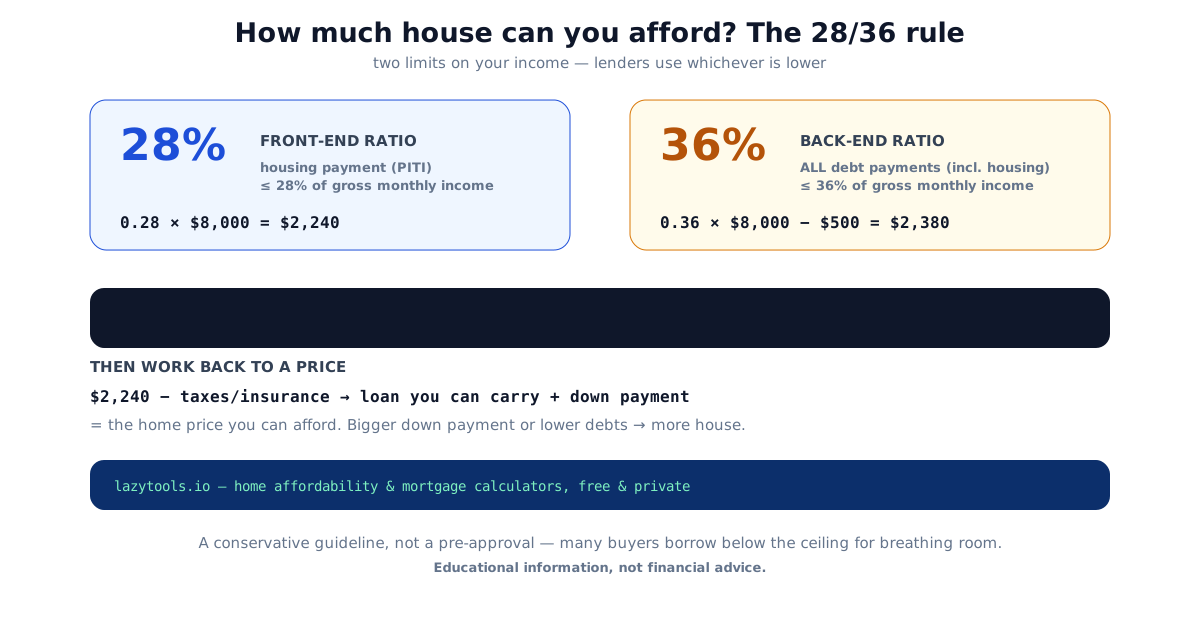
Lenders measure affordability with your debt-to-income (DTI) ratio, the share of your gross monthly income eaten by debt payments (the Consumer Financial Protection Bureau explains how lenders weigh DTI). The 28/36 rule sets two caps:
- Front-end ratio, 28%. Your monthly housing payment (the full PITI: principal, interest, taxes and insurance, plus HOA) should stay under about 28% of gross monthly income.
- Back-end ratio, 36%. All your monthly debt payments together, housing plus car loans, student loans and minimum credit-card payments, should stay under about 36%.
Your ceiling is whichever produces the lower housing budget.
A worked example
Say you earn $8,000/month gross and pay $500/month in other debts:
- Front-end: 0.28 × $8,000 = $2,240 for housing.
- Back-end: 0.36 × $8,000 = $2,880 for all debt, minus the $500 you already owe = $2,380 left for housing.
The lower of the two is $2,240/month, your maximum housing payment. Notice the lever: if you had $1,500 of other debts, the back-end limit would drop to $2,880 − $1,500 = $1,380, and that would become your ceiling. Paying down debt directly raises how much house you can afford.
From payment to price
The $2,240 is a payment, not a price. To get the price:
- Subtract estimated monthly property tax, insurance and HOA. Those are part of the payment but not the loan.
- The rest is your affordable principal-and-interest payment; run it backwards through the mortgage formula (at today’s rate and term) to get the loan amount you can carry.
- Add your down payment. Home price = affordable loan + down payment.
The home affordability calculator does all of this, enter your income, debts, down payment and rate and it returns the home price, loan and monthly payment you qualify for, and tells you which ratio is limiting you. Then the mortgage calculator breaks the actual payment down with a full amortization schedule.
Why the interest rate moves your ceiling so much
Step 2 above hides the single biggest variable: the interest rate. Because a fixed payment buys less loan as rates rise, the same monthly budget can swing tens of thousands of dollars in purchasing power. Here is roughly how much loan a $1,800/month principal-and-interest payment supports on a 30-year fixed loan at different rates (figures are approximate and rounded):
| Interest rate | Loan supported by $1,800/mo P&I |
|---|---|
| 5% | ~$335,000 |
| 6% | ~$300,000 |
| 7% | ~$271,000 |
| 8% | ~$245,000 |
The gap between 5% and 8% is roughly $90,000 of borrowing power on the identical payment. This is why affordability answers go stale quickly, and why you should re-run the numbers at the rate you can actually lock, not the rate from a headline six months ago. It is also the case for a larger down payment or a longer term: both lower the monthly cost of a given price, though a longer term means more total interest over the life of the loan.
A quick income-to-price sanity check
Before you touch a calculator, the front-end limit alone gives you a fast ceiling on the payment. Multiply gross monthly income by 0.28:
| Gross annual income | Gross monthly | Max housing payment (28%) |
|---|---|---|
| $60,000 | $5,000 | $1,400 |
| $90,000 | $7,500 | $2,100 |
| $120,000 | $10,000 | $2,800 |
| $150,000 | $12,500 | $3,500 |
These are the housing budgets, taxes and insurance included, not loan amounts. The common shorthand that buyers land around 3-4× gross annual income in home price is a byproduct of these ratios at typical rates and down payments; it is a useful gut-check, but it breaks down at the extremes (very high rates push it toward 3×, very low rates and big down payments can stretch it past 4×). Treat the multiple as a rough compass, not the map.
What the ratios leave out
Being under 28/36 gets you in the door, but underwriting weighs more than two ratios:
- Credit score. A stronger score earns a lower rate, which, per the table above, directly raises how much house the same payment buys.
- Cash reserves. Lenders like to see months of payments in savings after closing; thin reserves can shrink your approval even at a clean DTI.
- Down payment and PMI. Under 20% down usually adds private mortgage insurance, raising the monthly payment and eating into your 28% room.
- Loan type. Some government-backed programs allow higher back-end ratios than 36% with compensating factors, so 28/36 is a baseline, not a hard wall.
- The costs that never touch the loan. Closing costs, moving, maintenance and utilities all land outside the ratios but very much inside your budget.
A ceiling, not a target
Two cautions the ratios hide:
- It’s gross income. The 28/36 limits use pre-tax income, so a payment right at the 28% ceiling can feel heavy against your take-home pay.
- It’s a maximum. Lenders may even approve more, but “can borrow” isn’t “should borrow.” Buying below the ceiling leaves room for savings, an emergency fund, rate changes and the surprise costs every homeowner meets.
A useful sanity check alongside it: run the payment through a 50/30/20 budget, if housing alone blows past the “needs” half of your take-home pay, the mortgage may qualify on paper but strain real life.
The 28/36 rule is a widely-used lender guideline, not a guarantee of approval, actual underwriting varies with credit, reserves, loan type and lender. Ratios use gross income. This is educational information, not financial advice or a pre-approval. Sources: standard mortgage debt-to-income guidelines (Fannie Mae / CFPB).
Frequently asked questions
How much house can I afford?
Lenders use the 28/36 rule: your housing payment should be under about 28% of gross monthly income, and all debt payments under 36%. Take the lower limit, subtract taxes and insurance, and work back to the loan plus your down payment for the home price. As a rough shortcut, many buyers land around 3-4× gross annual income.
What is the 28/36 rule?
A lender guideline with two limits: the front-end ratio caps housing costs at ~28% of gross monthly income, and the back-end ratio caps all monthly debt payments (housing plus car, student, credit-card minimums) at ~36%. Whichever gives the lower housing budget is your ceiling.
What is the difference between front-end and back-end DTI?
Front-end DTI counts only your housing payment against income (the 28%). Back-end DTI counts all your debt payments including housing (the 36%). Existing debts eat into the back-end limit, which is why paying down debt can raise how much house you can afford.
Does the 28/36 rule use gross or net income?
Gross, your pre-tax income. That's why a payment at the 28% ceiling can still feel tight against your take-home pay, and why borrowing below the maximum is often wise.
How does my down payment affect affordability?
It adds directly to the price you can buy (home price = affordable loan + down payment), can remove PMI once you reach 20% down, and lowers the monthly payment on any given house, so a bigger down payment stretches your budget further.
Should I borrow the maximum I qualify for?
Usually not. The 28/36 result is a ceiling, not a goal, and it's based on pre-tax income. Leaving room below it protects your savings, emergency fund and lifestyle against rate changes, repairs and life events. Educational information, not financial advice.