
explainer
How to Calculate Square Footage of a Room (Including L-Shapes and Odd Angles)
By Uttam Regmi · Published 2026-07-14 · Updated 2026-07-14 · 4 min read · Fact-checked, sources cited
Square footage is length times width: measure both sides of a room in feet and multiply them. A room that is 12 feet by 10 feet is 12 × 10 = 120 square feet. For rooms that aren’t a simple rectangle, split the space into rectangles, work out each one, and add them together, that single trick handles L-shaped rooms, alcoves and open-plan spaces. To convert to square metres, multiply the square feet by 0.0929.
The basic formula
Area is length × width, and when both are in feet the answer is in square feet. So a bedroom measuring 12 ft along one wall and 10 ft along the other is:
12 ft × 10 ft = 120 square feet
That’s the whole idea. The only rules are that both measurements must be in the same unit (both feet, or both metres) and that you measure the actual floor, wall to wall.
If your tape reads in feet and inches, convert the inches to a decimal first by dividing by 12. A wall that’s 12 ft 6 in is 12 + (6 ÷ 12) = 12.5 ft. Then multiply as normal.
L-shaped and irregular rooms
Most “hard” rooms aren’t hard at all, they’re just two or three rectangles stuck together. The method never changes:
- Divide the floor plan into rectangles with straight lines.
- Measure and calculate each rectangle’s area separately.
- Add the areas together.
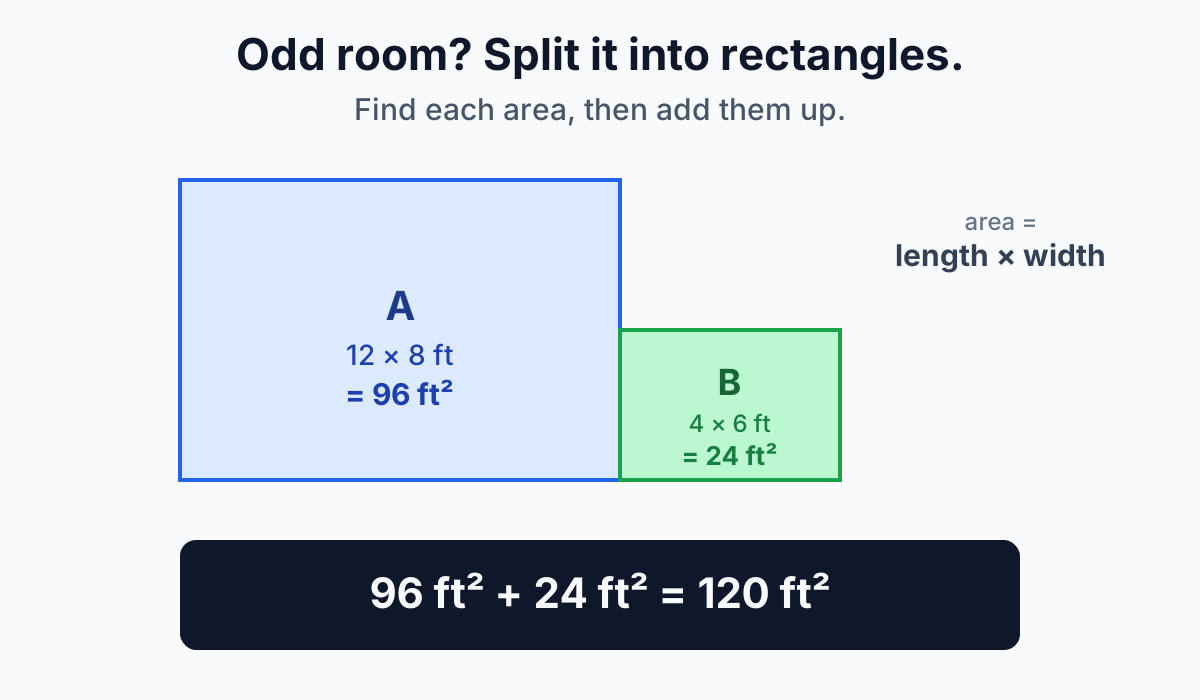
For an L-shaped living room, you might split it into a large 12 × 8 ft rectangle (96 sq ft) and a smaller 4 × 6 ft rectangle (24 sq ft). Total: 96 + 24 = 120 sq ft. For a room with a bay window or alcove, treat the alcove as its own little rectangle and add it on.
Circles, triangles and other shapes
Not everything is a rectangle. The two other formulas worth knowing:
| Shape | Formula | Example |
|---|---|---|
| Rectangle / square | length × width | 12 × 10 = 120 sq ft |
| Triangle | ½ × base × height | ½ × 10 × 6 = 30 sq ft |
| Circle | π × radius² | π × 5² ≈ 78.5 sq ft |
| Circle (from diameter) | π × (diameter ÷ 2)² | π × (10 ÷ 2)² ≈ 78.5 sq ft |
For a circular patio, measure across the middle to get the diameter, halve it for the radius, then square the radius and multiply by π (about 3.14159). A round table area 10 ft across is π × 5² ≈ 78.5 sq ft.
Converting between square feet and square metres
The exact conversion comes from the definition of a foot (0.3048 m), so one square foot is 0.3048² = 0.09290304 square metres:
- Square feet → square metres: multiply by 0.0929
- Square metres → square feet: multiply by 10.764
So that 120 sq ft room is 120 × 0.0929 ≈ 11.15 m². Our square footage calculator shows both units at once so you never have to convert by hand.
How much extra to buy for flooring
The bare square footage is what the room is, but it’s not how much flooring to buy. Cuts, offcuts, mistakes and future repairs all eat material, so add a waste allowance on top:
| Flooring type / layout | Typical waste to add |
|---|---|
| Straight lay (planks, tile) | 5-10% |
| Diagonal or herringbone | 15-20% |
| Highly patterned / many cuts | up to 20% |
Multiply your square footage by 1.05-1.20 accordingly, then round up to whole boxes. For 120 sq ft of straight-lay flooring at 10% waste, buy for 120 × 1.10 = 132 sq ft. Keeping a spare box from the same batch is smart for later repairs, since colours shift between production runs.
Square footage and price
Once you have the area, price per square foot lets you compare homes, rentals or materials of very different sizes on a fair basis, it’s total price ÷ area. A $350,000 home of 1,800 sq ft works out to about $194 per square foot. Our cost per square foot calculator does this and shows the per-square-metre figure too.
Frequently asked questions
How do you calculate the square footage of a room?
Measure the length and width of the room in feet, then multiply them together. A room that is 12 feet by 10 feet is 12 x 10 = 120 square feet.
How do I find the square footage of an L-shaped room?
Split the floor plan into separate rectangles, calculate each rectangle's area, then add them together. For example, a 12 x 8 ft rectangle (96 sq ft) plus a 4 x 6 ft rectangle (24 sq ft) totals 120 sq ft.
How do I convert square feet to square metres?
Multiply the square footage by 0.0929. So 120 square feet is about 11.15 square metres. To go the other way, multiply square metres by 10.764.
How do I calculate square footage when measurements include inches?
Convert the inches to a decimal by dividing by 12, then multiply as normal. A wall that is 12 ft 6 in becomes 12 + (6 / 12) = 12.5 ft.
How much waste should I add when buying flooring?
Add roughly 5 to 10 percent on top of the bare square footage to allow for cuts, offcuts and mistakes before you buy.
How do you calculate the area of a circular or triangular space?
For a circle, use pi x radius squared (a 10 ft diameter gives about 78.5 sq ft). For a triangle, use one half x base x height.