
explainer
How to Read SMD Resistor Codes (103, 4700, 01C and R47)
By Uttam Regmi · Published 2026-07-12 · Updated 2026-08-23 · 6 min read · Fact-checked, sources cited
A surface-mount resistor is too small for color bands, so it prints a short number instead, and 103, 4700, 01C and R47 are all valid ways to write a resistance. The rules aren’t intuitive, and the most common mistake (reading 470 as 470 Ω when it means 47 Ω) can quietly break a circuit. Here’s how each format works.
The 3-digit code (the common one)
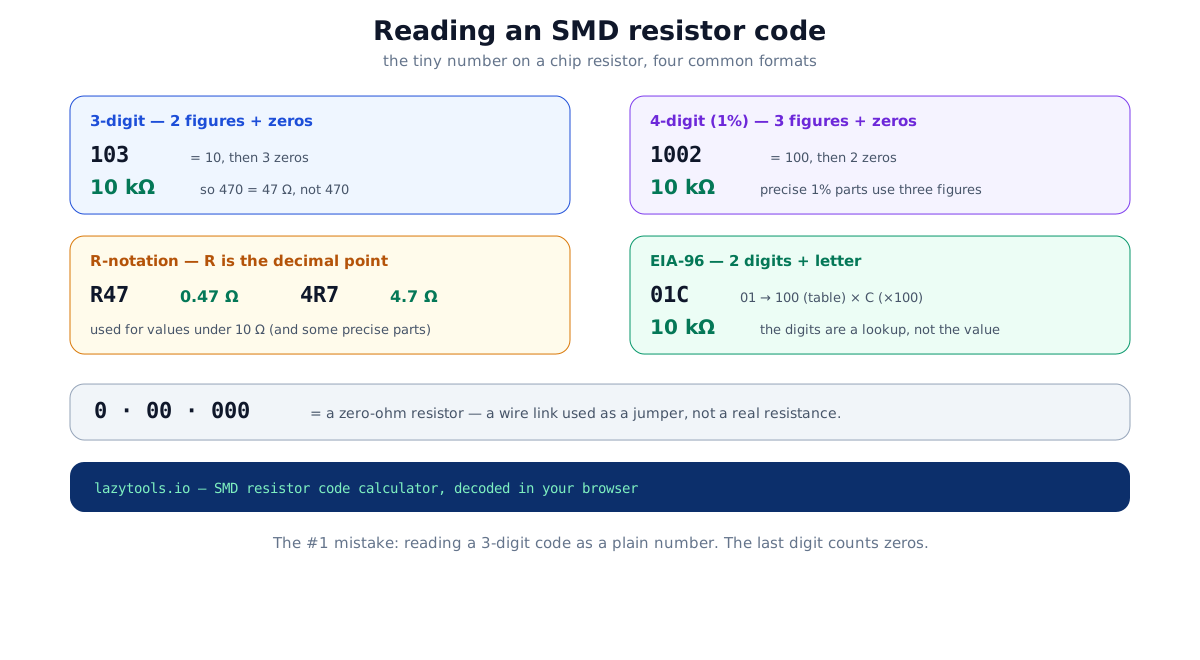
Most chip resistors carry a 3-digit code that works exactly like the old resistor color bands: the first two digits are significant figures, and the third is the number of zeros to add (a ×10ⁿ multiplier). The result is in ohms (electronic color code, Wikipedia).
103→10+ 3 zeros = 10,000 Ω = 10 kΩ472→47+ 2 zeros = 4,700 Ω = 4.7 kΩ220→22+ 0 zeros = 22 Ω
That last one is the trap. 470 is not 470 Ω, it’s 47 with zero extra zeros = 47 Ω. If you actually want 470 Ω, the code is 471 (47 × 10¹). When a value looks “off by a decade,” this is almost always why.
The 4-digit code (1% parts)
Precision 1% resistors need more resolution than two figures allow, so they use a 4-digit code: the first three digits are significant figures and the fourth is the zero-count.
1002→100+ 2 zeros = 10 kΩ4700→470+ 0 zeros = 470 Ω1000→100+ 0 zeros = 100 Ω
Same idea as the 3-digit code, one more figure of precision. The catch is that a 4-digit and a 3-digit code can look alike out of context: 4700 on a 1% part is 470 Ω, but a lone 470 on a general-purpose part is 47 Ω. When the ambiguity matters, the tolerance (marked on the reel or datasheet, not the body) tells you which system applies, 1% and tighter parts use the 4-digit scheme.
R-notation for small values
For resistances below 10 Ω, zeros-and-multipliers don’t help, so the code uses an R in place of the decimal point:
R47= 0.47 Ω4R7= 4.7 Ω47R0= 47 Ω
Wherever you see the R, put a decimal point and read the digits straight off.
EIA-96: two digits and a letter
The tiniest 1% resistors use the compact EIA-96 code: two digits + one letter. The two digits aren’t the value, they’re a position (01–96) in the standard E96 1% value table, and the letter is a power-of-ten multiplier.
| Code digits → value | Letter → multiplier | ||
|---|---|---|---|
01 = 100 | 30 = 200 | A = ×1 | D = ×1000 |
47 = 301 | 68 = 499 | B = ×10 | E = ×10000 |
96 = 976 | … | C = ×100 | R = ×0.01 |
So 01C = 100 × 100 = 10 kΩ, and 68X = 499 × 0.1 = 49.9 Ω (X = ×0.1). The SMD resistor code calculator has the full table built in, type the code and it detects the format for you.
The zero-ohm jumper
A code of 0, 00 or 000 isn’t a resistance at all, it’s a zero-ohm resistor, a wire link in resistor form. Boards use them to hop one track over another, or to leave a spot where a real value can be fitted later. A zero-ohm link isn’t perfectly resistance-free, datasheets typically spec a maximum around a few tens of milliohms and a current rating, but for signal routing it behaves as a plain wire.
A quick decision flow
When you’re staring at a code and not sure which system it belongs to, work through it in this order:
- Is it
0,00or000? Zero-ohm jumper. Done. - Is there an
Rsitting where a decimal point would go (R47,4R7,47R0)? R-notation, drop theRin as a decimal and read the digits straight off. - Is there a letter that isn’t
R-as-decimal, with two digits in front (01C,68X)? EIA-96, the two digits index the E96 table, the letter multiplies. - All digits? Count them: three digits is the common two-figures-plus-zeros scheme; four digits is the three-figures-plus-zeros 1% scheme.
The only genuinely tricky case is telling a 3-digit 4R7-style code apart from a same-length all-digit one, and the R makes that obvious. Everything else falls out of the digit count.
Worked example: decode 2R2, 331 and 49R9
2R2, anRbetween two digits, so it’s R-notation: 2.2 Ω.331, three digits, no letter: two figures (33) plus one zero = 330 Ω. Note it is not 331 Ω.49R9, theRis the decimal point, giving 49.9 Ω, a common 1% value.
The recurring lesson: the last all-digit position is almost always a multiplier, not a value digit, so 331 is 330 Ω and 470 is 47 Ω.
Common codes at a glance
A short reference spanning the four systems for values you’ll meet constantly:
| Resistance | 3-digit | 4-digit (1%) | R-notation | EIA-96 |
|---|---|---|---|---|
| 4.7 Ω | , | , | 4R7 | , |
| 47 Ω | 470 | , | 47R0 | , |
| 100 Ω | 101 | 1000 | , | 01A |
| 1 kΩ | 102 | 1001 | , | 01B |
| 4.7 kΩ | 472 | 4701 | , | , |
| 10 kΩ | 103 | 1002 | , | 01C |
| 100 kΩ | 104 | 1003 | , | 01D |
| 1 MΩ | 105 | 1004 | , | 01E |
Dashes mark combinations that system doesn’t naturally express, sub-10-Ω values fall to R-notation, and EIA-96 only covers standard E96 figures.
Why some chips have no marking at all
Very small packages simply run out of room. Parts in the 0402 (roughly 1.0 × 0.5 mm) case and smaller are frequently left unmarked, and 0201 and 01005 sizes essentially always are. If a resistor carries no printed code, you can’t decode it from the body, identify it from the board’s bill of materials or by measuring it with a multimeter across the desoldered part. Marked codes live mostly on 0603, 0805 and 1206 and larger cases, where there’s space for the three or four characters.
Reading it without the arithmetic
The formats overlap enough to be genuinely confusing at a glance, so the SMD resistor code calculator decodes any of them and tells you which format it recognised, all in your browser, nothing uploaded. For through-hole parts with colored stripes instead, use the resistor color code calculator; and if those resistors are feeding a tuned circuit, the LC resonant frequency calculator covers the L–C side.
The SMD codes here follow the standard IEC/EIA marking conventions, including the E96 value table used by EIA-96. Values are decoded exactly in your browser. This is general reference information; always confirm a critical value against the manufacturer’s datasheet or by measurement.
Frequently asked questions
What does 103 mean on a resistor?
10 kΩ. In a 3-digit SMD code the first two digits are significant figures and the third is the number of zeros, so 103 is 10 followed by three zeros = 10,000 Ω. Likewise 104 = 100 kΩ and 102 = 1 kΩ.
Why is 470 equal to 47 ohms and not 470?
Because the last digit is a multiplier (a count of zeros), not a value digit. 470 = 47 × 10⁰ = 47 Ω. To mark 470 Ω you'd print 471 (47 × 10¹). Misreading this is the single most common SMD-code mistake.
How do I read a 4-digit SMD resistor code?
Used on precise 1% resistors, it's three significant figures plus a multiplier: 1002 = 100 × 10² = 10 kΩ, and 4700 = 470 × 10⁰ = 470 Ω. The extra digit gives the finer resolution 1% parts need.
What does an R in a resistor code mean?
The R stands in for a decimal point, used for values below 10 Ω (and some precise parts). R47 = 0.47 Ω, 4R7 = 4.7 Ω, 47R0 = 47 Ω.
What is the EIA-96 code on very small resistors?
A compact 1% marking of two digits plus a letter. The two digits are a position in the standard E96 value table (01 = 100, 68 = 499…) and the letter is a power-of-ten multiplier (A = ×1, B = ×10, C = ×100, R = ×0.01, and so on). So 01C = 100 × 100 = 10 kΩ and 68X = 499 × 0.1 = 49.9 Ω.
What is a 000 or 0 resistor for?
It's a zero-ohm resistor, a wire link in the same package as a resistor, used as a jumper to route a track over others, or as a place to fit a real value later. It has essentially no resistance.
How do I tell an EIA-96 code from R-notation?
If the letter is anything other than an R sitting between digits, it's EIA-96 (the leading two digits are a lookup index). An R placed where a decimal point belongs, R47, 4R7, is R-notation, and the digits are the value directly.