
explainer
KSeF in 2026/2027: How to Open and Read an FA(3) Invoice XML, No Software, Nothing Uploaded
By Uttam Regmi · Published 2026-07-07 · Updated 2026-07-07 · 7 min read · Fact-checked, sources cited
In Poland, an invoice is no longer a document you send, it’s a record the state’s system accepts. Since 1 April 2026 every VAT-registered business issues invoices through KSeF as FA(3) XML, the XML is the legally binding invoice, and from 1 January 2027 issuing outside the system carries penalties of up to 100% of the invoice’s VAT. Reading one of these files, though, requires no software at all: the KSeF viewer parses FA(3)/FA(2) XML into a normal, readable invoice, entirely in your browser.
The model: clearance, not correspondence
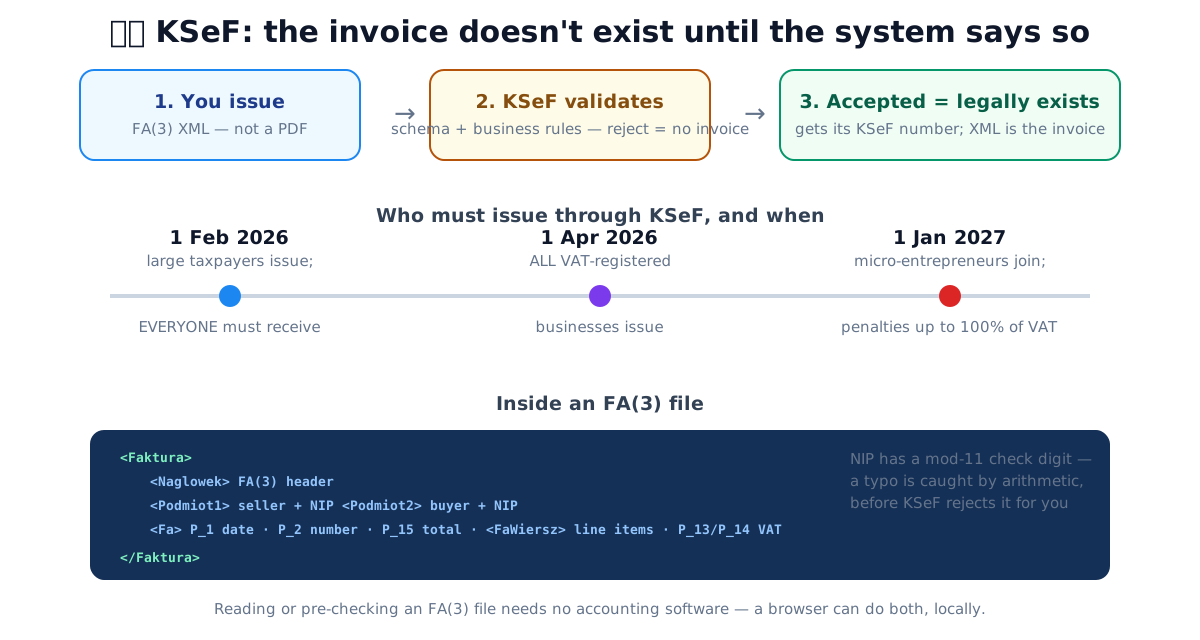
Most countries’ e-invoicing mandates (Germany’s, France’s) are about format. You must exchange structured files. Poland went further: KSeF is a clearance system. The invoice is submitted to the government platform as XML, validated against the FA(3) schema and business rules, and, only if accepted, assigned a KSeF number, at which moment it legally exists. A rejected submission isn’t a late invoice; it’s no invoice, per the European Commission’s country profile.
The timeline, and why 2027 matters more than 2026
| Date | Obligation |
|---|---|
| 1 Feb 2026 | Large taxpayers (> PLN 200M turnover) must issue via KSeF; everyone must be able to receive |
| 1 Apr 2026 | All VAT-registered businesses must issue via KSeF |
| 1 Jan 2027 | Micro-entrepreneurs (small invoice volumes) join; penalty grace period ends |
The detail that changes behaviour: 2026 is deliberately penalty-free while the country adapts, per the implementation guides. From January 2027, sanctions become enforceable, up to 100% of the VAT amount for invoices issued outside the system. So KSeF competence isn’t a passed deadline; it’s a rising-stakes requirement.
Inside an FA(3) file
FA(3) is the third revision of Poland’s struktura logiczna, the XML schema every KSeF invoice follows, mandatory since February 2026 (per the Ministry of Finance’s KSeF documentation). The shape is stable and readable once decoded:
| Element | What it holds |
|---|---|
<Naglowek> | Schema variant (FA(3)), creation timestamp, issuing system |
<Podmiot1> | The seller, name, address, NIP |
<Podmiot2> | The buyer, same structure |
<Fa> | The invoice: P_1 issue date, P_2 number, KodWaluty currency, P_15 total due, P_13_*/P_14_* net/VAT per rate group |
<FaWiersz> (repeated) | Line items: P_7 name, P_8B quantity, P_9A unit price, P_11 net value, P_12 VAT rate |
The cryptic P_n names come from the VAT regulation’s field numbering, one reason raw FA(3) XML
is unreadable to humans and why a viewer that maps them back to “issue date,
line items, total due” is the practical bridge. The viewer auto-detects FA(3) vs the older FA(2)
and flags the difference.
FA(2) vs FA(3): what actually changed
If you already handled the previous structure, most of your mental model carries over, the root
<Faktura>, the two Podmiot blocks, the Fa body and repeating FaWiersz lines are all still
there. FA(3) tightened and extended, rather than rebuilt:
| Aspect | FA(2) | FA(3) |
|---|---|---|
| Status | Superseded structure | Current mandatory structure |
Schema variant in <Naglowek> | Declares FA(2) | Declares FA(3) |
| Core skeleton | Naglowek / Podmiot1 / Podmiot2 / Fa / FaWiersz | Same skeleton, refined fields |
| Practical effect | Rejected once FA(3) became mandatory | The version KSeF now expects |
The takeaway for anyone reading files: a document that still declares FA(2) in its header is either historical or was generated by a system that hasn’t been updated. A good viewer names the variant explicitly so you notice before you rely on the file.
Reading an FA(3) file, step by step
The workflow when a supplier or your own accounting export lands an .xml on your desk:
- Open it locally. Drop the file into the KSeF viewer. Parsing happens in the browser’s XML engine, so the file never uploads.
- Check the parties. Confirm
Podmiot1(seller) andPodmiot2(buyer) NIPs match who you expect, the viewer renders them as plain names and tax IDs, notP_ncodes. - Scan the lines. Each
FaWierszbecomes a normal invoice row: description, quantity, unit price, net value, VAT rate. - Reconcile the totals. The
Fabody’sP_15(total due) should equal the sum of the line nets plus their VAT groups (P_13_*net /P_14_*VAT per rate). - Save a human copy. Print to PDF for your records, but remember the XML, not the PDF, is the legal instrument.
The NIP check digit, a worked example
Every Polish NIP’s tenth digit is a checksum: multiply the first nine digits by the fixed weights 6, 5, 7, 2, 3, 4, 5, 6, 7, sum the products, take the result modulo 11, and that must equal the last digit. (If the modulo comes out as 10, the number is simply not a valid NIP.)
Take a fictional NIP 527-251-06-34. The first nine digits are 5 2 7 2 5 1 0 6 3:
| Digit | 5 | 2 | 7 | 2 | 5 | 1 | 0 | 6 | 3 |
|---|---|---|---|---|---|---|---|---|---|
| Weight | 6 | 5 | 7 | 2 | 3 | 4 | 5 | 6 | 7 |
| Product | 30 | 10 | 49 | 4 | 15 | 4 | 0 | 36 | 21 |
The products sum to 169, and 169 mod 11 = 4, which matches the tenth digit, so the checksum holds.
Now fat-finger one digit, say the second becomes a 3, giving 537-251-06-34. The second product
jumps from 10 to 15, the sum becomes 174, and 174 mod 11 = 9 ≠ 4. The typo fails arithmetic
before it ever reaches KSeF.
That is exactly the class of error worth catching on your own machine rather than as a rejected submission. The pre-checker runs that checksum on both parties, plus the structural checks (required elements, date and currency formats, line items, totals consistency), clearly labelled as an unofficial early warning, because only KSeF’s own acceptance has legal effect.
Privacy: why local parsing is the whole point
An FA(3) file names your counterparties, itemizes what you sold them, and often carries a bank account number. Pre-submission invoices are unfiled tax data. Both are precisely what should not be pasted into a random “free online XML viewer” that processes uploads server-side. The LazyTools viewer and pre-checker parse everything with the browser’s own XML engine. They work offline, and nothing you load leaves your device.
Elsewhere in Europe, same story
Poland is the sharpest deadline, not an outlier. Belgium has required structured B2B invoices over the Peppol network since 1 January 2026 (penalties since April), the Peppol BIS viewer reads those UBL files. Germany (XRechnung, ZUGFeRD) and France (Factur-X, mandate from September 2026) are covered by the e-invoice viewer and Factur-X viewer. One pattern across all of them: the XML is the invoice, and being able to read it locally is the minimum literacy the mandates quietly assume.
Quick summary
KSeF turned Polish invoicing into a clearance process: FA(3) XML in, validation, KSeF number out, and only then does the invoice exist. All VAT-registered businesses have issued this way since
April 2026; micro-firms join by January 2027, when penalties (up to 100% of the invoice’s VAT)
begin to bite. The XML structure is decodable, parties with checksummed NIPs, P_n fields,
FaWiersz lines, and both reading and pre-checking an FA(3) file are browser-local jobs: the
KSeF viewer renders it as a normal invoice, and the
pre-checker catches the cheap mistakes before the system rejects them,
with your data never leaving your machine.
Sources: Ministry of Finance, KSeF FA(3) documentation · European Commission, eInvoicing in Poland · VATupdate, KSeF 2026 deadlines guide · EY, Belgium’s mandatory e-invoicing from 1 January 2026
Frequently asked questions
What is KSeF?
Krajowy System e-Faktur, Poland's national e-invoicing platform, operating on a clearance model: invoices are submitted as structured XML, validated by the system, and legally come into existence only when KSeF accepts them and assigns a KSeF number. The XML is the invoice; PDFs are visualisations.
What are the KSeF deadlines?
Issuing became mandatory for large taxpayers (over PLN 200M turnover) on 1 February 2026 and for all other VAT-registered businesses on 1 April 2026. Micro-entrepreneurs with low invoice volumes have until 1 January 2027. Receiving invoices through KSeF has been mandatory for everyone since February 2026.
What happens from January 2027?
The grace period ends. 2026 is penalty-free while businesses adapt; from 1 January 2027 sanctions for non-compliance become enforceable, up to 100% of the VAT amount shown on an invoice issued outside KSeF. Demand for getting this right grows into 2027; it doesn't fade.
What is an FA(3) file?
The current XML structure (struktura logiczna) that KSeF invoices must follow, mandatory since 1 February 2026 and replacing FA(2). Root element <Faktura>, with the header (Naglowek), seller (Podmiot1) and buyer (Podmiot2) with their NIPs, and the invoice body (Fa) holding dates, totals, VAT groups and FaWiersz line items.
How do I read an FA(3) XML someone sent me?
You don't need accounting software or a KSeF login just to read one: a browser-based viewer can parse the structure locally and display the parties, line items, VAT summary and payment details as a normal invoice, printable or saveable as PDF. Keep it local: the file contains counterparties, amounts and bank accounts.
Can I validate an invoice before submitting it to KSeF?
You can pre-check it: structure, required fields, date and currency formats, and the NIP mod-11 check digits that catch most tax-ID typos. That's an unofficial early-warning check, full XSD-schema and business-rule validation happens only inside KSeF, and only its acceptance has legal effect.