
explainer
LLM Tokens Explained: What Your Prompts Actually Cost, and Why Claude & Gemini Counts Are Estimates
By Uttam Regmi · Published 2026-07-07 · Updated 2026-07-28 · 8 min read · Fact-checked, sources cited
LLM APIs don’t bill you for words, requests or characters. They bill for tokens, and misjudging the conversion is the most common way AI budgets go wrong. A token is roughly 4 characters of English (¾ of a word); every model prices input and output tokens separately, with output typically 5-6× dearer. Count yours with the LLM token counter, exact for OpenAI models, honestly-labelled estimates for the rest, computed entirely in your browser.
What a token actually is
Before a model sees your prompt, a tokenizer splits the text into sub-word chunks from a fixed
vocabulary, common words become single tokens, rarer ones split into pieces
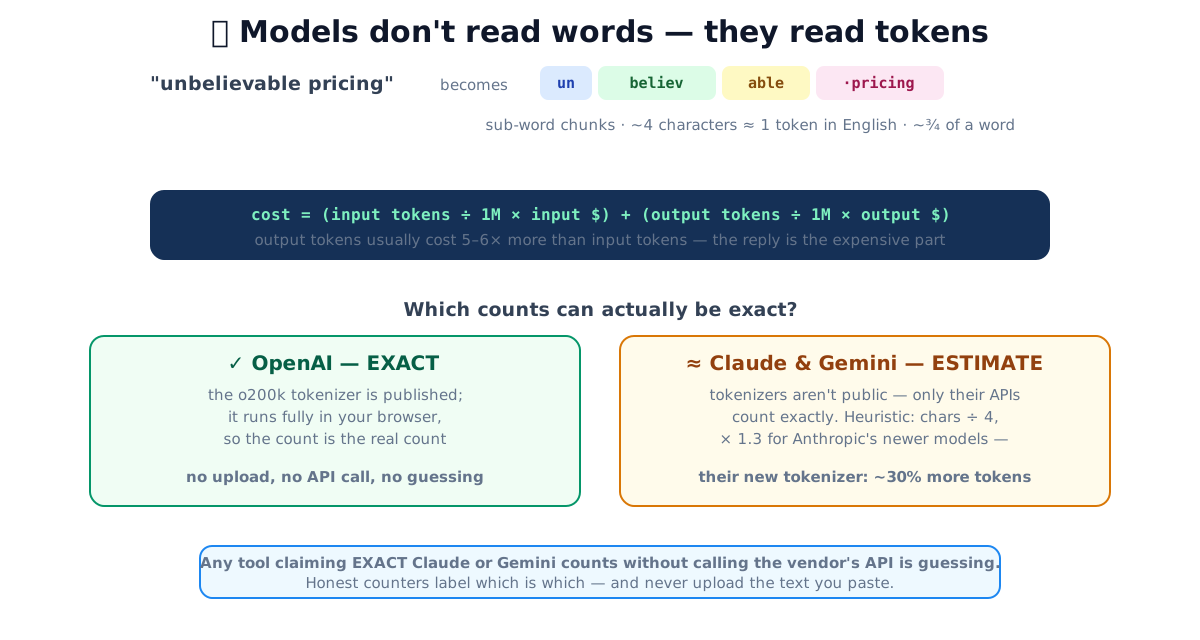
(unbelievable → un + believ + able). This is why vendors quote the same rule of thumb:
Anthropic’s pricing FAQ puts it at
“approximately 4 characters or 0.75 words in English.” Code, JSON, non-English text and whitespace
all tokenize differently, sometimes dramatically so, which is why estimating from word counts is
fine for napkin math and dangerous for budgets.
The tokenizer is not a word splitter. It is trained on a corpus and learns a vocabulary of the most
statistically frequent byte sequences, so a common word like the is a single token, while a
domain term, a rare surname, an emoji or a run of digits fractures into several. Two texts of
identical length can therefore carry very different token counts, and the model is billed for tokens,
not for anything a human would count by eye.
Words, characters, tokens: a working reference
For rough English prose, these conversions hold well enough for a first estimate. Treat every figure as a heuristic, not a guarantee, the further your text drifts from ordinary English, the more it under- or over-counts.
| You have | Rough token estimate (English) | Notes |
|---|---|---|
| 1 word | ~1.33 tokens | ¾ of a word per token |
| 100 words | ~133 tokens | a short paragraph |
| 1,000 words | ~1,300-1,400 tokens | a long blog section |
| 1 character | ~0.25 tokens | 4 chars per token |
| 1 page (~500 words) | ~650-700 tokens | double-spaced prose |
| This whole article | a few thousand tokens | still well under any modern context window |
Content type shifts these numbers noticeably. Source code and JSON tend to tokenize heavier per character than prose, brackets, indentation, operators and camelCase identifiers all break into extra pieces. Text in non-Latin scripts (Chinese, Japanese, Arabic, Hindi) and heavily accented languages usually costs more tokens per equivalent meaning than English, because those characters are under-represented in the vocabulary. Long numbers and hashes are among the worst offenders. When any of that dominates your prompt, stop estimating and count with a real tokenizer.
The cost formula, with verified prices
Every mainstream API prices the two directions separately, per million tokens (MTok):
cost per request = (input tokens ÷ 1M × input rate) + (output tokens ÷ 1M × output rate)
Current list prices, verified 28 July 2026 against the official pricing pages:
| Model | Input $/MTok | Output $/MTok |
|---|---|---|
| GPT-5.6 Sol | $5.00 | $30.00 |
| GPT-5.6 Terra | $2.50 | $15.00 |
| GPT-5.6 Luna | $1.00 | $6.00 |
| GPT-5.4 nano | $0.20 | $1.25 |
| Claude Fable 5 | $10.00 | $50.00 |
| Claude Opus 5 | $5.00 | $25.00 |
| Claude Opus 4.8 | $5.00 | $25.00 |
| Claude Sonnet 5 | $2.00 → $3.00 from 1 Sept 2026 | $10.00 → $15.00 |
| Claude Haiku 4.5 | $1.00 | $5.00 |
| Gemini 3.6 Flash | $1.50 | $7.50 |
| Gemini 3.5 Flash | $1.50 | $9.00 |
| Gemini 3.1 Pro (≤200k) | $2.00 | $12.00 |
| Gemini 2.5 Flash-Lite | $0.10 | $0.40 |
(Sources: OpenAI · Anthropic · Google. Standard rates, batch APIs are typically 50% off, and prompt-caching reads can be 90% off input.)
Worked example: a support bot on Claude Haiku 4.5 handling a 3,000-token context and replying with 500 tokens costs (3,000 ÷ 1M × $1) + (500 ÷ 1M × $5) = $0.0055 per conversation, about $16.50 a month at 100 conversations a day. The same traffic on Fable 5 is $0.055 per conversation, $165 a month: model choice is a 10× lever before any prompt engineering happens.
Notice the output column: 5-6× the input rate everywhere. Trimming a verbose system prompt
saves pennies; capping reply length (max_tokens) saves real money.
Why output is the expensive half
The asymmetry is not arbitrary. Reading your prompt is a single forward pass over the input, the model ingests all those tokens roughly in parallel. Generating a reply is sequential: the model produces one token, appends it, and runs the whole computation again to produce the next, hundreds or thousands of times over. Every provider prices that extra work into the output rate, which is why it lands at several times the input rate across OpenAI, Anthropic and Google alike.
The practical lesson is counter-intuitive. Teams often obsess over shrinking prompts while letting
the model ramble. But a 4,000-token prompt that yields a 200-token answer is cheap; a 400-token
prompt that yields a 2,000-token answer costs far more. Before micro-optimising your instructions,
set a sensible max_tokens, ask for terse output, and, where the API supports it, reuse cached
context so repeated input isn’t billed at full price.
Two levers that beat prompt-trimming
Most vendors expose two discounts that move bills more than wording ever will:
- Batch processing. Non-urgent jobs submitted through a batch API are commonly billed at around half the standard rate. If a workload can tolerate minutes of latency instead of seconds, that is a large saving for zero quality loss.
- Prompt caching. When a long, stable prefix (a big system prompt, a document, a few-shot block) is reused across many requests, cached input reads are billed at a steep discount, a large fraction off the normal input rate. The exact figures vary by provider and tier, so confirm them on the official pricing page before you model a budget around them.
The honesty problem: exact vs. estimated counts
Here’s what most token counters won’t tell you. OpenAI publishes its tokenizers (the current
encoding family is o200k), so a browser can run the genuine article and produce exact counts, no API call, no upload. Anthropic and Google don’t, exact Claude and Gemini counts exist only
behind their APIs (Anthropic offers a
count_tokens endpoint). Any
website showing “exact” Claude counts without calling that API is guessing with extra confidence.
It gets sharper with model generations. Anthropic’s pricing docs state that Opus 4.7 and later, Fable/Mythos 5 and Sonnet 5 “use a newer tokenizer… [that] produces approximately 30% more tokens for the same text” than the tokenizer in Sonnet 4.6 and earlier. Two consequences:
- Old heuristics undercount on new Claude models, a “200K-token” document by 2025 rules may not be one anymore.
- Per-token price comparisons mislead across generations, a model that’s 33% cheaper per token but tokenizes 30% heavier is barely cheaper per document.
The token counter handles this the only defensible way: OpenAI counts carry an EXACT badge (real tokenizer, run locally), Claude and Gemini counts carry an ESTIMATE badge with the heuristic disclosed (chars ÷ 4, × 1.3 for Anthropic’s newer models), and the pricing table shows its verification date with links to the sources.
The part nobody mentions: what you paste
Think about what goes into a token counter: your production system prompt. The contract you’re about to summarize. A transcript with customer names in it. Token counters attract exactly the text that shouldn’t touch a stranger’s server, and plenty of hosted counters process pasted text server-side or quietly log it. The fix is architectural, not policy: run the tokenizer in the browser, transmit nothing. That’s how the LazyTools counter works. It even keeps counting with the network unplugged.
Quick summary
Tokens are sub-word chunks (≈4 characters in English) and the billing unit of every LLM API. Cost is a two-term formula in which output tokens, at 5-6× the input rate, usually dominate, and model choice moves bills by 10× or more. Only OpenAI token counts can be computed exactly outside the vendor’s API, because only OpenAI publishes its tokenizer; treat every browser-side Claude or Gemini count as an estimate, and remember Anthropic’s newer models tokenize ~30% heavier than their predecessors. Count, compare and budget with the LLM token counter & cost calculator, exact where exactness is possible, labelled estimates where it isn’t, and nothing you paste ever leaves your machine.
Sources: Anthropic pricing documentation (model prices, tokenizer note, 4-chars heuristic, Sonnet 5 schedule) · OpenAI API pricing · Google Gemini API pricing · gpt-tokenizer library. Prices verified 28 July 2026.
Frequently asked questions
What is a token?
The unit LLMs actually process: a sub-word chunk of text produced by the model's tokenizer. In English, one token is roughly 4 characters or about three-quarters of a word, 'unbelievable' might split into un / believ / able. API usage and pricing are measured in tokens, not words.
How do I convert words to tokens?
As a rule of thumb, multiply words by 1.33 (or characters by 0.25) for English. But it's only a heuristic, code, non-English languages and unusual formatting tokenize very differently, which is why counting with a real tokenizer beats estimating.
Why are output tokens so much more expensive than input?
Generating tokens is more computationally expensive than reading them, and vendors price accordingly, output rates run 5-6× input rates across OpenAI, Anthropic and Google. Practically: long replies, not long prompts, dominate most bills.
Can a website count Claude or Gemini tokens exactly?
No. Anthropic and Google don't publish browser-runnable tokenizers; exact counts come only from their APIs (e.g. Anthropic's count_tokens endpoint). Any site showing 'exact' Claude/Gemini counts without an API call is estimating, honest tools label those numbers as estimates.
Why do Anthropic's newer models produce more tokens?
Anthropic's pricing documentation states that Opus 4.7 and later, Fable/Mythos 5 and Sonnet 5 use a newer tokenizer that 'produces approximately 30% more tokens for the same text' than the previous one (used by Sonnet 4.6 and earlier). When comparing per-token prices across model generations, that difference is part of the real cost.
Is it safe to paste confidential text into online token counters?
Only if the counting happens in your browser. What people paste into token counters is precisely their production prompts and internal documents, use a counter that runs the tokenizer client-side and transmits nothing, and be wary of any that upload your text to 'process' it.