
explainer
Markup vs Margin: Same Profit, Two Very Different Percentages
By Uttam Regmi · Published 2026-07-10 · Updated 2026-08-23 · 6 min read · Fact-checked, sources cited
Buy something for $60 and sell it for $100, and you’ve earned a 66.7% markup and a 40% margin at the same time, the identical $40 of profit, measured once against your cost and once against your selling price. They’re never equal, markup is always the bigger number, and mixing them up is one of the most expensive small mistakes in pricing. Compute both instantly for any cost and price in the markup & margin calculator; here’s the logic underneath.
One profit, two denominators
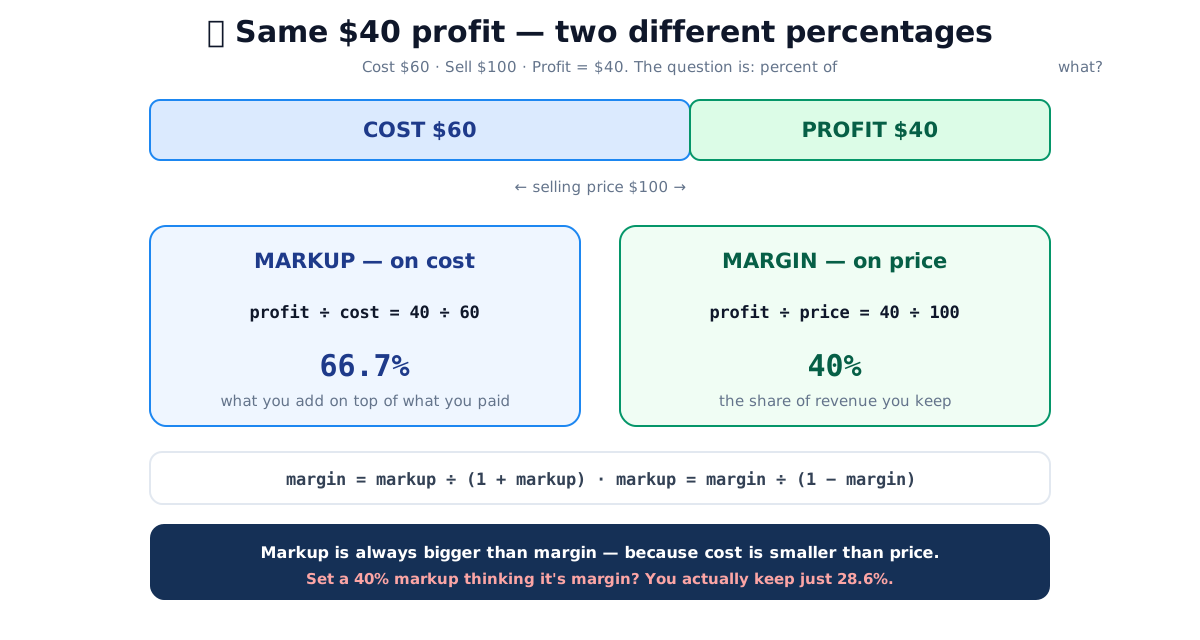
The whole confusion dissolves once you see that markup and margin ask the same question, how much profit?, but divide by different things:
- Markup looks backward at what you paid: profit as a percentage of cost.
- Margin looks at what you charged: profit as a percentage of selling price.
Since your cost ($60) is smaller than your price ($100), dividing the same $40 profit by the smaller number gives a bigger percentage. That’s the entire reason markup (66.7%) always exceeds margin (40%).
The four formulas you’ll actually use
Two to measure an existing price, two to set a price from a target:
| You have | You want | Formula | Example |
|---|---|---|---|
| Cost & price | Markup % | (price − cost) ÷ cost | (100 − 60) ÷ 60 = 66.7% |
| Cost & price | Margin % | (price − cost) ÷ price | (100 − 60) ÷ 100 = 40% |
| Cost & target markup | Price | cost × (1 + markup) | 60 × 1.667 = $100 |
| Cost & target margin | Price | cost ÷ (1 − margin) | 60 ÷ 0.60 = $100 |
Note the last two both land on $100 here, but only because 66.7% markup and 40% margin are the same deal expressed two ways. Feed a cost and a price into the markup & margin calculator and it returns the profit, both percentages, and the price/cost split in one go.
Converting between them
If you know one and want the other, you don’t need the cost and price at all:
margin = markup ÷ (1 + markup) · markup = margin ÷ (1 − margin)
Check it: a 66.7% markup → 0.667 ÷ 1.667 = 40% margin. A 50% margin → 0.5 ÷ 0.5 = 100% markup. That second one is worth remembering as a sanity anchor: doubling your money is a 100% markup but only a 50% margin.
It helps to keep a few common pairings in your head so a number never surprises you. Notice how the two figures start out close for small markups and then drift far apart as the markup climbs, because the bigger the profit, the more the two denominators (cost vs. price) diverge:
| Markup | Margin | Price on $60 cost |
|---|---|---|
| 15% | ≈13.0% | $69.00 |
| 25% | 20.0% | $75.00 |
| 33.3% | 25.0% | $80.00 |
| 50% | 33.3% | $90.00 |
| 66.7% | 40.0% | $100.00 |
| 100% | 50.0% | $120.00 |
| 150% | 60.0% | $150.00 |
| 200% | 66.7% | $180.00 |
A margin can never reach 100% (you would have to sell at an infinite price relative to cost), but a markup has no ceiling, a $1 item sold for $10 is a 900% markup and a 90% margin. That asymmetry is the whole story in one line.
Which one should you actually use?
Neither is “more correct”. They answer different business questions, and mature operations track both:
- Markup is a pricing lever. It starts from what you paid and asks “how much do I add?” That is how buyers, wholesalers, and anyone working up from a supplier invoice tends to think. Category markup rules (“we key everything at 2×”) are quick to apply on the floor.
- Margin is a performance measure. It starts from revenue and asks “how much did I keep?” Income statements, gross-profit targets, and investor comparisons are all expressed as margins, because margin is directly comparable across products with wildly different costs.
The friction appears at the handoff: the buying side sets prices in markup, the finance side reports results in margin, and unless someone converts cleanly between the two, targets get missed. That is exactly the gap the next section is about.
The mistake that quietly eats profit
Here’s where real money leaks. Say your business runs on 40% margins and you’re pricing a new item that cost you $60. If you absent-mindedly apply a 40% markup instead:
- Wrong (40% markup): $60 × 1.40 = $84 → that’s only a 28.6% margin
- Right (40% margin): $60 ÷ 0.60 = $100 → a true 40% margin
You’d have underpriced by $16 on a single item, and believed you hit your target. To see why that matters at scale, price a three-item order both ways. Say each product cost $60 and you plan to sell one unit of each:
| Item | Cost | ”40% markup” price | True 40% margin price | Profit gap |
|---|---|---|---|---|
| A | $60 | $84.00 | $100.00 | $16.00 |
| B | $60 | $84.00 | $100.00 | $16.00 |
| C | $60 | $84.00 | $100.00 | $16.00 |
| Total | $180 | $252.00 | $300.00 | $48.00 |
The mislabelled prices bring in $72 of gross profit ($252 − $180); the correct margin prices bring in $120 ($300 − $180). You collected only 60% of the profit you budgeted, a full 40% shortfall, purely from applying the right number against the wrong base. Across hundreds of SKUs that error compounds into a serious hole, and because every individual price still looks reasonable, it rarely gets caught by eye. The fix is simply to be explicit about which basis a percentage refers to, and to let the calculator show both figures side by side so the gap is impossible to miss.
A note on tax and the “keep” figure
Margin is the share of the selling price you keep as gross profit, before overheads, and before sales tax, which isn’t yours to keep at all. If your displayed price includes tax, strip it out before computing margin, or you’ll flatter your numbers. The sales tax calculator does that reverse step (price ÷ (1 + rate)) so your margin is measured on the real, pre-tax revenue.
Quick summary
Markup and margin are the same profit over different bases: markup divides by cost, margin divides by price. Because cost is the smaller number, markup is always the bigger percentage, $60→$100 is a 66.7% markup but a 40% margin. Convert with margin = markup ÷ (1 + markup), price from a target margin with cost ÷ (1 − margin), and never set a markup when you meant a margin (40% markup on $60 is only a 28.6% margin). Get every figure at once, privately in your browser, from the markup & margin calculator.
Sources: standard retail and accounting definitions of gross margin and markup · Investopedia, Margin vs. Markup · Corporate Finance Institute, Gross Margin.
Frequently asked questions
What's the difference between markup and margin?
They measure the same profit against different bases. Markup is profit ÷ cost, how much you added on top of what you paid. Margin is profit ÷ selling price, the share of the sale price you keep. Buy for $60, sell for $100: the $40 profit is a 66.7% markup (40/60) but a 40% margin (40/100). Markup is always the larger number.
How do I calculate markup?
Markup % = (selling price − cost) ÷ cost × 100. If cost is $60 and price is $100, that's ($100 − $60) ÷ $60 = 40 ÷ 60 = 66.7%. To go the other way, set a price from a target markup, multiply cost by (1 + markup): $60 × 1.667 ≈ $100.
How do I calculate margin?
Margin % = (selling price − cost) ÷ selling price × 100. With cost $60 and price $100 that's ($100 − $60) ÷ $100 = 40 ÷ 100 = 40%. To price from a target margin, divide cost by (1 − margin): $60 ÷ (1 − 0.40) = $60 ÷ 0.60 = $100.
Why is markup always bigger than margin?
Because they share the same profit on top, but markup divides by the smaller number (cost) while margin divides by the larger number (selling price). A smaller denominator gives a bigger percentage. The only time they'd be equal is at zero profit, where both are 0%.
How do I convert markup to margin?
margin = markup ÷ (1 + markup), and markup = margin ÷ (1 − margin). So a 66.7% markup converts to 0.667 ÷ 1.667 = 40% margin; a 50% margin converts to 0.5 ÷ 0.5 = 100% markup. The markup & margin calculator shows both figures at once so you never have to convert by hand.
What's the costly mistake people make with markup and margin?
Confusing the two when pricing. If you want a 40% margin but apply a 40% markup instead, you'll sell at $60 × 1.40 = $84, which is only a 28.6% margin, not 40%. Across a whole catalogue that gap quietly erases a big chunk of expected profit. Always be explicit about which one your target refers to.