
explainer
Why Your First Mortgage Payment Is Almost All Interest
By Uttam Regmi · Published 2026-07-10 · Updated 2026-07-10 · 7 min read · Fact-checked, sources cited
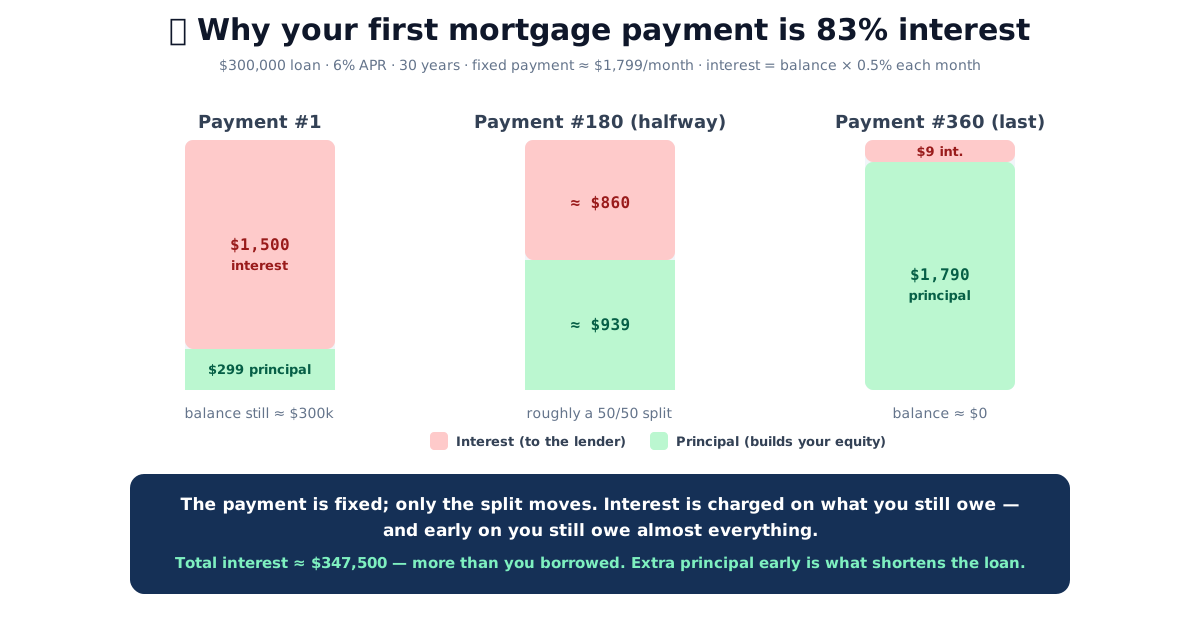
On a $300,000 mortgage at 6%, your very first payment is about $1,500 interest and only $299 principal, not because the bank is gouging you, but because interest is charged on the balance you still owe, and in month one you still owe almost the whole loan. As the balance falls, the split flips: the last payment is nearly all principal. See the full month-by-month breakdown for your own numbers in the mortgage calculator; here’s why it works this way.
The whole idea, in one picture
The one rule that explains everything
Every month, the lender charges interest on the balance you still owe, not on the original loan, and not on what you’ve paid off. The monthly interest rate is the APR divided by 12:
Interest this month = current balance × (APR ÷ 12)
At 6% APR that monthly rate is 0.5%. In month one you still owe the full $300,000, so:
- Interest = $300,000 × 0.5% = $1,500
- Your fixed payment is $1,798.65
- Principal = $1,798.65 − $1,500 = $298.65
So $1,500 of your first payment vanishes as interest and just under $300 chips away at the debt. It feels lopsided because it is, but it’s arithmetic, not a trick. You owe a lot, so you’re charged a lot of interest on it.
Where the fixed payment comes from
The payment is set once, at the start, so that exactly n equal payments zero out the loan. That’s
the amortizing-loan formula:
M = P · r(1 + r)ⁿ ⁄ ((1 + r)ⁿ − 1)
where P is the loan ($300,000), r is the monthly rate (0.005), and n is the number of months (360). Plug those in and M ≈ $1,798.65. The mortgage calculator computes this and then walks the schedule forward month by month.
This is what “amortizing” means, and it’s the opposite of an interest-only loan. With interest-only, you’d pay $1,500 every month and the balance would never move, you’d still owe the full $300,000 at the end. The extra ~$299 in an amortizing payment is precisely the amount that starts, slowly, to retire the debt. Note too that this figure covers only principal and interest (often written “P&I”). A real mortgage payment usually also bundles property taxes, homeowners insurance, and, if your down payment is under 20%, private mortgage insurance (PMI) into an escrow account. Those are real costs, but they’re separate from the amortization math and don’t change how the interest/principal split behaves.
Watching the split flip
Because principal reduces the balance, next month’s interest is charged on a slightly smaller number, so slightly less of the payment is interest and slightly more is principal. That feedback compounds:
| Payment | Interest | Principal | Balance after |
|---|---|---|---|
| 1 | $1,500.00 | $298.65 | $299,701.35 |
| 2 | $1,498.51 | $300.14 | $299,401.20 |
| 180 (halfway in time) | ≈ $860 | ≈ $939 | ≈ $172,000 |
| 360 (final) | ≈ $9 | ≈ $1,790 | $0 |
Notice the balance is still around $172,000 at the halfway point in time, you’re not halfway paid off until much later, because those early years barely touched the principal. This is the single most surprising thing about a mortgage, and the reason the equity in a newly-bought home grows so slowly at first.
Why total interest can beat the loan itself
Add up all 360 interest columns and you get roughly $347,500, more than the $300,000 you borrowed. Total paid: about $647,500 for a $300,000 loan. That’s not unusual; it’s what happens when you borrow a large sum for 30 years. Two levers cut it hard:
- A shorter term. A 15-year loan borrows the money for half as long (usually at a lower rate too), slashing total interest, at the cost of a higher monthly payment.
- A lower rate. Even a fraction of a percent moves the total by tens of thousands over 30 years.
How much the rate alone moves the total
Holding the loan and term fixed at $300,000 over 30 years, a single percentage point of rate swings the lifetime interest by roughly $70,000:
| Rate (30-yr) | Monthly P&I | Total interest | Total paid |
|---|---|---|---|
| 5% | $1,610 | ≈ $280,000 | ≈ $580,000 |
| 6% | $1,799 | ≈ $347,500 | ≈ $647,500 |
| 7% | $1,996 | ≈ $418,500 | ≈ $718,500 |
That’s why shaving even a quarter-point at closing, or refinancing when rates drop, is worth real effort, the difference compounds over hundreds of payments.
How much the term alone moves the total
Now hold the rate at 6% and change only the length of the loan:
| Term | Monthly P&I | Total interest | Total paid |
|---|---|---|---|
| 30 years | $1,799 | ≈ $347,500 | ≈ $647,500 |
| 15 years | $2,532 | ≈ $155,700 | ≈ $455,700 |
The 15-year payment is about 41% higher, but it eliminates more than half the total interest, roughly $192,000 in this example, because you’re borrowing the same money for half as long. In practice 15-year loans also tend to carry a somewhat lower rate than 30-year loans, which widens the gap further. The trade-off is cash-flow flexibility: the 30-year’s lower required payment is easier to sustain if your income dips.
Compare them yourself by changing the term and rate in the calculator and watching the total interest line, the same tool applies to a car loan too, via the auto loan calculator.
The payoff move: extra principal, early
Here’s the lever most people miss. Because interest is charged on the balance, every extra dollar of principal you pay permanently deletes all the future interest that dollar would ever have generated.
Take our example loan and add just $200 a month on top of the $1,799 payment. That $200 doesn’t merely pay off $200 of the house faster. It removes all the interest that $200 would have accrued for the rest of the term. The result on a $300,000 / 6% / 30-year loan:
- The loan is paid off in about 279 months (~23¼ years) instead of 360, roughly 6¾ years early.
- Total interest drops from ~$347,500 to about $256,500, a saving near $91,000 for $200 a month.
And it’s most powerful early, when the balance (and therefore the interest being charged) is largest. A dollar of extra principal in year one erases far more future interest than the same dollar in year 25, when little interest is left to cancel. The mortgage calculator has an extra-per-month field that shows the exact new payoff date and how many months you’d save, and you can export the full schedule to CSV to plan against it. Everything runs in your browser; none of your figures leave your device.
One caveat worth checking before you start: make sure extra payments are applied to principal, not prepaid toward next month’s bill, and confirm your loan has no prepayment penalty. Most conventional mortgages don’t, but it’s worth a one-line question to your servicer.
Quick summary
Mortgage interest is charged on the balance you still owe, so when the balance is highest, at the start, the interest portion of your fixed payment is highest too. On a $300k / 6% / 30-year loan that means $1,500 interest and $299 principal in month one, an even split near the middle, and almost pure principal at the end. The slow early paydown is why total interest (~$347,500) can exceed the loan, and why extra principal paid early is the most effective way to shrink both the term and the total. See your own numbers, schedule and payoff savings in the mortgage calculator.
Sources: standard amortizing-loan mathematics · Consumer Financial Protection Bureau, mortgage basics · Investopedia, Amortization. General educational information, not financial advice.
Frequently asked questions
Why is my first mortgage payment almost all interest?
Because interest each month is charged on the balance you still owe, and at the start you owe almost the entire loan. On a $300,000 loan at 6% APR, the monthly interest is $300,000 × (6%/12) = $1,500. Your fixed payment is about $1,799, so only ~$299 goes to principal that first month. The payment isn't unfair, the balance is simply still huge.
What is an amortization schedule?
A month-by-month table showing how each fixed payment splits between interest and principal, and the balance remaining. Every row: interest = current balance × monthly rate; principal = payment − interest; new balance = old balance − principal. The interest share shrinks each month as the balance falls, so principal grows, slowly at first, then faster.
How is the monthly mortgage payment calculated?
With the amortizing-loan formula M = P·r(1+r)ⁿ ÷ ((1+r)ⁿ − 1), where P is the loan amount, r is the monthly rate (APR ÷ 12), and n is the number of months. For $300,000 at 6% over 30 years, that's about $1,799/month. The payment is fixed for the whole term; only the interest/principal split changes.
How can total interest be more than the amount I borrowed?
Because for years the balance barely drops, so you keep paying interest on a large sum. On a $300,000 loan at 6% over 30 years you pay roughly $347,500 in interest, more than the house price, for a total of about $647,500. A shorter term or lower rate cuts this dramatically; the mortgage calculator shows the totals side by side.
Does paying extra principal really help?
Yes, and more than most people expect, because every extra dollar of principal permanently removes all the future interest that dollar would have accrued. Paying a little extra each month can cut years off a 30-year loan and save tens of thousands in interest. The calculator's 'extra per month' field shows exactly how many months you'd save.
Should I pick a 15-year or 30-year mortgage?
A 15-year term has higher monthly payments but far less total interest, because you're borrowing the money for half as long and usually at a lower rate. A 30-year term is easier on monthly cash flow but costs much more overall. Run both in the calculator and compare the 'total interest' line, the difference is often six figures.