
explainer
camelCase vs snake_case vs kebab-case: Which Naming Case Goes Where
By Uttam Regmi · Published 2026-07-05 · Updated 2026-08-23 · 6 min read · Fact-checked, sources cited
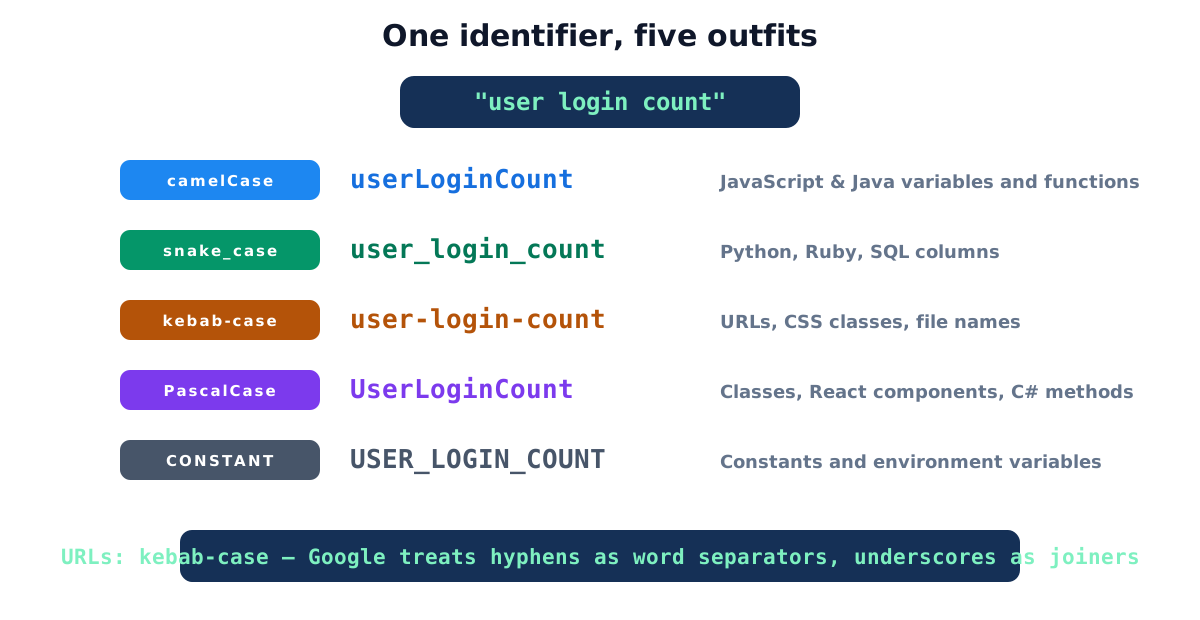
The convention map is short: camelCase for JavaScript/Java variables, snake_case for Python and SQL, kebab-case for URLs and CSS, PascalCase for classes, CONSTANT_CASE for constants. Follow it and your code reads like everyone else’s, cross it and every code review starts with the same comment. Convert anything between cases in one click with the case converter.
The five cases, defined
A naming case is a rule for writing multi-word identifiers where spaces aren’t allowed:
| Case | Example | Home turf |
|---|---|---|
| camelCase | userLoginCount | JavaScript, Java, Swift variables & functions |
| PascalCase | UserLoginCount | Classes, types, C# methods, React components |
| snake_case | user_login_count | Python, Ruby, Rust, SQL columns |
| kebab-case | user-login-count | URLs, CSS classes, HTML attributes, file names |
| CONSTANT_CASE | USER_LOGIN_COUNT | Constants, environment variables |
Why each ecosystem picked its case
These aren’t arbitrary tastes, each convention solves a local problem:
- JavaScript/Java (camelCase): inherited from Smalltalk-era style; the lowercase start visually separates variables from PascalCase classes at a glance.
- Python (snake_case): PEP 8, Python’s official style guide,
chose underscores for readability,
user_login_countparses faster for humans thanuserLoginCount, and Python’s culture prizes readability above brevity. - CSS/HTML (kebab-case): HTML is case-insensitive, so
fontSizeandfontsizecollide, hyphens sidestep the problem entirely, which is why CSS properties (font-size) and ARIA attributes (aria-label) are hyphenated. - SQL (snake_case): many databases fold unquoted identifiers to one case, destroying camelCase distinctions; underscores survive.
- Constants (CONSTANT_CASE): the all-caps shout is a warning label, “this value never changes.”
The one hard rule with SEO consequences sits in URLs:
Google’s URL-structure documentation
recommends hyphens over underscores because hyphens are treated as word separators while underscores
can join words. /my-blue-widget/ reads as three words; /my_blue_widget/ may read as one. That’s why the
slug generator defaults to hyphens.
A language-by-language cheat sheet
Most of the confusion comes from switching languages mid-project. Each language’s style guide fixes a default for each role, a variable is cased differently from a class, which is cased differently from a constant. This table collapses the guidance from the major style guides into one place:
| Language | Variables / functions | Types / classes | Constants |
|---|---|---|---|
| JavaScript / TypeScript | camelCase | PascalCase | CONSTANT_CASE |
| Python (PEP 8) | snake_case | PascalCase | CONSTANT_CASE |
| Java | camelCase | PascalCase | CONSTANT_CASE |
| C# | PascalCase (methods, properties) | PascalCase | PascalCase |
| Go | camelCase (unexported), PascalCase (exported) | PascalCase | PascalCase |
| Rust | snake_case | PascalCase | CONSTANT_CASE |
| Ruby | snake_case | PascalCase | CONSTANT_CASE |
| SQL (common) | snake_case | , | , |
| CSS / HTML | kebab-case | , | , |
A few rows surprise people. In C#, even public methods and properties are PascalCase, there’s no
camelCase for members, which trips up developers arriving from Java. In Go, casing is not cosmetic: a
leading capital letter is what exports an identifier from its package, so PascalCase versus camelCase
changes visibility, not just style. And Go leans on MixedCaps rather than underscores throughout, even
for what other languages would write as CONSTANT_CASE.
Handling acronyms and numbers
The single messiest corner of casing is acronyms. Is it parseJSON, parseJson, ParseHTMLDocument, or
ParseHtmlDocument? There is no universal answer, but there is a dominant modern practice: treat an
acronym as an ordinary word and case only its first letter. So Html, Url, Id, and Json, giving
parseHtmlDocument, userId, apiUrl. Microsoft’s .NET guidelines codify exactly this: acronyms of three
or more letters use only an initial capital.
The reason is mechanical, not aesthetic. Runs of capitals break automatic case conversion. A splitter that
turns HTMLParser into words has to guess where HTML ends and Parser begins, and most guess wrong at
least some of the time, HTMLParser can split as HTML Parser or HTM LParser depending on the rule.
Writing HtmlParser removes the ambiguity: every capital is a clean word boundary. Numbers are easier, keep them attached to the word they modify (utf8Decode, oauth2Token) and let the converter treat the
digit run as part of the preceding token.
Converting between cases (without retyping)
The case converter splits input on spaces, hyphens, underscores and existing capital-letter boundaries, so conversions work in every direction:
- Paste
userLoginCount→ pick snake_case →user_login_count(moving JS logic to Python). - Paste
Blog Post Title Here→ pick kebab-case →blog-post-title-here(or use the dedicated slug generator, which also strips accents and symbols). - Paste a whole column of identifiers, one per line, each converts independently.
Worked example, migrating a JS config to environment variables: apiBaseUrl → CONSTANT_CASE →
API_BASE_URL. One paste, one click, no typos.
The trick that makes round-trips reliable is the split step. Every conversion is really two phases: break the identifier into words, then re-join them in the target style. Breaking is where casing tools earn their keep, because the input can arrive in any of the five styles:
| Input | Detected boundaries | Words |
|---|---|---|
userLoginCount | capital-letter transitions | user · login · count |
user_login_count | underscores | user · login · count |
user-login-count | hyphens | user · login · count |
USER_LOGIN_COUNT | underscores | user · login · count |
Blog Post Title | spaces | blog · post · title |
Because all five reduce to the same word list, any input case converts cleanly to any output case, the
target style just decides the joiner (nothing, _, -, or a space) and which letters get capitalised.
That is why you can round-trip userLoginCount → user_login_count → user-login-count → USER_LOGIN_COUNT
and land back where you started without losing a word boundary.
Common naming-case mistakes
- Mixing cases in one codebase,
getUser()next tofetch_user()costs every future reader a double-take. Match whatever the file already does. - Underscored URLs,
/blog_post_title/hurts both consistency and how search engines parse the words. Hyphens, always. - camelCase CSS classes. They work until someone’s tooling lowercases them. Kebab-case is the ecosystem norm.
- Renaming halfway, converting
user_idtouserIdin some files but not the query layer creates the classic “works locally” bug. Convert systematically (the find & replace tool with match-case on helps audit). - Acronym ambiguity,
parseHTMLStringvsparseHtmlString: pick one treatment of acronyms and stick to it; most modern style guides preferHtml.
Quick summary
Match the ecosystem: camelCase in JavaScript, snake_case in Python and SQL, kebab-case in URLs and CSS, PascalCase for classes, CONSTANT_CASE for constants, and hyphens in URLs are an SEO-grade rule, not a preference. For any conversion, the case converter handles all five (plus a few joke ones), and the slug generator covers the URL case end-to-end.
Related: character counter for length limits on the names · find & replace for codebase-wide renames.
Frequently asked questions
What is the difference between camelCase and PascalCase?
Only the first letter: camelCase starts lowercase (userName), PascalCase starts uppercase (UserName). Convention assigns camelCase to variables and functions, PascalCase to classes, types and React components.
Which case does Python use?
snake_case for variables, functions and module names, PascalCase for classes, and CONSTANT_CASE for constants, all specified in PEP 8, Python's official style guide.
Should URLs use hyphens or underscores?
Hyphens (kebab-case). Google's documentation recommends hyphens because it treats them as word separators, while underscores can join words, my-blue-widget is parsed as three words, my_blue_widget may not be.
Why can't CSS classes and HTML attributes use camelCase reliably?
HTML is case-insensitive, so camelCase distinctions can be lost, which is why HTML attributes, CSS properties and classes standardized on kebab-case (font-size, aria-label).
What is CONSTANT_CASE (SCREAMING_SNAKE_CASE) for?
Values that never change: constants in most languages (MAX_RETRIES) and environment variables (DATABASE_URL). The visual shout signals 'do not reassign'.
How do I convert a whole list of identifiers between cases?
Paste them into the case converter one per line and pick the target case. It splits on spaces, hyphens, underscores and existing capital boundaries, so camelCase input converts to snake_case correctly.