
how-to
How to Calculate Your One-Rep Max (1RM)
By Uttam Regmi · Published 2026-07-28 · Updated 2026-07-28 · 6 min read · Fact-checked, sources cited
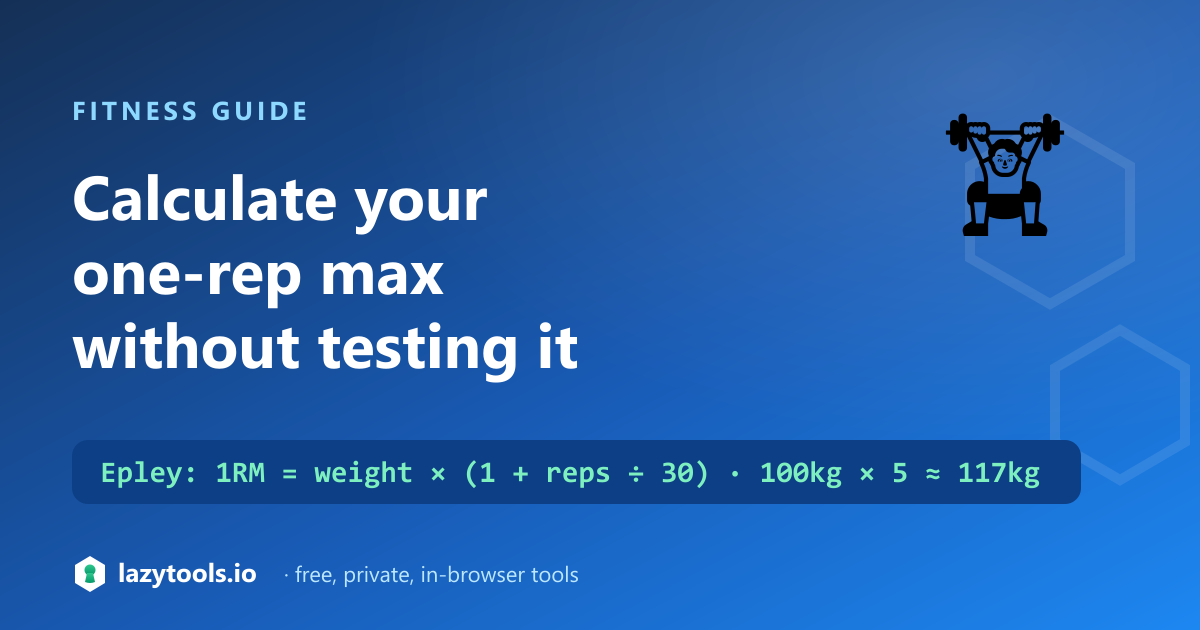
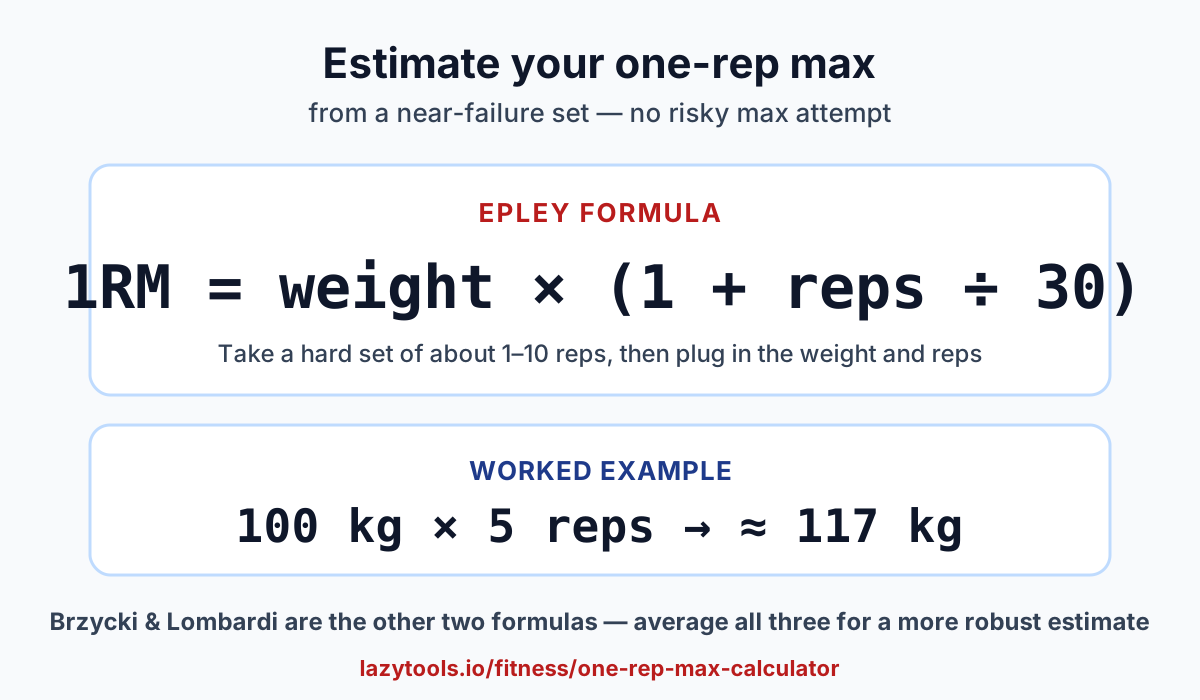
To find your one-rep max, don’t try to lift it, estimate it from a set taken close to failure using a formula like Epley: 1RM = weight × (1 + reps ÷ 30). That single equation turns a safer, submaximal set into a reliable strength number. If you bench 100 kg for 5 solid reps, Epley estimates your bench press max at about 117 kg, no grinding single, no spotter emergency required. Below is how the math works, how to use the number, and the mistakes that make people trust a bad estimate. You can run your own lifts through the one-rep max calculator as you read.
The three 1RM formulas
Your one-rep max is simply the heaviest weight you could lift for a single rep. Testing it directly is risky, so sports scientists built equations that predict it from a lighter set taken near failure. Three are well established, and each reads the same set slightly differently:
- Epley: 1RM = weight × (1 + reps ÷ 30)
- Brzycki: 1RM = weight × 36 ÷ (37 − reps)
- Lombardi: 1RM = weight × reps0.1
Run the same honest set, 100 kg for 5 reps, through all three and watch how close, but not identical, they land:
| Formula | Calculation | Estimated 1RM |
|---|---|---|
| Epley | 100 × (1 + 5 ÷ 30) = 100 × 1.1667 | 116.7 kg |
| Brzycki | 100 × 36 ÷ (37 − 5) = 100 × 36 ÷ 32 | 112.5 kg |
| Lombardi | 100 × 50.1 = 100 × 1.1746 | 117.5 kg |
The spread here is about 5 kg, small, but enough to matter when you’re setting training weights. That’s why no serious tool relies on a single formula. Averaging the three gives roughly 115.6 kg, a more robust figure that smooths out each equation’s quirks. The one-rep max calculator computes all three and their average for you, for any lift you enter.
Whichever you use, remember what these numbers are: estimates, not a measured max. They’re excellent for programming, but they’re a prediction, not a certificate.
What percentage of 1RM should you lift?
Once you have a 1RM, it becomes a dial. Almost every strength program prescribes work as a percentage of your max, because that percentage, not the raw weight, is what drives a specific adaptation. Here’s the general map:
| Goal | Intensity (% of 1RM) | Typical reps |
|---|---|---|
| Maximal strength | 80-95% | 1-5 |
| Muscle size (hypertrophy) | 65-80% | 6-12 |
| Muscular endurance | Below ~65% | 15+ |
A classic 5×5 program lives around 80-85% of 1RM, heavy enough to build strength, light enough to accumulate volume across five sets. For our lifter with an estimated 117 kg bench, that’s roughly 94-99 kg for the working sets.
Treat these bands as starting points, not laws. Your true max drifts day to day with sleep, stress and food, so the percentage that felt like a crisp triple on Monday might grind on Thursday. Use the number to pick a sensible weight, then let the bar tell you the rest. If you’re also structuring conditioning around effort, pair this with the heart-rate zone calculator to keep the same “train the right intensity” logic across cardio.
Why estimates beat max testing
It can feel more legitimate to actually load the bar and grind out a single. In practice, estimating is the smarter default for almost everyone:
- It’s far safer. A true 1RM attempt is maximal by definition, the rep most likely to fail mid-lift, tweak a joint or collapse form. A submaximal set of 3-5 keeps a margin in reserve.
- You don’t need a spotter or a competition setup. No handoff, no safety pins drama, no training partner required to fish a barbell off your chest.
- It’s accurate enough for programming. The whole point of a 1RM is to set training percentages. An estimate within a few percent does that job perfectly well.
- It’s repeatable. You can re-estimate from any hard set, any week, without the recovery cost of a genuine max-out. That means you can track progress far more often.
Competitive powerlifters do need to know their real max because the sport is contested at a single. For everyone lifting to get stronger, bigger or healthier, a formula from a near-failure set gives you the number without the risk.
There’s a practical bonus, too: because you can estimate from any working set, your 1RM becomes a live progress metric instead of a once-a-quarter event. Log the weight and reps from your top set each session, run it through the formulas, and you’ll see the trend line move, often before the bar visibly gets easier. That feedback is motivating and it keeps your training percentages honest as you get stronger.
Common mistakes
The estimate is only as good as the set you feed it and the way you read the result. Watch for these:
- Using a high-rep set. A gasping set of 15-20 pushes the formulas well past their accurate range and inflates your “max.” Keep the estimating set to about 1-10 reps, ideally 3-5, for a trustworthy number.
- Chasing true failure with breaking form. The set should be near failure with clean technique, not a rep where your back rounds or your knees cave. A grindy, ugly rep corrupts the input.
- Training maxes without safety. If you ever do verify a real single, do it with a spotter, safety pins or a machine, never solo on a heavy free-weight lift.
- Treating the estimate as exact. It’s a prediction with a margin of error. Don’t program to the kilo or panic if two calculators disagree by a few kilos, that’s normal.
- Ego-loading off the number. A calculator saying “150 kg” is not permission to load 150 kg and see what happens. Let your working weights come from the percentage bands and how the bar actually moves.
Warm up thoroughly before any hard set, build up in weight gradually, and stay within lifts you can control. This is general fitness information, not medical or coaching advice, if you’re new, returning from injury or unsure, get eyes on your technique from a qualified coach.
Get your number
You now have everything you need: take a clean set of about 3-5 reps close to failure, note the weight and reps, and let the formulas do the rest. Rather than doing three calculations by hand, drop the numbers into the one-rep max calculator. It returns Epley, Brzycki and Lombardi plus their average, and it runs entirely in your browser, so your training data never leaves your device. Estimate each lift separately, revisit it every few weeks, and watch the number climb. And when you plan the rest of your training day, the Fitness hub has the companion tools, from pace to calories burned, to round it out.
General information only, not medical advice. Formulas: Epley (1985), Brzycki (1993) and Lombardi (1989), standard strength-and-conditioning estimation equations. Estimates are most reliable for sets of roughly 1-10 reps.
Frequently asked questions
How do I calculate my one-rep max?
Take a set close to failure at a weight you can lift for about 1-10 reps, then plug the weight and reps into a formula. The Epley formula is 1RM = weight × (1 + reps ÷ 30). For example, 100 kg for 5 clean reps estimates a 1RM of 100 × (1 + 5 ÷ 30) ≈ 117 kg. You never have to attempt the true max lift to get the number.
Which 1RM formula is most accurate?
No single formula wins for everyone, Epley, Brzycki and Lombardi each make slightly different assumptions and can disagree by a few kilos. The most robust approach is to average all three rather than trusting one. Our calculator does exactly that. All of them are estimates, most reliable for sets of about 1-10 reps.
What percentage of 1RM should I train at?
It depends on your goal. Strength work sits around 80-95% of 1RM for low reps; hypertrophy (muscle size) sits around 65-80%; muscular endurance is below about 65%. A classic 5×5 program runs at roughly 80-85% of 1RM. These are general guidelines, not fixed rules, adjust to how the weight actually feels.
Is it safe to test my actual one-rep max?
A true 1RM attempt is demanding and carries real injury risk, especially without experience, a spotter or safety pins. For most people, estimating from a submaximal set is safer and accurate enough to plan training. If you do test a genuine max, warm up thoroughly and use proper safety equipment. This is general fitness information, not medical or coaching advice.
Why is the 1RM estimate less accurate at high reps?
The formulas assume a fairly predictable relationship between reps and load, and that relationship holds best from about 1 to 10 reps. Beyond roughly 10-12 reps, fatigue, technique breakdown and individual endurance vary too much, so the equations tend to overestimate your true max. Use a heavier set of fewer reps for the most reliable estimate.
Can I use this as a bench press or squat max calculator?
Yes. The same formulas work for any barbell or machine lift, bench press, squat, deadlift, overhead press and more. Enter the weight and reps from a hard set of that specific lift. Your 1RM is exercise-specific, so estimate each lift separately rather than assuming one number carries across movements.