
reference
Passport Photo Size by Country: The Complete Guide (2026)
By Uttam Regmi · Published 2026-07-10 · Updated 2026-07-10 · 7 min read · Fact-checked, sources cited
Most of the world uses the same passport photo size, the ICAO 35×45 mm standard, while the United States uses a 2×2 inch square, and a handful of countries use genuine outliers like Spain’s 26×32 mm, Canada’s 50×70 mm and Kenya’s 55×55 mm square. Size is only half the story: background colour and file rules vary too, and both get photos rejected. Here’s the full picture, with a country-by-country table, and you can make a compliant photo for any of them, privately in your browser, with the Photo Size Maker.
The size groups at a glance
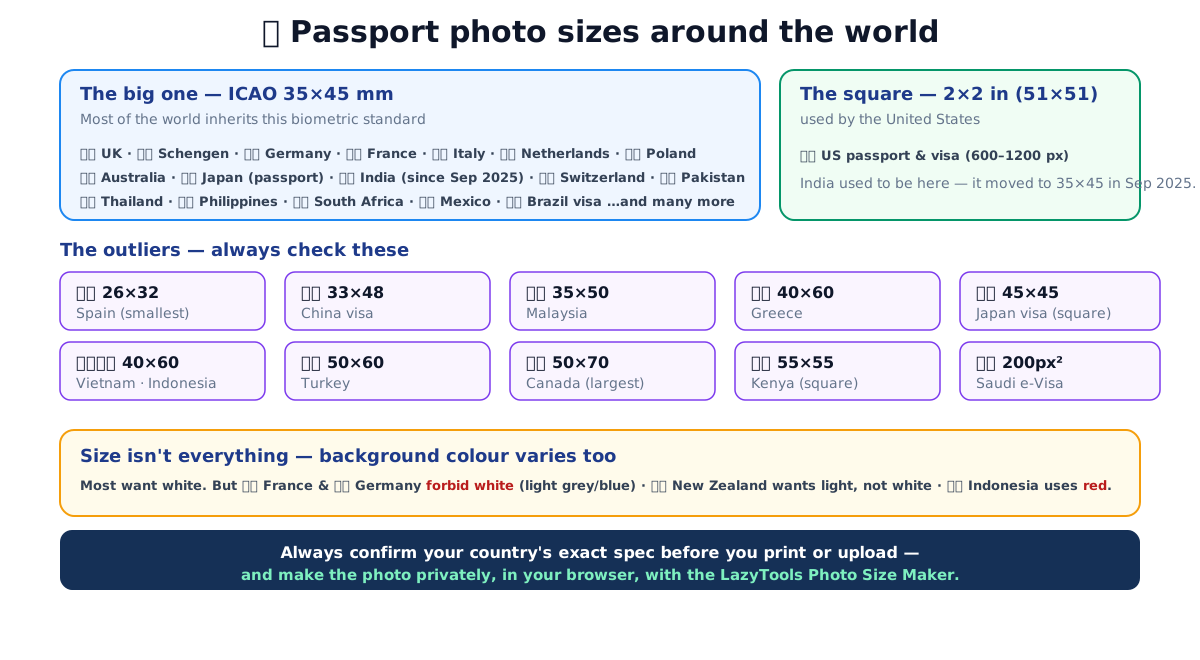
Most passport photo questions come down to which of three groups your country is in:
- The ICAO 35×45 mm group, the majority of the world, because countries inherit the same biometric-portrait standard (ICAO Document 9303, from the International Civil Aviation Organization, Doc 9303).
- The 2×2 inch square, the United States (51×51 mm). India used to be here but switched to 35×45 mm in September 2025.
- The outliers, countries with their own size, which is exactly where applications get rejected for using the wrong dimensions.
Passport & visa photo size by country
| Country | Document | Size | Background |
|---|---|---|---|
| 🇺🇸 United States | Passport / Visa | 2×2 in (51×51 mm) | White / off-white |
| 🇬🇧 United Kingdom | Passport | 35×45 mm | Cream / light grey (not white) |
| 🇪🇺 Schengen | Visa | 35×45 mm | Light (consulate-dependent) |
| 🇩🇪 Germany | Passport/ID | 35×45 mm | Light grey (white forbidden) |
| 🇫🇷 France | Passport/ID | 35×45 mm | Light blue / grey (white forbidden) |
| 🇮🇹 Italy | Passport/ID | 35×45 mm | White |
| 🇪🇸 Spain | Passport/DNI | 26×32 mm | White |
| 🇳🇱 Netherlands | Passport/ID | 35×45 mm | Grey / blue / white |
| 🇬🇷 Greece | Passport | 40×60 mm | Grey RGB(190,190,190) |
| 🇨🇭 Switzerland | Passport/ID | 35×45 mm | White or light grey |
| 🇨🇦 Canada | Passport | 50×70 mm | White / light |
| 🇮🇳 India | Passport | 35×45 mm (since Sep 2025) | Pure white |
| 🇨🇳 China | Visa | 33×48 mm | White / near-white |
| 🇯🇵 Japan | Passport / Visa | 35×45 mm / 45×45 mm | White |
| 🇦🇺 Australia | Passport | 35×45 mm | Light |
| 🇳🇿 New Zealand | Passport | 35×45 mm | Light (not white) |
| 🇸🇬 Singapore | Passport/IC | 400×514 px | White |
| 🇲🇾 Malaysia | Passport | 35×50 mm | White |
| 🇮🇩 Indonesia | Passport | 40×60 mm | Red |
| 🇻🇳 Vietnam | Passport/Visa | 40×60 mm | White |
| 🇦🇪 UAE | Visa/ID | 43×55 mm | Pure white |
| 🇸🇦 Saudi Arabia | e-Visa | 200×200 px | White |
| 🇹🇷 Turkey | Passport/Visa | 50×60 mm | White |
| 🇰🇪 Kenya | Passport | 55×55 mm | White |
(Plus Pakistan, Thailand, Philippines, Mexico, Brazil, South Africa and more in the Photo Size Maker. Each page links its official government source and a “last verified” date.)
Head size matters as much as photo size
A common mistake is to get the outer dimensions right but the face wrong. Every standard also specifies how much of the frame your head must fill, measured from the bottom of the chin to the top of the head (the crown), not the top of your hair.
- ICAO 35×45 mm: the head (chin to crown) should be roughly 32-36 mm tall, so your face fills about 70-80% of the frame, centred with a small margin above the hair.
- US 2×2 inch: the head should be 1 to 1⅜ inches (about 25-35 mm) tall, and your eyes should sit 1⅛ to 1⅜ inches (about 28-35 mm) from the bottom of the photo.
That is why you cannot simply resize a US photo to 35×45 mm and call it done, the head-to-frame ratio is different, so the face ends up too small or too large for the target country. Cropping to the head guides, not just the outer size, is what actually passes.
| Standard | Photo size | Head height (chin→crown) | Head as % of frame |
|---|---|---|---|
| ICAO (UK, Schengen, most of world) | 35×45 mm | ~32-36 mm | ~70-80% |
| United States | 2×2 in (51×51 mm) | ~25-35 mm | ~50-69% |
| Canada | 50×70 mm | ~31-36 mm | face measured chin→crown |
Print size and pixels: a worked example
Physical millimetres and upload pixels are two sides of the same photo. They are linked by resolution (DPI, dots per inch). Most print standards assume 300 DPI or higher.
Take the ICAO 35×45 mm photo. Converting to inches (÷ 25.4) gives about 1.378 × 1.772 in. At 300 DPI that is roughly 413 × 531 pixels; at 600 DPI it doubles to about 826 × 1063 pixels, which is why the UK online portal asks for at least 600 × 750 px.
The US 2×2 inch photo is cleaner: 2 in × 300 DPI = exactly 600 × 600 pixels, which is the floor of the accepted 600-1200 px range. Print at 600 DPI and you land at 1200 × 1200, the ceiling.
The practical rule: pick your country, and the tool exports at the right pixel dimensions and embeds the correct print resolution, so the same file works whether the office prints it or a portal ingests it.
Background colour: the rejection trap
Getting the size right isn’t enough, background colour is one of the most common reasons a photo bounces:
- White is the safe default for most countries (US, Italy, Spain, Poland, India, most of Asia).
- White is forbidden in France and Germany, which require light grey or light blue.
- Not white in New Zealand, which wants a plain light colour but specifically not white.
- Cream or light grey in the UK.
- Red for the Indonesian citizen passport, a genuine surprise.
The Photo Size Maker’s compliance check flags a background that isn’t uniform or is the wrong colour, so you catch this before you submit.
Digital rules also vary
If you’re uploading rather than printing, each country’s online portal sets its own pixel and file-size limits, for example the US (600-1200 px), the UK (≥600×750 px, 50 KB-10 MB), India (630×810 px, ≤250 KB), Singapore (400×514 px) and Saudi Arabia’s e-Visa (200×200 px, 5-100 KB). Each country page lists the exact numbers and the tool exports to them, embedding the correct print resolution.
Before you submit: a five-point check
Most rejections come down to the same handful of issues. Run through these before you print or upload:
- Size, exact millimetres or inches for your country, not a generic 35×45 assumption.
- Head height, chin-to-crown within the target range, face centred, small margin above the hair.
- Background, uniform and the right colour (white is common, but France/Germany forbid it, the UK wants light grey/cream, and Indonesia’s citizen passport uses red).
- Expression and pose, neutral face, mouth closed, eyes open and clearly visible, looking straight at the camera; no shadows on the face or wall behind you.
- File format, the pixel dimensions and file-size window your portal specifies (many want JPEG under a fixed kilobyte cap).
Glasses are increasingly discouraged and are outright banned for many passports (the UK and the US now ask you to remove them), and head coverings are only allowed for religious or medical reasons and must not cast shadows or hide the face.
Quick summary
The world mostly uses 35×45 mm (ICAO); the US uses 2×2 inches; and the outliers, Spain 26×32, China 33×48, Greece 40×60, Canada 50×70, Kenya 55×55 (square), are where people slip. Background colour varies just as much (white is common, but France/Germany forbid it and Indonesia uses red), and passport and visa specs can differ within one country (Japan). Whatever your country, make a compliant photo, cropped, checked and exported to the exact spec, entirely in your browser, with the Photo Size Maker.
Sources: ICAO Doc 9303 (Machine Readable Travel Documents) and each country’s official issuing authority, cited with a “last verified” date on the individual Photo Size Maker country pages. Government requirements change, always confirm against the official source before you apply.
Frequently asked questions
What is the most common passport photo size?
35×45 mm, the ICAO biometric standard used by the UK, the Schengen area, Germany, France, Australia, India (since September 2025) and most of the world. The main exception is the United States, which uses a 2×2 inch (51×51 mm) square.
What size is a US passport photo?
2×2 inches (51×51 mm), square. For online submission the digital photo must be 600×600 to 1200×1200 pixels. This is different from most countries, do not use a 35×45 mm photo for a US passport.
Which countries have unusual passport photo sizes?
Spain is 26×32 mm (the smallest), China is 33×48 mm, Malaysia is 35×50 mm, Greece is 40×60 mm, Vietnam and Indonesia are 40×60 mm, the Japan visa is a 45×45 mm square, Turkey is 50×60 mm, Canada is 50×70 mm (the largest common size), and Kenya is a 55×55 mm square. Always check your specific country.
Do passport photos have to be on a white background?
Usually, but not always. Most countries want plain white or off-white, but France and Germany forbid white and require light grey or light blue, New Zealand requires a light background that is not white, and Indonesia's citizen passport uses a red background. Background colour is one of the most common reasons a photo is rejected.
What resolution or file size does a digital passport photo need?
It varies by country's online portal. Examples: the US wants 600-1200 px square; the UK wants at least 600×750 px (50 KB-10 MB); India wants 630×810 px under 250 KB; Singapore wants 400×514 px; Saudi Arabia's e-Visa wants 200×200 px, 5-100 KB. Each country page in the Photo Size Maker lists the exact figures.
Can I use the same photo for a passport and a visa?
Sometimes, but not always, the specs can differ. Japan is the clearest example: its passport photo is 35×45 mm but its visa photo is a 45×45 mm square. Always check the specific document type you're applying for.