
explainer
Readability Scores Explained: Flesch Reading Ease, Grade Level, and How to Improve Them
By Uttam Regmi · Published 2026-07-11 · Updated 2026-08-23 · 6 min read · Fact-checked, sources cited
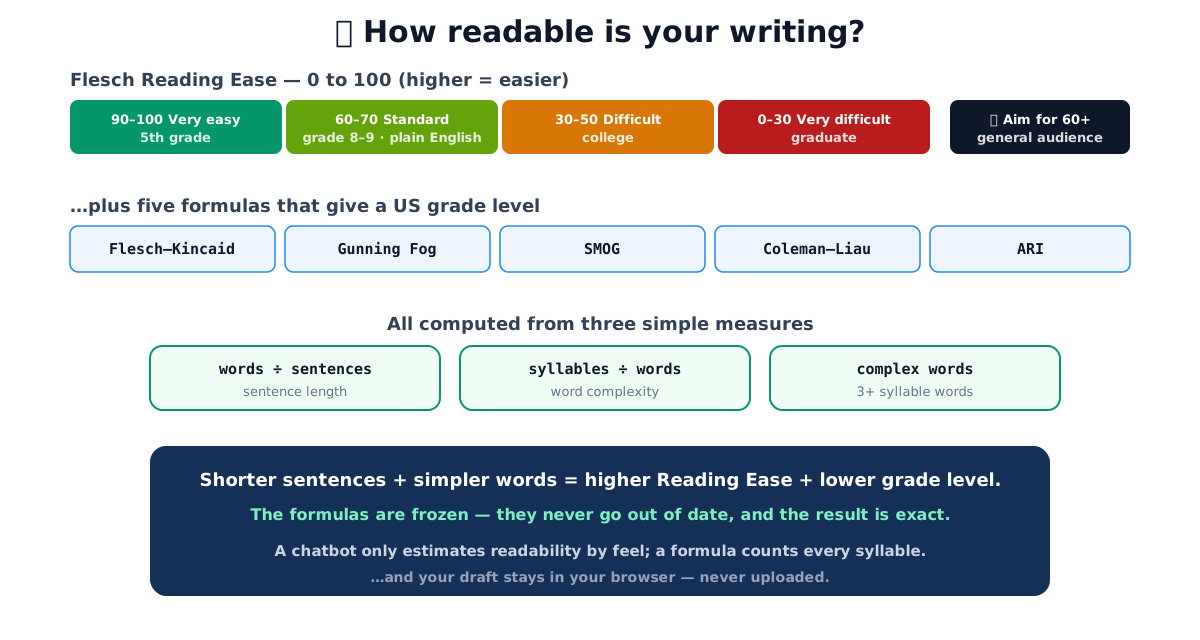
Flesch Reading Ease scores your text from 0 to 100, higher is easier, while Flesch-Kincaid, Gunning Fog, SMOG, Coleman-Liau and ARI translate the same measures into a US grade level. All of them come down to three things: how long your sentences are, how many syllables your words have, and how many long words you use. Score any text against all six, with the counts shown, in the readability checker; here’s what the numbers mean and how to move them.
The scores at a glance
Flesch Reading Ease: the 0-100 score
The best-known readability measure, the Flesch, Kincaid readability tests, runs from 0 to 100, and, unlike the others, higher means easier:
Reading Ease = 206.835 − 1.015 × (words ÷ sentences) − 84.6 × (syllables ÷ words)
Because long sentences and long words subtract from the score, plain writing lands high and dense writing lands low. Rough bands: 90-100 is very easy (5th grade), 60-70 is standard plain English (grade 8-9), 30-50 is difficult (college), and below 30 is very difficult. For most audiences, aim for 60 or above.
A worked example
Take these two short sentences: “Readability formulas are simple. They count your sentences, words, and syllables, then apply fixed math.” That is 15 words in 2 sentences (7.5 words per sentence) and 27 syllables (1.8 syllables per word). Plug those into the formula:
206.835 − 1.015 × 7.5 − 84.6 × 1.8 = 206.835 − 7.61 − 152.28 ≈ 47
A 47 lands in the “difficult” band, dragged down by heavy words like readability and syllables, each carrying several syllables. Feed the same counts into Flesch-Kincaid, 0.39 × 7.5 + 11.8 × 1.8 − 15.59 ≈ grade 8.6, and you see why looking at more than one number helps: on a short, word-dense sample the two Flesch measures can point at slightly different reading levels even though they share the same inputs.
The five grade-level formulas
The other indices report a US school grade instead of an ease score. They exist because each looks at slightly different features:
- Flesch-Kincaid Grade, sentence length + syllables per word.
- Gunning Fog, sentence length + the percentage of “complex” (three-or-more-syllable) words.
- SMOG, the count of polysyllabic words, favoured in healthcare writing.
- Coleman-Liau, uses letters per word instead of syllables (easier to compute exactly).
- ARI (Automated Readability Index), characters per word + sentence length.
They can disagree by a grade or two on the same text, which is exactly why the readability checker shows all of them plus the average, a more robust read than any single number.
The six formulas side by side
| Formula | Output | Key inputs | Often used for |
|---|---|---|---|
| Flesch Reading Ease | 0-100 (higher = easier) | words/sentence, syllables/word | General plain-language checks |
| Flesch-Kincaid Grade | US grade level | words/sentence, syllables/word | US government and military docs |
| Gunning Fog | Years of education | words/sentence, % of 3+ syllable words | Business and professional writing |
| SMOG | US grade level | count of polysyllabic words | Healthcare and patient materials |
| Coleman-Liau | US grade level | letters/word, sentences/word | Automated scoring (no syllable count) |
| ARI | US grade level | characters/word, words/sentence | Real-time and computer scoring |
Coleman-Liau and ARI deliberately avoid counting syllables. They use letters or characters instead, which a computer can tally without a pronunciation dictionary. That makes them robust on unusual words (brand names, code, jargon) where syllable estimation is shakiest, but slightly less sensitive to the “heavy word” effect the Flesch formulas capture.
What actually drives the numbers
Strip away the constants and every formula is measuring the same three things:
- Words per sentence, long sentences are harder.
- Syllables (or letters) per word, long words are harder.
- Complex words, the count of three-or-more-syllable words.
That’s good news, because it means you can improve all the scores with the same two moves.
How to improve your readability
- Shorten sentences. Split a 30-word sentence into two. This is the single biggest lever. It lowers every grade-level index and raises Reading Ease.
- Prefer short, common words. “Use” over “utilise”, “help” over “facilitate”. Fewer syllables directly lifts the score.
- Cut complex words where a simpler one carries the same meaning. This is what Gunning Fog and SMOG reward most.
- Break up paragraphs and use lists. This doesn’t change the arithmetic, but it makes the text feel readable, which is the real goal.
One caution: readability scores measure structural difficulty, not meaning, tone or flow. A text can score “easy” and still be badly written, treat the number as a signal, not a verdict.
What to aim for by content type
There is no universal “right” score, the target depends on who is reading. These are widely-recommended starting points, not hard rules:
| Content type | Flesch Reading Ease | Rough grade level |
|---|---|---|
| Children’s material | 80-100 | Grade 6 or below |
| General web and marketing copy | 60-70 | Grade 8-9 |
| News and consumer journalism | 50-65 | Grade 8-11 |
| Technical documentation | 30-50 | College |
| Academic, legal, and scientific | Below 30 | Graduate |
The pattern to notice: mainstream, wide-audience writing clusters around grade 8-9, which is why “aim for 60+ Reading Ease” is such a common piece of advice. Specialist writing scores lower not because it is worse, but because it uses longer terms its readers already know.
A quick before-and-after
Watch one sentence move the numbers. “The utilisation of overly elaborate terminology frequently diminishes comprehension” is 8 words but syllable-dense, and reads at a college-plus level. Rewrite it as “Big words often make writing harder to understand”, 8 words, far fewer syllables, and Reading Ease climbs sharply while every grade-level index drops. Same idea, same length, easier to read. That is the whole game: swap heavy words for light ones and split long sentences.
Why a formula beats asking an AI
A chatbot can estimate readability, but it does it by feel and will give you a different answer each time. The formulas here count every sentence, word and syllable and apply frozen arithmetic, the same input always gives the same exact score. And because it runs in your browser, you can paste an unpublished draft without it leaving your device. (If you just want the underlying counts, the word counter shows words, sentences and reading time live.)
Quick summary
Flesch Reading Ease scores text 0-100 (higher is easier; aim for 60+), while Flesch-Kincaid, Gunning Fog, SMOG, Coleman-Liau and ARI give a US grade level. All six are driven by sentence length and syllables per word, so shorter sentences and simpler words improve every score at once. Check your writing against all six, exactly and privately, with the readability checker.
Sources: Flesch, R. (1948) and Kincaid et al. (1975), the Flesch, Kincaid formulas · Gunning (1952), McLaughlin (1969, SMOG) · Coleman & Liau (1975) · Smith & Senter (1967, ARI). Educational information.
Frequently asked questions
What is a good readability score?
For a general audience, aim for a Flesch Reading Ease of 60-70, which corresponds to roughly a US grade 8-9 reading level, plain, widely-understood English. Web and marketing copy often target 60+, while academic and legal writing scores lower (more difficult). On Reading Ease, higher is easier.
What is the Flesch Reading Ease formula?
206.835 − 1.015 × (words ÷ sentences) − 84.6 × (syllables ÷ words). It rewards short sentences and short words with a higher (easier) score, on a 0-100 scale.
What is the Flesch-Kincaid grade level?
It converts the same sentence-length and syllable measures into a US school grade: 0.39 × (words/sentence) + 11.8 × (syllables/word) − 15.59. A score of 8.0 means an average eighth-grader can understand the text.
Why are there so many readability formulas?
Each weights different features, sentence length, syllables, complex words, or letters per word. Flesch-Kincaid, Gunning Fog, SMOG, Coleman-Liau and ARI can disagree by a grade or two, so looking at all of them (and their average) is more reliable than trusting one.
How do I improve my readability score?
Shorten sentences, prefer shorter and more common words, cut three-or-more-syllable words where a simpler one works, and break long paragraphs up. Every formula rewards shorter sentences and fewer syllables, so those two changes move all the scores at once.
Are readability scores accurate?
They are exact arithmetic on your text, but they measure structural difficulty (sentence and word length), not meaning, tone or how well the writing flows. Treat them as a useful signal, not a grade on the quality of the ideas.