
explainer
Reverse Complement of DNA: The Rule, the Steps, and Why Direction Matters
By Uttam Regmi · Published 2026-07-10 · Updated 2026-08-23 · 6 min read · Fact-checked, sources cited
The reverse complement of ATGC is GCAT: you complement each base (A↔T, G↔C) and then
reverse the order so it reads 5′→3′. That second step, the reversal, is the whole point, and it’s
what separates the reverse complement from the plain complement. Do it byte-exact on a sequence of
any length, privately, with the reverse complement tool; here’s the
reasoning.
The rule in one picture
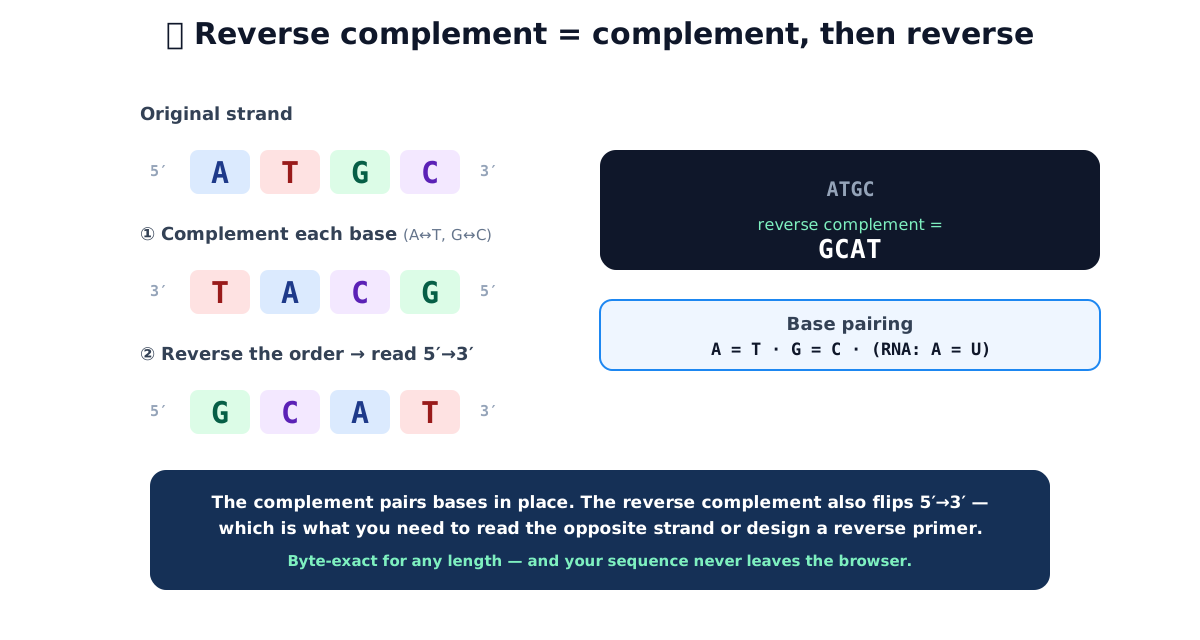
Complement vs reverse complement
These get mixed up constantly, so it’s worth being precise:
- Complement, replace each base with its pair, in place:
ATGC→TACG. - Reverse complement, do that, then reverse the string:
ATGC→TACG→GCAT.
The base-pairing rules are fixed: A pairs with T, G pairs with C (and in RNA, A pairs with U). Those never change, which is why the answer is exact and never goes out of date. Here is the full pairing reference in one place:
| Base | Name | DNA partner | RNA partner |
|---|---|---|---|
| A | Adenine | T | U |
| T | Thymine | A | , (DNA only) |
| U | Uracil | , (RNA only) | A |
| G | Guanine | C | C |
| C | Cytosine | G | G |
Notice that G and C behave identically in DNA and RNA; only the A partner changes (T in DNA, U in RNA). That single swap is the only thing that differs when you reverse-complement RNA instead of DNA.
A worked example, base by base
Take the strand 5′-ATGGCAT-3′. The two-step recipe is easiest to see when you write the complement
directly under each base and then read the bottom row backwards:
5′  A  T  G  G  C  A  T  3′   (original, read left→right)
    |  |  |  |  |  |  |
3′  T  A  C  C  G  T  A  5′   (complement in place)
The bottom strand is the complement, but it is written 3′→5′. To express it the normal way, 5′→3′, read it right to left: ATGCCAT. That string, ATGCCAT, is the reverse complement of ATGGCAT.
Palindromic-looking sequences are a good gut-check: the reverse complement of GAATTC (the EcoRI site)
is GAATTC again, which is exactly why many restriction sites read the same on both strands.
Why you almost always want the reverse one
DNA is double-stranded and the two strands are antiparallel, one runs 5′→3′, the other runs 3′→5′. By universal convention we write sequences 5′→3′. So if you have the top strand written 5′→3′ and you want the bottom strand written the normal way (5′→3′), you must complement and flip the direction. That flip is the reversal. It’s why designing a reverse primer, or finding what the opposite strand actually reads, needs the reverse complement, the plain complement would be written backwards.
A few concrete places this bites people:
- PCR reverse primers. A reverse primer anneals to the top strand but is itself written 5′→3′, so you take the reverse complement of the 3′ end of your target region, not the plain complement.
- Reading the antisense strand. When a gene sits on the minus strand of a reference genome, the coding sequence you care about is the reverse complement of what the plus-strand coordinates show.
- Checking a synthesis order. Vendors return oligos 5′→3′; confirming that two oligos anneal means checking that one is the reverse complement of the other, not merely the complement.
To make the distinction unmistakable, here is the same short input through both operations:
| Input (5′→3′) | Complement (in place) | Reverse complement (5′→3′) |
|---|---|---|
ATGC | TACG | GCAT |
AATTC | TTAAG | GAATT |
GGGAAA | CCCTTT | TTTCCC |
ATGGCAT | TACCGTA | ATGCCAT |
The middle column is almost never what you want on its own. It is only an intermediate step. The right column is the strand as it would actually be written and ordered.
Transcription and translation, briefly
The sequence tool also does the two other everyday operations:
- Transcription (DNA → mRNA): copy the coding strand and replace every T with U.
ATGC→AUGC. - Translation (→ protein): read the sequence in codons (threes) through the standard genetic
code.
ATGis Methionine (often the start codon);TAA,TAGandTGAare stop codons. Pick a reading frame (+1, +2, +3) and the protein is read until a stop.
The genetic code is a fixed 64-codon table, so translation, like the complement, is deterministic. Because a codon is three bases, a strand has three possible reading frames in each direction, and the reverse complement supplies the other three. Shifting the start point changes every codon downstream:
Sequence ATGGCATAA | Frame | Codons | Reads as |
|---|---|---|---|
| forward | +1 | ATG · GCA · TAA | Met · Ala · stop |
| forward | +2 | TGG · CAT | Trp · His |
| forward | +3 | GGC · ATA | Gly · Ile |
Only frame +1 here begins with a start codon and ends cleanly at a stop, which is why finding the right
open reading frame matters before you trust a translation. The sequence tool
shows all frames at once so you can pick the one that opens with ATG and closes on a stop.
Where each operation is used
| Operation | What it does | Typical use |
|---|---|---|
| Complement | Pairs each base in place | Intermediate step; rarely the final answer |
| Reverse complement | Complement + reverse | Reverse primers, antisense strand, oligo annealing |
| Transcription | T → U | Deriving the mRNA from a coding strand |
| Translation | Codons → amino acids | Predicting the protein an ORF encodes |
Why not just ask a chatbot?
Two reasons, one practical and one that matters more:
- Accuracy. Large language models drift on long strings. Ask one to reverse-complement two kilobases and it may quietly transpose or drop bases, and you won’t see it. A deterministic tool is byte-exact by construction.
- Privacy. Sequence data is frequently unpublished, proprietary, or tied to a real sample. Pasting it into a cloud chatbot or a random “free DNA tool” site shares it. The reverse complement tool runs entirely in your browser, your sequence is never uploaded, which is the responsible default for genetic data.
Quick summary
Complement pairs bases in place (A↔T, G↔C; A↔U for RNA); the reverse complement complements and
reverses, so ATGC becomes GCAT. You want the reverse complement because DNA strands are
antiparallel and read 5′→3′. Transcription swaps T→U; translation reads codons through the fixed
genetic code. Do all four, exactly and privately, with the
sequence tool, and check primer stats with the
GC content & Tm tool.
Sources: NCBI Bookshelf, The Structure and Function of DNA (base pairing and antiparallel strand orientation) · standard IUPAC nucleotide nomenclature · the standard genetic code (NCBI Taxonomy translation table 1). General educational information.
Frequently asked questions
What is the reverse complement of a DNA sequence?
It is the sequence of the complementary strand read in the 5′→3′ direction. You complement each base (A↔T, G↔C) and then reverse the order. For ATGC, the complement is TACG and the reverse complement is GCAT.
What's the difference between complement and reverse complement?
The complement pairs each base in place (ATGC → TACG). The reverse complement also reverses the order (ATGC → GCAT). You almost always want the reverse complement, because DNA strands run antiparallel and are read 5′→3′, so the opposite strand reads in the reverse direction.
How do I reverse complement an RNA sequence?
The same way, but adenine pairs with uracil instead of thymine (A↔U, G↔C). So the reverse complement of AUGC as RNA is GCAU. A good tool detects RNA automatically when it sees U instead of T.
Why does 5′ to 3′ direction matter?
The two strands of DNA are antiparallel: one runs 5′→3′ and its partner runs 3′→5′. By convention sequences are written 5′→3′, so to write the partner strand in the standard direction you must reverse it. That reversal is exactly why the reverse complement, not the plain complement, is what you need for primers and opposite strands.
Is it safe to reverse complement a sequence in an AI chatbot?
Two reasons to be careful. First, chatbots drift on long sequences and can silently flip or drop bases, whereas a deterministic tool is byte-exact. Second, and more important, sequence data is often unpublished or proprietary, pasting it into a cloud chatbot or upload site shares it. A browser tool that never uploads keeps it private.
How do I translate DNA to protein?
Read the sequence in codons (groups of three) from your reading frame and map each codon to an amino acid with the standard genetic code: ATG is Methionine (often the start), and TAA, TAG and TGA are stop codons. Transcription (DNA→mRNA) simply replaces T with U. The sequence tool does complement, reverse complement, transcription and translation on one page.