
explainer
Series vs Parallel: Resistors and Capacitors (and Why They're Opposite)
By Uttam Regmi · Published 2026-07-11 · Updated 2026-08-23 · 6 min read · Fact-checked, sources cited

Two components, two arrangements, and one reversal that trips everyone up. Resistors in series add; in parallel their reciprocals add (so the total drops below the smallest). Capacitors do the exact opposite. Get the pattern once and you never have to re-derive it.
The rules side by side
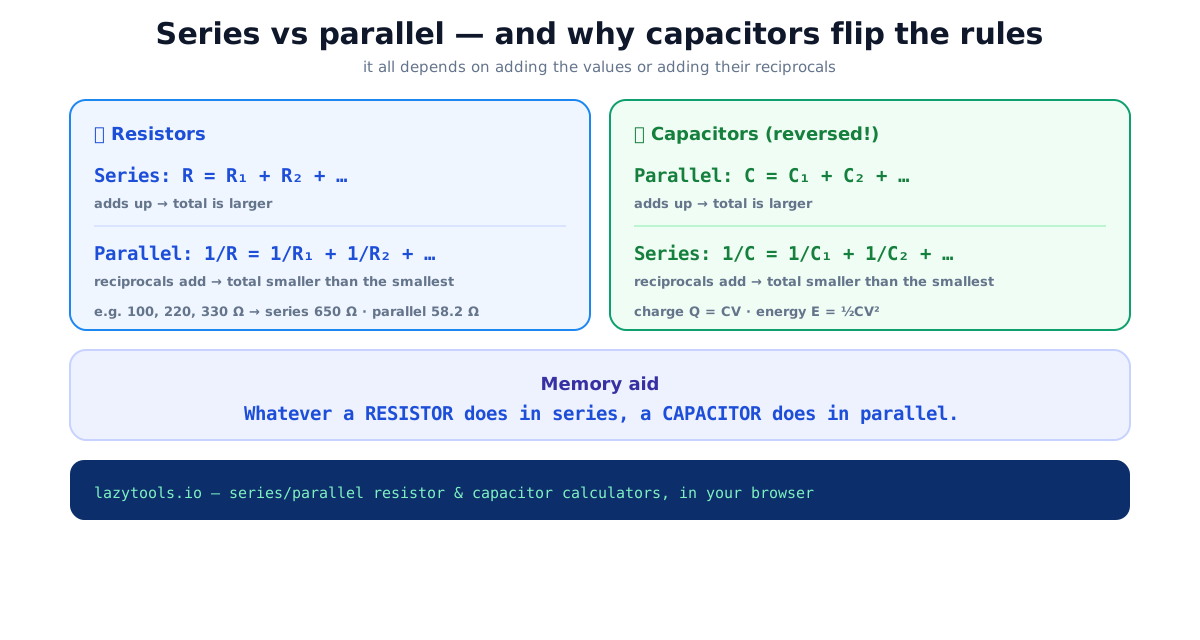
The four rules at a glance
Before the reasoning, here are all the standard series and parallel circuit rules in one place. Notice that only two kinds of maths appear, plain addition and reciprocal addition, and each component uses each kind exactly once, just swapped between the two arrangements.
| Arrangement | Resistors | Capacitors | Total ends up… |
|---|---|---|---|
| Series | R = R₁ + R₂ + … | 1/C = 1/C₁ + 1/C₂ + … | R: bigger · C: below the smallest |
| Parallel | 1/R = 1/R₁ + 1/R₂ + … | C = C₁ + C₂ + … | R: below the smallest · C: bigger |
The diagonal symmetry is the whole point: the resistor-series box and the capacitor-parallel box hold the same formula, and so do the other two. Learn one component and you already know the other.
Resistors
In series, current flows through each resistor in turn, so their oppositions stack up:
R_total = R₁ + R₂ + R₃ + …
Three resistors of 100, 220 and 330 Ω in series give 650 Ω. Series values simply pile on, so the total is always larger than any single resistor, handy when you need a value you don’t have in your parts bin (two 1 kΩ resistors in series make 2 kΩ).
In parallel, current splits between branches, giving it more ways through, so the total drops:
1/R_total = 1/R₁ + 1/R₂ + 1/R₃ + …
The same three resistors in parallel give about 58.2 Ω, less than the 100 Ω smallest. That’s the tell-tale sign of a parallel combination: the total is always below the smallest resistor. Two useful shortcuts fall out of the formula:
- Two resistors in parallel:
R = (R₁ × R₂) / (R₁ + R₂), the “product over sum” rule. - Equal resistors in parallel:
ncopies ofRgiveR / n. Ten 100 Ω resistors in parallel = 10 Ω.
So 100 Ω and 220 Ω in parallel work out to (100 × 220) / 320 ≈ 68.75 Ω. The
series & parallel resistor calculator adds up as many
as you like and applies these shortcuts automatically.
Capacitors, the reverse
Capacitors flip both rules. In parallel they simply add (like series resistors):
C_total = C₁ + C₂ + …
Three capacitors of 10, 22 and 47 µF in parallel give 79 µF, bigger than any single one.
In series their reciprocals add (like parallel resistors), so the total is smaller than the smallest:
1/C_total = 1/C₁ + 1/C₂ + …
Two 10 µF capacitors in series give 5 µF (the same n copies → C / n shortcut, and the product-over-sum
trick for two). Why bother putting capacitors in series when it loses capacitance? Because the applied
voltage divides across them, so a series string can withstand a higher total voltage than any single part
is rated for, a common trick in high-voltage supplies. The
capacitor calculator uses these reversed rules.
Why the reversal?
It comes down to what each component is:
- A resistor opposes current. Line more up in series and you add opposition; give current parallel detours and you reduce it.
- A capacitor stores charge per volt (
C = Q/V). Wiring capacitors in parallel is like widening the plates, more area, more capacitance, so they add. Wiring them in series is like increasing the gap between plates, less capacitance, so the reciprocals add.
Same maths (add values, or add reciprocals), opposite pairing. Hence the memory aid: whatever a resistor does in series, a capacitor does in parallel.
A worked mixed example
Real circuits mix both. The method is always the same:
- Find a group that is purely series or purely parallel.
- Replace it with its single equivalent value.
- Repeat until one value is left.
Take three resistors: a 220 Ω and a 330 Ω sitting in parallel, and that pair wired in series with a 100 Ω resistor.
- Step 1, the parallel pair.
(220 × 330) / (220 + 330) = 72,600 / 550 = 132 Ω. As expected, below the smaller branch (220 Ω). - Step 2, add the series resistor.
132 + 100 = 232 Ωtotal.
If a 12 V supply drives the whole thing, the current is I = V / R = 12 / 232 ≈ 51.7 mA. That same current
flows through the 100 Ω resistor (it’s in series), dropping 0.0517 × 100 ≈ 5.17 V across it and leaving
about 6.83 V across the parallel pair. For the voltage, current and power around each resistor, the
Ohm’s-law wheel finishes the job.
Capacitor networks reduce the same way, just swap which arrangement adds and which takes reciprocals.
Common mistakes to avoid
- Forgetting the final reciprocal.
1/R_total = 1/R₁ + 1/R₂gives you1/R_total, notR_total. You still have to flip the result. Skipping that flip is the single most common parallel-resistor error. - Reusing resistor rules for capacitors. They are mirror images, not the same. If a capacitor total comes out bigger in series, you’ve applied the wrong rule.
- Mixing units. Combine like with like, all ohms, or all farads (or all microfarads), before adding.
- Assuming parallel always means “smaller current.” Parallel resistance is smaller, which for a fixed voltage means more total current is drawn, not less.
Quick sanity checks
Two five-second tests catch most slips: a parallel resistor total must be smaller than the smallest branch, and a series capacitor total must be smaller than the smallest capacitor. If your answer breaks either rule, you’ve swapped a formula.
Quick summary
Resistors add in series and combine as reciprocals in parallel (total below the smallest); capacitors do the exact reverse, add in parallel, reciprocals in series. The reversal comes from resistance opposing current while capacitance stores charge. Remember “resistor-series = capacitor-parallel,” break mixed circuits into groups, and let the resistor and capacitor calculators do the arithmetic.
Sources: standard circuit theory (series and parallel combinations of resistors and capacitors) as taught in physics and electronics. Educational information.
Frequently asked questions
How do resistors combine in series and parallel?
In series they add: R_total = R₁ + R₂ + …. In parallel, their reciprocals add: 1/R_total = 1/R₁ + 1/R₂ + …, so the total is always less than the smallest resistor. For 100, 220 and 330 Ω: series = 650 Ω, parallel ≈ 56.9 Ω.
How do capacitors combine in series and parallel?
The opposite of resistors. In parallel capacitors add: C_total = C₁ + C₂ + …. In series their reciprocals add: 1/C_total = 1/C₁ + 1/C₂ + …, giving a total smaller than the smallest capacitor.
Why are capacitor rules the reverse of resistor rules?
Resistance opposes current, so more resistors in a line (series) means more opposition. Capacitance stores charge per volt; connecting capacitors in parallel effectively enlarges the plate area (more capacitance), while series increases the effective plate spacing (less capacitance), the reverse behaviour.
Why is parallel resistance always smaller than the smallest resistor?
Parallel branches give current extra paths to flow through, which reduces the overall opposition. Adding any parallel path can only lower the total resistance, so it ends up below the smallest branch.
How do I handle a mixed series-parallel circuit?
Break it into sub-groups: combine the purely series parts and purely parallel parts separately, replace each with its equivalent value, and repeat until one value remains. A calculator handles each group.
What is the memory trick for series and parallel?
Whatever a resistor does in series, a capacitor does in parallel (and vice-versa). If you remember the resistor rules, flip them for capacitors.