
explainer
BMR vs TDEE: How Many Calories You Actually Need (and Why)
By Uttam Regmi · Published 2026-07-10 · Updated 2026-07-10 · 7 min read · Fact-checked, sources cited
Your BMR is the calories you’d burn lying in bed all day; your TDEE is that number multiplied by how much you actually move, and TDEE is the one that decides whether you lose, hold, or gain weight. Get your BMR from the Mifflin, St Jeor equation, multiply by an activity factor, then eat below it to lose or above it to gain. Run your own numbers in the TDEE & calorie calculator, everything below is the reasoning behind it.
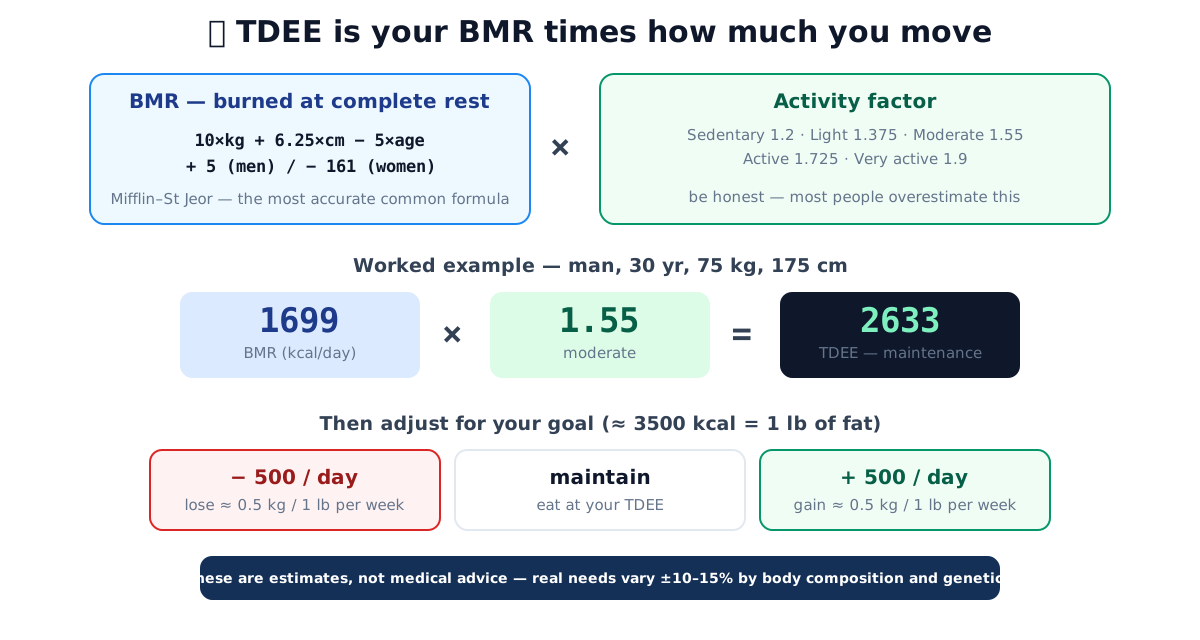
BMR and TDEE, in one picture
Step 1, BMR from Mifflin, St Jeor
Basal metabolic rate is what your body spends just staying alive: keeping your heart beating, your lungs working, your cells repairing. It’s the biggest slice of most people’s daily burn, usually 60-70% of the total. The Mifflin, St Jeor equation, published in 1990, is the one dietitians reach for because it tracks measured metabolism more closely than the older Harris, Benedict:
- Men: BMR = 10 × weight(kg) + 6.25 × height(cm) − 5 × age + 5
- Women: BMR = 10 × weight(kg) + 6.25 × height(cm) − 5 × age − 161
Work it for a 30-year-old man, 75 kg, 175 cm: 750 + 1093.75 − 150 + 5 = 1,699 calories a day at complete rest. If you think in pounds and inches, the calculator converts (1 lb = 0.4536 kg, 1 in = 2.54 cm) before applying the formula, so you don’t have to.
Why Mifflin, St Jeor, and how the alternatives compare
It isn’t the only resting-energy equation, but for the general population it’s the one that lands closest to the calories a metabolic chamber actually measures. The others are still in use, and knowing what each one needs as input explains why two calculators can disagree:
| Formula | Year | Inputs it uses | Best for |
|---|---|---|---|
| Mifflin, St Jeor | 1990 | Weight, height, age, sex | The default for most people |
| Harris, Benedict (revised) | 1984 | Weight, height, age, sex | Older tools; tends to read a bit high |
| Katch, McArdle | , | Lean body mass (needs body-fat %) | Lean, well-trained people who know their body fat |
Mifflin, St Jeor and Harris, Benedict use the same four inputs but different coefficients, so they can part ways by roughly 100-200 calories. Katch, McArdle skips height and sex entirely and works from lean mass, which makes it sharper for a muscular athlete but useless unless you have a reliable body-fat measurement. When you don’t, Mifflin, St Jeor is the safe pick.
Step 2, scale it to your life with an activity factor
Almost nobody spends the day at rest, so BMR alone understates your needs. Multiply by an activity factor to get TDEE:
| Activity level | Factor | Who it’s for |
|---|---|---|
| Sedentary | 1.2 | Desk job, little or no exercise |
| Light | 1.375 | Light exercise 1-3 days/week |
| Moderate | 1.55 | Moderate exercise 3-5 days/week |
| Active | 1.725 | Hard exercise 6-7 days/week |
| Very active | 1.9 | Physical job or twice-daily training |
Our example man at the moderate factor: 1,699 × 1.55 ≈ 2,633 calories a day. That’s his TDEE, the calories that keep his weight steady.
The single most common mistake here is over-rating yourself. A gym session three times a week on top of a desk job is light-to-moderate, not active. When you’re between two levels, choose the lower one: it’s easier to add food later than to explain why a too-generous estimate stalled your progress.
To see how much the factor matters, keep our example man’s BMR of 1,699 fixed and slide the multiplier across the range:
| Activity level | Factor | TDEE (1,699 × factor) |
|---|---|---|
| Sedentary | 1.2 | ≈ 2,039 kcal |
| Light | 1.375 | ≈ 2,336 kcal |
| Moderate | 1.55 | ≈ 2,633 kcal |
| Active | 1.725 | ≈ 2,931 kcal |
| Very active | 1.9 | ≈ 3,228 kcal |
The gap between “sedentary” and “very active” is nearly 1,200 calories for the same body, which is exactly why guessing your activity level wrong swamps every other rounding error in the formula.
A second example, worked for a woman
Take a 40-year-old woman, 65 kg, 165 cm, who does light exercise a couple of times a week. Her BMR is 10 × 65 + 6.25 × 165 − 5 × 40 − 161 = 650 + 1031.25 − 200 − 161 = 1,320 calories at rest. At the light factor of 1.375, her TDEE is 1,320 × 1.375 ≈ 1,815 calories a day, her maintenance line. The female constant (−161 instead of +5) is the only thing that changes; everything else is the same machinery.
Step 3, turn TDEE into a goal
TDEE is your maintenance line. To change weight, create a gap:
- To lose: eat below TDEE. A pound of body fat stores roughly 3,500 calories, so a 500 kcal/day deficit ≈ 1 lb (0.45 kg) a week; 250/day ≈ half a pound. In our example, ~2,133 kcal/day targets a half-kilo weekly loss.
- To maintain: eat at your TDEE.
- To gain: eat above it. A 500/day surplus supports roughly a pound a week, though for muscle gain a smaller 250-300 surplus wastes less as fat.
Two guardrails. Don’t drop below your BMR for extended periods, that’s the floor your organs need. And bigger deficits aren’t better: past ~1,000/day you start burning muscle and the plan gets hard to keep. Once you know your target calories, split them into protein, carbs and fat with the macro calculator, and sanity-check your goal weight against a healthy range with the ideal weight calculator.
Why the number is an estimate, not a verdict
Every formula on this page is a population average fitted to your height, weight, age and sex. It can’t see your muscle mass (metabolically pricier than fat), your thyroid, or your NEAT, the calories you burn fidgeting, pacing and generally not sitting still, which varies by hundreds of calories between people. Realistically your true TDEE sits within about ±10-15% of the estimate.
So use it the way a coach would: eat at the target for two to three weeks, watch the trend on the scale (not any single day, which is mostly water), and adjust by 100-200 calories if reality and the math disagree. The formula gives you a smart starting point; your own results are the calibration. This is general information, not medical advice, check with a professional before big changes, especially if you have a health condition.
Quick summary
BMR is what you burn at rest (Mifflin, St Jeor: 10×kg + 6.25×cm − 5×age ± sex constant). TDEE is BMR times an activity factor from 1.2 to 1.9, and it’s the number that governs your weight: eat ~500 below it to lose about a pound a week, at it to maintain, above it to gain. Pick your activity level honestly, never live below your BMR, and treat the result as a two-week experiment to refine. Get your own figures, privately, in your browser, from the TDEE & calorie calculator, then plan the plate with the macro calculator.
Sources: Mifflin MD, St Jeor ST, et al. A new predictive equation for resting energy expenditure (Am J Clin Nutr, 1990) · NIH, Body Weight Planner · standard dietetics activity-factor conventions. General information only, not medical advice.
Frequently asked questions
What's the difference between BMR and TDEE?
BMR (basal metabolic rate) is the energy your body burns at complete rest just to stay alive, breathing, circulation, cell repair. TDEE (total daily energy expenditure) is your BMR multiplied by an activity factor, so it also includes moving, working and exercising. TDEE is the number that matters for eating: eat below it to lose weight, at it to maintain, above it to gain.
How do I calculate my BMR?
The most accurate common formula is Mifflin, St Jeor: BMR = 10 × weight(kg) + 6.25 × height(cm) − 5 × age + 5 for men (or − 161 for women). For a 30-year-old man at 75 kg and 175 cm that's 750 + 1093.75 − 150 + 5 ≈ 1699 calories a day. The TDEE calculator does the unit conversion and the arithmetic for you.
Which activity factor should I use?
Sedentary (desk job, no exercise) = 1.2; light (1-3 workouts/week) = 1.375; moderate (3-5/week) = 1.55; active (6-7/week) = 1.725; very active (hard physical job or twice-daily training) = 1.9. Most people overestimate, if you sit most of the day and train a few times a week, you're 'light', not 'active'. When unsure, pick the lower factor and adjust.
How big a calorie deficit should I use to lose weight?
About 500 calories a day below your TDEE loses roughly half a kilogram (one pound) per week, since a pound of fat is about 3,500 calories. A 250-calorie deficit gives a gentler quarter-kilo per week. Larger deficits aren't better. They cost muscle and are hard to sustain. Never eat below your BMR for long.
Why did two calculators give me different numbers?
Different formulas. Mifflin, St Jeor (used here) is the modern standard; the older Harris, Benedict runs a little higher; Katch, McArdle uses body-fat percentage instead of height and weight. They can differ by 100-200 calories. All are estimates, your true expenditure varies with body composition, genetics and NEAT (fidgeting and everyday movement) by roughly ±10-15%.
Is a calculated TDEE exact?
No, treat it as a starting estimate, not a medical prescription. The formula can't see your muscle mass, hormones or day-to-day activity. Use the number for two to three weeks, track your actual weight trend, then adjust: if weight isn't moving the way the deficit predicts, nudge intake by 100-200 calories. The scale over weeks is the real feedback, not the formula.