
explainer
Telescope Magnification: Why the '600x' on the Box Is a Lie
By Uttam Regmi · Published 2026-07-18 · Updated 2026-07-18 · 5 min read · Fact-checked, sources cited
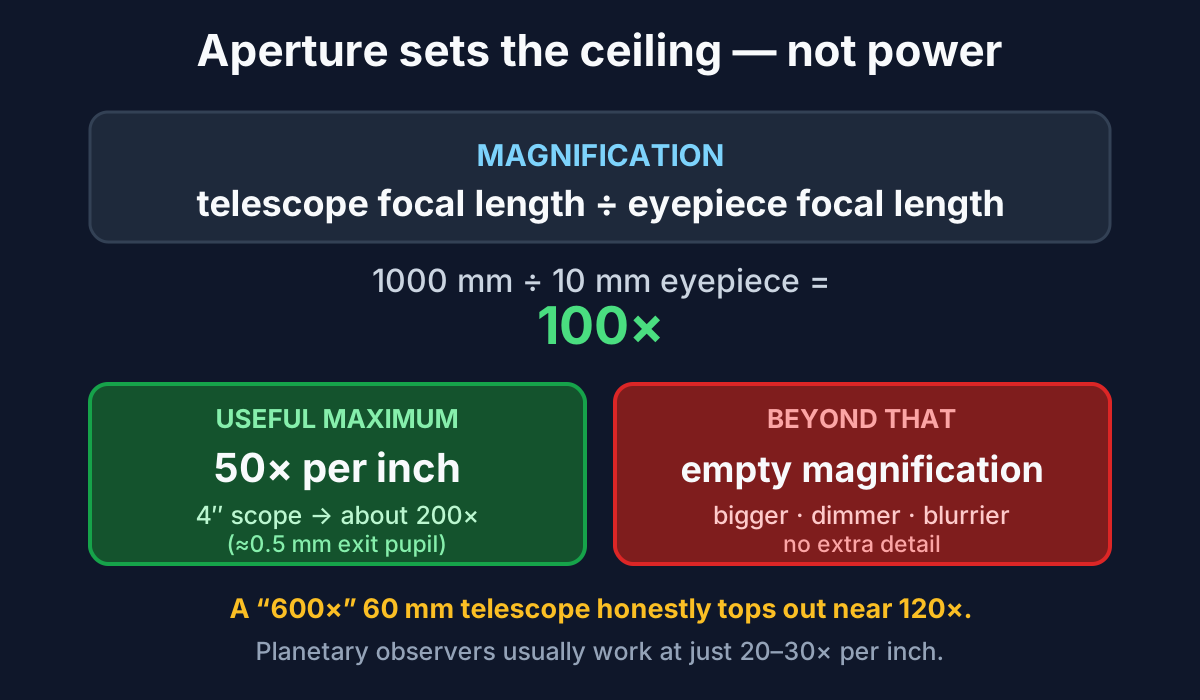
Magnification = telescope focal length ÷ eyepiece focal length. A 1,000 mm telescope with a 10 mm eyepiece gives 100×. But the number that actually limits what you can see is aperture, not magnification, and the useful ceiling is roughly 50× per inch of aperture (about 2× per millimetre). Past that you get “empty magnification”: a bigger, dimmer, blurrier image with no extra detail. That “600x” printed on a beginner telescope box with a 60 mm lens is marketing, not optics.
The formula
Magnification = telescope focal length ÷ eyepiece focal length
Both in millimetres. A 1,200 mm telescope with a 25 mm eyepiece gives 1,200 ÷ 25 = 48×. Swap to a 6 mm eyepiece and you get 200×.
The telescope’s focal length is fixed; the eyepiece is what you change. That’s why a telescope is sold with more than one eyepiece, and why a Barlow lens (typically 2×, which doubles the effective magnification of any eyepiece) is a cheap way to fill gaps in your set. Work out combinations with the telescope calculator.
Why 50× per inch is the ceiling
Aperture, the diameter of the main lens or mirror, sets two hard physical limits:
- Light grasp. Area scales with the square of the diameter, so a 6″ scope collects over twice the light of a 4″. More light means fainter objects are visible.
- Resolving power. Diffraction means a given aperture can only separate detail down to a certain angular size. No eyepiece can add detail the aperture never captured.
Magnification just spreads the light your aperture already collected across a larger apparent image. Push too far and you’re enlarging blur while making everything dimmer, because the same photons now cover more area.
The rule of thumb that captures this: maximum useful magnification ≈ 50 × aperture in inches (or 2 × aperture in mm).
| Aperture | Useful max | Best planetary range (20-30×/inch) |
|---|---|---|
| 60 mm (2.4″) | ~120× | 50-70× |
| 100 mm (4″) | ~200× | 80-120× |
| 150 mm (6″) | ~300× | 120-180× |
| 200 mm (8″) | ~400× | 160-240× |
Which is exactly why the classic “600 power, 60 mm” department-store telescope is such a reliable way to put a beginner off astronomy for good. At 600× that scope delivers a field of view too small to find anything, too dim to see, and so shaky on its mount that the slightest touch sends the target out of frame. Its honest ceiling is about 120×.
Exit pupil: the number nobody mentions
Exit pupil = aperture ÷ magnification (in mm). It’s the width of the light beam leaving the eyepiece and entering your eye.
- Too large (bigger than your eye’s dark-adapted pupil, roughly 5-7 mm) and the outer part of the beam is wasted. You paid for aperture you can’t use.
- Too small and the image gets dim, and you start seeing “floaters” in your own eye.
The 50×-per-inch limit corresponds to about a 0.5 mm exit pupil, which is roughly where the human eye stops being able to make use of what’s presented. So the rule of thumb isn’t arbitrary, it’s the point where the optics and your eye’s limits meet.
Practical targets:
| Observing | Exit pupil | Why |
|---|---|---|
| Deep sky (nebulae, clusters) | 4-7 mm | Maximum brightness, wide field |
| General viewing | 2-3 mm | Good balance of scale and brightness |
| Planets, double stars | 0.7-1.5 mm | Maximum scale while still sharp |
The atmosphere usually decides
Even a perfect telescope is looking through kilometres of moving air. Astronomers call this seeing, and on an average night it limits usable magnification to somewhere around 150-250× regardless of your aperture. On a poor night, 100× may be all that holds together; on an exceptional night, a large scope might push past 400×.
This is why experienced planetary observers habitually work at 20-30× per inch rather than the 50× maximum. A slightly smaller, rock-steady, high-contrast image reveals more genuine detail than a bloated, wobbling one. The maximum is a ceiling, not a target.
Practical approach: start low to find the object, then step up magnification until the image starts to soften, and then come back one eyepiece. That’s the night’s real limit.
What to buy instead of magnification
If you’re choosing a telescope, ignore any power claim on the box and look at:
- Aperture, the single most important spec, for both brightness and detail.
- The mount, a good scope on a wobbly mount is unusable at any power. Many beginners are better served by a modest scope on a solid mount than the reverse.
- Eyepieces, a low-power (wide-field) and a medium-power eyepiece cover most nights. Add high power later.
Aperture also has a cost: bigger scopes are heavier and less likely to get carried outside. The best telescope is the one you actually use.
Frequently asked questions
How do I calculate telescope magnification?
Divide the telescope's focal length by the eyepiece focal length, both in millimetres. A 1,000 mm telescope with a 10 mm eyepiece gives 100x. The telescope's focal length is fixed, so you change power by swapping eyepieces.
What is the maximum useful magnification of a telescope?
Roughly 50x per inch of aperture, or about 2x per millimetre. A 4-inch (100 mm) telescope tops out near 200x. Beyond that you get 'empty magnification', a larger, dimmer, blurrier image with no extra detail.
Why is the '600x' printed on a beginner telescope box misleading?
Because magnification is limited by aperture, not the eyepiece. A 60 mm scope has an honest ceiling around 120x. At 600x its image is too dim, the field of view too small to find anything, and the mount too shaky to hold a target.
What is exit pupil and why does it matter?
Exit pupil equals aperture divided by magnification, in millimetres, the width of the light beam leaving the eyepiece. Too large (over roughly 5-7 mm) wastes aperture; too small makes the image dim and reveals floaters in your eye.
What magnification should I use to see planets?
Experienced planetary observers often use just 20-30x per inch of aperture rather than the maximum, because atmospheric turbulence usually limits sharpness. For a 4-inch scope that is roughly 80-120x.
Does a Barlow lens increase magnification?
Yes. A Barlow lens (typically 2x) multiplies the effective magnification of any eyepiece it is paired with, so a 2x Barlow with a 10 mm eyepiece behaves like a 5 mm eyepiece. It is a cheap way to fill gaps in an eyepiece set.