
explainer
The Mole Explained: Converting Grams, Moles and Molecules
By Uttam Regmi · Published 2026-07-11 · Updated 2026-08-23 · 6 min read · Fact-checked, sources cited
The mole is the number that makes chemistry add up. It ties together three things you constantly
switch between: the mass you weigh on a balance, the moles (amount) in a reaction, and the
number of particles actually reacting. Two conversions do all the work: moles = mass ÷ molar mass,
and particles = moles × 6.022×10²³.
The mole as a hub
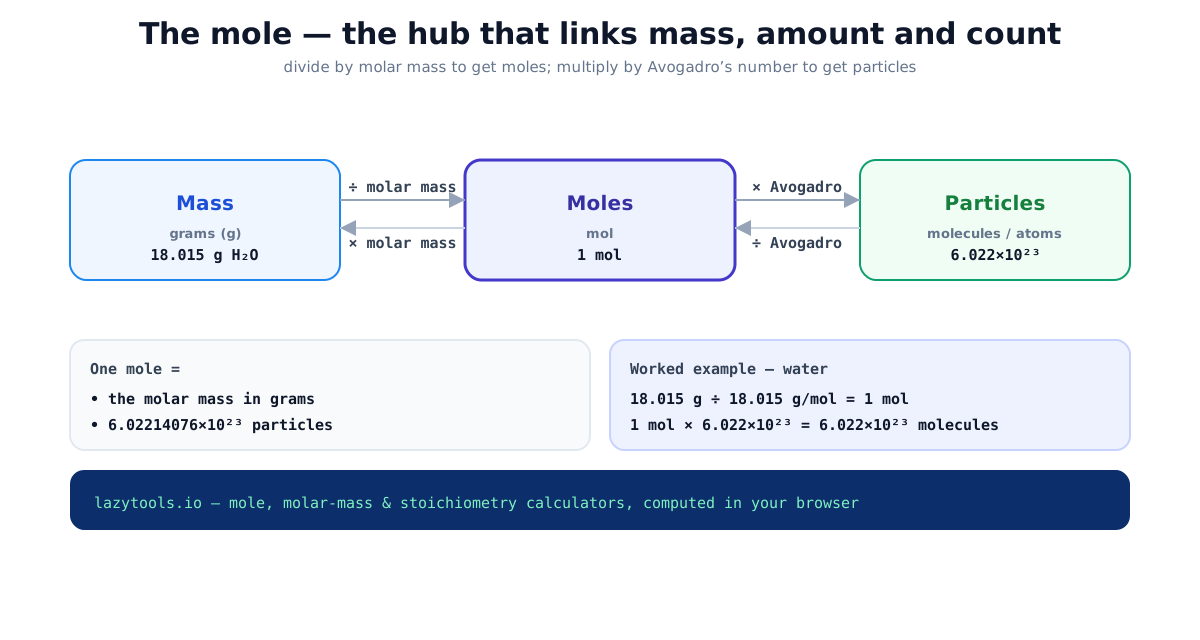
Think of moles in the middle, with mass on one side and particle count on the other:
- To go from grams to moles, divide by the molar mass. To go back, multiply.
- To go from moles to particles, multiply by Avogadro’s number. To go back, divide.
You never convert grams directly to molecules. You always pass through moles. The mole calculator does all three at once: type a formula, enter any one of mass, moles or particles, and read the other two.
Here are the four moves laid out as a reference. Notice each pair is a simple inverse, divide one way, multiply the other:
| From | To | Operation | Formula |
|---|---|---|---|
| Grams | Moles | divide by molar mass | n = m ÷ M |
| Moles | Grams | multiply by molar mass | m = n × M |
| Moles | Particles | multiply by Avogadro’s number | N = n × Nₐ |
| Particles | Moles | divide by Avogadro’s number | n = N ÷ Nₐ |
Here n is moles, m is mass in grams, M is molar mass in g/mol, N is the particle count, and
Nₐ = 6.022×10²³ mol⁻¹. Any grams-to-particles (or particles-to-grams) question is just two of these
moves chained together, with moles in the middle.
Why one mole = the molar mass in grams
This is the clever part of the definition. The molar mass in grams per mole is numerically equal to the average molecular mass in atomic mass units. So:
- 1 mole of carbon-12 weighs 12 g
- 1 mole of water (H₂O, 18.015 u) weighs 18.015 g
- 1 mole of glucose (C₆H₁₂O₆, 180.16 u) weighs 180.16 g
That correspondence is what lets you count particles with a balance: weigh out the molar mass in grams and you have exactly one mole, 6.022×10²³ molecules. Get the molar mass for any formula with the molar mass calculator.
A reference table of one mole
To make the idea concrete, here is what one mole looks like for a few everyday substances. In every row the particle count is identical, only the mass on the balance changes, because that depends on the molar mass:
| Substance | Formula | Molar mass (g/mol) | Mass of 1 mole | Particles in 1 mole |
|---|---|---|---|---|
| Carbon-12 | C | 12 (exact) | 12 g | 6.022×10²³ atoms |
| Water | H₂O | 18.015 | 18.015 g | 6.022×10²³ molecules |
| Table salt | NaCl | 58.44 | 58.44 g | 6.022×10²³ formula units |
| Carbon dioxide | CO₂ | 44.01 | 44.01 g | 6.022×10²³ molecules |
| Glucose | C₆H₁₂O₆ | 180.16 | 180.16 g | 6.022×10²³ molecules |
The molar masses are the sum of the standard atomic weights of the constituent atoms, so small rounding differences between sources are normal in the last digit or two.
Worked example: grams to molecules
How many molecules are in 36.03 g of water?
- Grams → moles: 36.03 g ÷ 18.015 g/mol = 2 mol.
- Moles → molecules: 2 mol × 6.022×10²³ = 1.204×10²⁴ molecules.
Two steps, always through moles.
Worked example: the other direction
Now run it backwards. You have 3.011×10²³ molecules of carbon dioxide, what do they weigh?
- Particles → moles: 3.011×10²³ ÷ 6.022×10²³ = 0.5 mol.
- Moles → grams: 0.5 mol × 44.01 g/mol = 22.0 g.
Same hub, same two moves, just applied in reverse. If you are ever unsure which way to divide, sanity-check the size of the answer: half a mole of anything should weigh half its molar mass, and it does.
A note on molar volume for gases
Gases add a convenient shortcut. Under the same temperature and pressure, equal volumes of any ideal gas contain equal numbers of molecules (Avogadro’s law), so one mole of an ideal gas occupies the same volume regardless of what the gas is. At 0 °C and 1 atm that volume is about 22.4 L per mole; at 25 °C and 1 atm it is closer to 24.5 L per mole. Because different bodies define “standard conditions” differently, always confirm which temperature and pressure a given 22.4 L (or 22.7 L) figure assumes before you rely on it. For a gas, then, volume becomes a fourth spoke on the same hub, divide the volume by the molar volume to reach moles, and continue as usual.
Avogadro’s number
6.02214076×10²³ is Avogadro’s number, the count of particles in one mole. Since the 2019 revision of the SI, it is an exact defined value (it’s how the mole is now defined), so it never drifts. It is staggeringly large: a mole of water molecules is about 18 mL, yet contains more molecules than there are stars in the observable universe by a wide margin.
Where it pays off: stoichiometry
The reason the mole matters so much is that balanced-equation coefficients are mole ratios, not mass
ratios. In N₂ + 3 H₂ → 2 NH₃, one mole of N₂ reacts with three of H₂, but their masses are 28 g and
6 g. So every reaction calculation runs: mass → moles → (mole ratio) → moles → mass. Skip the mole
step and the arithmetic is wrong. The stoichiometry calculator
automates exactly this, including finding the limiting reagent.
As a quick worked case: how much ammonia forms from 28 g of nitrogen (with hydrogen in excess)? 28 g of N₂ is 1 mol; the 1:2 ratio of N₂ to NH₃ gives 2 mol of NH₃; and 2 mol × 17.03 g/mol is about 34 g of ammonia. The mole ratio does the real work in the middle step, mass alone can never tell you that.
Common mistakes to avoid
A few errors trip people up again and again:
- Converting grams straight to molecules. There is no direct conversion; you must pass through moles.
- Using coefficients as mass ratios. Balanced-equation numbers are mole ratios, not gram ratios.
- Forgetting diatomic elements. Elemental hydrogen, oxygen and nitrogen are H₂, O₂ and N₂, so their molar masses are roughly 2, 32 and 28 g/mol, not 1, 16 and 14.
- Confusing molar mass with molecular count. Two substances with one mole each contain the same number of particles but almost always weigh different amounts.
- Rounding Avogadro’s number too early. Carry
6.022×10²³(or more digits) through the whole calculation and round only at the end.
Quick summary
A mole is 6.022×10²³ particles, and one mole of a substance weighs its molar mass in grams. Convert with
moles = mass ÷ molar mass and particles = moles × Avogadro's number, always routing through moles, which is also why the mole is the essential middle step in stoichiometry. Try it on the
mole calculator.
Sources: SI definition of the mole and Avogadro constant (2019 SI redefinition); standard general chemistry. Educational information.
Frequently asked questions
What is a mole in chemistry?
A mole is an amount of substance: exactly 6.02214076×10²³ particles (Avogadro's number). One mole of any substance has a mass in grams equal to its molar mass, and contains that many atoms, molecules or ions, the bridge between the mass you weigh and the number of particles reacting.
How do I convert grams to moles?
Divide the mass in grams by the molar mass in g/mol: moles = mass ÷ molar mass. For water (18.015 g/mol), 36.03 g ÷ 18.015 = 2 moles. A mole calculator does this once you enter the formula.
How do I convert moles to molecules?
Multiply the number of moles by Avogadro's number, 6.022×10²³. So 2 moles of water = 2 × 6.022×10²³ = 1.204×10²⁴ molecules.
Why does one mole equal the molar mass in grams?
The mole is defined so that the molar mass in grams per mole is numerically equal to the average molecular (or atomic) mass in atomic mass units. That is why 1 mole of carbon-12 is 12 g, and 1 mole of water is 18.015 g. It makes weighing out a known number of particles simple.
What is Avogadro's number?
The number of particles in one mole: 6.02214076×10²³, an exact defined constant since the 2019 SI redefinition. It links the microscopic count of atoms and molecules to the macroscopic mole.
How is the mole used in stoichiometry?
Balanced-equation coefficients are mole ratios, so reaction calculations run through moles: convert the mass you have to moles, apply the mole ratio to find moles of product, then convert back to grams. The mole is the required middle step.