
explainer
How to Find the pH of a Weak Acid (the ICE-Table Method)
By Uttam Regmi · Published 2026-07-12 · Updated 2026-08-23 · 7 min read · Fact-checked, sources cited
Drop a strong acid like HCl to 0.1 M and the pH is 1. Do the same with acetic acid and the pH is about 2.87, nearly a hundred times less acidic. Same concentration, wildly different pH, because a weak acid barely comes apart in water. To find its pH you can’t just take a logarithm; you have to solve an equilibrium. The tool for that is the ICE table.
Why −log(C) fails
For a strong acid, every molecule donates its proton, so [H⁺] equals the acid concentration and pH = −log(C). Simple.
A weak acid doesn’t. Acetic acid in water sits mostly as intact CH₃COOH molecules, with only a small fraction broken into H⁺ and CH₃COO⁻ at any moment. That fraction, the percent ionization, is often just 1-2%. So the real [H⁺] is a fraction of the concentration, and the pH is much higher (less acidic) than −log(C) predicts.
How much ionizes is set by the acid’s Ka, its acid-dissociation constant. A bigger Ka means a stronger weak acid; acetic acid’s Ka is 1.8×10⁻⁵ (a pKa of 4.74). Chemists usually quote pKa = −log Ka because it’s a friendlier number, and because a difference of one pKa unit is a tenfold difference in strength. The table below shows how wide the range is among common weak acids, all far from the strong-acid limit.
| Weak acid | Formula | Ka (25 °C) | pKa |
|---|---|---|---|
| Hydrofluoric acid | HF | ~6.6×10⁻⁴ | ~3.18 |
| Formic acid | HCOOH | 1.8×10⁻⁴ | 3.75 |
| Benzoic acid | C₆H₅COOH | 6.3×10⁻⁵ | 4.20 |
| Acetic acid | CH₃COOH | 1.8×10⁻⁵ | 4.74 |
| Carbonic acid (1st) | H₂CO₃ | 4.3×10⁻⁷ | 6.35 |
| Hypochlorous acid | HClO | 2.9×10⁻⁸ | 7.54 |
| Ammonium ion | NH₄⁺ | 5.6×10⁻¹⁰ | 9.25 |
| Hydrocyanic acid | HCN | 6.2×10⁻¹⁰ | 9.21 |
Ka values are standard reference figures and vary slightly between sources (HF in particular is often listed anywhere from ~3.5×10⁻⁴ to ~7×10⁻⁴); always use the value that came with your problem or dataset.
Setting up the ICE table
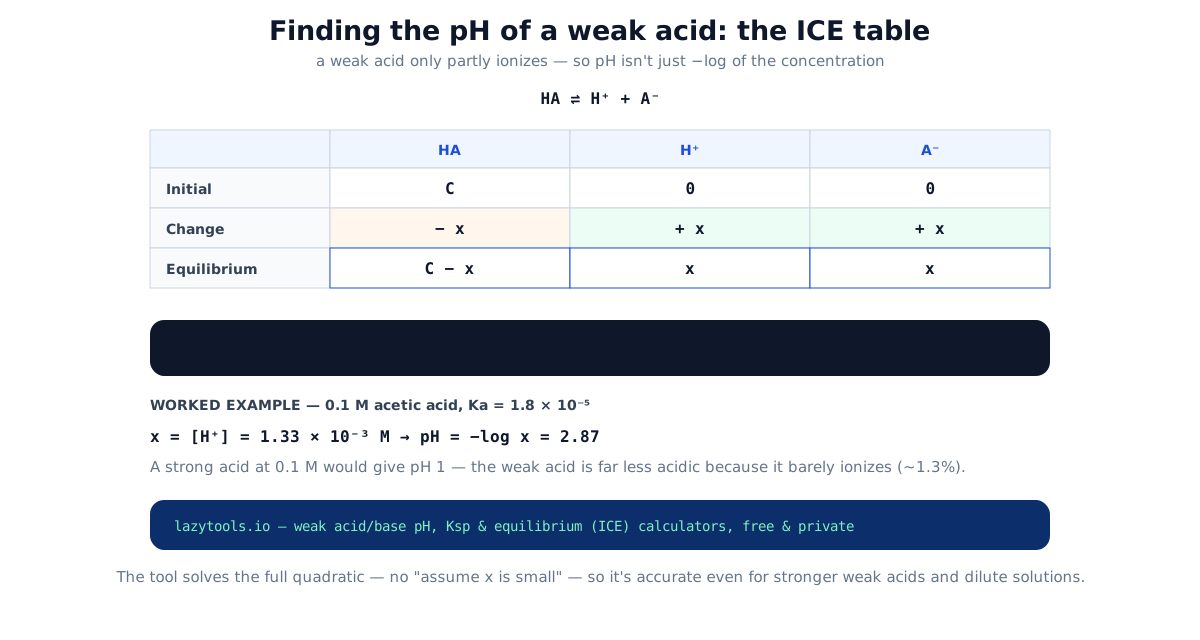
ICE stands for Initial, Change, Equilibrium (also written as a RICE chart). For a weak acid HA ⇌ H⁺ + A⁻ starting at concentration C:
| HA | H⁺ | A⁻ | |
|---|---|---|---|
| Initial | C | 0 | 0 |
| Change | −x | +x | +x |
| Equilibrium | C − x | x | x |
Here x is the amount that ionizes, which is exactly [H⁺] at equilibrium. Plug the equilibrium row into the Ka expression:
Ka = [H⁺][A⁻] / [HA] = (x)(x) / (C − x) = x² / (C − x)Solving for x
Rearranging gives a quadratic:
x² + Ka·x − Ka·C = 0which solves (taking the positive root) to x = (−Ka + √(Ka² + 4·Ka·C)) / 2. For 0.1 M acetic acid:
x = [H⁺] ≈ 1.33×10⁻³ M → pH = −log(1.33×10⁻³) ≈ 2.87
And the percent ionization is 1.33×10⁻³ ÷ 0.1 × 100 ≈ 1.3%, confirming that only a sliver of the acid came apart. That’s the whole story in one number: 98.7% of the acetic acid is still sitting there as intact molecules.
A worked walk-through
If you’re solving by hand, it helps to see every step for the 0.1 M acetic acid case:
- Write the equilibrium expression from the ICE row:
1.8×10⁻⁵ = x²/(0.1 − x). - Clear the denominator:
x² = 1.8×10⁻⁵ (0.1 − x), i.e.x² + 1.8×10⁻⁵·x − 1.8×10⁻⁶ = 0. - Apply the quadratic formula with a = 1, b = 1.8×10⁻⁵, c = −1.8×10⁻⁶: the discriminant is
(1.8×10⁻⁵)² + 4(1.8×10⁻⁶) ≈ 7.20×10⁻⁶, whose square root is 2.68×10⁻³. - Take the positive root:
x = (−1.8×10⁻⁵ + 2.68×10⁻³)/2 ≈ 1.33×10⁻³ M. - Convert to pH:
pH = −log(1.33×10⁻³) ≈ 2.87.
The negative root gives a physically impossible negative concentration, so you always keep the positive one.
The “x is small” shortcut, and when it breaks
Textbooks often skip the quadratic by assuming x is tiny compared to C, so C − x ≈ C and Ka ≈ x²/C, giving x ≈ √(Ka·C). For 0.1 M acetic acid that shortcut gives √(1.8×10⁻⁶) = 1.34×10⁻³, indistinguishable from the exact 1.33×10⁻³. Close enough.
But it fails when x isn’t small. The usual guideline is the 5% rule: the approximation is trustworthy only if the percent ionization stays below about 5%. Cross that line, with a stronger weak acid, or a dilute solution, and dropping x from C − x introduces real error.
Hydrofluoric acid at 0.1 M is the classic counterexample. With Ka ≈ 6.6×10⁻⁴:
- Shortcut:
x ≈ √(6.6×10⁻⁴ × 0.1) = √(6.6×10⁻⁵) ≈ 8.1×10⁻³ M, a percent ionization of about 8%. - Full quadratic:
x ≈ 7.8×10⁻³ M.
That 8% ionization is over the 5% threshold, and the shortcut overstates [H⁺] by roughly 4%. The gap only widens for stronger acids or more dilute solutions. The safe move is to always solve the full quadratic, which is what the weak acid & base pH calculator does, no approximation, so it’s accurate across the board.
Dilution: why weaker-looking pH means more ionization
A counterintuitive twist trips up a lot of students: diluting a weak acid raises the pH but increases the percent ionization. Add water and the total [H⁺] drops, so pH climbs toward 7, yet the fraction of molecules that ionize goes up. Le Chatelier’s principle explains it: dilution shifts the equilibrium toward the side with more dissolved particles, which is the ionized side. This inverse relationship between concentration and fractional ionization is Ostwald’s dilution law. So “more ionized” and “more acidic” are not the same thing, a very dilute weak acid can be almost fully ionized and still have a pH near neutral.
The same idea, everywhere in equilibrium
Once the ICE table clicks, the rest of equilibrium follows the same pattern. A Ksp / solubility calculation is an ICE table for a dissolving salt; a general Kc equilibrium problem is an ICE table solved for the extent of reaction. Weak bases are identical with Kb and pOH: solve Kb = x²/(C − x) for x = [OH⁻], take pOH = −log x, then pH = 14 − pOH at 25 °C. Learn it once and it powers the whole topic.
Where the simple model stops working
The Ka = x²/(C − x) equation assumes a single, monoprotic acid whose ionization dominates the solution. Two situations break that assumption:
- Very dilute solutions. When the acid is dilute enough that its [H⁺] approaches the 1×10⁻⁷ M that water itself supplies, you can no longer ignore water’s autoionization, and the simple quadratic underestimates the pH. A weak acid’s pH never actually exceeds 7 no matter how dilute it gets.
- Polyprotic acids. Acids like carbonic (H₂CO₃) or phosphoric (H₃PO₄) donate protons in successive steps, each with its own Ka. Because Ka1 is usually far larger than Ka2, the first ionization dominates the pH, so treating it as a single-step weak acid with Ka1 is a good first approximation, but the later steps still matter for the full speciation.
For ordinary homework and lab concentrations (roughly 0.001 M and up, monoprotic), the single-quadratic model is exactly right.
Just solve it
Enter your Ka (or Kb) and concentration into the weak acid & base pH calculator and it returns the pH, pOH, ion concentration and percent ionization, solving the exact quadratic, with quick presets for common acids and bases. Like every LazyTools tool, it runs entirely in your browser, nothing uploaded.
This uses the standard weak-acid equilibrium: Ka = x²/(C − x) solved exactly for x = [H⁺], with pH = −log x, for a monoprotic acid at 25 °C. Ka values are standard reference figures; enter the one from your data. Source: standard general-chemistry treatment of acid, base equilibria (e.g. IUPAC conventions, Zumdahl/Brown LeMay).
Frequently asked questions
How do I find the pH of a weak acid?
Set up an ICE table for HA ⇌ H⁺ + A⁻, which gives Ka = x²/(C − x) with x = [H⁺]. Solve that quadratic for x, then pH = −log x. For 0.1 M acetic acid (Ka = 1.8×10⁻⁵), x ≈ 1.33×10⁻³ and pH ≈ 2.87.
Why isn't the pH of a weak acid just −log of the concentration?
That formula only works for strong acids, which ionize 100%. A weak acid ionizes only partially, often a percent or two, so the actual [H⁺] is far smaller than the acid concentration, giving a much higher pH than −log(C) would.
What is an ICE table?
A table of Initial, Change, and Equilibrium concentrations. For a weak acid: Initial is C, 0, 0; Change is −x, +x, +x; Equilibrium is C−x, x, x. The equilibrium row goes into the Ka expression to solve for x.
Do I need the quadratic formula, or can I assume x is small?
The 'x is small' shortcut (Ka ≈ x²/C) works when the acid is weak and reasonably concentrated, but it fails for stronger weak acids or dilute solutions. Solving the full quadratic x² + Ka·x − Ka·C = 0 is always correct, which is what the calculator does.
What is percent ionization?
The fraction of acid that actually dissociates: [H⁺] ÷ C × 100. For 0.1 M acetic acid it's about 1.3%. Percent ionization increases as the solution gets more dilute, even though the pH rises.
How do I find the pH of a weak base?
The same way with Kb: solve for x = [OH⁻] from Kb = x²/(C − x), take pOH = −log x, then pH = 14 − pOH at 25 °C. The calculator has a weak-base mode that does this.