
explainer
What Is a Cord of Wood? Full Cord vs Face Cord (and How Not to Get Shorted)
By Uttam Regmi · Published 2026-07-14 · Updated 2026-07-14 · 9 min read · Fact-checked, sources cited
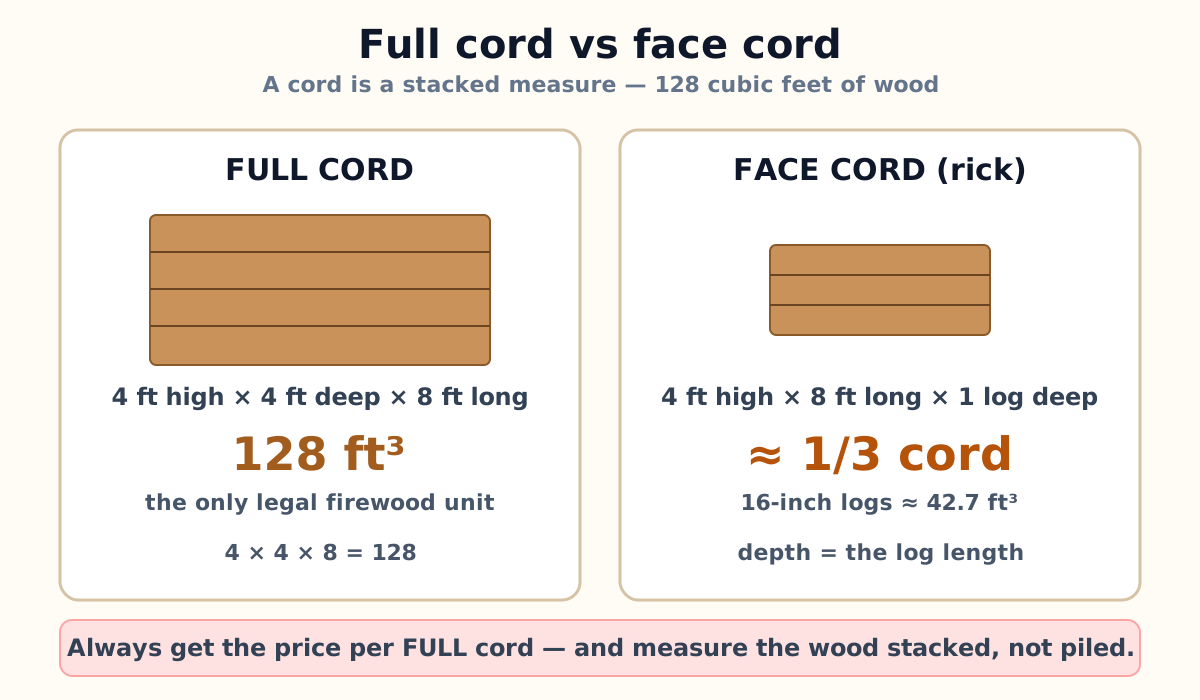
A full cord of firewood is a tightly stacked pile measuring 4 feet high × 4 feet deep × 8 feet long, exactly 128 cubic feet of wood and air. That’s the only measurement legally defined in most places. The confusion, and the way people get shorted, comes from the “face cord” (also called a rick), which is 4 feet high and 8 feet long but only one log deep, so it’s usually just a third to a half of a full cord.
The full cord: the only real standard
A cord is a unit of volume for stacked firewood, standardized at 128 cubic feet. The classic arrangement is 4 feet high, 4 feet deep, and 8 feet long (4 × 4 × 8 = 128), but any tightly stacked pile totalling 128 cubic feet is a cord. In the US, the cord is the legally defined firewood measure. It appears in the National Institute of Standards and Technology (NIST) Handbook 130 model regulations that most states adopt, and many states prohibit advertising firewood by vague terms like “truckload,” “pile,” or “face cord” without also stating the amount.
The key phrase is tightly stacked. A cord is a stacked measure that includes the unavoidable air gaps between split logs, but a wood pile thrown loosely into a truck bed holds far more air and far less actual wood than the same apparent volume stacked. The same wood that stacks into 128 cubic feet will occupy noticeably more space when dumped loose, so a truck bed that looks full is not proof of a cord. Always measure, or have delivered wood stacked, before you judge the amount.
Why the standard stack isn’t the only cord
Because a cord is defined by volume, the 4 × 4 × 8 shape is just the most convenient way to reach 128 cubic feet. It is not required. Any of these stacked dimensions is exactly one full cord:
| Height × Depth × Length | Cubic feet | Cords |
|---|---|---|
| 4 ft × 4 ft × 8 ft | 128 | 1 |
| 2 ft × 4 ft × 16 ft | 128 | 1 |
| 4 ft × 2 ft × 16 ft | 128 | 1 |
| 8 ft × 4 ft × 4 ft | 128 | 1 |
This is why measuring your own stack works no matter how it’s shaped: multiply the three dimensions in feet and divide by 128.
The face cord (rick): where people get shorted
A face cord, also called a rick, is a stack 4 feet high and 8 feet long, but only one log deep. That “depth” therefore depends entirely on how long the logs are cut:
| Log length | Face cord depth | Fraction of a full cord | Approx. volume |
|---|---|---|---|
| 12 inches | 1.0 ft | ~1/4 | ~32 ft³ |
| 16 inches | 1.33 ft | ~1/3 | ~42.7 ft³ |
| 24 inches | 2.0 ft | ~1/2 | ~64 ft³ |
So if someone advertises a “cord” but delivers a face cord of 16-inch wood, you’re getting roughly a third of a full cord, for what might be full-cord money. Because “face cord” and “rick” aren’t standardized volumes, the only safe question is: how many cubic feet, or what fraction of a full cord, is this?
How to measure a firewood delivery
- Stack it tightly in a neat rectangle, rows straight, gaps minimized.
- Measure the stack’s length, height and depth in feet.
- Multiply the three for the volume in cubic feet.
- Divide by 128 for the number of full cords.
For example, a stack 8 ft long × 4 ft high × 2 ft deep is 64 cubic feet, exactly half a cord. Our firewood cord calculator does this instantly and also shows the face-cord equivalent, so you can check a delivery against what you paid for, one of the Home & DIY tools for planning a project.
A worked example
Say a seller delivers wood and stacks it against your fence. You measure it as 7 ft long × 4 ft high × 1.5 ft deep (the logs are cut to about 18 inches).
- Volume = 7 × 4 × 1.5 = 42 cubic feet
- Full cords = 42 ÷ 128 = 0.33 cords, i.e. about a third of a cord.
That is essentially one face cord of 18-inch wood. If the ad said “a cord” and the price matched a full cord, you received roughly a third of what you paid for. The math is the same every time: length × height × depth ÷ 128, all in feet. Convert inches to feet by dividing by 12, so 18-inch logs are 18 ÷ 12 = 1.5 ft deep.
How much heat is in a cord?
A cord is a measure of volume, not energy, and different species pack very different amounts of wood, and therefore heat, into the same 128 cubic feet. Dense hardwoods like oak and hickory hold far more usable heat per cord than light softwoods like pine. The figures below are approximate, drawn from university forestry-extension firewood charts, and assume properly seasoned (dry) wood; treat them as ballpark rankings rather than exact numbers, since heat output varies with species, moisture, and how completely the wood burns.
| Species (seasoned) | Relative density | Approx. heat per cord (million BTU) |
|---|---|---|
| Shagbark hickory | Very high | ~27-28 |
| White oak | High | ~26-29 |
| Sugar maple | High | ~24 |
| White ash | Medium-high | ~23-24 |
| Paper birch | Medium | ~20 |
| Douglas fir | Medium (softwood) | ~20-21 |
| Eastern white pine | Low (softwood) | ~15-16 |
The practical takeaway: a cord of oak or hickory can deliver close to twice the heat of a cord of white pine, so a cheaper cord of softwood is not always the better deal once you account for how often you’ll be reloading the stove.
Buying firewood without getting burned
- Get the price per full cord in writing, and the log length.
- Be sceptical of “cord” prices that sound too cheap, they’re often face cords.
- Prefer wood sold by the cord or fraction of a cord over “ricks”, “truckloads” or “piles”.
- Stack before you accept if you can, or measure the stacked wood on arrival.
- Remember seasoning: green (unseasoned) wood is heavier and burns poorly; a cord is a volume, not a moisture guarantee.
Seasoning: a cord is volume, not dryness
The cord tells you how much wood you got, but not how well it will burn. Freshly cut “green” wood can be 50% or more water by weight, and wet wood wastes energy boiling off that moisture instead of heating your room, while producing more smoke and creosote. Well-seasoned firewood is typically dried to around 20% moisture content or less, which usually takes six months to a year or more of air-drying, split and stacked off the ground under cover. Signs of seasoned wood include checked (cracked) ends, a lighter weight, a hollow sound when two pieces are knocked together, and bark that peels easily. Buying a “cord” of green wood in autumn often means it won’t be ready to burn well until the following season.
A quick glossary of firewood terms
Sellers use a lot of informal words for the same shapes. Here’s how they map to real volume:
| Term | What it usually means | Standard volume? |
|---|---|---|
| Full cord | 128 cubic feet, stacked | Yes |
| Face cord / rick | 4 ft × 8 ft face, one log deep | No, depends on log length |
| Half cord | 64 cubic feet, stacked | Yes (half of a cord) |
| Quarter cord | 32 cubic feet, stacked | Yes (quarter of a cord) |
| Truckload / pile | Whatever fits the truck | No |
| Bush cord | Another name for a full cord (Canada) | Yes (= 128 ft³) |
Only the fractions of a full cord are precise. Any time a seller uses “rick,” “truckload,” or “face cord,” convert it back to cubic feet or a fraction of a full cord before comparing prices.
Frequently asked questions
How many cubic feet are in a cord of wood?
Exactly 128 cubic feet. The standard stack is 4 feet high, 4 feet deep and 8 feet long (4 × 4 × 8 = 128), but any tightly stacked pile totalling 128 cubic feet counts as one full cord.
What is the difference between a cord and a face cord?
A full cord is 128 cubic feet (4 × 4 × 8 ft). A face cord (or rick) is 4 ft high × 8 ft long but only one log deep, so its volume depends on the log length, for 16-inch logs it’s about one-third of a full cord. “Face cord” is not a fixed, legal volume.
How much is a face cord of 16-inch wood?
About 42.7 cubic feet, roughly one-third of a full cord. It’s a 4 ft × 8 ft stack about 1.33 ft (16 inches) deep. Always confirm the log length, since that sets how much wood a face cord actually contains.
Is a rick the same as a face cord?
Usually yes, “rick” is another name for a face cord: 4 ft high and 8 ft long, one log deep. Like face cord, it isn’t a standardized volume, so ask how deep (how long the logs are) to know what you’re getting.
How do I know if I got a full cord?
Stack the wood tightly, measure its length, height and depth in feet, multiply them for cubic feet, and divide by 128. If the result is close to 1.0 you got a full cord; well under that means you were short-changed. A calculator makes this a ten-second check.
Why does loosely piled wood look like more?
A thrown pile is full of large air gaps, so it takes up more apparent space than the same wood stacked neatly. Because a cord is a stacked measure (128 ft³ stacked), always measure firewood stacked, a loose heap “measuring” a cord contains noticeably less wood.
Frequently asked questions
How many cubic feet are in a full cord of wood?
A full cord is exactly 128 cubic feet of tightly stacked wood, most commonly arranged as a pile 4 feet high, 4 feet deep, and 8 feet long (4 x 4 x 8 = 128).
What is the difference between a full cord and a face cord?
A full cord is a fixed 128 cubic feet. A face cord (also called a rick) shares the 4-foot-high by 8-foot-long face but is only one log deep, so its volume depends on log length. For 16-inch logs, a face cord is about one-third of a full cord.
Is a face cord a legal or standard measurement?
No. Only the full cord (128 cubic feet) is legally defined in most US states through the NIST Handbook 130 model regulations. Terms like face cord, rick, truckload, and pile are not standard volume units, so ask for the price per full cord in writing.
How do I measure a firewood delivery to check for a short cord?
Stack the wood tightly, measure its height, depth, and length in feet, multiply the three together, and divide by 128 to get the number of cords. Always measure the wood stacked, not thrown loose, because loose piles hold far more air.
Why does thrown firewood look like more than a stacked cord?
A cord is a stacked measure that includes only the small air gaps between split logs. Wood dumped loosely into a truck bed traps much more air, so the same 128 cubic feet of stacked wood takes up noticeably more space when thrown, making a full-looking truck bed no proof of a cord.